How three firms are tackling
the 2020s
Advice firms of vastly different sizes share their asset allocation and fund choices for the start of the new decade
By Tim Cooper
13 Jan, 2020
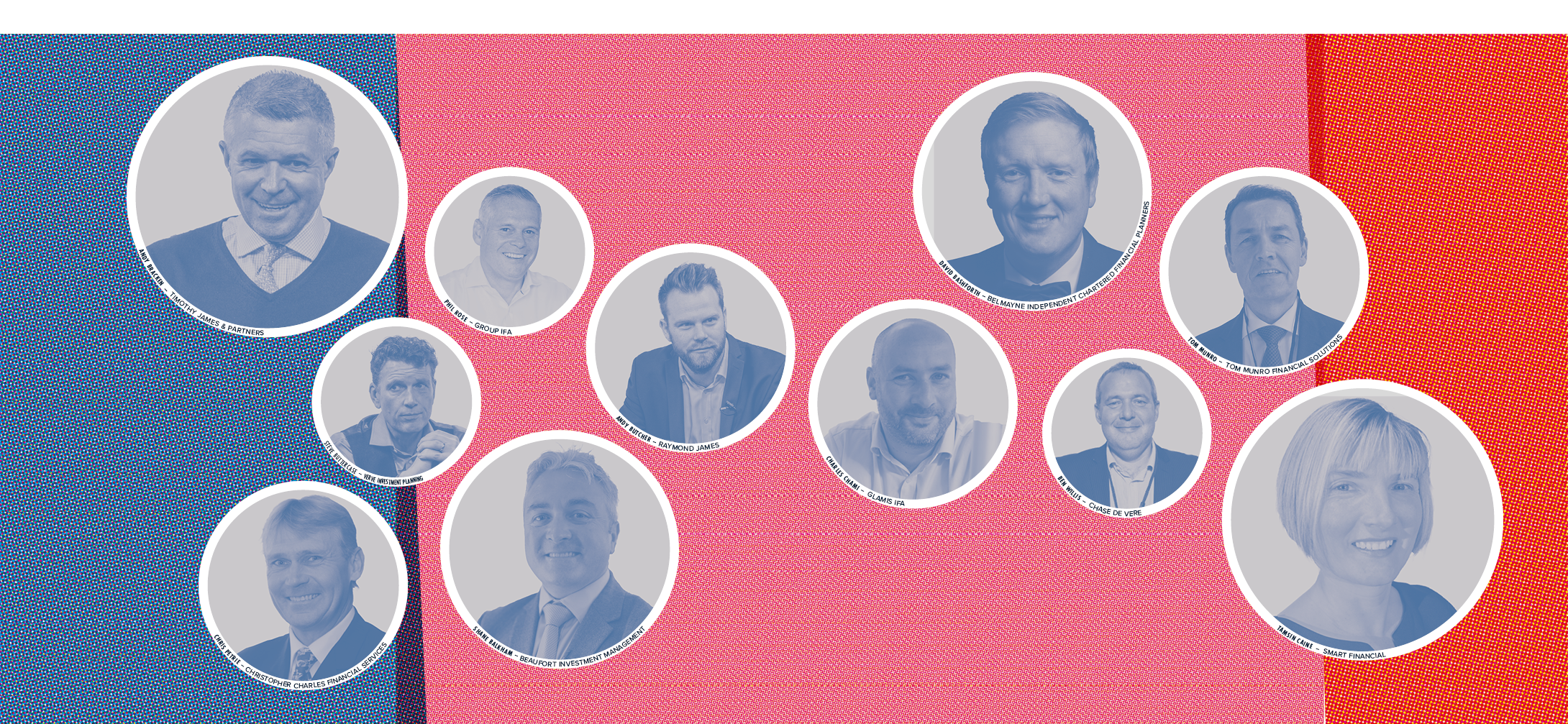
CHRISTOPHER CHARLES FINANCIAL SERVICES AUM: £55 MILLION
Chris Petrie, director at Northampton-based Christopher Charles Financial Services, is starting the New Year by tidying his asset allocations, and he is eyeing significant moves. Christopher Charles last made changes 12 months ago, but market conditions have changed since then in favour of UK and US equities and a small amount of bonds.
That took him to slightly overweight in UK equities – at 24% in Christopher Charles’ moderate portfolio – and Petrie plans to maintain that position. ‘I’m hopeful about the UK, though it goes up and down,’ he said. ‘UK equities are still good value – probably the cheapest in the developed world.’
In contrast, America has become more expensive throughout 2019, he said. ‘At some point, the pound will recover and that will drag on overseas equities, so I don’t want to be overweight America now,’ he said. ‘However, I will maintain my [10%] position in emerging markets because they will be the long-term growth story.’
Christopher Charles is currently underweight in property, at 8% of the moderate portfolio, and bonds, at 25%. ‘Index-linked bonds rose sharply, so I’m nervous about those now. I may take some profit and move it to other bonds,’ said Petrie. ‘I’m also considering reducing commercial property further.’
LIQUIDITY FOCUS
Another 2019 story that changed Petrie’s outlook on asset allocation was the fall of fund manager Neil Woodford. The Equity Income fund was suspended then closed when a sharp reading of the rules allowed it to store up substantial liquidity issues.
‘Most advisers I speak to these days say they had no money with Woodford,’ Petrie said with a chuckle. ‘I certainly didn’t, which I’m pleased about.’
However, Christopher Charles did have lots of money with Woodford’s previous funds, Invesco Income and High Income, managed by Woodford’s protege Mark Barnett. The fund continued with elements of Woodford’s approach after his departure. Petrie stopped buying these Invesco funds for new money 18 months ago and, as the Woodford saga unfolded, sold out of them at client reviews throughout 2019.
Aside from performance issues, the problem with Woodford’s funds was lack of liquidity. The debacle has made Petrie focus on how much liquidity is available in his portfolios.
‘Liquidity is an issue with commercial property open-ended funds too. However, many of these funds have built their liquidity so much, that they’re stockpiling cash. They’re frightened. So, we’ve been trimming exposure to commercial property funds.
‘Another move was out of Aviva Investors Multi Strategy Target Return fund, which wasn’t doing much, but we only had small amounts in there.’
Christopher Charles’ largest fundholding in its moderate portfolio is JP Morgan US Equity Income, managed by Citywire A-rated Clare Hart. According to Citywire Discovery, Hart has recorded first-decile, risk-adjusted performance over five and three years in the US equity sector and second decile over one year.
‘JP Morgan have great research and are great to deal with,’ Petrie says. ‘They tend to run a sensible, stable set of funds with no “dogs”. I like the US Equity Income fund as it produces good dividends, regardless of capital ups and downs.’
AVOIDING SEQUENCE RISK
Christopher Charles uses research from Dynamic Planner to set asset allocation, but Petrie adds his own tilt if he sees a strong enough reason.
He uses FE Analytics to research funds, because he likes the detail it offers, he said. Selected funds must also have a Morningstar bronze, silver or gold qualitative rating, where available.
Christopher Charles has £55 million funds under advice. Due to the small size of the company, Petrie runs the investment committee alone with help from his compliance consultants.
The firm has run ethical portfolios for several years for the few clients who ask for them. One favourite environmental, social and governance (ESG) fund has been the Royal London Sustainable World Trust (managed by AAA-rated Michael Fox), which has performed excellently, said Petrie (37.2% thee-year return).
He is also beginning to ‘dip his toe in’ investment trusts, including Lindsell Train Japanese Equity, and some property funds. ‘I had a client interested in investment trusts, so I’m starting to use them but it’s still a learning curve,’ said Petrie. ‘I don’t yet feel I have the in-depth market knowledge as I do on the open-ended funds.’
The firm also has decumulation portfolios for income-oriented clients. Petrie said these are similar to growth portfolios except they hold more cash to provide income for the year ahead, and usually some more fixed income. ‘Having more bonds and cash helps avoid sequence risk – selling equities after the market has gone down,’ he said.
GROUP IFA
AUM: £600 MILLION
Phil Rose, chartered financial planner and group chief executive at Bolton-based Group IFA, faces a dilemma. His portfolios have too much in cash but he does not know where to move it.
After the Brexit referendum in 2016, the firm halved its gilt holdings and increased cash to a 9% weighting in its mid-risk Strategy 5 portfolio – a position it has held ever since. The result is that now it has too much – for Rose’s liking – in cash and wants to deploy that into other low-risk assets. But while he says markets have been ‘surprisingly robust’ recently, producing ‘astounding’ returns for some asset classes, he is unsure where to move his cash into.
‘Fixed income concerns us the most,’ he said. ‘Gilts have posted high returns in the last few months – that makes us nervous. At the last investment committee meeting, we discussed moving all our gilts into cash, but we already have too much cash. [The only thing we can do is] target shorter-duration gilts and shorter-duration index links, which we did recently.
‘In corporate debt, we’re nervous about the quality of the debt in many funds. They say its triple AAA or B-rated, but is it actually? We wouldn’t put the money into equities [at the end of the economic cycle] and property also makes us nervous due to challenging conditions across real estate markets. In our Strategy 5 portfolio, we have 13% in property, which is already relatively high.’
INVESTMENT TRUST COMFORT
Group IFA holds two infrastructure investment trusts, which it places in a separate asset class making up 5% of the Strategy 5 portfolio. However, it holds more infrastructure, alongside global resources in its alternatives bracket, at 6% of the portfolio.
‘We are comfortable with the investment trusts as they are valued daily and work on a net asset value basis,’ said Rose. ‘The alternatives are separate as they are more of an equity stance. But we don’t hold investment trusts in any other part of portfolios as some of them use gearing, which we don’t want. Also, some investment trusts cannot be traded on some platforms, so access is an issue.’
The firm does not want to invest more into infrastructure or alternatives. The quantitative figures justify their current weighting but nothing more, he said.
Rose added that he is also comfortable with Group IFA’s position in UK equities, which make up 25% of Strategy 5; and US equities at 9.3%.
‘UK equities have been undervalued due to the political situation,’ said Rose. ‘In the US, Trump will be elected again next year and he will drive markets as he likes to. We only hold a small amount in Europe [2.7% in Strategy 5], and Asia Pacific [4.5%] will grow more significantly.
Keeping a high cash weighting has dragged on performance as the bull run continued. However, Group IFA portfolios still beat the Asset Risk Consultants (ARC) benchmark over the last three years. Rose attributes this simply to lack of skill among managers in the ARC benchmark.
TRAIN STILL ON TRACK
Group IFA’s biggest recent fund change was to remove Jupiter European, due to the departure of its manager Alexander Darwall in July.
Two of the largest holdings in the Risk 5 portfolio are Slater Growth managed by Citywire AA-rated Mark Slater; and Lindsell Train UK Equity managed by AA-rated Nick Train.
According to Citywire Discovery, Train recorded first-decile performance in the UK equity sector over one, three and five years. Slater posted second-decile performance over five years, first over three and second over one.
‘Lindsell Train’s performance against volatility over a long period is impressive,’ said Rose. ‘It also has four fund managers contributing. We did a deep dive study on it because it had done so well, we worried about another Woodford situation [but we found nothing to worry about]. Slater Growth complements other funds as it has more small cap holdings and brings diversification without much overlap.’
Group IFA’s investment committee comprises four internal plus three external experts, with an impressive level of all-round experience and credentials. It holds short monthly and longer quarterly meetings.
The firm does not offer income-oriented portfolios, as Rose said the necessary asset constituents can restrict performance. It does offer ESG portfolios, which have the same asset allocation as other portfolios but more ESG-focused criteria in fund selection.
BEAUFORT INVESTMENT
AUM: £1.1 BILLION
Shane Balkham, chief investment officer and fund manager at Redhill-based Beaufort Investment Management, fears there will be no roaring twenties this century. His cautious asset allocations show that he expects the decade to start with more of a whimper than a whoop.
The three main themes affecting asset allocation decisions in recent years have been central bank activity, trade wars and Brexit, said Balkham. The uncertainty created by the latter two led Beaufort to reduce its equity weighting to neutral in early 2019; then to go underweight in October.
Beaufort’s mid-risk Active 5 portfolio was 10% overweight equities – equating to 60% in total – so the firm reduced that to 50% in January last year, then to 45% in October.
‘When we went to neutral, we also removed riskier funds, so equities became more of a defensive position,’ said Balkham.
‘We removed some US funds including BNY Mellon US Opportunities, which had a lot of mid caps in. Doing that also gave us a more agnostic style bias. Plus, we removed a few European funds and consolidated our portfolios, from around 28 funds to 24 or 25.’
UK funds were the main victim of the decision to go underweight equities in October.
‘We sold Investec UK Equity Income when its manager Blake Hutchins left in August,’ said Balkham. ‘We had held him since he launched, and he’d been a brilliant, but when the main manager goes you must sell.
‘We also sold GAM UK Equity Income. Its managers also did well but GAM hadn’t raised enough assets. We don’t mind holding funds where we have a large shareholding [provided they can] dilute that quickly. But that wasn’t happening, so we sold up.
‘We kept our positions with Evenlode Income, Polar Capital UK Value Opportunities and Franklin Templeton UK Managers Focus.’
Another big change came on 1 July, when Beaufort moved away from a heavy sterling bond tilt to a more global aggregate bond bias. It also introduced AQR Global Aggregate Bond and Pimco Global Investment Grade Credit funds to portfolios.
BIG IN JAPAN
‘These changes have been successful,’ says Balkham. ‘We performed well this year, even with fewer equities, which shows that our fund picks held up. The diversification in the portfolio is also doing well and we’ve had fewer dramatic falls than we might have.’
In the last few years, Beaufort has stuck by the Polar Capital fund through some periods of indifferent performance, said Balkham. ‘But we buy that purely for a different profile compared to Evenlode and Franklin Templeton,’ he said. ‘Within asset classes, we don’t want all the funds pointing in the same direction at the same time. We look for a blend.’
Balkham said he loves Japan currently and his favoured fund there is Legg Mason Japan Equity, despite its volatility. ‘It has lumpy performance, but the longer
you hold it, the more those characteristics smooth out,’ he said.
‘We also like property but we’re aware of its potential liquidity issues. So we make sure that if we hold any bricks and mortar, we complement that with property securities, other real asset funds, and some parts of the fixed income market.’
ROOM TO GROW
When selecting funds, capacity is key. ‘We want funds that have room to grow returns,’ said Balkham. ‘We find that better managers know exactly how much they can run before they have to dilute their investment process. When they breach their capacity, we tend to move on. But it is difficult to judge, as it is not always based on quantitative criteria.’
One of Beaufort’s biggest holdings is BMO Property – a fund it has stuck by despite lower-decile performance compared with its peers. ‘We’ve invested in it for 10 years and the manager Guy Glover knew how much he wanted from the outset to maximise his ability to manage assets,’ said Balkham. ‘He planned to get properties up to scratch, in the best UK towns and cities, and diversify asset type. He has done exactly that.’
Another large holding is Sanlam Multi Strategy managed by Citywire AAA-rated Mike Pinggera.
‘Pinggera has a slick investment process that looks to get the most sustainable return for the least risk and maintain liquidity and diversification,’ said Balkham.
Beaufort’s investment committee comprises seven people and meets monthly to discuss fund and asset allocation decisions.


Allocating for a smooth outcome
Mixed assets still popular despite icy returns in 2010s
Dynamic planner: Much is luck, so make sure client needs drive decisions
‘I’m an asset
liability matcher’
What advisers need to know about behavioural biases
Why you can’t ignore geopolitics in 2020
Asset allocation roundtable
As liquidity dries up, it’s time to wet the whistle
How three firms are tackling the 2020s
Bond investors: shaken, not stirred
Six twists that might
affect asset allocation in 2020