A succulent roast turkey will be the centrepiece of most Irish dinner tables on Christmas Day, but this wasn’t always the case. The prized bronze turkey that many of us consume at this time of year is a domesticated relative of the original wild turkey (Meleagris gallopavo), which is, of course, not indigenous to these shores. These birds are a domesticated strain, bred from the original American wild black turkey – an upland game bird that originated on the plains of the eastern and south-western states, as well as parts of Mexico. Here in Ireland, turkey began appearing on Christmas dinner tables during the 16th century and even then it was a rare delicacy to be enjoyed by the aristocracy. Most people continued to eat goose at Christmas, and even the smallest farms would generally have had at least one or two geese reserved for the big occasion. It wasn’t until the mid 17th and early 18th century that the idea of a turkey as the staple of an Irish Christmas dinner began to take hold among the general populace.
SPONSORED CONTENT
The free-range bronze turkeys, by Hogan’s Farm for the Simply Better range, are heritage birds in the truest sense


NEVEN'S RECIPE FOR
wild
turkey

Shop The Simply Better
Collection
Savour the heartwarming delights of this family-run Irish dessert business, sprinkled with love and tradition
Talking Turkey
It was also around that time, in 1740, that Charles Tisdall commissioned a famous architect — the appropriately-named Richard Castles — to design a home for him and his family, to be built with stone from the nearby Ardbraccan quarry. Castles was paid the princely sum of £20 for his designs and for supervising some of the construction.
The resulting structure, Charlesfort House, is a regal stone building in the classical Palladian style on around 6,000 acres of land. It was handed down through several generations of Tisdalls right up until 1968. The family then decided to sell up and the long established Tisdall family association with Charlesfort came to an end. Enter the Hogans.
Charlesfort House certainly didn’t look nearly as resplendent as it does today when Paul Hogan’s father purchased it in 1976. A Land Commission dispute had meant that it had remained unoccupied for nearly a decade and was, as Paul describes it, “A horror! People come in now and say, ‘isn’t it great that it has lasted so long?’ but if they had only seen it when my Dad first came in,” Paul says, shaking his head. “I suppose, if it hadn’t been for the turkey business, we wouldn’t be here,” he adds.
The Hogans recognised in Charlesfort House an opportunity to restore a beautiful piece of architectural heritage, and in the rolling hills and fields that fringe the estate, they saw the perfect place for free range turkeys to roam. The restoration process was long and laborious, but the result is a magnificent family home that sits adjacent to Hogan’s Farm Shop & Café, from where they have been supplying Dunnes Stores with premium quality free range woodland bronze turkeys for many years.
Christmas Centrepiece
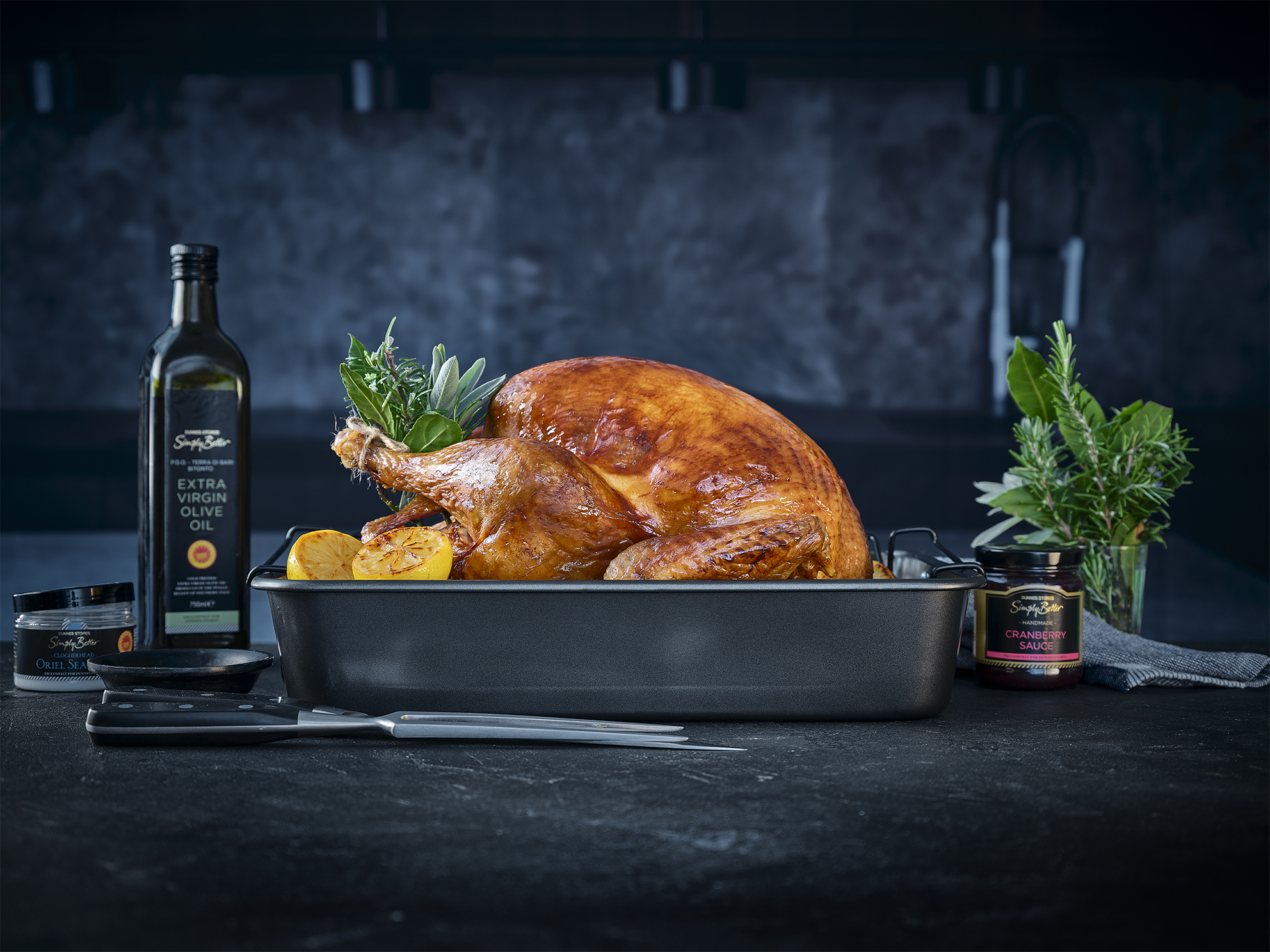
Dunnes Stores Simply Better Heritage Bronze Free Range Fresh Irish Reared Turkey
A bird in the hand
Paul Hogan surrounded by a flock of his free-range heritage bronze turkey
Paul’s mother started the turkey business back in 1962, “down the road, about one mile away”. It was the year of the Cuban Missile crisis and the world was every bit as turbulent as the one we inhabit today. Paul’s father was a dairy farmer and his wife first started rearing turkeys as little more than a hobby. It is a hobby that has mushroomed into a huge enterprise over a sprawling estate, and the challenge each year is to be as successful as the last.
Paul’s’ daily ‘commute’ is a gentle stroll down the avenue from Charleston House to a small office beside the café, which has successfully been run by his wife, Sandra, for several years. It offers coffee, soup and sandwiches to those visiting the shop, or simply dropping in for chat. Alongside Paul and Sandra, Hogan’s farm is also managed by Paul’s brother Fintan and his wife Hilda, making it a true family business.
The grounds are surrounded by picturesque woodland. A local historical website records that Charles Tisdall planted 50 pear trees, 150 apple trees and 1,000 beech trees here back in 1741. Three years later, he planted 1,000 oak trees and 800 ash trees. Further ash and elm were added a few years later.
Today, Paul carries on the tradition set down by the elder Tisdall and plants around 200 trees every year.
“If we don’t keep planting, all of a sudden the woods will be gone,” he says. There are crab apple and birch trees as well as willows, Spanish chestnut, copper beech and lime trees. The purples, orange and yellow leaves make the place look spectacular in the autumn.
It is here, in among these wooded glades near the secluded walled garden, that the turkeys reside. The garden was added to the grounds in 1807, as the keystone above the entrance attests. The birds are free to roam this idyllic space and do so for up to seven months, enjoying the fresh air and serene environment that culminates in the big feast on Christmas. “Christmas Day is our harvest, if you like,” he says. “If we get Christmas wrong — we never have so far, thankfully — I’d hate to be around in January, if anything mad happened that we could have avoided.”
The two big worries are diseases such as avian flu, and predators, such as foxes. Everything is done to keep both at bay. An electrified fence around the enclosure keeps roaming foxes out, but they have to be constantly vigilant and protective of the flock.
“The difference is that we feed them outside and they have water outside,” Paul says. He points to the watering stations hanging from several trees across the four-acre plot. These are proper free-range birds.
�
Bronze Age
“This area is five times larger than a regulation free-range space needs to be.” That freedom makes for a contented flock who can go in or out of the wooden sheds as they please. The birds tend to stay indoors a little more during the day and wander about in the field at night.
“They have the woods on the far side,” says Paul, pointing to a densely wooded copse, “…and they have the shed on that side.”
The forest looms large over the high stone walls surrounding the turkey’s living quarters, dappled with sunlight and gently swaying branches of deciduous and evergreen trees. If you are a turkey, seeing out your final days before the festivities, this is not a bad setting in which to do so.
“It’s a paradise for them, really,” Paul says, surveying the rolling fields and mature trees. As the birds get older, they travel further around the enclosure and discover more of the wooded areas. As they get more adventurous, the feeders are moved further away from the sheds, and the birds will wander over to them and stretch their legs.
Anyone buying a Hogan’s Farm bird over the holiday season can be assured that this is the very setting in which they were reared.
Morish offerings
Simply Better Handmade Gluten Free Apple Blackberry Crumble and Carrot & Walnut Cake
The Simply Better turkeys are all grown and reared on site in the gently rolling surroundings
of Tisdall’s original
walled garden.
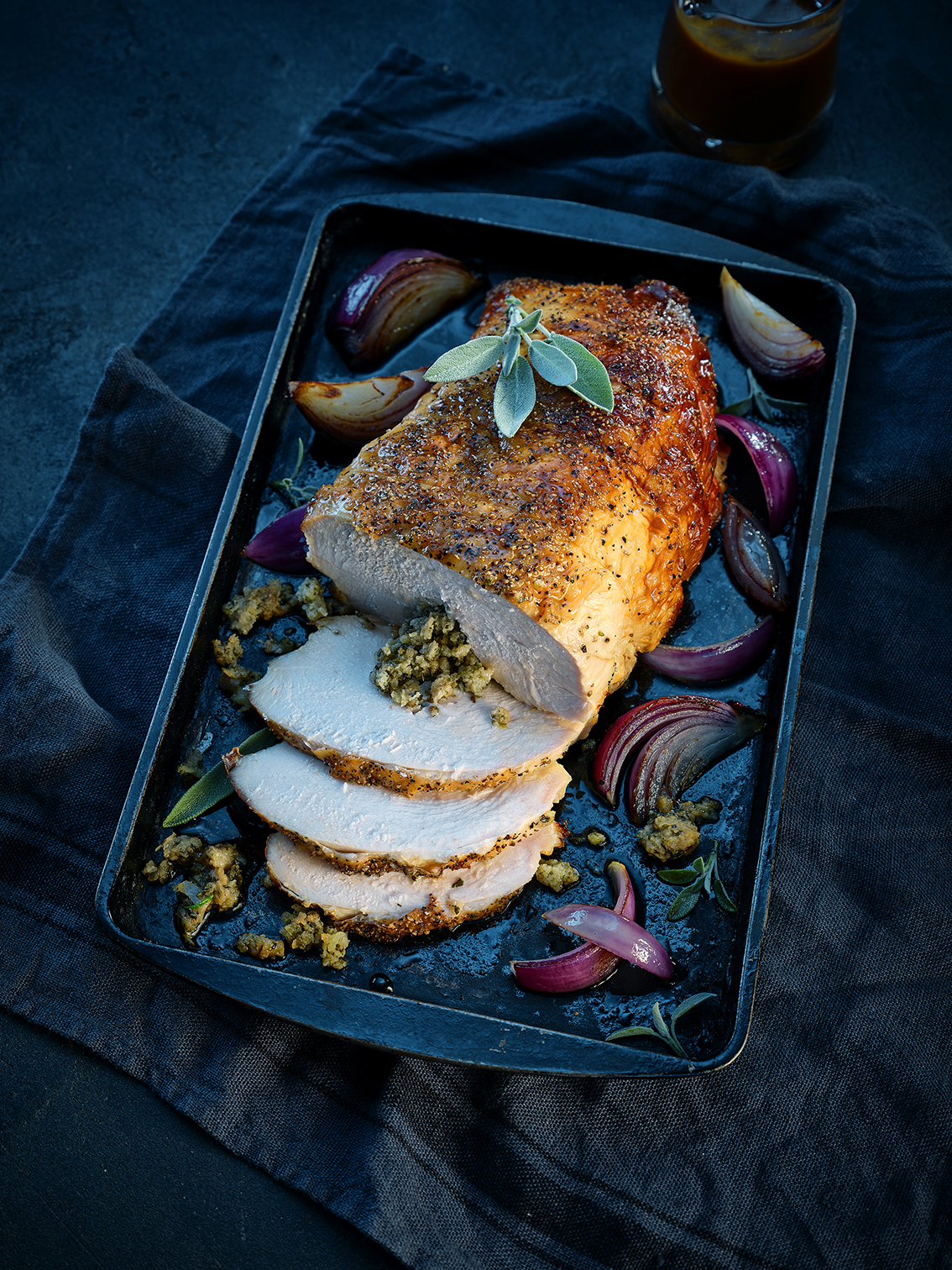
Dunnes Stores Simply Better Heritage Bronze Fresh Irish Reared Turkey Breast with Cranberry, Apricot & Clementine Stuffing


The birds in question are magnificent, curious creatures with the richly coloured plumage of dark copper that becomes more lustrous and vibrant as the birds age. With their distinctive pinkish red snood and wattle under their down-turned beaks, the turkeys are a regal, imperious looking bunch. They are fed a cereal-based mixture, which they supplement by foraging the forest floor, nearby foliage and berries from holly trees. There is also kale for them to eat, as well as apples and carrots to vary their diet. The folk at Hogan’s Farm want the birds to be free to explore the ground around the estate in relative comfort, which is why only a limited number are available each year for people’s Christmas tables.
These creatures have a direct lineage to the original wild turkeys that roamed the American prairies. “They are a heritage breed; our packaging says Simply Better Heritage Bronze Turkey.” It is, as Paul says, “all to do with the breeding — going all the way back to the original American turkeys.”
While Hogan’s Farm does import ‘top-of-the-range’ standard European turkeys from Italy and Germany, the Simply Better turkeys are all grown and reared on site in the gently rolling surroundings of Tisdall’s original walled garden.
If you are lucky enough to nab one for your Christmas table, remember to keep an eye out for Neven Maguire’s guide to cooking the perfect turkey, published in DISH magazine, inside The Sunday Times on December 1 — leaving plenty of time for you to plan the perfect day.
You’ll feel like a proper 16th-century aristocrat with a genuine free-range Simply Better Heritage Bronze Turkey from America’s wild prairies — via Cortown, Kells, Co Meath.


Dunnes Stores Simply Better Heritage Bronze Butter Basted Fresh Irish Turkey Breast Joint with Sage & Onion Stuffing
A succulent roast turkey will be the centrepiece of most Irish dinner tables on Christmas Day, but this wasn’t always the case. The prized bronze turkey that many of us consume at this time of year is a domesticated relative of the original wild turkey (Meleagris gallopavo), which is, of course, not indigenous to these shores. These birds are a domesticated strain, bred from the original American wild black turkey – an upland game bird that originated on the plains of the eastern and south-western states, as well as parts of Mexico. Here in Ireland, turkey began appearing on Christmas dinner tables during the 16th century and even then it was a rare delicacy to be enjoyed by the aristocracy. Most people continued to eat goose at Christmas, and even the smallest farms would generally have had at least one or two geese reserved for the big occasion. It wasn’t until the mid 17th and early 18th century that the idea of a turkey as the staple of an Irish Christmas dinner began to take hold among the general populace.
A bird in the hand
Paul Hogan surrounded by a flock of his free-range heritage bronze turkey
The Simply Better turkeys are all grown and reared on site in the gently rolling surroundings
of Tisdall’s original
walled garden.
“This area is five times larger than a regulation free-range space needs to be.” That freedom makes for a contented flock who can go in or out of the wooden sheds as they please. The birds tend to stay indoors a little more during the day and wander about in the field at night.
“They have the woods on the far side,” says Paul, pointing to a densely wooded copse, “…and they have the shed on that side.”
The forest looms large over the high stone walls surrounding the turkey’s living quarters, dappled with sunlight and gently swaying branches of deciduous and evergreen trees. If you are a turkey, seeing out your final days before the festivities, this is not a bad setting in which to do so.
“It’s a paradise for them, really,” Paul says, surveying the rolling fields and mature trees. As the birds get older, they travel further around the enclosure and discover more of the wooded areas. As they get more adventurous, the feeders are moved further away from the sheds, and the birds will wander over to them and stretch their legs.
Anyone buying a Hogan’s Farm bird over the holiday season can be assured that this is the very setting in which they were reared.