With everyday living costs remaining high, it is often tempting — or necessary — to shop for deals or to go for cheaper options. But when it comes to food, knowing that you have total peace of mind about what’s on your fork is what really counts.
According to recent research by Quality Meat Scotland (QMS), 79% of Scottish shoppers say they are most likely to look for markers of quality assurance when shopping for meat.
That is why Quality Meat Scotland’s assurance schemes are so important — because they guarantee that livestock has been born and reared in Scotland and spent their entire lives on farms that are independently inspected to a strict set of world-class standards that are supported and approved by Scotland’s animal welfare charity, the Scottish SPCA.
What does ‘farmed with care’ mean for the producers themselves, those who are really in the know? For Bruce Duncan, 53, the third generation of his family to farm on land around Loch Lomond, that’s easy to answer. “We’ve been part of the quality assurance scheme for as long as I can remember and our animals are looked after to the highest standards from birth until they leave the farm,” he says.
“We take real pride in what we produce. Ultimately, our life is about caring for our animals and their welfare is paramount. We are out in all weathers every day of the year — checking the stock, feeding them — so you have to love what you do”.
The family have farmed the land since the 1950s, when Duncan’s grandfather retired from the Navy and bought Inveruglas Farm at Ardlui, in Argyll and Bute, to the north west of the loch.
Buying premium quality Scotch Beef UKGI, Scotch Lamb UKGI and Specially Selected Pork guarantees that your food has been farmed with care, locally sourced and quality assured, writes Annabelle Love. Why choose anything less?
SHARE


Subhead acta with animation
SPONSORED CONTENT
In amongst it
Bruce Duncan with his cattle
Pull quote in Times font
Acta display bold in this case
To carry the Scottish red meat industry’s prestigious premium brands — Scotch Beef UKGI, Scotch Lamb UKGI and Specially Selected Pork — livestock must have been born and reared in Scotland and spent their entire life on Quality Meat Scotland (QMS) assured holdings.
When you see these logos in supermarkets and butcher shops, you can be absolutely sure that the meat you are buying is locally sourced, quality assured and farmed with care — and that you can enjoy top quality beef, lamb or pork that is delicious, nutritious and will deliver an exceptional eating experience for everyone to enjoy.
Look for the logo

Wise choices
Nutritionist Dr Carrie Ruxton says red meat is rich in many key nutrients
Today they have two businesses involving six partners — all family members — who run three farms in total, including Blairfad near Drymen, Stirlingshire, and Lands of Drumhead near Gartness, also Stirlingshire - both at the south end of the loch.
The farms are quite different - the hill unit, at Inveruglas, has 1,200 Scottish Blackface ewes roaming over 6,000 acres, including three Munros, where the land rises to more than 3,000ft above sea level. “The ewes are very hardy and all of them lamb outside,” explains Duncan. “We keep an eye out for predators, but the sheep are actually best left to their own devices and what they produce is very traditional and high quality.”
These sheep are a hefted flock, which means that they always return to the area of the hills that they’re born in; they learn where good grazing and shelter can be found at different times of the year and this knowledge passes from ewe to lamb with each generation.
They are gathered in several times a year, a task that takes all day and is not for the faint-hearted. “The land is much too harsh for quad bikes so it’s hill boots, a crook and a couple of collie dogs. It takes all day to gather sheep from one area, and there are six areas to cover; we put aside a day for each one,” says Duncan.
“Just now we have three generations of our family heading up to the hills — my wife Shona and me, Uncle John, who’s 75, our daughters Rebecca and Sally, and our son, Gregor, as well as two contract shepherds. We all chip in and help each other.” Duncan’s oldest daughter, Jan teaches at the local high school.
“Out on the open hill you might see ptarmigan, red deer and often buzzards or eagles circling above,” he adds. “Without the sheep grazing the hills, much of the land would revert to scrub, so they help to maintain these important wildlife habitats.”
The Duncans also have a small herd of 25 rough, hardy hill cows running with a shorthorn bull at Inveruglas. They used to be hairier and hardier, Duncan says, but now they are wintered in sheds and fed hay and silage grown on the farms.
Between their other farms, Lands of Drumhead and Blairfad, the family have another 1,100 ewes and 160 cows over 1,000 acres. "The sheep at Lands of Drumhead are descendants of the Inveruglas flock, but very different,” explains Duncan. “They have been specifically bred to provide prime lambs for the butcher, reared naturally on grass, and they’re much more productive because the ground is lower and more accessible. The calves born at Lands of Drumhead spend around 18 months with us before being sold to other QMS farms, via local markets, for finishing, ensuring the highest standards of care throughout their lives."
The QMS quality assurance guarantee covers every aspect of their animals’ lives; including what they are fed and how they are transported when it’s time to move them off the farm.
The Duncan family have also diversified into agritourism, with two self-catering cottages at Inveruglas and larch-clad glamping pods at Lands of Drumhead, and they also sell some of their home-grown lamb direct from the farm.
Changes like these have created another income stream, allowing them to build the next generation into the business just now.
Duncan loves the fact that they all work together so well. “I’m very proud to be carrying on the family tradition and our children are very much part of that too. They are what drives us to keep improving and building on what we have already,” he says, “and they are part of why quality assurance matters so much to us.
“When you understand the true value of producing meat that is farmed with care, why would you choose to farm any other way? Equally, as consumers, why buy anything that hasn’t been?”
That is certainly food for thought.
�
you know
Laurent Labede is proud to support Scotch Beef, Scotch Lamb and Specially Selected Pork, because he believes the meat is world class and has total trust in its provenance and how it has been reared.
�In his role as Executive Chef at Buzzworks - one of Scotland’s most acclaimed restaurant groups which includes Scotts, Herringbone and Lido and many more — Labede regularly meets with his suppliers, drawing on their expert knowledge to select the very best Scottish produce.
�“We live in a world where everything has to be quick and fast, and people won’t fully understand all the hard work that it takes to make high quality Scotch Beef, Scotch Lamb or Specially Selected Pork. Knowing where our meat has come from and being sure of exceptionally high animal welfare standards is so important. Educating people on the importance of these quality assurance standards behind the label is vital,” he explains.�
Championing the world class produce in our own backyard
Plate up
Laurent Labede, Executive Head Chef at Buzzworks

Beef, lamb and pork are naturally rich in protein, low in salt and a great source of the vitamins and minerals we all need for good health and wellbeing

Lamb and pork naturally provide vitamin B12, which also helps reduce tiredness and fatigue


Meat helps to boost iron absorption in our bodies when eaten with other foods containing iron
90% of the water needed to produce Scottish beef comes from rainwater

Since 2005, British farmers have planted more than 18,640 miles of hedgerows – that’s long enough to reach Australia and back

More than 80% of our land is grass or rough grazing, ideal for livestock

Just 7% of the UK’s greenhouse gas emissions come from livestock, compared to �16% from homes,
18% from businesses and �24% from transport

Farmers across Scotland are proud to be custodians of a unique landscape, working hard to protect and enhance it for future generations.
�This includes creating wildlife corridors along water margins, field margins and headlands, protecting and restoring wetlands, including floodplain management, as well as taking action to control soil erosion.
�They protect peatland and moorland from damage by avoiding ploughing, drainage and over-grazing, manage existing farm woodlands and plant trees and wild flowers. Farmers also consider reduced cultivation, when necessary, to protect farm soils and reduce carbon losses.
�They are always on the lookout for new ways to ensure their farms are run efficiently — a more efficient farm is a more sustainable farm.�
How Scottish farmers are focusing on sustainability
The business is based on a simple philosophy: take the finest livestock from local farms and produce matured meats to satisfy their customers’ highest standards. Most of their Scotch Beef and Scotch Lamb is bought live at auction in Dingwall and Thainstone, while their Specially Selected Pork comes direct from a farmer they have worked with for more than 30 years.
Charlie, who is managing director, says, “As butchers, buying quality assured Scotch Beef, Scotch Lamb or Specially Selected Pork gives us peace of mind. We know the animals have been well cared-for and that the farm, feed and transport have all been independently inspected.
Craft butcher backs Scotch meat

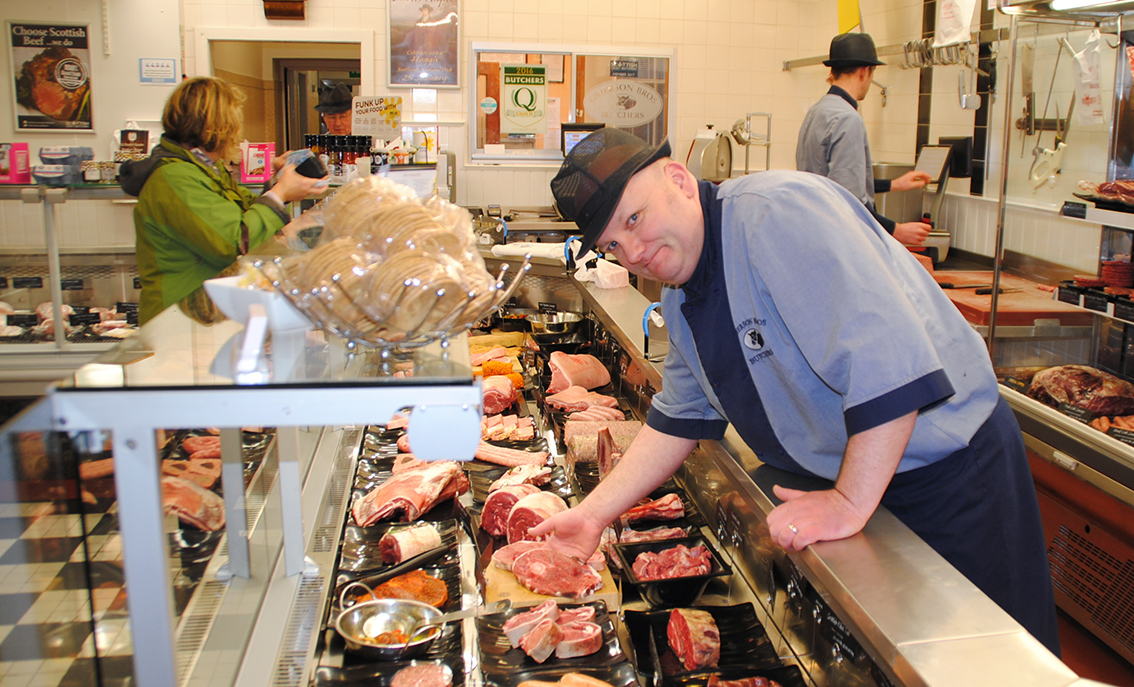
Craft butcher Tom Grierson is the fourth generation of his family to run multi-award winning Grierson Bros Butchers in Castle Douglas, Dumfries and Galloway.
�He joined the firm straight from school, eventually taking over from his uncle, John, and father, Clark, now 82, who remains a partner in the business.
�“I count myself really lucky because I’m doing the job I’ve always wanted to do,” says Grierson, who is passionate about serving his customers premium quality meat that has only been reared on Quality Meat Scotland (QMS) assured holdings. “All our meat is locally sourced, and Scotch assured, so it’s guaranteed to offer the very best eating experience,” he explains.
�Grierson’s beef comes from Nether Dargarvel Farm, just outside Dumfries; lamb direct from auctioneers Wallets Marts in Castle Douglas, or Border Meats in Lockerbie, while their Specially Selected Pork is from Dryfeholm Farm in Lochmaben. �
Harissa Scotch Lamb and Sweet Potato Traybake with Roasted Garlic Yoghurt
Serves: 4
Prep time: 20 minutes
Cook time: 35-40 minutes
METHOD
1) Preheat the oven to 180°C fan/200°C. Add the olive oil, red onions, sweet potatoes, red peppers and garlic cloves to a large roasting tray. Add the harissa and salt and toss everything together so it is well coated in the harissa. Roast for 25 minutes.
2) Once the vegetables have had 25 minutes, add the chickpeas and raisins to the tray and stir. Turn the oven up to 200°C fan/220°C. Nestle the lamb loin chops into the vegetables and roast for a further 15-20 minutes near the top of the oven. �
3) After 15-20 minutes, remove the tray from the oven, remove the 2 garlic cloves and cover the tray with foil to allow the lamb to rest while you make the yoghurt dressing.
4) Add the yoghurt to a bowl with a handful of the chopped parsley and lemon zest and juice. Squeeze the roasted garlic out of its skins and mash into the yoghurt. Mix and season to taste.
5) Serve the roasted vegetables topped with the chops and a dollop of the yoghurt.�
INGREDIENTS
1 tbsp olive oil
8 Scotch Lamb loin chops
2 red onions, chopped into wedges�
3 large, sweet potatoes,�scrubbed and chopped�into chunks�
2 red peppers, deseeded�and chopped into chunks�
2 large garlic cloves, skin on�and pierced�
2 tbsp harissa�
1 tsp sea salt flakes�
400g can chickpeas, drained�and rinsed�
70g raisins�
Half a bunch of flat leaf parsley, finely chopped plus extra for garnish�
1 lemon, zest and juice �
100g low-fat natural yoghurt
SPONSORED CONTENT


When you know,


“People probably underestimate what they have in their own backyard; what we have here is world class. We are very lucky — the nature of farming in Scotland, the land, the weather, the hard-working people; this all contributes to the best possible meat and it’s a beautiful thing. We should all try to follow the seasons, sticking with a local butcher or supplier, and choosing the best of what they have coming in at different times of the year.
�“When you understand the process behind producing Scotch meat, especially the respect and care shown to the livestock, you prepare and cook the meat with respect too. There are meat products coming in from other parts of the world which may not have been reared to the same strict standards; that’s why we need to focus on the provenance of what we are using.”
�Meat that has not been reared properly will not cook properly, he adds. It loses a lot of moisture in the cooking process and will be tough and lacking in flavour. “The price of meat farmed with the care and attention of Scotch might be a bit higher, but it is definitely worth it.”
�Laurent’s favourite dish is loin of lamb, served with dauphinoise potatoes, rosemary jus and seasonal vegetables, and he says the secret to cooking any piece of meat well is to let it rest for as long as you have cooked it.
�“Fillet steak is lean and very tender, and the flavour is just beautiful, so you don’t want to play around with it too much, but chefs do like a ribeye steak too because it has that lovely vein of fat running through it, which takes the meat to a different level.”
�Labede supports all Buzzworks venues across Central Scotland, including Thirty Knots in South Queensferry, overlooking the Firth of Forth. Originally from the South of France, he has been here for more than 25 years. He is proud that Buzzworks is a member of the Scotch Beef Club and says that the quality of Scottish produce is a big part of what has kept him here.
�“At Buzzworks we are all about bringing people together to enjoy delicious feel-good dishes made from the very best local ingredients.
�“As a chef I’m very proud to work in Scotland with such beautiful high-quality produce. It really doesn’t get any better than this.” �
A cut above
Pistachio herb crusted rack of Scotch lamb


Visit makeitscotch.com or check Make It Scotch on Facebook, Instagram and X for more quick and easy recipe ideas for Scotch Beef, Scotch Lamb and Specially Selected Pork.
Grierson has nine staff — six of whom are full-time — and between them they process everything in the shop. Beef and lamb are hung in the cold chill to improve its flavour and tenderness; pork is processed more quickly. “With beef, I like something with a good covering of fat on the back, because you know it’s been well fed,” says Grierson. “If it’s a touch yellow, you know it’s more grass fed as well.”
�An enthusiastic cook himself, Grierson is always happy to share tips with customers. One of his favourite ways to cook is on a charcoal barbecue — something he does all year round. “I have an electric heater at the back of my legs, and with the barbecue in front of me I can keep warm in all weathers — even on the coldest of days I’ve got a nice wee heat going through my body.”
�Beef shoulder is his go to for making a stew. “It’s a cheaper cut but it’s got all the marbled fat through it which breaks down and makes a great stock. I like a nice shoulder of lamb on the bone too; it’s lovely to cook it slowly in the oven, with roasted vegetables like parsnip, onion, carrots and garlic. Salt and pepper pork belly is also delicious - pop it in the oven for about 40 minutes and it’ll have a nice bit of crackling when it’s done.”
�Unsurprisingly, Grierson believes it is vital that we support Scottish farmers by only buying meat that has been farmed with care, is quality assured and locally sourced.
�“If you want to keep costs down, it’s better to buy less, less often and really enjoy what you’re eating, rather than going for a cheaper option that hasn’t been reared to the same high standards and doesn’t taste as good.”�
All together now
Three generations of Duncan family help run the businesses and farms
you know