report
2018
M25
The
02 | knight frank: m25 report 2018
DEFINITIONS
TAKE-UP Take-up figures refer to space let, pre-let, or acquired for occupation within schemes exceeding 10,000 sq ft SUPPLY Office space that is immediately available and being marketed in properties over 10,000 sq ft PRIME RENTS Rents stated are prime headline rents for units over 10,000 sq ft, let to a top quality tenant for a 10 year plus term LEASE EVENTS Known lease breaks and expiries in the four year period (2018-2021) in schemes in excess of 10,000 sq ft DEVELOPMENT PIPELINE (MARKET PAGES) A combined total of schemes that are either under construction, proposed and expected to start within 24 months, and those with potential to start within five years PRIME RENTS FORECAST Our forecast for prime headline rental levels at Q1 2021 in units over 10,000 sq ft let to a top quality tenant for a 10 year term CAGR Compound Annual Growth Rate
The old cycles are over and a new structure has begun to emerge.
Scroll down
Structural change is upon us. It is challenging the dynamic of the M25 market. It requires a new approach to investment and development that utilises new wave technologies to offer service, flexibility and vibrancy through real estate.
Foreword
emma.goodford@knightfrank.com
Head of National Offices
A new reality is emerging in the M25 market. Since we started specifically researching the market 30 years ago, we’ve seen cycles- the early 90’s crash, the dot.com bubble of 2001, quickly followed by 9/11, the Global financial crash of 2007. After each, we saw the market dynamic recover to a similar pattern of supply and demand, some markets quickly back to equilibrium, others taking longer. Several themes are driving a change to the historic cycles. The dominance of London as a source of labour, the imminent arrival of the Elizabeth Line, and most significantly technology, the demand for offices space to be seen as a service, not just as bricks and mortar and for workspaces to be vibrant and exciting- talent magnets. The old cycles are over and a new structure has begun to emerge. With its proximity to London, the M25 and Thames Valley region is well placed to respond to this new structural reality and those landlords with assets which address the demands of the forward thinking occupier will be the winners. Key centres with the best connections stand out - Reading, Maidenhead, Watford and Woking. Many might think this means only town centres will thrive- think again. As overarching ownerships in business parks allow for the curation of services that are bespoke to a group of customers whose data informs the landlord what’s needed, and what’s not, those edge of town schemes can provide exciting alternative choice. Over the last 24 months the market dynamic has shifted to one focussed on smaller, flexible requirements, and often demanding a serviced approach. In 2016 just 2% of take-up was from serviced operators - this rose to 12% in 2017. Some M25 centres are now attracting providers outside the ‘traditional’ operators. This take-up is in response to the new demand dynamic. The quality of the workplace is also affected by age - and with stock in the M25 centres now showing signs of obsolescence caused by age, there is a case for selective new development. We have seen the recent completion of the speculative development wave, which started in 2016. From mid 2018 supply will peak and then reduce. So while we may believe the uncertainty surrounding Brexit has been the biggest impact on the market; by stealth, the impact of technology, the demands placed on the office workplace to be service centered and dynamic, and the need for flexibility have been impacting, accelerating the changing face of occupier take up. Imperative to this is an understanding of demand, how investors will respond, and what’s coming in the pipeline. Structural change is upon us. Ultimately, it will play-out in different ways across different markets. In an area as diverse as the M25 it is vital to have a detailed and granular understanding of current market conditions and future dynamics. Consequently, this year’s report provides you with detailed analysis of 18 key markets across the M25 market. Each submarket page provides the insights and data necessary to guide your next market move.
Emma Goodford
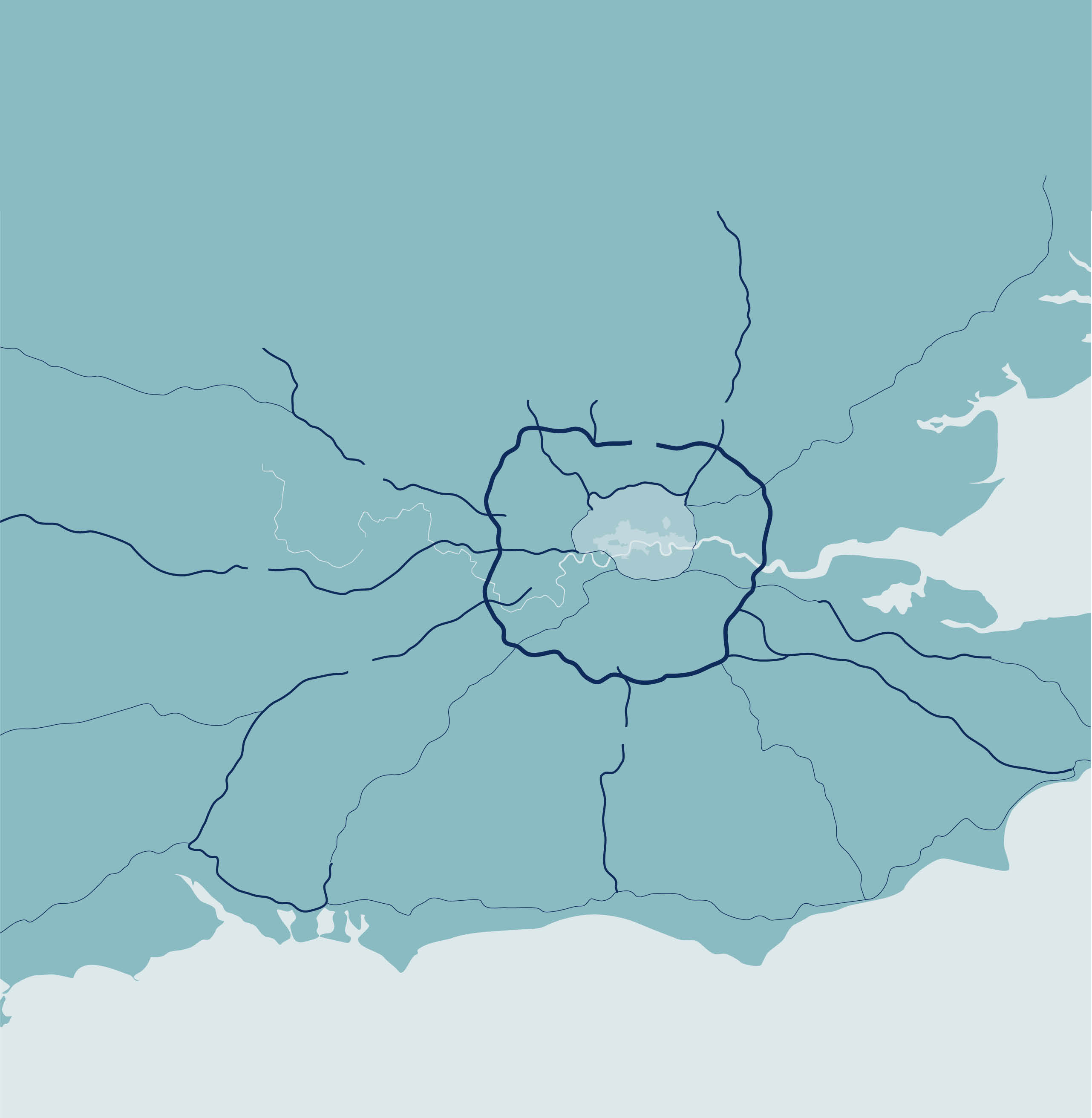
Blackwater Valley Bracknell Brighton Cambridge Crawley / Gatwick Croydon Guildford Heathrow Maidenhead Oxford Reading Slough Staines-upon-Thames Uxbridge Watford West London Wimbledon Woking
key Markets
08-25
Which aspects of change will have the greatest impact on the demand and supply dynamic over the next five years?
Mapping the future market
04
The development landscape
06
tap an area on the map to visit our key market pages
Knight Frank contacts
26
The M25 market continues to attract a diverse range of capital, but how can investors future-proof performance?
Investing in the future
07
The old cycles are over and a new structure has begun to emerge
02
contents
03 | knight frank: m25 report 2018
bracknell
woking
guildford
brighton
cambridge
Oxford
M23
M11
m25
M40
m3
M4
staines-upon-thames
blackwater valley
crawley / gatwick
croydon
west london
wimbledon
heathrow
uxbridge
watford
slough
maidenhead
reading
For landlords the market dynamic demands change. As the saying goes ‘old ways won’t open new doors’.
Landlords must adapt to a new supply side dynamic, with innovation moving beyond the design of the built product and towards the provision of soft-services, community and well-being.
04 | knight frank: m25 report 2018
Dynamic (Adj.)
3. Place activation – active management to create vibrancy and buzz
This drive towards highly serviced environments that create a physical and emotional connection is something that landlords must pay growing attention to. Occupiers want to attract and retain talented staff. They will locate in buildings and locations that support them in this task. They are seeking what I have referred to previously as talent magnets; locations that have a buzz, vibrancy and cohesion. Landlords must invest more time (and yes money) in activating their schemes and buildings. This encompasses the creation of a brand identity which supports the marketing of a scheme to occupiers and employees. The best practice example of this remains, almost twenty years since its inception, Chiswick Park. The ‘Enjoy Work’ brand has proven to be a marketing masterstroke in raising profile and challenging preconceptions of the location. Yet as Chiswick Park also ably shows, place activation is about much more than a catchy slogan. It is about creating events, educational programmes, temporary installations, site specific apps and even concierge staff to consistently and continually bring substance to the brand. To date, many traditional landlords have baulked at such active asset management, but in a world where staff retention is the key to retaining occupiers and avoiding expensive voids it is becoming an essential part of the investment process. A new dynamic is emerging in the M25 market. Several of the key centres are well placed to address the opportunities this dynamic represents. Traditional market orthodoxies are being challenged by occupier activity and demands. New market entrants will be ushered in. More importantly it will create new opportunities for those investors and developers bold enough to recognise that, as the saying goes, ‘old ways won’t open new doors’.
2. Space as a service – going beyond the physical product
The use of data derived from within office space to influence future product design has been central to WeWork’s meteoric rise across the globe. It is just one way in which the emerging flexi, co-working phenomenon – which is not of course limited to WeWork - should be influencing more traditional supply side players. Key amongst these influences is the necessary transition from viewing real estate simply as a physical product and towards the concept of ‘space as a service’. Co-working and flexi providers – to date relatively limited within the M25 market – place tremendous emphasis on providing real estate and associated services that support the creation of a highly connected, collaborative community housed within a modern, curated and highly serviced environment. The strength of connection and satisfaction that the ‘customer’ (note the language) has with the space will be key as co-working providers increasingly seek to compete for occupiers of scale through their emerging enterprise model. In this sense, traditional landlords must recognise the threat and nullify it through, at the very least, the adoption of its key features. Landlords must adapt to a new supply side dynamic, with innovation moving beyond the design of the built product and towards soft-services, community and well-being.
1. New wave technology – disruptor or enabler?
i. (of a process or system) characterised by constant change, activity, or progress ii. (of a person) positive in attitude and full of energy and new ideas
The conventions of market supply and demand are under attack. An effective understanding of, and response to, the emerging market dynamic is essential for the future competitiveness and performance of the M25 and South East office market.
Partner, Global Head of Occupier Research
The South East office market is no stranger to occupational demand from the technology sector. In fact, the tech sector has accounted for, on average, 23% of annual office take-up over the last five years and has absorbed some 3.8 million sq ft during that period. Similarly, occupiers drawn from other sectors have been transformed by the application of new technology to business processes, often fuelling new property requirements. This pressure will intensify as new wave technologies such as artificial intelligence, virtual reality, augmented reality, robotics and automation take greater hold. The occupational market will therefore continue to see demand arising out of disruption. The application of new wave technologies also has a positive impact on supply. The use of sensors, mobile telephony and monitoring hardware and software – the raw materials of the so called ‘Internet of Things’- will allow the emergence of smart buildings within the M25 market. This technology, or more accurately the data emerging from it, enables more effective and pro-active workplace and asset management. It also creates much needed evidence to support the business case for a prospective occupiers real estate move – cases that are now typically focused on metrics relating to increased productivity, staff retention, space utilisation and total real estate spend or savings. Used correctly, data will shape future built products or reconfigure existing stock to better meet occupier needs.
The new dynamic emerging within the M25 office is challenging both our thinking about the source and needs of future occupiers and about how we, in the property industry, can create in the second sense of the definition, more dynamic places and workplaces. Knight Frank have sought to define, through our Future Gazing mind-map (next page), this emerging market dynamic. The map outlines aspects of change that could alter the demand and supply dynamic over the next five years. We must be mindful of these issues when making occupational or investment decisions. It is how such decisions can be future-proofed and de-risked. Amongst the many themes, there are three which present the strongest challenge to landlords within the M25 market and hence are worthy of further elaboration.
Dr Lee Elliott
05 | knight frank: m25 report 2018
Select any of the factors below to filter the mind-map.
Technological disruption
Corporate re-engineering
Rethinking space & place
Adapting to a new social & demographic reality
View all
Reshaping skills & education
Five future forces of change
Crowd sourced public services
Virtual city / estate app
Civic laboratories
Built in flexibility
Cohesion
Smart construction smart living
Active communal space
Co-working
Data security
Fintech
Data firms
Intrapreneurship
Artificial intelligence
Advanced robotics
Virtual reality
Automation
New wave technology
Dis-aggregation: erosion of space advantage
From jobs to tasks
3rd spaces
Corporate incubators
Digital disruption
Productivity
Info-toxicated
Business process outsourcing
From hot desk to thin desk
Sector convergence
Activity based working
Elephants & fleas
Team of teams
Engagement with space / place
Headcount light / tech heavy
Rainmaker launch pads
Concept / experience stores
Bringing out of town retail in town
Open / secure corporate space
Retail back to the future: digital high streets
Office as an off-grid sanctuary
Digital and VR broadcasting hub
Artisan and community markets
Virtual galleries
Family space & attractions
Tenure / use class flexibility
Leisure heavy places
Space as a service
Place activation
A new centre for arts & events
Transport
Networking & learning events
Infrastructure
Amenity rich
Maker cities
Innovation & experience centres
Mottainai space
Living longer, working longer
The sandwich generation
An environment for all ages
Community as family
20 minute neighbourhoods
City of neighbourhoods
Community partnerships
Wellness
Walkability
Work / life balance
Healthcare
Multi-generational workforces
From talent shortage to talent alignment
Centres of knowledge vs centres of energy production
New models of education provision
Rise of freelancing
Talent magnets
Gig economy
Grey hair, grey matter
Platform employment
Information elites
Immersive learning
Corporate universities
Science in the city
Southeast office market
Over the next 2 years
Over the next 5 years
demand
Who will occupy and why?
supply
What to deliver?
Landlords must adapt, with innovation moving beyond the design of the built environment and towards soft-services, community and well-being.
gazing
Future
06 | knight frank: m25 report 2018
In 2017, the office development pipeline in the South East reached its peak of the current cycle. Completions in the South East exceeded 3.3 million sq ft, of which, 2.5 million sq ft was completed within the 18 key markets contained in this report. This represents the highest development total for more than 15 years. Moving forward, developer activity will be considerably reduced. At the time of writing, 1.1 million sq ft is under construction across the 18 markets, with delivery scheduled before 2020. Outside of this supply, there is the potential for 8.8 million sq ft of office development to begin within the next five year period (2018 - 2022). Market conditions and town specifics will of course, ultimately dictate the viability and timing of commencement. Given this development picture, we expect that market vacancy, having increased in 2017, will again dip below the long-term average during 2018.
DEVELOPMENT PIPELINE - 18 KEY MARKETS
Staines-upon-Thames
The circles in this map are a proportional representation of the development pipeline inclusive of schemes under construction; proposed with a start date within the next 24 months; and those schemes that have the potential to start within the next five years.
07 | knight frank: m25 report 2018
Demand to finance defensive, core, real estate assets is strong, and well-let offices in the South East certainly fit the bill.
£3.66 billion of office stock was transacted within the M25 market during 2017, raising volumes to within a hair’s breadth of 2015’s record £3.68 billion. This near 30% rise in activity is particularly impressive given the backdrop of political and economic uncertainty, as well as the long-running erosion of stock to residential uses. More fundamentally, this volume of activity is evidence of a liquid market with broad and deep investor appeal. So what can the makeup of this demand tell us about the year ahead, and importantly, how should investors think about the market over the longer term?
Partner, Head of UK Commercial Research
William Matthews
The M25 market continues to attract a diverse range of capital, but how can investors futureproof performance?
Partner, Head of Regional Office Capital Markets
Tim Smither
Benefits will accrue to those investors that have done more than simply time the market, and have proactively addressed the fundamental changes taking place for occupiers.
The bigger picture
In a world in which ever more capital is being directed to real estate, transparent, liquid markets such as the South East are well-placed to benefit from the demand. However, we believe that in the longer term, the strongest benefits will accrue to those investors that have done more than simply time the market, and have proactively addressed the fundamental changes taking place for occupiers. Some may be wary of the practical implications: does offering greater lease flexibility equate to greater tenant churn; will the activation of vibrant shared spaces ultimately boil down to more intensive asset management requirements? The answer is that aligning more closely to the needs of ‘customers’ will not necessarily be without cost for landlords. But neither will it be without benefit. The investment payoff for creating and maintaining spaces that tenants truly desire is long-term stability of income, higher rental values, and ultimately the most effective way of future-proofing returns.
Capital rich, but asset poor?
There is no doubt that significant amounts of capital continues to target the M25 office market. But is that enough to guarantee another record year of investment? Our view is that the answer will be defined primarily by the availability of stock, not demand. The well-documented conversion of offices to residential uses is one of the major factors behind the current shortage, although as our analysis shows, the calculations are becoming increasingly marginal in many locations as residential prices slow. Yet while the pressure on existing stock may be abating, the issue remains live, as office construction activity in most markets is low. The very factors supporting office rental growth, and therefore investor demand, are ones that will mean that deploying capital in this market will remain a competitive endeavour.
Lending a hand – for now
Debt finance will remain in abundance for the market more broadly during 2018, as a variety of investors have joined traditional lenders in choosing to gain exposure to real estate in this way. Demand to finance defensive, core, real estate assets is strong, and well-let offices in the South East certainly fit the bill. However, lenders will increasingly be challenged to balance rising money market rates on the one hand, with the need to maintain competitive margins on the other. Which force will win out? In the short-term, we expect some lenders will accept slimmer margins, but longer term, the rising cost of interest rates will eventually need to be reflected in a higher cost of borrowing. Ultimately, this will influence the amount that debt-backed investors will be able to pay for assets.
Government office
As we predicted last year, local government purchasers – largely those based in or close to the South East markets – were also very active, spending over £500 million in 2017. Although these purchases have tended to be made at lower yields than their institutional rivals, there remains a significant arbitrage for those funding via low-cost borrowing from the public works loan board. We therefore expect further buying this year, albeit with greater scrutiny from investment committees, as new official guidance is observed.
Institutional appeal
Domestic investment continues to come from myriad sources. With over £600m of purchasers in 2017, UK institutions returned to the market in force after a year of lower activity. Typically buying lot sizes between £10 million and £60 million, assets acquired have been good quality, if not always prime, in some cases reflecting scope for potential refurbishment uplifts. Looking ahead, the investment rationale for the yield-hungry institutional market remains intact: we do not expect central London office yields to move significantly this year, while pricing in regional cities continues to face upward pressure, meaning that M25 offices will remain comparatively attractive.
The international market
Overseas investors accounted for 51% of transactions by volume in 2017, and was responsible for each of the six deals over £100 million. Two groups stood out amongst a diverse mix of buyers: Singaporean Frasers Property made over £700 million of acquisitions across four assets, while North American purchasers accounted for a similar volume. That nearly half of investment came from abroad is no one-off fluke: this share has been rising steadily in recent years. As a measure of how quickly the market has internationalised, overseas purchasers were behind less than 15% of deals just 10 years ago. Today, more than ever, the desire to deploy capital into relatively large lot sizes, or platforms, is undiminished amongst global investors, and we expect that 2018 will see new names enter the M25 office market with precisely this in mind.
08 | knight frank: m25 report 2018
Knight Frank View
Jack Riley
The statistics speak for themselves – there is a critical mass of blue chip companies closely linked to the aerospace, defence and technology industries clustered around Farnborough. Will it continue to lead the way for Blackwater Valley in terms of investor and occupier activity? More than likely, given the continued letting success of Farnborough Business Park over recent years (recently acquired by Frasers in one of the largest South East investment transactions in 2017) and because of the critical lack of Grade A office supply other than the pipeline at Farnborough Aerospace Centre. We live in a digital age where cyber security is becoming ever more important and could lead to increased occupier demand as new contracts are awarded – the Blackwater Valley is well placed to take advantage of this potential trend. In addition, engineering firm Fluor, who seem to be constantly expanding at Farnborough Business Park or the Aerospace Centre, are also driving take-up levels. On the flipside, some more marginal locations seem to be struggling - Ancells Business Park, for one - and there is much talk about Novartis moving part of its operations to West London, which would be a blow.
French emperor Napoleon III is entombed in the crypt at Saint Michael’s Abbey, Farnborough
per sq ft
A B C D E F G H I J K L M N O P Q R
£29.00
Prime rent per sq ft by 2021
£27.00
7% CAGR (5 years)
PRIME RENT
135,000
Development pipeline (5 years)
sq ft
396,700
2.2 years market supply
1,459,600
Space subject to a lease event 2018-2021
118,600
34% below the 10 year average
Take up
A_ Blackwater Valley B_ Bracknell C_ Brighton D_ Cambridge E_ Crawley / Gatwick F_ Croydon G_ Guildford H_ Heathrow I_ Maidenhead J_ Oxford K_ Reading L_ Slough M_ Staines-upon-Thames N_ Uxbridge O_ Watford P_ West London Q_ Wimbledon R_ Woking
House price to income ratio
8.6*
*Representative of farnborough
Aerospace companies in Hampshire
235
Redevelopment of ‘The Square’ shopping centre in Camberley
£110m
GB retail destination ranking (CACI)
366* of 4,300+
To central London
41 minutes
Office space lost to Permitted Development
726,000 sq ft
REDUCED SUPPLY
Although demand has proved relatively diverse over time, the area has a strong historic connection to the aerospace industry and technology occupiers. The TMT sector, for example, accounts for 18% of take-up over the past 15 years, with firms such as IBM, Siemens, CSC all having established headquarters within the Blackwater Valley. Farnborough is also the home to the national headquarters of the UK’s largest aerospace company BAE Systems, Boeing’s state-of-the-art network-enabled centre for collaboration and experimentation and QinetiQ’s Cody Technology Park. Global brands such as BMW, Time Inc, and Fluor have also secured a significant presence in the area in recent years. In fact, BMW’s acquisition of the Nokia Campus in 2013 represents the second largest occupier acquisition in the South East since our records began.
On the supply side, office stock in the area has seen a reduction of close to 10% in recent years, as conversion to residential use has gained favour through Permitted Development and market conditions rendered new speculative starts a bold call. This has meant that availability has shrunk markedly, dipping to 396,700 sq ft at the end of 2017. Nonetheless, the Blackwater Valley still accounted for 17% of available stock within the M3 region at year-end. Future development in the area is limited and is dominated by refurbishments. The first phase of Canmoor’s Ascent scheme at Farnborough Aerospace Centre has completed, with the balance to follow over the next 12 months. Once complete, this will have delivered c.135,000 sq ft of Grade A space to the market.
OCCUPIER DIVERSITY
Business Park Dominance
Blackwater Valley incorporates Aldershot, Farnborough, Fleet, Frimley and Camberley. Supported by ease of access to the M3 and just a short hop to central London, an out-of-town office market has developed within this region. The Blackwater Valley accounts for 18% of total office stock in the M3. Partly due to the limited appeal of the town centres in this area, market activity is dominated by 10 business parks. Notably, Farnborough accounts for half of the business park presence and whilst historically, occupier demand has been spread across the region, Farnborough has most recently been the centre of activity. The town accounts for two thirds of occupier take-up within the Blackwater Valley over the past five years.
A market driven by business parks and home to an increasingly diverse pool of occupiers of international repute.
Blackwater Valley
09 | knight frank: m25 report 2018
Andy Nixon
Key lease events combined with the arrival of the Lexicon supported a strong year for market activity in 2017. An unusual spike. 2018 is anticipated to revert to the historical take-up trends. Attracted by low rental values, occupiers accept the lack of the Elizabeth Line and fast train connections to London – both key to the success of Reading and Slough. The new town centre is creating important place activation and improving demographics, both key to the employer decision-making process. Bracknell, however, will remain the centre for ‘good value’ offices.
Bracknell Forest Council was named Council of the Year 2018
£29.50
£24.00
4% CAGR (5 years)
252,600
426,200
2.8 years market supply
780,300
211,900
40% above the 10 year average
Regeneration of Bracknell Forest Borough
£768m
626,500 sq ft
The Lexicon opened in 2017
£240m
429 of 4,300+
60 minutes
New supply soon?
Bracknell is located at the heart of the UK’s answer to ‘Silicon Valley’ meaning the technology sector has provided a basis for market growth. Over the past decade, demand derived from technology firms has accounted for 38% of office take-up, with around 70% of that satisfied within one of Bracknell’s business parks. Resident firms now include Vodafone (formerly Cable and Wireless), Panasonic, Dell, Hitachi and Fujitsu. The skew towards the business park product in Bracknell has attracted the pharmaceutical and research sectors. Leading industry firms such as Boehringer Ingelheim, Syngenta and Johnson & Johnson all have a presence.
Overall market availability dipped to just over 400,000 sq ft at the end of 2017. Currently, there is no active development underway. Within the next five years, 252,600 sq ft across three substantial schemes are in the pipeline. With annual headline rents in the mid-twenties, it is impossible to justify speculative development. Our forecast rent of £29.50 per sq ft by 2021 barely supports viability for the quality of space occupiers demand.
Tech tenants
A town in transformation
Equidistant between the M3 and M4, 2017 was a pivotal year for Bracknell. A significant part of the town centre’s extensive regeneration was completed in September, bringing a much needed high quality amenity offer to the town. Centre stage of the work is the Lexicon, an investment of £240 million which created 580,000 sq ft of space. Its completion has established a retail offer of 70 new shops, high quality restaurants and a 12 screen cinema. The transformation of the town has been inclusive of the conversion of office space to residential use. Close to 630,000 sq ft of office space has been subject to residential planning, a number that has now led Bracknell Forest Council to invoke Article 4, constraining further conversion.
Home to household names in the tech and pharmaceutical sectors, the market has undergone regeneration but presents little upcoming office development.
Bracknell
10 | knight frank: m25 report 2018
The development pipeline of offices in Brighton is naturally constrained by the sea to the south and the South Downs to the north. This concentrates an already tight office supply dynamic in a town where too few sites can be identified. A cool culture, dynamic workforce, big business and entrepreneurial start-ups, creates perfect conditions for rental growth. Prime headline rents currently sit at around £31.00 per sq ft, although as new quality stock comes to the market we believe this will support further rental growth. The Brinell Building is a good example as it will set record rents for the city and help cater to the pent up demand in the occupational market.
Brighton is home to Britain’s oldest cinema – The Duke of York
£33.50
£31.00
9% CAGR (5 years)
352,100
160,000
1.4 years market supply
679,400
97,000
17% below the 10 year average
7.8
Digital sector jobs based in Brighton
12,600
Population educated to degree level
39%
22 of 4,300+
58 minutes
529,100 sq ft
Sub 4% vacancy
The creative sector in Brighton is at the forefront of its growth, with a plethora of digital advertising and marketing agencies, design and gaming studios. The digital tech spectrum is widening, supported by talent from two universities. Following the approval of £1.2 million investment from the Government’s Local Growth Fund, Wired Sussex and the University of Brighton are conducting a three year programme of 5G-related engagement. This is the UK’s first non-university 5G testbed. Impressively, according to the 2017 Tech Nation report, Brighton’s digital sector has grown by 29% since 2011.
Brighton has 4.6 million sq ft of office accommodation, predominantly located in the city centre, close to transport hubs and links to London. Over the past five years, development activity has been very limited, which, combined with an upturn in demand, has meant vacancy has fallen to below 4%. CityView in the New England Quarter, completed in 2016, delivered 32,000 sq ft and represented the first major speculative completion since 2009. Developer McAleer & Rushe have now commenced work on the 62,000 sq ft Brinell Building. Completion is expected in Q2 2019. The U+I regeneration of Circus Street is the only other office scheme underway. This will deliver 33,000 sq ft of office space alongside residential and student housing. Again, completion is expected in 2019.
5g testbed
Growing in reputation
Strategically located just an hour from central London and less than half an hour from London Gatwick Airport, Brighton ‘the business centre’ is growing in reputation. Brighton is internationally renowned, not just for its tourist industry and trendy culture, but also big business, with American Express, BUPA and Legal & General all having established operational centres in the city. Brighton also has a strong student foundation, with two top universities in Brighton and Sussex. Notably, Brighton also has one of the highest business start-up rates in the UK, ranked eighth in the country by the Centre for Cities.
A highly qualified and creative population is driving high levels of business start-ups which complement established big businesses.
Brighton
11 | knight frank: m25 report 2018
Will Buttery
One of the global hubs of innovation in the life sciences and technology sectors and recognised as part of the Golden Triangle brand (alongside Oxford and London), Cambridge has suffered a similar fate to Oxford due to its constraining historic city centre. This trend is starting to reverse however with the redevelopment of the area around the main railway station drawing large occupiers such as Microsoft and Amazon into the city centre. Ongoing investment in infrastructure, notably the opening of Cambridge North Station in May 2017, has resulted in greater connectivity into London from the science and business parks to the north of the city. The global draw of Cambridge, its position as one of the UK’s fastest growing cities, coupled with the current supply and demand imbalance, will push headline rents to a record level of £42.50 per sq ft in 2018 – making Cambridge the first South Eastern centre outside of central London to reach this benchmark. Proposals announced for the CaMkOx corridor linking by road the 70 miles in an arc from Oxford would further reinforce the strength of the city.
The first official game of football was played on Parker’s Piece in 1848
£44.00
£38.00
5% CAGR (5 years)
462,500
660,000
1.2 years market supply
1,298,000
460,000
7.9
Digital and science businesses based in Cambridge
3,000
A direct rail service between Gatwick and Cambridge has opened
27 of 4,300+
53 minutes
146,000 sq ft
Further rental growth
Emerging government policy frameworks look set to bring additional focus to Cambridge. The UK Industrial Strategy, launched by the government at the end of 2017, is underpinned by four key business sectors, one of which is life sciences. This has a strong affinity with Cambridge – as exemplified by AstraZeneca’s relocation of its R&D facilities from Cheshire to the city. The policy focus will inevitably serve to pave the way for further investment into Cambridge from venture capital funds and occupiers alike.
From a real estate standpoint, the ongoing imbalance between Grade A supply and occupier demand has served to fuel greater competition between occupiers for the very best space. This has, in turn, fuelled rental growth in the market with prime rents standing at £38.00 per sq ft in the city centre and set to rise to £42.50+ by mid 2018. In the absence of a significant development pipeline over the medium term, we anticipate further rental growth over the next 12-18 months, particularly in the core market.
Growth in Life Sciences
Growth Vs. Cohesion
Cambridge has developed based upon its long-standing academic infrastructure, creating an appealing commercial and residential centre of national and global standing. The city’s highly qualified, highly skilled workforce has underpinned the rapid growth of both life sciences and technology clusters, which, in turn, have ensured that new office and laboratory space has been regularly absorbed. The key challenge for Cambridge is to ensure that its growth does not negatively impact upon its cohesion. There are growing concerns about both the cost and range of housing available within the city, with house prices now equivalent to those in London. This could be a constraint on growth if not addressed.
The development of life sciences and technology clusters of global standing underpins strong real estate market performance with new rental benchmarks being set, but the affordability of housing could serve as a brake on growth.
Cambridge
12 | knight frank: m25 report 2018
Will Foster
Crawley / Gatwick’s fundamentals of multi-modal transport, historically affordable land and a strong local skills base has seen the local market deliver major occupier deals, over many years - many on a pre-let basis. The current supply conditions may dictate that ‘vanilla’ office occupiers will have a range of standing options to choose from and will expect to negotiate hard - although recent evidence suggests the best quality products in the market can still generate improving rents. With a connection to the Elizabeth Line at Farringdon from 2019, and London bound trains every two minutes, infrastructure will be a key item for Gatwick. Oyster-users can already access the station, opening the market ever-wider to the young, skilled London population. For these workers out-migration is simply a matter of convenience and travel time, not address.
Gatwick was the world’s first airport to have a direct mainline train link with a dedicated railway station
3% CAGR (5 years)
548,200
xxxx
291,800
2.4 years market supply
667,700
70,100
42% below the 10 year average
7.1
591,000 sq ft
77 of 4,300+
46 minutes
Train frequency to central London by 2024
2.5 minutes
Manor Royal coverage
540 acres
LARGE SCALE LEASING
Although supply of existing office product is considerable, it is worth noting that new office development is negligible. As well as reflecting developer / investor concern over current supply levels, an insatiable demand for industrial / distribution property has led to the hoovering up of most spare land within the Crawley / Gatwick market at extraordinary price levels. However looking forward, at Horley Business Park which lies just to the north of the airport (but technically falls outside of the Crawley / Gatwick market boundary), up to 1.5 million sq ft of new office space can potentially be delivered over the next few years. Outside of this scheme, the choice available to those occupiers seeking high quality space will become thinner as existing office stock ages.
There is a notable demand dynamic at work within the Crawley / Gatwick market that is in stark contrast to much of the wider South East office market. Although not receiving the press-headlines typically afforded to the Thames Valley, the market has seen a greater volume of larger-scale office / R&D deals than anywhere else in the South East, with perhaps the exception of Reading, Oxford and Cambridge. Nestlé, Elekta, Virgin, Deloitte, L3, Thales, Novo Nordisk, Boeing / Jeppersen, amongst others have all made major, long term commitments to the market over recent years as they have sought to benefit from relatively cheap real estate costs but excellent connectivity into London, the South East and internationally.
LIMITED FUTURE SUPPLY
NEW HEADLINE RENTS
There is something of a contradiction at work within the Crawley / Gatwick market. Analysis of available stock shows a current glut of office supply, especially on Manor Royal. Simple economics would maintain that this excess supply will inevitably dampen rental growth prospects for a time. Yet, in reality, we have seen rents move on with headline rents hitting an all-time record level of £27.00 per sq ft at 2 City Place, Gatwick. In comparison to the remainder of the South East this rental level looks extremely good value, particularly when one considers the proximity to London Gatwick Airport and the national and international connectivity offered by the airport itself, as well as the adjacent rail station.
Transport benefits coupled with relative cost advantage over the rest of the South East has fuelled large-scale occupier deals, whilst record headline rents and limited future supply will support investor interest.
Crawley / Gatwick
13 | knight frank: m25 report 2018
Croydon is no longer the town that Nestlé felt compelled to leave in 2011, having exhausted all attempts to secure a property solution. Prior to this, local government inertia and a poor urban environment rendered Croydon an unappealing location, with only the fast rail service and relatively cheap South London staff pool providing reasons for low-level financial services and government divisions to locate or remain here. What a change since then. Speculative office development, London out-migration, a hugely improved cultural scene and streetscape, a growing tech sector and 30%+ rental growth in less than five years. Croydon still has a way to go – it still sees some adverse press coverage and it’s not pretty – but it really WORKS. With Westfield and Hammerson still to come, it’s only going to get better.
Croydon airport was the first to introduce air traffic control
£36.50
£34.00
1,288,000
268,500
2.3 years market supply
1,038,300
58,600
50% below the 10 year average
Cost to build the new Westfield Shopping Centre, due to complete in 2022
£1.4bn
Article 4 imposed to prevent further office conversion to residential use
2015
20 minutes
28 of 4,300+
7.5
2.9m sq ft
Cost advantage
Almost 3 million sq ft of poorer, tertiary office space has been removed from the Croydon market since Permitted Development rights were introduced in 2013 - resulting in an Article 4 directive in October 2015. Accordingly, Croydon’s core office market has been right-sized and tightened considerably. This has served to drive improved asset performance, with headline rental growth of 39% for the market’s best product over the last four years. This in turn has generated growing investor interest and confidence in the market, which has led to greater speculative investment in both new-build and refurbished office stock. The momentum achieved is now delivering a grade of office property that the Croydon market had, for many years, failed to deliver to an increasingly discerning occupier.
Cost consciousness is firmly on the corporate agenda and much occupier interest in the Croydon market is financially motivated. The differential in total occupational costs between Croydon (circa £50.00 per sq ft) and central London (well in excess of £100.00 per sq ft) is now so significant that there is a genuine story of out-migration to the Croydon market for the first time since the 1980s. A diverse range of occupiers, including Body Shop, EDF Energy, Towergate and most recently Green Networks, are amongst those occupiers who have made the jump in the last 24 months, paying rents of up to £34.00 per sq ft - an all-time record for the town. We expect more occupiers to follow them.
Market right-sizing
Commercial Rebirth
The forthcoming Westfield / Croydon shopping centre – with a projected delivery date of 2022-23 – and to a lesser extent, the opening of the innovative and cool BoxPark – have captured most of the business headlines. Yet Croydon’s wider commercial rebirth has been remarkable, if less remarked upon, the exception being the 2016 185,000 sq ft letting to HMRC at Ruskin Square. Central to this rebirth has been the removal of dated office stock; the delivery of brand new, or materially new, Grade A offices at the likes of Interchange and Renaissance, providing large, flexible floorplates and superior building performance that cater for modern business needs; and a new wave of London out-migration, as promised but rarely seen since the 1980s.
A remarkable commercial and cultural rebirth, together with the cull of older office stock, is changing the market dynamic and attracting a growing roster of occupiers migrating out from central London.
Croydon
14 | knight frank: m25 report 2018
Other than the traffic, this is a genuine lifestyle location, matching the charms of St Albans or Windsor and with rents to match for best stock. Some businesses – especially their senior staff, perhaps – will be attracted to the town, although their staffing profile will increasingly dictate locational choice with employee turnover, a critical factor these days. The knowledge economy is the trump card for the South East of England over other regions and indeed other European locations. Accordingly, the town’s relationship with its two universities look vital to the longer term retention and capture of high margin businesses and skilled staff, and can provide a major differentiator over competing locations such as Woking, Farnborough and Weybridge and indeed, over those further afield as well.
Guildford was the location for the earliest reference to cricket, dated January 1597
£35.00
313,200
148,000
583,300
85,000
28% above the 10 year average
The 5G Innovation Centre is the UK’s largest academic research centre
5G
Employees in Guildford have a degree or higher educational qualification
44%
6.8
37 of 4,300+
38 minutes
134,150 sq ft
RECORD RENTS
It has not all been plain sailing recently, however. The recently confirmed exit of major blue-chip Ericsson - and going forward, possibly Sanofi as well - to the Thames Valley provides cause for concern. There is also an affordability factor: young workers have difficulty getting on the local housing ladder, with new apartments often commanding prices of over £600.00 per sq ft. As a result, certain business sectors within the regional office market, such as insurance and other mainstream financial services, may choose locations such as Redhill or Woking which may be more affordable for staff.
Despite this, Guildford remains the number one Surrey location for professional services, with accountancy and legal services providing good levels of on-going market activity. This is particularly the case in the town centre core, where top office rents are now touching £34.00 per sq ft, an all-time high. In addition, the town is well-placed to capture a growing share of the burgeoning tech market. The University of Surrey is highly rated in many fields of science, technology and R&D, with the centre for 5G mobile phone technology based on campus. Also, encouragingly, in re-positioning the town at the forefront of the value-add industry, computer games is also a major growth story – in some circles Guildford is known as the ‘Hollywood of Gaming’.
OUT-MIGRATION?
A FLAGSHIP LOCATION
Guildford has, for many years, rightly considered itself as the flagship commercial and residential location in the Surrey commuter belt. The high street is one of the most popular shopping destinations in the UK, as evidenced by Guildford taking third position in the latest Knight Frank High Street Investment Ranking. Excellent schools abound and the town is also home to both the University of Law and the University of Surrey, providing an excellent recruiting ground for businesses seeking high-calibre graduates.
Although rocked by some recent corporate out-migrations, the market remains strong in its amenity offer and its educational infrastructure augurs well for a growing role in the tech sector.
Guildford
15 | knight frank: m25 report 2018
Heathrow will remain a key hub due to its status as a major centre for international corporate businesses, although the third runway construction works may lead to some short term pain. The serviced and co-working offering must become increasingly sophisticated and grow in order to take advantage of the major corporate occupier presence around Heathrow. This occupational drive toward greater flexibility and amenity is filtering into the business park model where we are already seeing Stockley Park and Bedfont Lakes become more service orientated. Rental growth has been significant in Heathrow over the last five years, with prime headline rents moving up from £29.50 to the mid £30’s, an increase of 27%. Our forecasts indicate that growth will be sustained, with an increase to £39.00 per sq ft anticipated by 2021.
Heathrow Terminal 5 is the largest free-standing structure in the UK
£39.00
£37.50
185,100
788,700
6.0 years market supply
902,300
79,400
39% below the 10 year average
Final Parliamentary approval expected on the proposed third runway
Passengers passed through Heathrow Airport in 2017
78m
Western Rail Link to Heathrow opens
2024
15 minutes
297,000 sq ft
FLEXIBLE CORPORATE SPACE
With a total built office stock of over 10m sq ft, Hillingdon, inclusive of Heathrow, accounts for 15% of the built stock in the M4 corridor. Significantly, approximately, two thirds of this office stock is business park space. Stockley Park and Bedfont Lakes are the dominant parks close to Heathrow, with the former being the longest established business park in the Thames Valley at 32 years old. Recent development work has centred on these schemes, with 336,500 sq ft of major refurbishment projects completed over the past 24 months. Additionally, LLF Real Estate completed speculative works on the 84,000 sq ft Heathrow Approach and Arora Group have built the 85,000 sq ft 4 World Business Centre to accommodate a pre-let to tech firm Amadeus.
Heathrow is home to several large corporate occupiers. Unsurprisingly, the aviation industry has a strong presence, with British Airways and BAA having an HQ on the Bath Road. The technology sector, however, has been the dominant source of new demand over the past 10 years, accounting for 32% of take-up. Global names such as Cisco, IBM, and Rackspace sit alongside pharma occupiers such as Gilead, Celgene, GSK, and Merck. Although not yet a stampede, flexible office providers have begun to influence the Heathrow market. IWG / Regus have two facilities on Stockley Park and other providers are expected to follow and take advantage of the strong corporate presence.
BUSINESS PARK REFURBS
The world’s busiest airport?
As a major source of business generation for the UK, a flourishing office market has developed around Heathrow. Growth of the airport is reaching the final stages of approval, with the final parliamentary decision on a third runway expected in 2018 - yet still is in flux. If approved, passenger numbers will rise from 78 million to 130 million per year, making Heathrow the busiest airport in the world. Served by rail, underground and major road routes, connectivity is already a major business attraction. This will be bolstered by connections to the Elizabeth Line in 2019. In addition, consultation for the Western Rail Approach to Heathrow is ongoing. The link to the Great Western Mainline would increase rail traffic to and from Reading and the West of England. Works are expected to complete in 2024, if approved.
A market of international repute, Heathrow is starting to see the influx of flexible office providers keen to offer solutions to corporate occupiers and their transitory workers passing through the airport.
Heathrow
16 | knight frank: m25 report 2018
The town centre has historically underwhelmed new potential occupiers but with the recent appointment of the HUB Group as development manager on The Landing scheme, London & Aberdeen Group are expected to submit a formal planning application. Inclusive of office, retail and residential space, The Landing scheme will provide a key enhancement in terms of the amenity provision and vibrancy of this centre so often unfavourably compared to Marlow, with it’s first-class high street but poor connectivity. Given such improvements to the civic realm and very little new space currently under construction, we anticipate further growth in rents which have achieved annualised growth of 4% over the last five years.
Prime Minister Theresa May is the MP for Maidenhead
£42.00
£38.50
396,900
436,400
3.7 years market supply
836,400
134,600
15% above the 10 year average
New investment for regeneration of the town centre
£1bn
Four trains an hour to run on the Elizabeth line
2019
7.3
57,600 sq ft
22 minutes
GROWING TOWN CENTRE FOCUS
The heart of Maidenhead is constrained, creating a potential limiting factor for future growth. Choice for occupiers is extremely limited at present at a time when demand has been on the rise, driven by the Elizabeth Line. 2017 saw almost 135,000 sq ft of take-up in the market – a figure that is 15% above the long-term annual average. The consequence of this has been that best quality supply presented by the market has been rapidly absorbed. This is leaving occupiers with no choice but to extend their search areas beyond the city centre. As they seek high quality space, occupiers are starting to focus their attention on either the out-of-town market, or alternative centres, such as Reading and Slough.
Given the supply and demand dynamic noted, the emergence of high-quality space around the town’s train station will be crucial to the future success of the market. There are 10 development schemes within the town with consent for offices, but only one – with a total size of 20,000 sq ft – actually has works underway. The consented office space within the London & Aberdeen Groups The Landing development will obviously be significant over the longer term and will serve to support the further promotion of the city centre as a place of connection, talent and vibrant amenity.
LIMITED QUALITY SUPPLY
EXTENSIVE REGENERATION
Maidenhead is fast gaining a reputation as a centre of strategic importance not only within the Thames Valley but also across the wider South East office market. The almost £1 billion regeneration programme aimed at transforming the town centre, alongside the continued availability of good quality, affordable housing is appealing to a young and talented labour force seeking to migrate from more expensive and central areas. Of course, the arrival of the Elizabeth Line, in 2019, will further add to the appeal of Maidenhead as a place to live and work and will induce further demand from global and national businesses seeking a regional hub within striking distance of central London.
A market whose appeal will strengthen with enhanced connectivity via the Elizabeth Line and town centre regeneration progress, but one that will need to witness a further injection of quality office supply in order to convert that appeal into concrete commitment from occupiers.
Maidenhead
17 | knight frank: m25 report 2018
Oxford’s historic city centre, the nature of which has restricted significant development, means the office and laboratory market remains driven by the out-of-town science and business parks which have the available sites to deliver the high quality office space that occupiers demand. Over 200,000 sq ft of Grade A accommodation is being delivered through speculative developments at Milton Park, Harwell and Oxford Science Park, although much of this space is anticipated to be committed at practical completion due to pent-up market demand. Whilst the out-of-town science and business parks will continue to flourish with demand from spin-outs from Oxford University and the R&D cluster which surrounds it, the next generation of product for the city will be led by the regeneration around the city centre sites, including Oxpens and Osney Mead, which will also help spur further rental growth.
Oxford University has educated 27 British Prime Ministers
£36.00
8% CAGR (5 years)
298,900
289,000
1.5 years market supply
284,600
245,000
30% above the 10 year average
Digital sector jobs
26,400
University students
23,200
42 of 4,300+
56 minutes
247,200 sq ft
SCIENCE VALE
Oxford’s academic pre-eminence has shown considerable commercial teeth over recent years. The establishment of the university’s own innovation fund - Oxford Sciences Innovation – has sought to create an infrastructure and environment supportive of knowledge-based spin-offs. The fund searches Oxford’s Math, Physical, Life Sciences, Medical Sciences, Computer Sciences and Engineering divisions to spot opportunities for commercialisation. To date it has raised over £600m to support more than 40 companies in fields as diverse as drug discovery and cutting-edge machine learning. This is an important development in the context of the Oxford real estate market – essentially creating a pool of local, knowledge-intensive and potentially high-growth occupiers in the market.
The emergence of Science Vale in the south Oxford market, badged the UK’s home for scientists, entrepreneurs and innovators has created a knowledge based industry cluster, located midway between the M4 and Oxford and supported by local authorities in the area. Its aim is to build on the research talent within the area to create one of the most significant commercial knowledge based clusters in the world. Science Vale amounts to 216 hectares of development land spread across seven distinct locations. It benefits from two designated Enterprise Zones – Science Vale Oxford and the Didcot Growth Accelerator. Particularly encouraging is the fact that the area is synonymous with emerging, new wave technologies. For example, Science Vale has recently been designated the first place within the UK to host fully autonomous vehicle trials.
COMMERCIAL KNOWLEDGE
COHESION THROUGH CONNECTIVITY
There are renewed attempts to enhance the cohesion of the Oxford market by creating stronger public transport connectivity between the city centre and out of town science and business parks. Central to this would be the re-opening of the Cowley Branch Line, which last took passengers back in 1963. The proposed reopening of the line, which could be as early as 2019, would link Oxford Business Park and Oxford Science Park to the city centre and Oxford train station in around 10 minutes. The economic value of opening the Chiltern corridor north to Oxford Parkway and Bicester is evident. The real benefit of enhanced train connectivity is reducing dependence on the car and the resulting congestion. Furthermore, this would be a key element of a wider transport initiative that could ultimately lead to the redevelopment of Oxford’s main railway and the creation of an East-West rail link with Cambridge.
A market full of occupiers at the leading edge of bioscience, robotics and many new wave technologies and one set to further benefit from enhanced connectivity between the city centre and out-of-town science and business parks.
18 | knight frank: m25 report 2018
Whilst the Elizabeth Line continues to be a lure for a diversifying range of occupiers, the ongoing evolution of Reading as a technology cluster remains the mainstay of activity. The attraction of a diverse graduate population, excellent retail and leisure amenities, plus a broad range of residential accommodation is key to the success of the office sector. Reading is growing in stature rapidly and, alongside connectivity and business space work, there is an impetus towards regeneration of local attractions including the abbey ruins and the Thames Lido. A rent of £38.00 per sq ft was achieved in Thames Tower in Q1 2018. Projections suggest this will rise to £42.00 per sq ft by 2021.
Reading is the largest town without city status in the UK
1,520,200
1,490,000
4.0 years market supply
2,225,500
359,100
1% below the 10 year average
Trains begin to run along the new Elizabeth Line
Dec 2019
Data centre facilities, the largest cluster in the UK
45,300
6.3
23 of 4,300+
25 minutes
750,000 sq ft
TOWN CENTRE FOCUS
Long since considered a technology hub, Reading continues to have a strong affinity with innovation and research. Over the past 10 years, ‘tech’ firms have accounted for 33% of office take-up, with the town’s business parks satisfying two thirds of these requirements. Reading now has the highest density of technology focussed companies in the UK. Nonetheless, redevelopment of the town centre, particularly around the train station, has bolstered interest from major corporate occupiers and firms from business services. The rise in co-working and space as a service in particular is very much in evidence. Total space acquired by flexible office providers accounted for 37% of office take-up in 2017, this being the highest amount of any location in the South East office market.
Office development has complimented the ongoing regeneration of Reading. Between 2015 and 2017, 1.2 million sq ft of ‘ground up’ and refurbished office schemes were delivered to market. Notably, 71% of developed space has been in town centre locations, a step change in development focus which has typically centred on Reading’s key office parks. With major schemes such as the 184,000 sq ft Thames Tower and the 185,000 sq ft 2 Forbury Place completed in 2017, ongoing office development work has shrunk to less than 20,000 sq ft. Further ahead, the potential pipeline is extensive at 1.5 sq ft earmarked for the next five years.
TECH CENTRAL
the ELIZABETH LINE BOOST
The regeneration of Reading was underway several years before royal assent was granted for the Elizabeth Line in 2008. Now the new rail route has heightened activity and been a catalyst for business generation. The most obvious change is Reading Station, which was the subject of a £850m comprehensive redevelopment completed in 2015. This will serve the anticipated growth in travel, with annual passenger numbers using the station expected to increase from 20 million today to 30 million by 2030. Elizabeth Line services begin full operation in December 2019. In addition, final consultation on the proposed Western Rail Link to Heathrow (WRATH) is due in 2018. If progressed, this could see four direct trains an hour run from Reading into Heathrow. Completion is expected in 2024.
Benefiting from sustained regeneration and the imminent opening of the Elizabeth Line, Reading has seen a marked upgrade in stock notably within the town centre.
Reading
19 | knight frank: m25 report 2018
Roddy Abram
Slough has very much turned a corner with the ‘Heart of Slough’ regeneration well underway, leveraging the fast links to London. The erosion of a significant amount of Grade B office supply for Permitted Development, predominantly along the Bath Road, has helped to realign office stock and focus on the best quality buildings catering for occupier demand. The arrival of the Elizabeth Line will further benefit what is already a very well used train connection to Paddington. This is evidenced by Fiserv relocating from Stockley Park to The Porter Building at a new prime headline rent for Slough.
Mars opened its first European HQ in Slough in 1932 and it is still based there today
11% CAGR (5 years)
1,158,200
785,400
7.6 years market supply
870,800
97,500
5% below the 10 year average
Journey time to Heathrow once the Western Rail Link is complete in 2024
7 minutes
23
7.0
253 of 4,300+
670,400 sq ft
STRONG DEVELOPMENT PIPELINE
The ‘dot.com boom’ of the late 1990’s and early 2000’s served to drive major office development in Slough with the town still considered as an important IT location. The information & communication sector accounts for 13.3% of employment in the town, the highest individual sector. The technology sector is attributable for 28% of office take-up since 2000 and 70% in 2017. Fiserv has been the latest arrival paying a record rent to occupy space at The Porter Building. Notably, the operational heart of many technology companies is also housed in Slough, with the town boasting the highest concentration of data centres in the UK.
2017 proved to be a strong year for office development, with 320,200 sq ft completed across four schemes. The Landid / Brockton development of The Porter Building delivering 110,500 sq ft of brand new space perhaps best demonstrates the image change at work in Slough. The 100,000 sq ft first phase of ‘The Future Works’ is due for delivery in the second quarter of 2018.Set within Slough’s first commercial quarter, the development forms part of a 350,000 sq ft Grade A office scheme led by Ashby Capital and U+I. Further ahead, just short of 1.1 million sq ft is proposed for office development in Slough over the next five years.
TECH SAVVY
RICH IN ACCOLADES
Recently voted the best ‘UK town to work in’, Slough has developed in to a major UK business hub. Over 4,600 businesses call Slough home, with the town reported as having the highest concentration of corporate HQ’s outside of central London. Many are located in Slough Trading Estate, which, since its development in the 1920’s, has become the largest industrial estate in single private ownership in Europe supporting over 20,000 jobs in 500 businesses. Major regeneration of the town is ongoing, which will yield new residential and business space via the ‘Heart of Slough’ scheme. In addition planning is underway to redevelop Queensmere Shopping Centre adding to the retail offering. With the Elizabeth Line due in 2019 and the Western Rail Approach to Heathrow expected by 2024, the growth of Slough’s ‘centre for business’ reputation is being cemented.
Recent plaudits recognise the long-established strength of Slough as a corporate HQ location, while regeneration initiatives and development activity will inevitably lift demand levels.
Slough
20 | knight frank: m25 report 2018
Critically, in a very competitive marketplace, Staines-upon-Thames has managed to retain and grow its critical mass of tech firms. It is attracting major new occupiers such as VMWare and other major firms in the town are re-committing for the next decade or longer. North American firms figure strongly amongst the bigger occupiers, given Heathrow's proximity and this is likely to continue. Rental growth, whilst slowing of late, has continued for the best new stock located in the town centre, such as Strata, and for schemes such as Lotus Park and Flow at the eastern end of the Causeway. The absence of planned new starts and the continued loss of some peripheral / secondary stock to Permitted Development has driven headline rents close to the highest in the M25 ring, with £34.50 per sq ft the current high and forecast to rise by another 3% by 2021.
Staines-upon-Thames was twinned with Mauritius in 2009
£34.50
215,500
167,400
1.8 years market supply
322,500
25,700
72% below the 10 year average
Nearest town centre to Heathrow Airport
9 minutes
Phase 1 Windsor Rail Link
£370M
5.9
146 of 4,300+
40 minutes
257,200 sq ft
transport links
Another sign of the ongoing appeal of Staines-upon-Thames to both business and residents is the new apartment development aimed at young professionals by London Square – traditionally a brand more comfortable in ‘cooler’ locations such as Teddington and Bermondsey. Other town centre new-build apartments have been snapped up quickly too. Residential pricing remains competitive, especially relative to nearby towns such as Weybridge, Windsor and Egham. This can be a factor in appealing to younger workers, who typically tend to be more commute-averse.
Whilst considered a key Thames Valley location, the Elizabeth Line is potentially an issue for Staines-upon-Thames, with some footloose occupiers being dragged north as a result. Recent absorption of the remaining Grade A stock has been a little slow, rendering new speculative starts unlikely for the immediate future. The amenity and aesthetics of the Causeway may need consideration as employees demand more ‘service’ overall. However its combination of a strong macro-position, good train service and M25 proximity for drivers, means that Staines-upon-Thames’ broad appeal should endure to occupiers from across the outer West London / western M25 region.
Young professionals
MOVING UP
Recently renamed Staines-upon-Thames, this is the closest town centre of note to Heathrow Airport. Whilst perhaps lacking true glamour, the riverside setting is far more pleasant than the name implies and the towpath / parks provide superb breakout opportunities for workers. Although the recent loss of Waitrose is a blow, the town centre has also seen new, aspirational restaurant brands, such as GBK, Limeyard and Wagamama, move in. These amenities support a youthful, skilled working population with a strong emphasis on tech. Gartner, Future Electronics, VMWare and Service Now are major players in this field, if not necessarily household names to the ‘man on the street’. New build office product has generally been of high quality and offers the large, flexible floor-plates increasingly demanded by the fast-moving tech sector.
Renamed and revitalised, the market has strong appeal, particularly to emerging tech-sector occupiers, and has witnessed rising rents and an injection of high quality space.
21 | knight frank: m25 report 2018
The old adage of ‘build it and they will come’ seems apt for recent market dynamics in Uxbridge. The provision of high-quality office space at both The Charter Building and Belmont has attracted increased occupier attention both from within and outside of the town. This is a useful counter-balance to the removal of lower quality space from the office inventory following the rush of Permitted Development applications. The next 24 months are crucial for Uxbridge as the profile of the office market is testedby the opening of the Elizabeth Line. A combination of a vibrant town centre and tube connections must win out if occupiers with lease events are to stay.
For about 200 years most of London’s flour was produced in Uxbridge. In the 19th century Kingsmill opened – now one of the best known bread makers
401,400
502,300
6.8 years market supply
678,100
128,400
75% above the 10 year average
‘Uxbridge Change of Heart’project
£2m
Sale price of the Arlington Portfolio, including Uxbridge Business Park
£350m
7.2
110 of 4,300+
54 minutes
142,300 sq ft
Possibly perceived as a two deal town (Nexen and CCE), Uxbridge has successfully retained its business base. Occupiers such as Giff Gaff, Jazz Networks and Lavazza have all maintained their commitment to the town, citing the powerful combination of highly skilled labour and high-quality office space. The notable enhancement of the built stock within the town centre market has been key to attracting occupiers from surrounding centres. Two key office buildings – namely The Charter Building, developed by Landid / Brockton, and Belmont, developed by Aviva – have raised the bar in terms of quality. Consequently, these schemes have achieved success in drawing occupiers into the town-centre, with recent examples from surrounding the hinterland being Regeneron and Tracelink UK.
In November 2016, Hillingdon Council notified the market that it would introduce an Article 4 directive that would prevent the further conversion of office stock into residential units. The policy did not come into effect until November 2017 and as a result there was a rush of Permitted Development applications issued in the hiatus period. These applications have served to reduce the volume of spaces available in the market but also drive an increase in the quality of stock overall. This has changed the rental profile of the area and we anticipate rents of £37.50 per sq ft will be achieved over the next five years.
STRONG OCCUPIER RETENTION
A TALENT MAGNET
Uxbridge presents all the core ingredients of a talent magnet – a place that is able to attract and retain high skilled workers and support high-growth, high-tech companies. However, strong physical connections to central London via the Metropolitan and Piccadilly underground lines may be overshadowed by the opening of the Elizabeth Line and Uxbridge’s lack of integration. Housing, available at a much lower-cost than the majority of London and the South East, supports outwards migration of younger people seeking to get on the housing ladder. Uxbridge is primed to benefit and will subsequently bolster its already highly skilled employment base, one which is regularly replenished via Brunel University, which itself is home to more than 13,000 students.
A market that has retained its occupier base and added to it through high quality new supply, but there are challenges ahead.
Uxbridge
22 | knight frank: m25 report 2018
Watford has historically seen limited development activity due to constrained site availability. Consequently, current available Grade A supply equates to approximately one year’s worth of average take-up, at a time when occupiers are seeking high quality real estate. The market’s supply dynamic, is however, changing. New development sites on the Clarendon Road have bolstered the supply pipeline, and when coupled with the significant regeneration underway within the town centre, the Watford market has strengthened its appeal to the occupier while presenting a positive rental growth story to the investor. The changing dynamic is illustrated by the particularly strong performance of recent speculative developments, including the pre-letting of 36 Clarendon Road and much of the redeveloped Building 1 at Croxley Park, both of which also serve to illustrate the occupiers continued flight to quality.
Watford has several roads named after its famous resident, Elton John, including Your Song Street
£33.00
627,000
145,500
1.3 years market supply
693,500
117,000
On par with the 10 year average
Intu shopping centre expansion
£180M
Watford Riverwell regeneration project
£350M
6.7
243,000 sq ft
53 of 4,300+
18 minutes
CLOSING THE DISCONNECT
A common criticism of the Watford market has been the geographical disconnect between the main elements of the office market and retail and leisure amenities. In an age where amenity provision is high on the agenda of talented workers, and hence occupiers, the inability to access such facilities can constitute a black mark. It is encouraging, therefore, that the extensive regeneration of Watford town centre continues apace towards completion. This initiative includes a £180 million extension of the Intu shopping centre and its integration with the council owned Charter Place Shopping Centre. The result will be a reduction of the disconnect between the Clarendon Road office market and amenities, together with an improvement in Watford’s overall retail ranking.
RETAILER RICH
The appeal of Watford to the office based operations of major retailers has been a long-standing market trend. In the latest example, TJX Europe, the operator of the TK Maxx and Homesense retail chains, has furthered its commitment to Watford as its dominant European hub by obtaining planning permission for a new 150,000 sq ft headquarters building at the gateway to the prime pitch of Clarendon Road. This is in addition to ASOS taking space at Leavesden Park and wholesale retailer Costco having their UK headquarters within the town. We anticipate further interest in the Watford market from retailers, and indeed other occupiers, who see the operational benefits of short travel times into central London coupled with easy access to the national motorway network.
Sizeable investment and wider regeneration initiatives are breaking down the historic disconnect between the office market and the town’s amenity provision, increasing its appeal to occupiers and investors alike.
Watford
23 | knight frank: m25 report 2018
White City, the expansion of Westfield, Imperial College and the redevelopment of Television Centre, have propelled West London to become a recognised and established London hub. Transport and amenity improvement will encourage further development of office space and support business generation in the area. The market has proven attractive predominantly to TMT and retail occupiers, but more recently, the life sciences market is showing signs of evolving as one of the next big things. Hammersmith & Chiswick continue to perform well, generating improved rental evidence. Forecasts indicate that rents in Hammersmith in particular will move from £59.00 per sq ft today to £62.50 per sq ft by the start of 2021, and in Ealing from £42.50 to £47.50. Chiswick Park provides the decisive answer to occupiers seeking quality office space with place activation - demonstrating the value of the ‘Enjoy Work’ offer.
Hammersmith had the first suspension bridge over the Thames, opening in 1827. It’s since been bombed twice
£62.50
£59.00
1,528,300
1,424,200
3.5 years market supply
1,911,900
549,800
38% above the 10 year average
* REPRESENTATIVE of Hammersmith
**REPRESENTATIVE OF EALING
7.6*
1,300,000 sq ft
166** of 4,300+
Crossrail stations located in The London Borough of Ealing
5
Total investment in White City
£8 bn
DEVELOPMENT HOTSPOT
Close proximity to central London has meant that the West London market has historically attracted major corporate and service occupiers. Financial and business services firms account for the largest proportion of take-up over 10 years, 27%. This percentage rises to 29% if considered over the past two years. Most notable is that flexible office providers have quickly gained a strong presence, taking just short of 200,000 sq ft since the beginning of 2016. However, given the background of the area, it is little surprise that firms from a digital and media background remain drawn to the market. The TMT sector has accounted for 31% of office take-up over the past 24 months.
2.2m sq ft of office development has been completed over the past five years, the highest total of any location in the South East. Notably 70% of development has been refurbished space. Blackstone’s Building’s 6 & 7 Chiswick Park and U+I 10 and 12 Hammersmith Grove the only ground up new schemes to complete. Legal and General’s development of 245 Hammersmith Road is the only scheme where works are actively underway and the 245,000 sq ft scheme is due to complete in Q3 2019. The development pipeline consists of 1.5 million sq ft which is mostly core in Hammersmith, but beyond this, Commercial Estates Group’s redevelopment of Exchange Plaza in Ealing is expected to start a new extension of the core West London market.
FLEXIBLE OFFER
RIVAL TO CENTRAL LONDON
Combining affluence, amenity and connectivity, the West London market (which encompasses Hammersmith and Fulham, Chiswick and Ealing) continues to develop an office market to rival its central London neighbour. The £8 billion redevelopment of White City is the standout regeneration project bringing 2,500 new homes, more than two million sq ft of office space and 20,000 new jobs. White City Place is the centre piece, with the project repurposing six former BBC media village buildings to create a modern office hub. Westfield Shopping Centre has also undergone major work with the 740,000 sq ft expansion opening in March 2018 making it one of the largest shopping centres in Europe. The Elizabeth Line will run through West London in December 2019.
Following significant development and refurbishment activity at White City and Chiswick Park, the market has strengthened its appeal to a more diverse group of occupiers.
West London
24 | knight frank: m25 report 2018
Wimbledon offers a genuine alternative to Hammersmith, Chiswick and Richmond as a South / West London suburban office location of choice, being part of a select group where the phrase ‘outside the West End, I WOULD work there’ is valid. With human resource considerations now a primary driver of office decisions in London and the South East, Wimbledon’s appeal to occupiers – and its rents - have grown accordingly. Suitably sized and located schemes within the office core will continue to benefit from healthy demand and limited pipeline – sound fundamentals for further rental performance. Crossrail 2 is something of a curate’s egg – longer-term connectively benefits versus short-medium term distruption. Although some might disagree, you can’t stand in the way of progress.
Wimbledon is home to the first Thai Buddhist temple to be built in the UK
£49.00
£53.00
127,400
2.5 years market supply
90,000
7,260
86% below the 10 year average
285,500
6.9
Journeys made on the Tramlink
29.5m
156 of 4,300+
267,500 sq ft
OPPORTUNITY FROM SPEC
With Wimbledon being very much their ‘Jewel in the Crown’ Merton Council have strong aspirations to intensify the use of a tight core office market within the town centre, and maintain the strength of the high-value residential property offer which surrounds it. Consequently, the local authority is openly encouraging developers and investors to design and submit development schemes that present larger, taller buildings to the Wimbledon market. The ambition is laudable but somewhat problematic. At the time of writing, the profile and scale of demand in the market does not support the scale of development envisaged. Similarly, the overall financial viability of office towers in this location does also suggest that the local authority should be setting their sights lower, literally.
The longer-term vision for the Wimbledon market and the connectivity it will offer occupiers through improved transport infrastructure are important considerations. Yet near-term market dynamics also suggest significant market opportunity. The shortage of quality office supply, coupled with sustained occupier demand for well-connected suburban London locations, ensures that the town centre remains an attractive investment proposition. Columbia Threadneedle and TH Real Estate have recognised this, with both having recently commenced speculative office developments in Wimbledon. We expect both to generate strong occupier interest as the schemes move towards practical completion and present tenants with a relatively rare opportunity to upgrade the quality of their accommodation.
DENSITY & ELEVATION
CONNECTIVITY VS DISRUPTION
The initiation of Crossrail 2 – which could potentially lead to the construction of a new station at Wimbledon in 2030 or beyond – would represent something of a double-edged sword for the office market. Clearly, taking a long term perspective, the extra connectivity provided would augment what is already a notable multi-modal transport hub offering first-class connectivity into central London via train, tube, tram and bus. Yet over the short to medium term there would inevitably be uncertainty over both the length and magnitude of disruption that would ensue from construction activity. Until the Crossrail 2 route is officially confirmed it is impossible to determine which real estate assets are going to be most heavily impacted. This will be a key consideration for occupiers and investors alike as they make their property decisions over the next cycle.
A tight market that presents genuine opportunity to investors, real appeal to occupiers and will see upside over the longer-term through further connectivity improvements and its integration into the Greater London market.
Wimbledon
25 | knight frank: m25 report 2018
The appeal of Woking is improving gradually, supported by development schemes such as Aviva’s Victoria Gate. You’d expect that a fast, reliable train link to London Waterloo, which satisfies the reverse commuters from Clapham, coupled with significant town centre regeneration would shift Woking’s ‘Guildford’s grubby sibling’ image and put it in a position to secure tenants from a variety of sectors at new record rents – certainly well over £30.00 per sq ft for best space. In an occupier market which is trending towards town centre and amenity offering for the ‘HR Factor’, Woking should present well but still needs more of the regeneration projects to complete to properly cement its improved image.
Woking is the UK base for the McLaren Formula One team
£32.00
164,400
101,200
1.7 years market supply
722,300
39,700
35% below the 10 year average
Of jobs are professional services
31%
Redevelopment of Victoria Square
£460m
145 of 4,300+
24 minutes
228,900 sq ft
NEW SUPPLY EMERGING
Woking town centre is home to a large number of professional and business service firms. This ranges from management consultants such as Capgemini to major regional lawyers Barlow Robbins, alongside financial services specialists such as Allianz and Mercer. Considered over the longer term, engineering and exploration firms have proved a consistent source of office demand. Petrofac, Skanska, Vision Group and Wood Group are good examples of major occupiers from this sector. More recently, Formula One racing team McLaren Group have also established a Technology Centre along Chertsey Road. To a certain degree, the technology sector remains an influence on the market. Nuvias Cyber Security are the latest arrival and join long term Woking tenants such as Fidessa Group.
Having had very little new space delivered in the last five years, refurbished space such as Hollywood House and One Christchurch Way was let quickly. Now, slightly belated, three brand new products are coming through to meet demand for town centre product. Victoria Gate at 63,000 sq ft has completed and Woking One (34,000 sq ft) is close and is also under offer to Regus’ Spaces brand. The third major speculative commitment is the Royal London / Lamron SPACE scheme, which is 85,700 sq ft and will complete in Q2 2019. We anticipate the headline market rents to be in the mid £30’s by practical completion of this scheme.
TECH IN POLE POSITION
ENHANCED AMENITY
Supported by the rapid growth of the tech sector in the 1990’s, Woking has developed into a key commercial centre in the South West quadrant of the M25. It benefits from a fast rail route into central London, with proposals to add Woking to the Crossrail 2 route being considered. The motorway system is nearby, with the M25, M3 and A3 all in close proximity, although access is not necessarily as straightforward as neighbouring towns. Nonetheless, Woking is benefitting from an ambitious and commercial Borough Council who have overseen, approved and indeed paid for various town centre improvements, notably the improved restaurant and bar offering along Commercial Way and the in-progress Victoria Square development. This will deliver 145,000 sq ft of retail space, residential apartments, a new Hilton and public plazas by 2021.
Improving civic realm through regeneration has served as a catalyst to the first new supply in the market for five years.
Woking
richard.claxton@knightfrank.com
+44 20 7861 1221
Partner, Head of UK Capital Markets
Richard Claxton
simon.rickards@knightfrank.com
+44 20 7861 1158
Partner
Simon Rickards
tim.smither@knightfrank.com
+44 20 7861 1277
Capital Markets
william.matthews@knightfrank.com
+44 20 3909 6842
michael.lewis@knightfrank.com
+44 20 7861 534
Partner, Head of Property Asset Management
Michael Lewis
Property Asset Management
David.jones@knightfrank.com
+44 148 361 7937
David Jones
justin.gaze@knightfrank.com
+44 20 7861 5407
Justin Gaze
Residential development
anthony.duggan@knightfrank.com
+44 20 3869 4705
Partner, Global Head of Capital Markets Research
Anthony Duggan
darren.mansfield@knightfrank.com
+44 20 7861 1246
Associate
Darren Mansfield
lee.elliott@knightfrank.com
+44 20 7861 5008
Research
ashley.drewett@knightfrank.com
+44 20 7861 1156
Partner, Lease Advisory
Ashley Drewett
roddy.abram@knightfrank.com
+44 20 7861 1280
will.foster@knightfrank.com
+44 20 7861 1293
+44 20 7861 1144
Partner, Head of National Offices
National Offices
26 | knight frank: m25 report 2018
Contacts
Important notice: This report is provided strictly on the basis that you cannot rely on its contents and Knight Frank LLP (and our affiliates, members and employees) will have no responsibility or liability whatsoever in relation to the accuracy, reliability, currency, completeness or otherwise of its contents or as to any assumption made or as to any errors or for any loss or damage resulting from any use of or reference to the contents. You must take specific independent advice in each case. It is for general outline interest only and will contain selective information. It does not purport to be definitive or complete. Its contents will not necessarily be within the knowledge or represent the opinion of Knight Frank LLP. Knight Frank LLP is a property consultant regulated by the Royal Institution of Chartered Surveyors and only provides services relating to real estate, not financial services. This report was written in May 2018 and is based on evidence and data available to Knight Frank LLP at the time. It uses certain data available then, and reflects views of market sentiment at that time. Details or anticipated details may be provisional or have been estimated or otherwise provided by others without verification and may not be up to date when you read them. Computer-generated and other sample images or plans may only be broadly indicative and their subject matter may change. Images and photographs may show only certain parts of any property as they appeared at the time they were taken or as they were projected. Any forecasts or projections of future performance are inherently uncertain and liable to different outcomes or changes caused by circumstances whether of a political, economic, social or property market nature. Prices indicated in any currencies are usually based on a local figure provided to us and / or on a rate of exchange quoted on a selected date and may be rounded up or down. Any price indicated cannot be relied upon because the source or any relevant rate of exchange may not be accurate or up to date. VAT and other taxes may be payable in addition to any price in respect of any property according to the law applicable. © Knight Frank LLP 2018. All rights reserved. No part of this publication may be copied, disclosed or transmitted in any form or by any means, electronic or otherwise, without prior written permission from Knight Frank LLP for the specific form and content within which it appears. Each of the provisions set out in this notice shall only apply to the extent that any applicable laws permit. Knight Frank LLP is a limited liability partnership registered in England with registered number OC305934 and trades as Knight Frank. Our registered office is 55 Baker Street, London W1U 8AN, where you may look at a list of members’ names. Any person described as a partner is a member, consultant or employee of Knight Frank LLP, not a partner in a partnership.
Produced by Real Media Group
important notice
knightfrank.co.uk |
connecting people & property perfectly.