Prime London & Country
Spotlight | Autumn 2017
Savills World Research UK Residential savills.com/research
£1 million+
The information contained in this publication is correct at time of going to press. All rights reserved. No material may be used in whole or in part without the permission of Savills. The views expressed in this publication are not necessarily those of Savills or the publishers. While every care is taken in compiling content, Savills does not assume responsibility for effects arising from this publication.
Prime London & Country 2017
Forecasts and commentary on the changing fortunes of the central London prime market 2013-2022.
Buying a £1m+ property? We look at what you’ll get for your money around the country.
07
CONTACTS
Contact Savills Residential Research dedicated team.
development
The prime development market is evolving with alternative uses and new buyers at the top end.
12
forecasts
The prime central London market faces challenges, but history says it has the ability to recover quickly.
06
rental
Mat Oakley discusses the impact of Brexit on London’s commercial market.
As prime London rents soften, we look at five micro-trends in the residential rental market.
11
market overview
Prime properties continue to sell, but vendors must be realistic on price expectations.
05
commercial
10
Summary
Eight at-a-glance facts you need to know from this report about the prime market.
04
More people are leaving London, taking their housing wealth in search of more spacious homes.
09
08
Foreword
Making sense of uncertainty by Katy Warrick, Head of London Residential Research
03
contents 02
foreword 03
There have been some big votes of confidence in the London market, despite Brexit
Katy Warrick Head of London Residential Research 020 7016 3884 | kwarrick@savills.com
What these two articles tell us is that prime property sentiment is fragile, but London has not ground to a halt. Prime London may not be able to maintain the stellar growth trajectory of 1979 to 2014, but it retains its time zone, language and cultural offerings, which underpin its status as the world’s business hub. And, as Mat Oakley, our head of commercial research, points out (page 20), there have been some big votes of confidence in the London market, despite Brexit. We are also including updated forecasts for the prime regions outside London, where buyers can get at least twice the square footage for their money compared with prime central London (page 16). The stop-start nature of the ripple effect is likely to persist for a little longer, but the platform is set for a renewed flow of wealth between London, its commuter zone and beyond. In the meantime, the expectation of a price-sensitive market means buyers and sellers will need to continue to keep their feet on the ground.
If 2016 was tough to forecast, 2017 is equally challenging. The political landscape looks even less clear, with Theresa May holding a minority government, a US administration seemingly in chaos, and the complexity of Brexit becoming much more apparent. In her market overview (page 6), Kirsty Bennison delves into new data from TwentyCi which shows how price sensitive the prime market has become as a result. However, the overwhelming evidence is that where sellers have realistic expectations on price the market is active. Yolande Barnes and Lucian Cook have taken up the challenge of forecasting what happens next in prime central London (page 8), building in a further period of uncertainty post-Brexit and looking at how longer-term drivers for growth compare to those of the past.
This time last year, we published our five-year price forecasts for the prime housing markets with the information available to us at the time – which, given the recent referendum, was very little. Our forecast then was for two years of no growth followed by a bounce back, before returning to the long-term trend rate at the end of the five-year period.
Making sense of uncertainty
summary 04
PAGE 10
PAGE 5
PAGE 6
PAGE 7
PAGE 8
PAGE 9
25%
months
£1m
17.7
65%
20%
8,500
27%
90%
Forecast for price growth in the prime central London residential market to end of 2022
The five-year increase in the number of people in their 30s moving out of London
In Kensington and Chelsea, £1m will buy you 806 sq ft. In Elmbridge, the figure is 1,797 sq ft
During the next 20 years, the number of over-65s in London will grow by 65%, making it the fastest-growing age group
The average length of tenancy for prime residential property is 17.7 months, up from 13.1 months five years ago
Over the next five years, an average of 8,500 new build homes above £1,000psf will be completed every year in London
In the first half of 2017, the volume of leasing activity in the central London office market was 25% higher than the 10-year average
In the first half of 2017, the asking price was cut on 10,604 properties marketed at £1m+, compared with 5,585 in the first half of 2016. This was a rise of 90%
This publication presents commentary on the prime property market. Here are some key facts that our research has uncovered. For more detailed perspectives, turn to the features and read our full analysis
MARKET OVERVIEW 05
The Boltons, Chelsea
Number of agreed sales that have exchanged
Number of sales that have been agreed
Rest of UK
London
Number of properties brought to the market
Source Savills Research using TwentyCi
first half 2017
first half 2016
Cuts in asking price over £1m (UK)
£1m+ Market Activity Tracker 1st half 2017 vs 1st half 2016
They say a week is a long time in politics. When the political backdrop is uncertain, three years can seem like an eternity in the prime housing markets. A lot has happened in that time. Two general elections. Changes in the leadership of all of the main political parties. A vote to leave the EU. This level of political uncertainty alone would be enough to make buyers cautious. But, there has also been a series of stamp duty increases and, for those buying an additional home, a further stamp duty rise. Prices in central London are now 15.2% below their peak of three years ago. With a snap general election and a hung parliament forerunners to the start of Brexit negotiations, prices have fallen 3.2% in the first nine months of this year. Elsewhere across London, the price adjustment has been less significant. This reflects less exposure to stamp duty and other tax changes. But, as price growth in the mainstream London markets has slowed dramatically, so prices in the prime markets along London’s wealth corridors have softened, falling 6.5% since September 2015. In both cases, the effect of mortgage regulation has been felt – a factor that is less relevant to prime central London. The hint of interest rate rises has not helped sentiment, even though those rates are coming off unprecedented lows. With much lower levels of price growth in the run up to the past three years, prime markets beyond London have been more resilient. Still, in the past year, they have struggled to deliver any meaningful price growth, whether in the commuter belt, the increasingly fashionable uber-towns, the second-home hotspots or the rural idylls. Across all, the market has become much more needs-based. This is reflected in less stock being brought to the market. Still though, some sellers are happy to chance their arm and see if they can turn back the clock to 2014. Few have succeeded. So, optimistic asking prices are being cut with increasing regularity. In these cases, properties are continuing to sell, as shown in our £1 million+ activity tracker which is based on marketwide information from TwentyCi. This suggests the prime market remains price sensitive, but far from dormant. Much like the curate’s egg, it can be deceivingly good in parts, but this should not detract from sellers having realistic price expectations. Over the next three years, as the political and economic implications of Brexit become clearer, there will be more change. The prime markets will probably take their lead from the central London market. Here, depending on the underlying conditions, sentiment can spin on a sixpence. For now, and through 2018, a pick-up in sentiment seems unlikely. Much, then, depends on the economic outlook. But after the period of adjustment and sobriety already seen across the prime markets, we are forecasting a return to growth.
Pricing change Prime markets beyond London have been more resilient
words Kirsty Bennison
The prime market remains price sensitive, but it’s far from dormant. Realistic pricing is key.
2%
11%
-8%
10,604
76
122
5,585
+90%
Price reductions for every 100 properties sold for more than £1m across the rest of the UK in the year to the end of June 2017
Price reductions for every 100 London properties sold for more than £1m in the year to the end of June 2017
Increase in the number of £1m+ properties where the asking price has been cut
-13%
-2%
-20%
Precision pricing
Prime outer London and the country
More aggressive taxation and Brexit coincide with London maturing as a world city
Impact of the GFC is short lived as QE supports asset price growth
Strong global wealth creation combines with the financial services boom
Russian Debt Crisis temporarily interrupts period of price growth
UK recession is followed by White Wednesday
Big Bang and Lawson boom is followed by Black Monday
Demand is primarily driven by domestic wealth
Prices currently 28% below trend line, having fallen 15.2% in nominal terms since their Q2 2014 peak
Prices fall to 10% below their trend line, having fallen by 22% in nominal terms in just 18 months post credit crunch
Prices 9% above trend line in Q1 2012
Prices 32% above trend line in Q3 2007, having risen by 214% in the preceding 10 years
Prices 15% above trend line in Q3 2002
Prices fall to 34% below their trend line by end of 1992, having fallen by 26% in nominal terms
Prices 40% above trend line in Q1 1988. Prices peak in the 1st quarter of 1989 following house price growth of 297% in the preceding 10 years
Source Savills Research
Click for info on variables that affected prices
Click for house price info
Tracking change Prime central London prices compared with trend line growth (5.7% per annum above the rate of inflation)
The overall effect is that values will have grown by 12% over a 10-year period, with a more modest recovery than in previous cycles.
read more
Political uncertainty is expected to curtail price growth on the basis of a close-run general election.
Our five-year forecasts for a delayed recovery are based on a number of key assumptions regarding the political and economic backdrop and are detailed left.
Overseas and domestic buyers re-enter the market on the basis that property looks good value in both sterling and foreign currencies with greater post-Brexit certainty.
Growth is lower than the previous long-term trend to reflect the higher tax environment, weaker demand drivers and increased returns from other investment assets.
Growth is delayed to reflect ongoing uncertainty during transitional arrangements post-Brexit.
Continued uncertainty regarding the economic impact of the Brexit result prevents any recovery in values.
The performance during this period reflects the changed tax environment, as well as increasing political and economic uncertainty.
Uncertainty regarding Brexit feeds into domestic political uncertainty, with the snap general election resulting in a hung parliament.
The introduction of the 3% stamp duty surcharge for purchases of ‘additional’ homes was compounded by buyer caution, following the vote to leave the EU.
Prices continued to adjust to a higher tax environment that included greater exposure to capital taxes for non-doms and overseas buyers.
Price adjustments in the final quarter, that were triggered by stamp duty reform in the Autumn Statement, resulted in annual price falls.
Price growth continued despite successive increases in stamp duty that were introduced in 2011 and 2012.
To arrive at our forecasts we have made the following assumptions • A Conservative minority government remains throughout the period to 2022 • The London economy grows by 11% over the period of the forecast (2018-2022)* • Job losses in the financial and insurance sectors are contained to no more than 20,000 (a similar scale to those seen in the early 1990s and post credit crunch). Employment in these sectors is retained at circa 350,000 over the remainder of the forecast period • Bank base rates increase to 1.81% by the end of the forecast period* • Transitional agreements are put in place to minimise business disruption as the UK leaves the EU • Brexit ultimately results in a free-trade agreement with the remaining EU members • There are no further changes to stamp duty • The 2022 general election is close run, assuming the main political parties maintain the same broad policy agendas currently adopted. *According to Oxford Economics
Prime central London timeline and forecast 2013-2022
forecasts 06
Oxshott Way, Cobham, Surrey
Lancaster Gardens, Bayswater
Source Savills Research Note These forecasts apply to average prices in the secondhand market. New-build values may not move at the same rate.
Five-year forecast The future performance of prime London will reflect the capital’s low-risk world status. Elsewhere, much depends on economic drivers and the extent to which they support a wider ripple effect.
Since the global financial crisis (GFC), London has remained a sought-after global city of high international standing, but, we would argue, its prime markets have been influenced by different forces than the ones that drove it in the previous phase. The characteristics of the post-GFC phase have been like other global cities, such as Hong Kong and Singapore. The period 2009 to 2014 saw high asset price inflation because of quantitative easing (QE) and its consequent low global interest rates. Large amounts of global capital sought safe-haven assets in this period and prime London property also fitted the bill. The market absorbed several successive increases in stamp duty over this phase, until the end of 2014 when further increases in stamp duty heralded price falls, as the market adjusted to a new tax environment as well as the tapering of QE and increased expectation of rising global interest rates.
This means London’s prime housing stock will continue to benefit from new sources of domestic wealth generation, as well as attracting wealthy overseas buyers. Returns in future will reflect this low-risk world status. So, when prime London real estate once again represents identifiably good value and the fog of uncertainty clears, we expect a return to growth.
The rocket-fuelled promotion phase is over. London’s rise to an elite group of world cities is complete and it has secured its place in this company. It cannot see another promotion, but it can maintain its global status. Irrespective of the decision to leave the EU, London will retain the features that make it unique in this group – the quality and accessibility of its real estate underpinned by constants such as language, culture, education and legal structure. Whatever the challenge from other cities, it will almost certainly remain a key global financial centre and can develop as one of several major European hubs for the growing tech sector.
The flow of wealth out of London plays a significant role in our forecasts for the prime housing markets of the commuter zone. Here, the price gap that is reflected by the difference in what you can buy for £1 million is an important factor, especially as the market becomes more fluid (see page 16). Further from London, much depends on more general economic drivers and the extent to which they support a wider ripple effect.
The factors that drive the central London market are not as relevant to other prime markets. The other prime London housing markets have a far more domestic buyer profile. So, while they can be affected by the migration of housing equity from central London, they are less affected by the concerns of international buyers. By contrast, they are more influenced by the state of high-value employment markets, such as finance, banking and the growing tech industry. Similarly, factors such as the availability and cost of mortgage finance play their part – though not to the same extent as in the mainstream markets.
Other tax factors are also at play. These include more exposure to capital gains tax and inheritance tax for overseas owners. This higher tax environment makes this part of the market far more sensitive to changes in underlying sentiment. As we stand, that sentiment has been knocked by the political uncertainty fuelled by Brexit. It has not been helped by the uncertainty surrounding city employment when cities, such as Paris, appear to be ready to roll out the red carpet to the banking industry. At the same time, QE has been halted and global interest rates have stopped falling, with increased expectations of rate rises and more focus on yields. This all suggests a permanent departure from the historic trend line. It is difficult to see what could support the huge surge in prices that would be needed to make up for lost ground on an ever-upward arching curve of prime London house prices.
While being some way above their 2007 levels, prices in the prime central London market are now 15.2% below their 2014 peak. This is not just because of stamp duty. For a £5 million property bought as an investment or second home, the fall in value is more than four times the extra stamp duty now payable.
Whatever the challenge from other cities, London will almost certainly remain a key global financial centre
First, US and other foreign banks bought out traditional British merchant banks and stockbrokers. This injected new wealth into the market as the proceeds of these acquisitions fell into the hands of erstwhile company owners and partners – boosting both purchasing power and new demand. Second, new business owners, bankers and traders started to arrive from overseas, boosting demand for homes in the city centre. A new breed of Londoner arose; young, wealthy professionals working long hours and wanting a city home with minimal commute. As London developed as a world city, so it became a magnet for increasingly wealthy individuals from around the globe. The market was susceptible to events in the financial markets, such as the 1997 Russian debt crisis and the bursting of the dotcom bubble, but recovered quickly. When affected by the recession of the early 1990s, it was still the quickest to bottom out and recover most strongly.
The promotion phase was characterised by an extraordinary period of globalisation and the emergence of London, alongside New York, as a premier world financial centre and a focus of global attention. London’s ascendency from the first division into the premier league was kicked off by Margaret Thatcher in 1983, when plans to end restrictive practices in London’s stock exchange were announced. The subsequent deregulation of the financial sector in 1986 enabled a massive expansion. Over the years, this, in turn, boosted many other areas of the London economy.
Phase 4 Post-quantitative easing (2014 onward)
Prior to 1984, London was depopulating and under-performing the rest of the south-east of England economically. London was a national capital, a centre of parliament, arts and culture, but not yet a globalised financial centre. At this time, the prime real estate market was dominated by domestic buyers. Compared with the country, urban living was relatively unfashionable, typically linked to work or a need to be in London. Leafier, outlying prime districts, like Hampstead or Richmond were often preferred to more central areas, such as Mayfair. During this period, price movements in prime London were closely linked to the domestic economy, so were more similar to the mainstream UK property market than they have been subsequently.
Between 1979 and 2014 the prime central London market delivered average annual house price growth of 5.7% above the rate of inflation – despite going through large peaks and troughs. During that time, three distinct phases underpinned performance. As we go forward, the prospects of a recovery are linked to whether we are entering a fourth phase – one where higher taxation and changing relative returns from other assets result in different drivers of price growth. To bring this into context, we need to understand what happened before.
words yolande barnes & lucian cook
Since 1979, the performance of central London’s prime residential real estate has been underpinned by three influential phases. Now, against a backdrop of political and economic uncertainty, we assess its prospects as the market enters a fourth phase.
During the promotion phase, a new breed of young, wealthy Londoner arose, wanting a city home with minimal commute
Phase 3 Post-global financial crisis (2007-2014)
Phase 2 Promotion (1984-2007)
Phase 1 Domestic (pre-1984)
The fourth phase
£1 MILLION+ 07
What £1 million will buy you across London (sq ft) In Kensington and Chelsea, expect a bijou 806 sq ft
Spatial awareness The size of property (in sq ft) that £1 million will buy across the country
Source Savills Research using OnTheMarket
2006
2016
£1 million+ properties in numbers
18%
95%
£883bn
250,000
394,000
176,000
Proportion of £1 million+ homes that are located in Westminster, and Kensington and Chelsea
Proportion of all £1 million+ properties which are located in the South of England
Number of £1 million+ properties in London (equivalent to 63% of the GB total)
Combined value of £1 million+ properties in GB
Total number of £1 million+ properties across GB
People migrating from central London to Oxford or Cambridge will get twice as much for their money
Despite hotspots in Cheshire and Yorkshire’s golden triangle, there are just 7,900 £1 million+ homes across the north of England, reflecting the huge disparity in property values across the country.
How does this compare to other areas?
The smallest £1 million homes are found in Kensington and Chelsea, where this seven-figure price tag will buy you just 806 sq ft on average. South of the Thames, your money will stretch to just over 1,200 sq ft in Wandsworth and around 1,300 sq ft in Richmond. For London’s biggest £1 million homes, buyers will need to look east to Havering, where the average is almost 2,500 sq ft. As discussed in our ‘Migration’ piece on page 19, those who have accumulated considerable housing wealth in the capital during the past decade will be looking to see where else in the country they can get more for their money.
Where in London can I get the most for my £1 million?
Beyond the capital, £1 million will stretch much further. It shows why those looking to upsize without significantly increasing their budget, particularly now they also face higher stamp duty rates, are likely to move further out. Those migrating from central London boroughs to Oxford or Cambridge, the most popular choices, will get twice as much home for their money. Similarly, in the established commuter hotspots of Elmbridge and St Albans, highly favoured by London migrants, buyers can expect to get a property of 1,800 sq ft and 1,740 sq ft respectively. For those willing to look further afield, Bristol and Bath both offer around 2,500 sq ft for the £1 million price tag, while in Harrogate, Rushcliffe and Stratford-upon-Avon, you can get around 3,000 sq ft.
Where are those buyers moving to?
The capital accounts for almost two-thirds (250,000) of £1 million-plus homes, with a further 21% (81,400) located in the South East. The highest concentration of these are in central London boroughs: for example, almost half of all privately-owned housing stock in Kensington and Chelsea exceeds the £1 million mark.
How many of those properties are in London and the South East?
According to migration data released by the Office for National Statistics (ONS), the number of people moving out of the capital is on the increase. For people in their 30s, for example, the migration figure has risen by 27% in the five years to the end of June 2016. By leaving London, movers are taking advantage of a significant house price gap. Our analysis shows that, across the housing market, the average house price in the areas they are moving from is as high as £580,000, while the average value in the areas they move to is £333,000. Unsurprisingly, the biggest recipients of migration flow from London among the over-25s are those areas closest to the capital. The most popular destinations are the ones that offer more affordable locations. However, Elmbridge, Surrey, where the average sale price of all properties in the year to the end of April 2017 was £750,000, comes in sixth on the list. Elmbridge is also the most popular location for people moving out of Hammersmith and Fulham. People living in Islington and Camden are most likely to move to St Albans, whereas homeowners in Richmond and Wandsworth look to Spelthorne, and Epsom and Ewell respectively. People moving out of the central London boroughs of Westminster and Kensington and Chelsea, tend to move further afield, with Cambridge and Oxford the two most popular locations. Other higher-value locations that have bucked the trend in terms of the demand they attract from London relative to their distance from the capital, include Brighton and Hove, the Bournemouth-Poole conurbation, and neighbours Bristol and Bath – which have become as much of a magnet as the Cotswolds. In each case, the level of demand from London has contributed to the relatively strong house price growth in prime urban markets. But, as we report in our analysis of what can be bought for £1 million (see page 16), these locations continue to be attractive to those leaving the capital in search of more space. The movement out of London is likely to continue to underpin demand in these locations, even though the slowing down of the London market may temper that demand in the short term.
words Lucian Cook
The number of people moving out of London continues to rise, taking the capital’s housing wealth to more affordable and spacious locations
More country, more space
We estimate that in 2016 there were 394,000 properties worth £1 million or more across the country. Despite falling back by 3.4% in 2016, we believe this number has more than doubled over the past 10 years, driven mostly by the strong house price growth seen in and around London.
How many £1 million-plus properties are there in Great Britain?
words Frances Clacy
Owning a property worth £1 million or more was once the reserve of an elite group. But, with rising prices over the past 10 years, many more homeowners across the country have joined the club
The million pound questions
commercial 08
Mat Oakley is Head of Savills European Commercial Research. He is an expert in office, retail and leisure real estate, and advises investors and developers across these markets. He is also on the board of the British Council for Offices.
Without doubt, Brexit will result in some structural change for all business types in London. However, we believe that the downside risks are being overplayed dramatically. Generally, we do not expect to see any major corporate decisions being taken until the early 2020s. When those decisions are made, even in our worst-case scenario, the downside for London’s employment numbers are not as bad as the correction that was seen during the GFC, and it will be spread over a longer period. Whether it’s demand for housing or office space in London, the impact will be comparatively small.
So, you expect businesses to play more of a waiting game than react in the short term?
The volume of leasing activity in the City and West End of London is up 19% and 33% respectively year on year. Across central London, the first six months of 2017 has seen a rise in the proportion of leases being signed of 15 years or more compared with either 2015 or 2016 – another sign that an immediate exodus is unlikely.
Is there evidence in the property market that reflects this longer view?
We see the point of peak uncertainty being a year or so after we exit. Businesses will then have the data to assess whether their operating costs in London have gone up sufficiently to consider downsizing in London or moving to the EU.
In that case, when do you expect businesses to decide whether they will move or not?
What may surprise people is just how resilient London’s employment levels have been, with none of the last three economic shocks leading to a fall in office-based employment of more than 70,000 jobs. This resilience shapes our scenarios for the London office market in the run-up to and aftermath of Brexit. These scenarios have more to do with how long the process takes than whether the exit is hard or soft.
Is there anything we can learn from previous events, such as the GFC?
Any mishandling of the freedom to hire skilled and unskilled workers could impact rapidly growing industries, such as the technology and media sectors. Indeed, these sectors are more important to London’s employment structure than finance. Even in the City of London and Tower Hamlets, finance and insurance are no longer the largest employer of office workers. Information and communication, and professional and tech sectors now employ more people in what used to be relative monocultures.
So, what are the concerns for other key industries for London jobs?
No, but this is where the biggest regulatory push is likely to occur.
But the impact of Brexit on London’s jobs will not be confined just to the finance sector, will it?
Eurostat’s own data shows that average employers’ costs in Germany are 25% higher than in the UK. In France, they are 37% higher. Given that the global finance industry has been in a sustained period of cost control since the global financial crisis (GFC), it is a challenge to imagine that large-scale job moves from London to the EU are credible, unless operating costs in London rise dramatically in a post-Brexit world.
Even though some EU countries are making encouraging offers to attract business?
Finance organisations need an EU banking licence, but there are few businesses among the global players that do not already have one. The European Central Bank will not accept this licence to just be ‘brass-plated’ in terms of sitting in an empty representative office somewhere in the EU. So, some jobs will be moved from London or new ones created within the EU. One or two regulatory organisations will also leave London for operational reasons. However, the main reason we do not expect to see large numbers of jobs relocating is the simple matter of cost.
But won’t many jobs have to move because of EU banking licences?
Following the referendum, commentators were suggesting that the loss of financial services passports could lead to hundreds of thousands of jobs being put at risk in the city. However, 2017 has seen a degree of calm emerging in the London office market. Major employers are thinking that the exit from the EU may not be as cataclysmic as first imagined. More importantly, it’s going to take a lot longer than was expected in July 2016.
Is the outlook for London’s office-based businesses as negative as many predict?
Mat Oakley discusses the impact of Brexit on London’s commercial market and assesses the resilience of the city’s diverse employment sectors in the face of an uncertain future
“It is a challenge to imagine that large-scale job moves from London to the EU are credible”
rentals 09
As more and more tenants choose to rent (up from 15% in 2013 to 20% in 2017 according to our data) the decision of what and where to rent is becoming more important. It is now common for tenants to focus their search on one area, but eventually decide to live somewhere entirely different. Often, the standard of property has become more important than the location. Tenants now prefer high-spec properties in immaculate condition over the prestige of a well-known address. New build properties are setting the bar, with the quality of place an important factor, favouring locations such as Marylebone and Westminster over more traditional core central London areas. This means that investors entering the market need to consider what they buy and where. Existing owners, particularly the great London estates, should continue their programme of stock upgrades and public-realm improvements to retain a rental premium and prevent voids.
Best in class beats location
During the past 12 months, there has been a rise in super prime rental properties (£4k+ per week) being brought to market, mainly from developers providing new luxury homes and individuals who have chosen to let their properties while waiting to see how the sales market moves during the next few years. The supply of available properties has coincided with a rising number of high-net-worth individuals now choosing to rent, rather than buy, a London home. Only needing a London base for a few years and deterred from buying given the 2014 stamp duty changes, the cost of short-term renting can make more financial sense than the purchasing costs. In recent years, we have also seen a rise in the number of global entrepreneurs who are living more transient lifestyles, moving from country to country, year by year. These wealthy tenants prefer prime central London locations, and properties with the type of decor and amenities that enable them to move straight in.
Changing demands of super prime
The decision to move out of London can be a daunting one for those unsure of whether to make the leap. So, for many, renting before committing to making a purchase is a sensible step to ensure the new area is suitable. According to our dealbooks, tenants moving from London and renting in the commuter zone accounted for 21% of the market between 2015 and 2017. These relocators have a clear preference for properties in a city or town with good schools, easy access to amenities and transport. This is not a new tendency and, by contrast, demand continues to be weaker for both village and rural locations. Looking forward, we expect this trend to continue, particularly as we see more meaningful increases in the number of people following traditional relocation routes out of London.
Proportion of tenants moving from London and renting in the commuter zone between 2015 and 2017
The rise of try before you buy
Against a backdrop of falling rents, corporate budgets have risen 13% year on year according to Savills Corporate Services, largely driven by higher financial-sector budgets. In the first half of 2017, these were 59% higher than the same period last year, adding more than £2,000 to the average monthly budget. This time last year, companies were relocating fewer senior executives to London, focusing more on mid-ranking staff moving alone or as a couple. Now, banks and financial institutions are relocating higher-level staff to steer decision making through the Brexit process. The diplomatic community is experiencing a similar trend, which means in some locations the market is seeing greater demand for family housing close to the best schools.
21%
59%
The rise in financial sector corporate budgets, H1 2017 versus H1 2016
Corporate budgets have increased
Renting, rather than buying, is becoming an increasingly popular choice, whether for convenience or financial reasons. As a result, longer tenancy lengths are more common thanks to the stability they provide. Our data highlights this growth across prime London, where the average length of tenancy increased from 13.1 months in 2012 to 17.7 months in 2017. One particular group behind this increase is tenants at the top end of the market who are showing renewed commitment to renting. In particular, there has been a growth in the number of 35 to 45-year-old long-term renters looking to upsize. For those looking to rent for a longer period than maybe originally planned, the quality of the space they rent is of great importance and they are willing to pay a premium for these properties.
Average length of tenancy 2012 – 13.1 months 2017 – 17.7 months
The lifestyle upsizer commits to renting
words Kirsty bennison
Prime London rents have continued to fall slowly during the past year in the face of increased uncertainty, recording an eighth consecutive quarter of marginal falls. Rents were softening ahead of the EU referendum, but the Brexit vote has altered the shape of the market. Here we look at five micro-trends in the residential rental market that the broad averages conceal.
It’s all in the detail
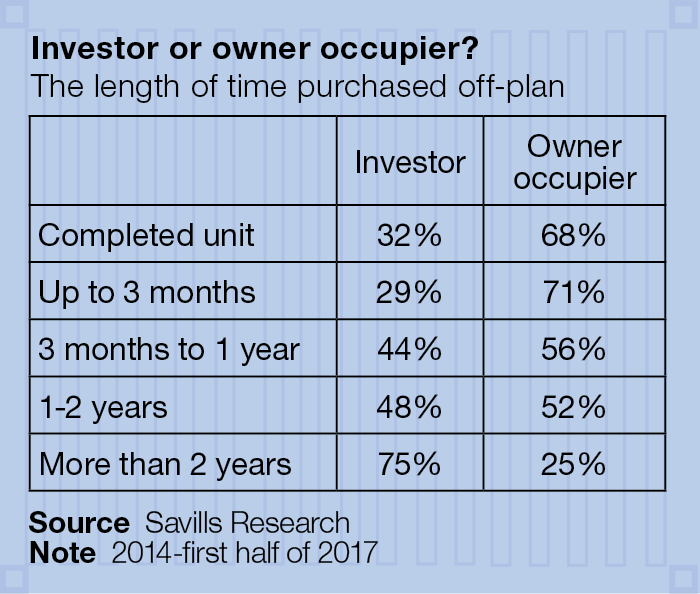
New homes in London are being purchased closer to their practical completion (PC). Our data shows that, in 2014, the average length of time a prime new build property was bought off-plan was 2.9 years pre-PC. By 2016, this was down to 1.9 years. During the first half of 2017, the average reduced to just over a year. More recently in the new build market above £5 million, buyers have been more focused on completed units as buyers at the top end prefer homes that are ready to move into. Just 25% of £5 million+ new build sales were of completed units in 2016. During the first half of 2017, this proportion increased to two-thirds of sales. With more properties available upon, or closer to, completion, the profile of buyers is changing in the prime new build market. Owner occupiers (whether downsizing or purchasing for a main residence, a second home or a weekday pied-a-terre) tend to feature more heavily closer to practical completion. In previous years, buy-to-let investors have been an important source of demand for the new build market. These buyers are often prepared to purchase off-plan, enabling developers to unlock the development finance required to commence construction. However, investors, particularly those with mortgages in the UK, are facing more stringent mortgage regulations and taxation changes. London has experienced an uptick in overseas investors, but, contrary to popular belief, the majority of overseas-bought stock is occupied. The GLA’s recent study found less than 1% of new homes were left unoccupied on a long-term basis. While international buyers may also face the difficulties mentioned above (depending on how they procure finance), those buyers who are willing to take a long-term view and believe in the fundamentals of London as an attractive place to invest, could benefit from favourable currency movements. There is little doubt that the prime development market is evolving. Flexible developers are exploring new uses and new buyers are enjoying the tangibility of completed homes.
Large-scale residential developments that are phased have the ability to deliver future phases as commercial office units, serviced apartments, retirement housing (see p26) and, to a lesser extent at the top end, build to rent. Battersea Power Station has already exercised this option, choosing to hold on the delivery of the residential element in the next phase and focus on delivering the 1.2 million sq ft of office and commercial space.
Despite strong off-plan sales in the prime new build market, starts continue to outpace sales. As a result, there remains a large pipeline of unsold homes yet to complete. The number of starts increased significantly between 2014 and 2016, as many tower schemes that cannot be phased began construction. This meant that in 2016, nearly two units were being started for every home sold. Looking forward, unless sales increase from their current levels, there will be more practically completed and unsold homes on the market. This is an important consideration for developers’ expectations of future sales rates. However, there are mitigating factors which could reduce future prime residential supply. First, during the last year, the annual number of starts reduced to 8,000 units, down from the peak of 11,000 seen during 2016. Second, there is a growing trend by pragmatic residential developers to diversify into alternative asset classes.
With more than 6,200 exchanges of prime new build homes over the last 12 months in London, new build activity at the top end has held up in an uncertain market. This is the highest number ever of £1,000psf+ sales in the London development market and 8% higher than the peak of 2013. This contrasts with the more domestically driven prime secondhand market, which has felt the effects of taxation changes and mortgage regulation.
The increase in London’s prime supply pipeline is unprecedented. Over the next five years, we forecast that, on average, 8,500 new build homes above £1,000psf will be physically completed every year. That’s three times more than the annual average over the last five years, and nearly double the number of completions during the 12 months to Q2 this year. However, completion figures do not paint the full picture of the prime development market; the pipeline is best understood by also looking at sales and construction starts.
london development 10
Dovehouse Street, Chelsea
The London retirement market
2,620
The GLA has a target of 2,620 retirement properties to be delivered every year over the next five years
313
Over the last three years, only 313 private homes for retirement were delivered in London
£253bn
Over-65s in London own £253bn in housing equity, 35% of all owner-occupier equity in London
During the next 20 years, the number of over-65s will grow by 65% in London, making it the fastest-growing age group
54%
The proportion of over-65s who are under-occupying their London homes by two or more bedrooms, according to the 2011 Census
With increasing under-supply and signs of government support, more investors are directing their attention and cash at retirement housing. Although companies such as Audley and McCarthy & Stone are already well established in the UK, there remains a massive opportunity for other developers. Demand is growing for homes that meet the needs and aspirations of downsizers and the retirement market. Challenges remain in this market. Developers/operators typically need to provide homes at values that allow downsizers to release equity from their current home, which may be used to enhance their quality of life, pay for later-life care, or provide financial support for children and grandchildren. Keeping service charges affordable is also an important consideration, given that most downsizers will not have been accustomed to paying annual property fees and tend to be asset rich and cash poor. Planning remains a hurdle for this sector. Currently, there is inconsistency in the way boroughs treat retirement housing. Whether schemes qualify for C3 ‘dwelling house’ or C2 ‘residential with care’ status depends on a whole range of opaque and confusing factors. The difference in Community Infrastructure Levy (CIL) and section 106 requirements for each class can make or break the financial viability of these schemes, which typically deliver higher levels of residents facilities than a typical residential scheme. With a fundamental lack of suitable housing for downsizers in the capital, some retirees might look to move beyond the boundaries of the M25 (see page 19 for our feature on London’s migration). Developers/operators have an opportunity to help meet the needs of the undersupplied, undercatered for, but rapidly growing downsizer market in London.
words Emily Donovan
Are we heading into new territory for the prime London residential development market, as alternative uses serve to mitigate over-supply and buyers at the top end of the market change nature?
Living the high (retirement) life
The alternative reality of new build realty
Savills is a leading global real estate service provider listed on the London Stock Exchange. The company was established in 1855 and has a rich heritage with unrivalled growth. It is a company that leads rather than follows, and now has more than 700 offices and associates throughout the Americas, Europe, Asia Pacific, Africa and the Middle East. This report is for general informative purposes only. It may not be published, reproduced or quoted, in part or in whole, nor may it be used as a basis for any contract, prospectus, agreement or other document without prior consent. While every effort has been made to ensure its accuracy, Savills accepts no liability whatsoever for any direct or consequential loss arising from its use. The content is strictly copyright and reproduction of the whole or part of it in any form is prohibited without written permission from Savills Research.
Savills plc
Contacts 11
lettings
sales
Emily Donovan Associate, London Residential Research 020 7409 5903 edonovan@savills.com
Ed Lewis Head of London Residential Development Sales 020 7409 9997 elewis@savills.com
Jane Cronwright-Brown Head of Lettings 020 7578 9980 jcronwrightbrown@savills.com
Lindsay Cuthill Head of Country Department 020 7016 3820 lcuthill@savills.com
Jonathan Hewlett Head of London Residential 020 7824 9018 jhewlett@savills.com
Justin Marking Head of Global Residential 020 7016 3810 jmarking@savills.com
Gaby Day Analyst, UK Residential Research 020 7299 3003 gday@savills.com
Yolande Barnes Head of World Research 020 7409 8899 ybarnes@savills.com
Mat Oakley Head of European Commercial Research 020 7409 8781 moakley@savills.com
Frances Clacy Associate, UK Residential Research 020 7409 5905 fclacy@savills.com
Kirsty Bennison Associate, UK Residential Research 020 7016 3836 kbennison@savills.com
Katy Warrick Head of London Residential Research 020 7016 3884 kwarrick@savills.com
Lucian Cook Head of UK Residential Research 020 7016 3837 lcook@savills.com
Research
Savills Residential Research We’re a dedicated team with an unrivalled reputation for producing well-informed and accurate analysis, property research and commentary on all sectors of the UK’s housing market. Established prime residential markets make the UK a global centre. Savills Residential Research understands the reasons why