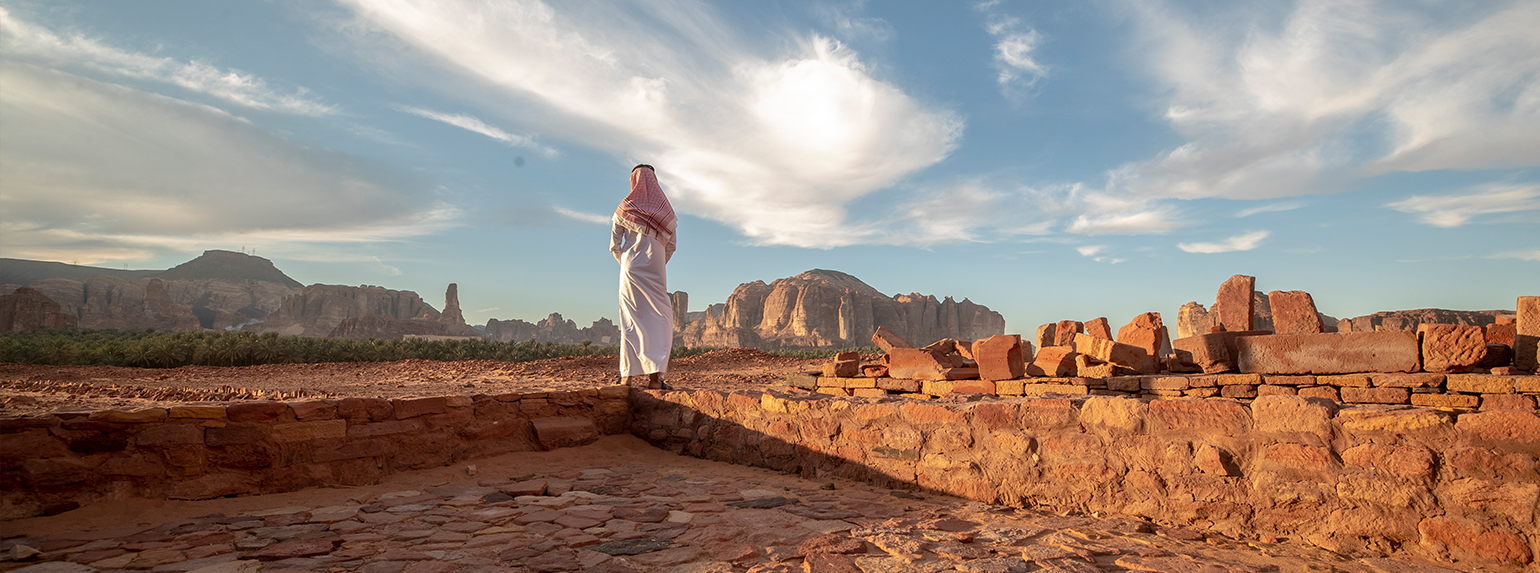

Dadan
Capital of the Dadan and Lihyan kingdoms, this stone-built city features magnificent history and over ten tombs carved into red-rock cliffs
First mentioned in the Old Testament and the book of Ezekiel, the metropolis of Dadan has a long and powerful past, reaching its zenith in the ninth century as one of the most developed cities in northern Arabia.
Capitalising on their strategic geographical position, the kingdoms of Dadan and Lihyan controlled vital trade routes. Funded by taxes on goods such as aromatic frankincense farmed in southern Arabia and transported to the Mediterranean, homes, temples and tombs were built as the economy boomed.
Yet – like so many of AlUla’s great civilisations – there’s still so much to learn.
A team of French, Australian and Saudi archaeologists have excavated less than five per cent of the sprawling site, a 10-minute drive from Jabal Ikmah, unearthing more questions than answers every day. The discovery of stone tools close by has even led some scholars to believe the area was occupied by hunter-gatherers more than 200,000 years ago.
Exploring the site with a rawi (guide), it’s possible to piece together pieces of a fascinating story. Evidence remains of defence, agricultural and water-management innovations used to cultivate hundreds of date palms still found growing in the oasis today.
The uncovering of several life-size statues also suggests a sculpture school may have existed in the area, although the jury is still out on who the elaborate figures with broad shoulders and clenched fists are supposed to represent
More symbols of strength can be found in the cliff face of Dadan, where a dozen niches in the sheer rock face conceal tombs carved high above the valley, using an almost death-defying burial technique which remains unknown.
The most striking and intriguing are two slots marked with lions, seemingly inaccessible at 50 metres from the ground. Characterised by fuzzy manes and long legs, the regal cats symbolise power and protection, while their elevated position chimes with a belief souls of the dead would reach heaven faster if buried high up in the mountains.
Admire them from a distance through binoculars and join the ongoing debate on how the tombs could have been conceivably built by human hands in such an impossible, treacherous spot.
The easiest way to fly is direct from London to Saudi Arabia with Saudia or British Airways, taking six and a half hours. Change planes in either capital Riyadh or Jeddah to take a short domestic flight of around 90 minutes to AlUla’s newly renovated international airport, a 35km or 30 minute drive from most accommodation.
Another option is to fly with Emirates Airlines to Dubai where flights connect with Emirates’ partner airline flydubai flying non-stop from Dubai into AlUla International Airport. Alternatively, you can fly with Qatar Airways or Royal Jordanian from the UK non-stop to Doha or Amman with flight connections directly into AlUla. Local Saudi airline flynas provides flights into AlUla from Dubai, Cairo, Riyadh, Jeddah and Dammam.
How to get to AlUla

Click an area on the map to explore AlUla, or scroll to keep reading

Back to top

Advertiser content for
Illustration: Pei-Hsin Cho, Design: Matthew Brant,
Editor: Hannah Hopkins, Pictures: Alex Kelly,
Web Producer: Caroline Stacey,
Project Manager: Michelle Birbeck
Words: Sarah Marshall
Select an option below to continue exploring
Introduction
Hegra
Jabal Ikmah
AlUla Old Town & AlJadidah


One of Arabia’s oldest cities and home to the Nabataean city of Hegra, a UNESCO World Heritage Site, the ancient region of AlUla is being rediscovered.
For more inspiration, visit experiencealula.com