BLUE SHIFT REPORT
BUILT TO
LAST?
CRITICAL INFRASTRUCTURE WASN’T DESIGNED FOR THIS CENTURY
WHY THIS REPORT?
WHY NOW?
Arthur D. Little’s Blue Shift Institute presents “Built to Last? Rethinking the Aging of Critical Infrastructure” as a call to confront the invisible crisis of infrastructure aging. Drawing on insights from over 20 industry leaders across energy, transportation, water, telecoms, and materials, the report examines:
How aging unfolds in complex systems, where failure is rarely linear and often sudden
Predictive tools and digital twins that could transform maintenance from reactive to anticipatory
Design innovations and material science that extend asset lifecycles
The ecosystems and partnerships required to manage risk at scale

Download the full report

Most infrastructure management still assumes that assets degrade gradually, predictably, and in isolation. Reality looks different:
Nonlinear system aging means cascading failures (e.g., a transformer that sparks a blackout, a water main break that floods an entire transport hub).
Layered complexity from decades of upgrades, regulation, and patchwork fixes often hides vulnerabilities until stress tests reveal them.
Feedback loops and interdependence mean fragility can accelerate invisibly.
FROM LINEAR DECAY TO COMPLEX FAILURE
To control aging, owners and operators must stop treating infrastructure as simple machines and start viewing them as complex adaptive systems.
Hybrid digital twins — combining AI pattern recognition with physics-based models — are pushing predictive maintenance into new territory:
Real-time simulations spanning entire infrastructure networks, not just single assets
Integration of sensor streams from satellites, drones, thermal imaging, and IoT devices
Adaptive risk models that evolve as usage patterns, climate conditions, and materials change
Barriers remain — data silos, high up-front costs, organizational inertia — but the potential is transformative: up to 30% operational cost savings through predictive maintenance are within reach.
PREDICTION AS A SUPERPOWER

Aging control begins long before the first crack appears. Tomorrow’s infrastructure will be defined not just by strength, but by resilience and adaptability:
Material innovations like corrosion-resistant alloys, nano-enhanced coatings, and self-healing composites
System-level adaptability through modular design, scalable capacity, and multi-mission compatibility
Software designed for durability where modular architectures and rigorous update practices prevent “digital rot”
The shift is from surface fixes to deep transformations that embed longevity by design.
Material science innovations across material families
Infrastructure owners must build an end-to-end aging ecosystem. The new value chain spans:
Data architecture for interoperable, real-time insights
Sensor networks and analytics that transform field data into foresight
Integrated solution providers that connect legacy assets with digital platforms
End-use applications that deliver resilience and efficiency in practice
The strategic challenge is no longer just maintaining assets but curating the right ecosystem of partners — while avoiding vendor lock-in, clarifying data ownership, and aligning with regulators early.
Aging management value chain
10 PRIORITIES
Simple system — general
When we imagine the cities of tomorrow, our minds leap to cinematic marvels. Our collective imagination pictures maglev pods racing silently through mega-structures, power grids fed by crystalline reactors, and sentient transit systems weaving seamlessly through green canopies. These visions feel alive, adaptive, intelligent.
Yet the reality beneath our feet tells another story. This year alone, aging and overstressed systems have failed in ways that rippled across economies and societies:
BUILDING THE RIGHT ECOSYSTEM
FIND OUT HOW WE CAN HELP
�
Contact our team
Get in touch

Get in touch
Find your nearest office
Find your nearest office
DESIGNING FOR LONGEVITY
These are not isolated shocks. They are the visible symptoms of deeper fatigue: infrastructure built decades ago — for different load levels and different risks — is now cracking under the volatility of today.
LOOKING FURTHER AHEAD

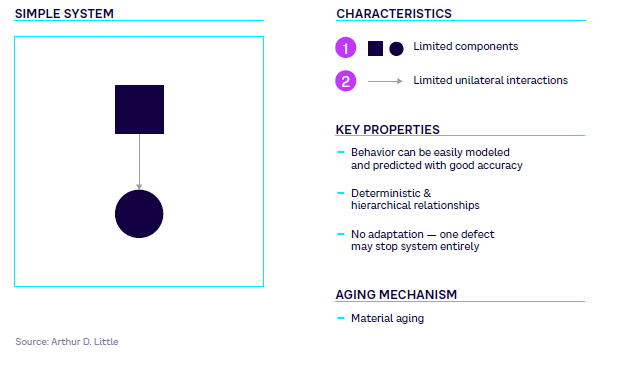
Simple system
Characteristics
Limited components
Limited unilateral interactions
1
2
Key properties
Behavior can be easily modeled�and predicted with good accuracy
Deterministic &�hierarchical relationships
No adaptation – one defect�may stop system entirely
Aging mechanism
Material aging
Source: Arthur D. Little


Technology building blocks
Hybrid Digital Twin
Real-world Infrastructure system
Connect
Compute
Conceive


Real data exchange
AI
Complex system modeling & simulation
Data visualization & dashboards
Computing capability

Sensors: Exchange live, current data from/to real-world physical system
System: Exchange existing, stored data from/to information system
Learn from both real & synthetic data leveraging “statistical” AI
Simulate real system & run futurewhat-if scenarios to generate synthetic data
VR/AR/MR visualizations
AI-driven visualizations
Advanced HMI technologies
HPC, cloud, edge, quantum computing, low-code/no-code software


Data
Actions


Data
Actions
VR/AR/MR = virtual reality/augmented reality/mixed reality; HMI = human-machine interface
Source: Arthur D. Little
Concrete
Metals & Alloys
Composite Materials
Polymers & Plastic
Low
High
Low
High
Technical maturity
Longevity impact
Self-healing concrete
Cement composition
Ultra-high-performance concrete
Advanced admixtures
Low
High
Low
High
Technical maturity
Longevity impact
High-entropy alloys
Nanostructured matels
Advanced corrosion-resistant coatings
Surface modification techniques
Traditional corrosion-resistant alloys
Self-healing coatings
Low
High
Low
High
Technical maturity
Longevity impact
Improved fiber-matrix interfaces
Nanomaterial integration
Environmental barrier coating
Self-healing composite system
Low
High
Low
High
Technical maturity
Longevity impact
Advanced stabilizers & additives
Polymer nanocomposites
Barrier coating & surface treatments
Self-healing polymers
Source: Arthur D. Little
Advanced additives
Surface treatments & coatings
Corrosion-resistant alloys
Nanomaterials
Self-healing materials
Niche/limited adoption
Widespread adoption
DATA ARCHITECTURE
FIELD DATA ACQUISITION
Integrated solution providers
End users
Data collection & computation
General-purpose hardware
GPUs
Microcontrollers
Wireless chips
Data management & storage
Cloud platforms for data storage & organization
SCADA repositories
Asset system integration
Centralized records of assets, condition & work history
Multimodal fusion of operational data
Sensor technology
Fixed sensors
IoT
LiDAR
Thermal
Vibration
Remote mobile sensing
Drone
Mobile
Robotics
Geospatial
Integrated system OEMs
Rolling stock
Turbines
Switchgear
Asset inspection software
Hardware-agnostic anomaly-detection software
Third-party asset inspection
Engineering & maintenance firms
Subcontractors
Predictive analytics platforms
Full service
Modular scope
Digital twin simulation
Physics models
Complex models
Infrastructure asset owners
Source: Arthur D. Little
The report identifies 10 priorities for infrastructure leaders to address today’s realities and prepare for tomorrow’s uncertainties:
1
Embed aging scenarios in portfolio strategy to guide asset reinforcement, phase-out, or repurposing decisions based on lifecycle curves, usage trends & external stressors�
2
Establish interoperable data platforms to integrate sensor streams (e.g., vibration, thermal, satellite, multiple vendors of drones), operational systems & external inputs
3
Adopt robust, centralized data architecture that combines scalable storage — via data lakes, cloud platforms & SCADA repositories — with integrated asset systems like SAP or IBM Maximo
4
Embed cybersecurity by design to ensure regulatory compliance, safety & operational resilience, protecting edge devices, operational data & interfaces from interference
5
Adopt a problem-led, not tech-led, approach to engaging with partners, prioritizing adaptability over fixed off-the-shelf solutions�
6
Avoid vendor lock-in to retain access to historical data if providers change & maintain long-term flexibility�
7
Challenge conventional budgeting cycles by moving toward total cost of ownership, engaging finance & procurement early to align investment with lifecycle strategy
8
Clarify data ownership & governance to ensure operators can scale predictive maintenance & avoid dependency on vendor-defined upgrade cycles
9
Align early with regulators for AI-based deployments, especially in public procurement, to prevent delays in scaling beyond pilots
10
Build workforce capabilities & talent pipelines for data-rich operations, including expertise in analytics, sensor systems, digital tools & predictive interpretation


When we imagine the cities of tomorrow, our minds leap to cinematic marvels. Our collective imagination pictures maglev pods racing silently through mega-structures, power grids fed by crystalline reactors, and sentient transit systems weaving seamlessly through green canopies. These visions feel alive, adaptive, intelligent.
In Spain and Portugal, a grid blackout was brought about by decades-old grid infrastructure buckling under demand, plunging tens of millions into darkness and halting transport, commerce, and emergency services across borders.
In London, a substation fire cascaded into a shutdown of Heathrow Airport, grounding more than 1,000 flights and stranding 200,000 travelers, exposing how a single aging asset can disrupt one of the world’s busiest global hubs.
In California, the Palisades Fire spread rapidly as aging water storage and distribution systems left firefighters without sufficient supply, exposing hidden vulnerabilities in critical infrastructure and fueling the destruction of over 5,000 structures.
Spain & Portugal Blackout
London Heathrow Shutdown
Palisades Fire
The central question: What does it take to future-proof what already exists?


4
FOR ACTION
Several promising directions are emerging:
Aging is unavoidable — but it does not have to mean decline. From predictive maintenance to regenerative materials, innovation is shifting the conversation: the goal is not just to resist decay, but to design systems that evolve with it.
Together, these advances point toward a new paradigm: aging not as a failure to be delayed, but as a force to be designed for. The future of infrastructure is not static and fragile, but dynamic, adaptive, and even regenerative. Built to last, by design.
Stronger and lighter. Advanced composites, graphene-reinforced concrete, and tensioned glass combine reduced weight with greater load capacity, extending lifespan without compromising performance.
Long-lasting and bio-inspired. Self-healing materials, shark-skin coatings, lotus-effect hydrophobic layers, and gecko-inspired adhesives borrow from biology to repair, resist, and adapt in ways traditional systems cannot.
High-performing and sustainable. Carbon-negative bricks, recyclable turbine blades, and other material innovations embed sustainability as a performance feature, lowering end-of-life impacts.
Self-adaptive and autonomous. Embedded sensors, reinforcement learning, and autonomous control algorithms are enabling infrastructure to reconfigure itself in real time, extending operational life through continuous optimization.


What if you could anticipate failure before it surfaced?
Download the full report

Download the full report

FIND OUT HOW WE CAN HELP
�
Contact our team
Get in touch
Get in touch
Find your nearest office
Find your nearest office


zoom in

“The future is not what�will happen, but what�we will do.”
— attributed to Henri Bergson,�early 20th century
Complicated system — general
Source: Arthur D. Little
Material and interface-based aging
Aging mechanism
Behavior dependent on multiple elements, but structure is stable with low dynamics
Deterministic &�hierarchical relationships
No adaptation – one defect�may stop system entirely
Key properties
Multiple components
Limited unilateral interactions
1
2
Characteristics
COMPLICATED system
Complex — GENERAL
Source: Arthur D. Little
Material & Interface-based aging
& cascading events
Aging mechanism
Emergent behaviour where new properties emerge from the interaction between parts
Nonlinear relationships
(feedback loops between parts)
Resilience (small disturbance �doesn't lead to failure)
Key properties
Multiple components
Multiple Interactions
1
2
Characteristics
COMPLEX system
3

Nested sub-systems