
Energy Transition
Seeking to capture the power of the Energy Transition with Thematic Investing
Recent years have truly exposed the weaknesses and vulnerabilities of a system heavily reliant on 20th century fuel sources. The world faces a number of interconnected crises of unparalleled magnitude. Efficient renewable technologies, by contrast, can form a system less prone to market shocks, improving resilience and energy security through the diversity of supply options and actors. The Energy Transition presents a host of opportunities for thematic investors to potentially generate returns while making a tangible contribution to some of humanity’s greatest challenges.





Powered by:

Protect the
Earth’s climate
Seeking to foster energy
independence
Long-term insulation
against inflation
Your thematic partner

Invest for your future - act for the planet
Marketing Communication
Unless otherwise stated, all information contained in this document is from Amundi Asset Management S.A.S. and is as of February 2024. Diversification does not guarantee a profit or protect against a loss. The views expressed regarding market and economic trends are those of the author and not necessarily Amundi Asset Management S.A.S. and are subject to change at any time based on market and other conditions, and there can be no assurance that countries, markets or sectors will perform as expected. These views should not be relied upon as investment advice, a security recommendation, or as an indication of trading for any Amundi product. This material does not constitute an offer or solicitation to buy or sell any security, fund units or services. Investment involves risks, including market, political, liquidity and currency risks. Past performance is not a guarantee or indicative of future results.
Date of first use: 02 February 2024
Doc ID: 2185743


Due to continuing geopolitical crisis this has resulted in new levels of inflation, concern and uncertainty.
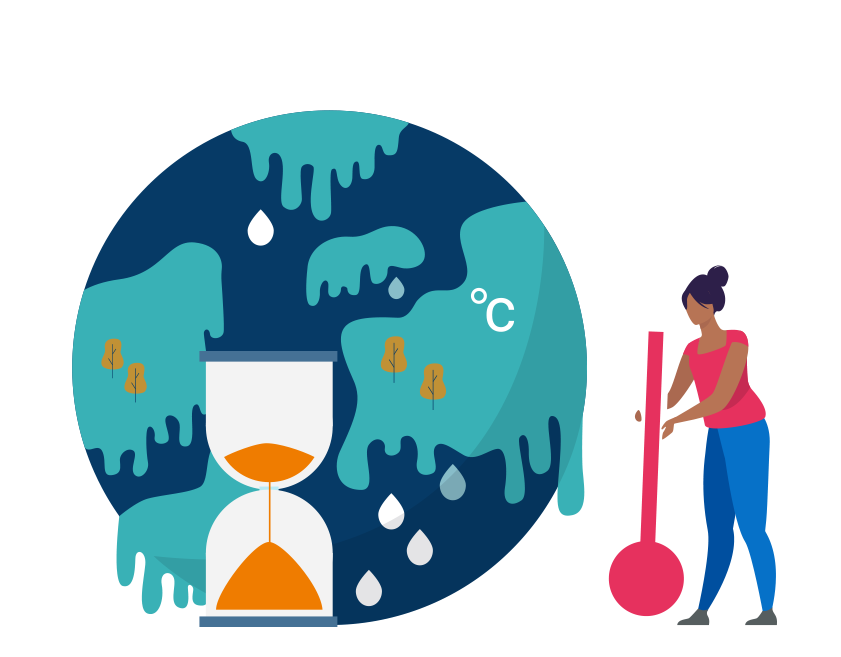
Since the 1980s, each decade has been warmer than the previous one. Nearly all land areas are seeing more hot days.
Caused by greenhouse gas emissions are increasingly evident around the world.
14.2%
Renewables share of global energy consumption in 2022


Source: IEA, January 2023
Source: United Nations, 2023
Source: World Health Organization, October 2023
Facilitating the Energy Transition

has never been more important
of current greenhouse gas emissions are linked directly to the burning of fossil fuels for energy
75%
Source: Forbes, Primary Global Energy Consumption 2022, as of 2023


Facilitating a large emissions reduction in the energy sector is paramount to averting the worst effects of climate change.
The Energy Transition
describes the pathway towards transformation of the global energy sector from fossil-based to zero-carbon by the second half of this century
Six technological avenues pace the way to achieving this goal


Renewables
Energy Efficiency
Electrification
Hydrogen
CO CCS*
2
BECCS**

Significant and sustained investments are needed to facilitate the energy transition
$
T
5
3-6x
Global investment in energy transition technologies reached USD 1.3 trillion in 2022, yearly investments must more than quadruple to over USD 5 trillion to stay on the 1.5°C pathway
Source: IRENA 28 March 2023
Current financial flows are 3-6x lower than levels needed by 2030, to limit global warming to below 1.5 or 2°C
Source: Ire
Far-reaching socio-economic benefits can be unlocked by accelerating the transition
Protecting the climate
3.3-3.6bn people already live in settings highly vulnerable to climate change - emissions reductions can safeguard our planet for generations to come
Source: World Health Organization, 12 October 2023


A new industrial boom
Renewable and other transition-related industries are expected to add 81 million jobs worldwide by 2030
Source: IRENA World Energy Transitions Outlook 2023
Achieve energy independence
Reducing global dependence on a small number of fossil fuel-producing countries may enhance geopolitical security in times of conflict
Cheap & stable energy supply
Renewable energy can be a more efficient and stable energy source, reducing consumer exposure to the
price volatility of fossil fuels over the long-term

Renewable Energy
$4.5 Trillion
Clean energy investment must reach $4.5 trillion per year by 2030.
Source: IRENA World Energy Transitions Outlook 2023
Investors are taking action across key sub-themes
200 - 700%
The potential economic payback through to 2030 for accelerating renewables deployment & efficiency measures
Source: IRENA Global Renewables Outlook 2020, as of 2020


Energy Efficiency and Sustainable Building
58.3 Million
Jobs can be created by 2030 in energy efficiency, power grids, flexibility, and hydrogen more than offset losses of 12M jobs in the fossil fuel and nuclear industries.
Source: IRENA WETO 2022, as of 2022
30%
The operations of buildings account for 30% of global final energy consumption and 26% of global energy-related emissions.
Source: IEA, Buildings, 11 July 2023


Sustainable Mobility
250 MT CO2
In 2022 global CO2 emissions from the transport sector grew by more than 250 Mt CO2, 3% more than in 2021.
Source: IEA Transport, as of 11 July 2023
4% to 14%
The share of electric cars in total sales has more than tripled in three years, from around 4% in 2020 to 14% in 2022.
Source: : IEA Electric Vehicles, 11 July 2023


Learn more about Environmental Challenges


Fluctuating oil & gas prices
Hotter temperatures
Impacts of climate change
Source: United Nations as of 2023
Source: IRENA World Energy Transitions Outlook 2022; *Carbon Capture and Storage **Bio Energy with Carbon Capture and Storage