Exports of Iraqi Basrah Medium and Basrah Heavy crude fell by almost 90pc to 500,000 b/d in March - the lowest since Argus records began in 2014 due to the effective closure of the strait of Hormuz. Around 440,000 b/d of those exports remain in the Mideast Gulf. This adds to around 360,000 b/d, of February exports that did not cross the strait before the war began. As a result, refiners in Europe and the Mediterranean were grappling with an almost 600,000 b/d shortfall in medium and heavy sour crude.
Refiners turned to spot supplies of Libyan medium sweet Es Sider as a substitute for Basrah Medium. The majority of Es Sider supplies typically already find an outlet in the Mediterranean leaving little additional supply available for the region. Spot prices for April-loading cargoes gained more than $11.50/bl in March to their widest premium on record.
Exports of Algerian Saharan Blend to the Asia-Pacific hit a six-year high of 180,000 b/d in March, as Asia-Pacific buyers sought alternatives to Abu Dhabi Murban. Spot prices for the light sweet grade jumped by more than $10/bl last month to a record high, as increased Asia-Pacific demand prompted competition with European refiners.
Argus products
Argus European Crude Oil Forward Curves
Mediterranean
Russian Caspian
Russian Caspian
Caspian light sour CPC Blend strengthened sharply in March, averaging more than $5/bl higher on the month at a $2.26/bl premium to Dated. European buyers scrambled to secure the key import grade to bolster supplies amid the US–Israel war with Iran, pushing CPC Blend to its highest monthly average since Argus records began in 1997.
Exports climbed to a six‑month high of around 1.58mn b/d as European and Asian buyers competed for volumes. Shipments to Asia rose five‑fold on the month to 291,000 b/d. Around 135,000 b/d of this comprised Kazakh‑origin supply, mainly bound for South Korea. Kazakh CPC Blend had not loaded for the region since December. Eastbound shipments are set to remain elevated, with at least 6mn bl due to arrive between April and June. Strong Asian demand also lifted Russian‑origin CPC exports to 156,000 b/d, more than four times February levels, with most cargoes headed to India.
Light sweet Azeri BTC Blend also rallied, averaging $6/bl higher on the month. Exports reached an 11‑month high of 588,000 b/d, up 13pc on the month. Just under one‑sixth of volumes moved east, with India, Thailand and Taiwan among the buyers. This reduced availability for BTC Blend’s core Mediterranean and Black Sea markets.
Russian medium sour Urals strengthened as India ramped up intake after the US issued a sanctions waiver. India’s imports averaged about 1.77mn b/d, nearly double February levels. Ona delivered-India basis, Urals climbed by nearly $9/bl against North Sea Dated. Prices in the Baltic and Black Sea made more modest gains, as high freights pressured values.
Argus products
Argus Caspian Markets


View chart

View chart

Mediterranean
Russian Caspian
Mediterranean
View arbitrage map

North Sea
West Africa
North Sea

View chart
North Sea prices climbed to new highs in March as buyers rushed to secure alternatives to the Mideast Gulf supplies shut in by US and Israel’s war on Iran. Atlantic basin benchmark North Sea Dated added more than $55/bl over the course of March to reach $125.92/bl by the month’s end — its highest since June 2022. The effect on supplies was not immediate. Long transit times meant that Europe continued to receive supplies from Iraq, Saudi Arabia and Kuwait in March. But these flows came to a halt in April, driving prices higher still, with Dated subsequently reaching an all-time high.
But supplies in the North Sea were tight in March nonetheless as competition from elsewhere drove up the price of the region’s normal crude sources. The price of WTI — which heads to Asia-Pacific as well to Europe — climbed by almost $10/bl against North Sea Dated on a delivered Rotterdam basin. And competing North Sea supplies climbed as a result, with UK light crude Forties adding $10.30/bl against Dated and Norway’s medium sour Johan Sverdrup gaining $14.71/bl.
While prices for future delivery were all higher, it was the price of prompt crude which came under the most pressure. North Sea Dated — which prices crude loading up to one month ahead — began March at discount to the front-month June Ice Brent contract. But by the month’s end, it had reached a premium of around $10/bl. By early April, that spread had reached almost $34/bl, the widest spread on record.
Links
Argus Crude
Argus Brent Sour
Argus North Sea Dated
North Sea

View chart
Prices for west African crude surged through March-early April, as buyers looked to the region for viable alternatives to Mideast Gulf supply, a large part of which has been disrupted by the US-Israel war on Iran.
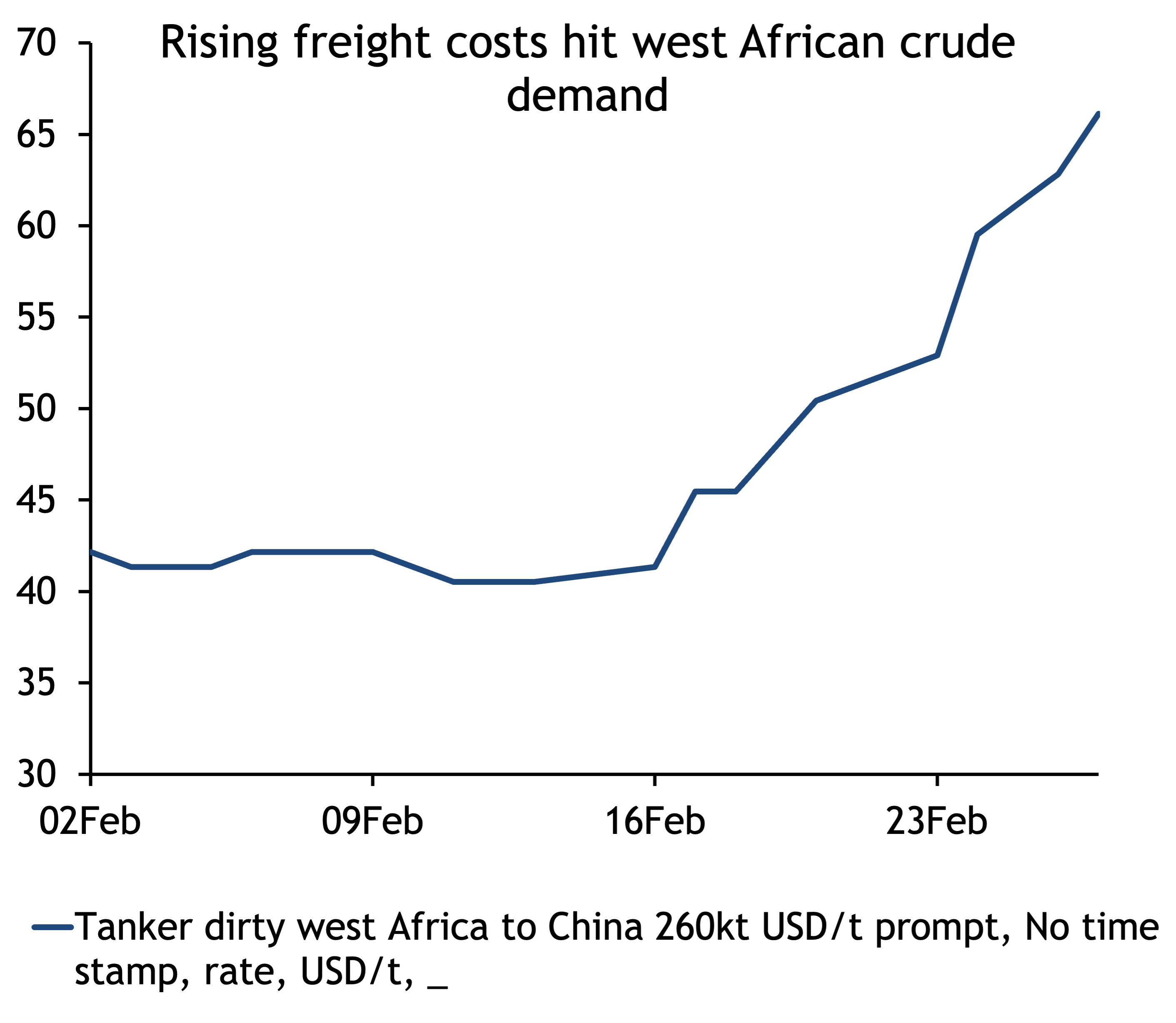
Prices for Angolan grades and Congolese Djeno, which typically find an outlet in Asia-Pacific, saw the largest gains. Asian countries are historically more reliant on Mideast crude, and experienced a shortage of crude much sooner and of a much larger scale than those in Europe. At the same time, wide refinery cracks in the region when the war just started made run cuts unattractive in March. Those factors pushed Asian refiners to pay record premiums for reliable west African barrels.
Nigerian grades, which are typically shipped to Europe, saw much more gradual and modest gains in March. The wide backwardation in the Dated benchmark and high freight rates made long-haul shipments very expensive, as crude effectively loses value while on water. And while Asian refiners had little choice but to absorb those higher costs, buyers in Europe first turned to local supplies to limit the impact of the backwardation on their feedstock price.
Argus products
Argus West Africa Oil
West Africa
West Africa

Click on the regions on the map to explore insights