photographY Agata Pospieszynska �sTYLING Miranda Almond �WORDS Alexandra English
chameleon
odie Comer is covering her face, peering at me through the gaps in her fingers. This is how she watches horror movies. “I remember when I was a kid, I’d be watching the corner of the television so I couldn’t really see,” she says, diverting her gaze from me to point at nothing in the distance. “Horror is not something I generally like to watch.” We’re both
From a psychopathic polyglot Russian assassin
to a 14th-century feminist noblewoman,
Jodie Comer has proved herself to be one of the � most transformative actors of her generation. � Now, she’s trying her hand at a new genre: horror.
J
laughing, sharing stories of being as squeamish as each other. Why then – and maybe more importantly, how – is she starring in the sequel to one �of the most iconic horror films of the 21st century?
We’re speaking ahead of the release of 28 Years Later, the third film in the 28 franchise about a society that has been infected by a “rage” virus that’s left very few survivors. When the original film, 28 Days Later, came out in 2002, it was credited with reviving the zombie genre, despite not technically featuring any zombies. Where the stock-standard undead are stiff and slow, these rage-infected hordes move fast, making them all the more terrifying. The film is also set in broad daylight, giving the classic jump-scare tactic extra potency – when you’re looking for horror in the shadows, you often miss when it’s basking in the sunshine in front of you. Directed by Danny Boyle and written by Alex Garland, 28 Days Later was the zombie-not-zombie movie that launched myriad imitations. After decades, the struggling genre was officially, ahem, undead. �
“I usually meet [these] things with a lot of like ...” (here Comer contorts her face into an exaggerated grimace) “but I’m genuinely really excited,” she says. “Horror is not a genre I’ve ever explored before, so when the opportunity came through, I saw that it was a lot of the creative team from the original movie, and I was really excited by that.” She’s not in it for the gore, she’s in it because “it’s so smart, and what’s difficult to pull off is how they’ve given this horror a real sense of humanity”, she says.
Balenciaga biker boots in a psychiatric evaluation. She was playing Villanelle, the cheeky, flirty, exacting and psychopathic Russian assassin-for-hire in Phoebe Waller-Bridge’s darkly comedic Killing Eve. Throughout the series, Comer simultaneously charmed and shocked audiences as she toyed with her victims like a cat playing with a mouse between its paws before sinking its teeth into its neck. She was a mercurial, ruthless and luxury fashion-obsessed killer, whose first hit involved a Chloé silk georgette pussy-bow blouse and a poisoned hairpin. Her murderous rampages were undertaken in Burberry, Gucci, Miu Miu, Halpern, Valentino and Dries Van Noten – among others. She celebrated every �win with a bottle of champagne from her fully stocked fridge.
�Where Villanelle’s style was loud and flamboyant, Comer’s real-life taste �is more on the laidback side. For our cover shoot in London, her �favourite looks were a black Victoria Beckham suit “that we wore with �a Bella Freud shirt that had a denim tie on it”, she says, “and then a very simple Miu Miu shirt. You can’t go wrong with a pinstripe, can you? I love clothes that are very comfortable. I’ll feel an ease within myself when �I’m in that environment.”
“I felt like it got to a point where I was getting � accents thrown at me for the sake of it.”
- jodie comer

“There’s probably a very quiet strength �and resilience in a lot of the characters I play. �They have to overcome something.”
- jodie comer
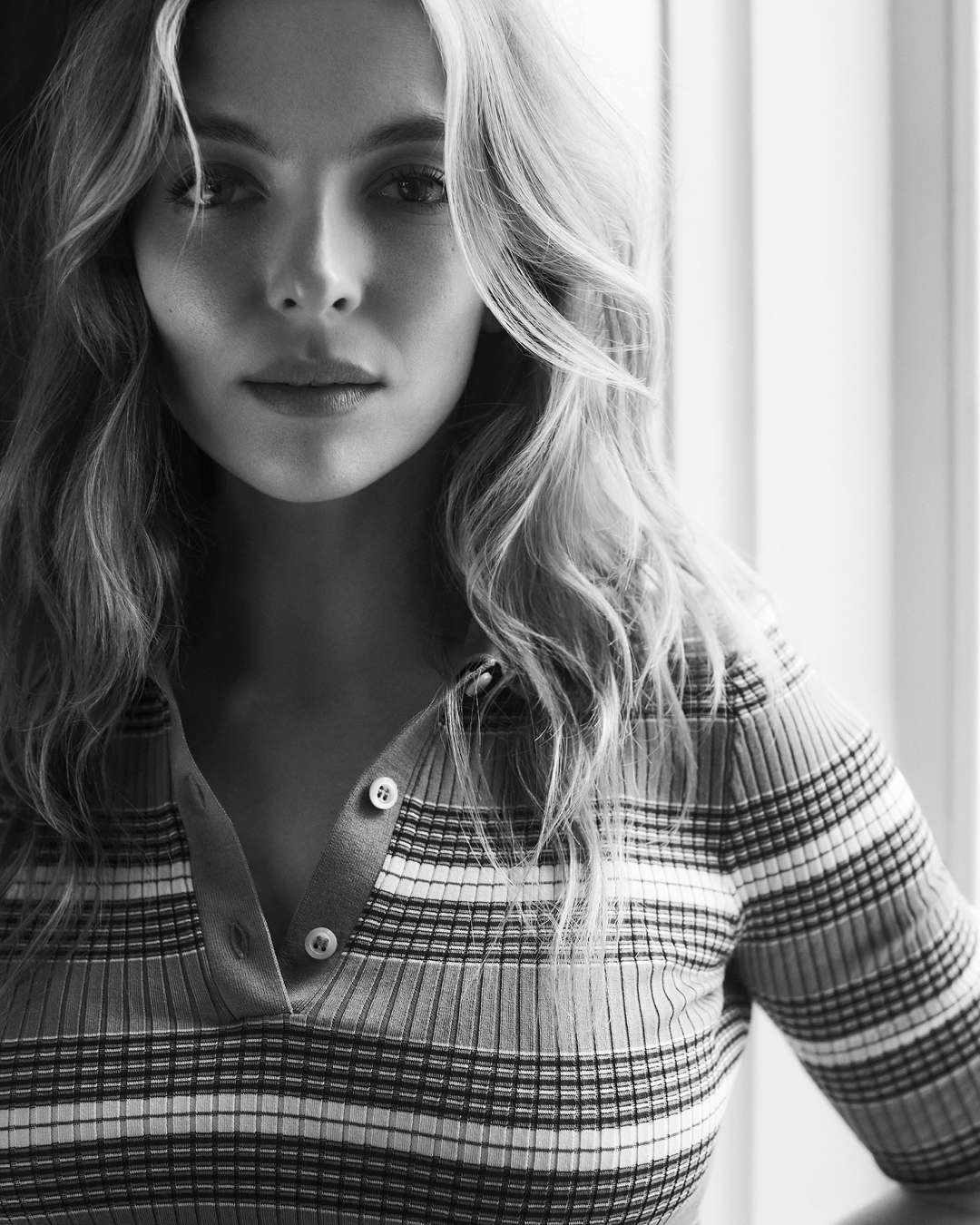
Jodie wears Cartier and Max Mara.
Jodie wears max mara and cartier

CREDITS
Talent: jodie comer
Editor: Georgie McCourt
Creative Director: Juanita Field
art director: rebecca rhodes
interview: alexandra english
PHOTOGRAPHER: Agata Pospieszynska
stylist: Miranda Almond
Hair: Patrick Wilson/The Wall Group.
Makeup: Naoko Scintu/The Wall Group.
Manicure: Emily Rose Lansley/The Wall Group.
Production: Harriet Rosen/One Production; �and Robyn Fay-Perkins.


Comer plays Isla, living on a tiny island off mainland Britain with a small group of survivors. She and her husband, Jamie (played by horror master Aaron Taylor-Johnson), were kids when the virus first broke out, and have vague memories of The Before. Their son, Spike (newcomer Alfie Williams), though, has grown up in The After, so that is his normal. Now that he’s turned 12, he must undertake a rite of passage and venture to the mainland where the infected live in order to learn of the danger that exists across the water.
And this is where it’s easy to see what the appeal is for Comer. She always seeks out roles that are more than what they seem. “It’s really interesting to see how [Boyle and Garland] have explored what that community would look like nearly 30 years into the virus. Would they have regressed? What kind of norms would they have conformed �to in that time? Or how have they advanced?”
Comer has been acting since she was 12, but it was Killing Eve that changed her life. The 2018 – 2022 series flipped the traditional assassin trope on its head. Instead of the female-victim-male-detective (or vice versa) dynamic, Killing Eve saw women in all the major positions – except for the victim, which was usually a man.
Killing Eve also introduced Comer as an uncanny accent mimic. Villanelle spoke English with a Russian accent, often layering others such as Italian and French on top as well as speaking fluently in other languages. “I felt like it got to a point where I was getting accents thrown at me for the sake of it,” she says, laughing. “It then gave everyone this perception of me that I was this accent person, which was terrifying! But ... I always treat it with a real seriousness, because I imagine when you hear someone doing an Australian accent and it’s not quite right, you step out of it.” Her chameleonic ability earned Comer BAFTA and Emmy award wins, and Golden Globe and SAG award nominations. Still, her parents never expected she would make her living from acting.
physiotherapist and her mother, Donna, works for the rail network. Jodie was born in Liverpool, England, in 1993, and her brother, Charlie, was born in 1995. She went to the local Catholic school. “I was quite a flamboyant child; I think I got that from my nan,” she says, referring to her Nana Frances, who passed away while Comer was filming season one of Killing Eve. “She was quite a big character, and the more I think about, ‘Where did this come from?’ I think there’s something about her energy that’s in me.”
Comer started drama classes when she was nine or 10. “It was an hour of singing, dancing and drama on a Saturday afternoon,” she says, “and the only reason I went initially was because my friends from school all seemed �to love it. I was like, ‘I’m home.’” At 11, Comer performed a monologue �at a local talent competition about the Hillsborough disaster of 1989, where nearly 100 people were crushed to death at an overcrowded football match. The piece had been written by a local playwright whose father had died �in the stampede. “I remember seeing my dad’s face after the monologue �and him being so shocked and surprised and proud,” she says. “I was like, �‘Oh, I might actually be good at this.’”
She made one of her earliest on-screen appearances in the 2012 series Good Cop, and her first pinch-me moment came not long after when she landed the best frienemy part in the hit teen series My Mad Fat Diary.
More parts followed, but it was her role in Thirteen that set her on the trajectory for stardom. The 2016 miniseries tells of a teenager who is kidnapped and held hostage for 13 years. In 2017, Comer was nominated for �a Best Actress BAFTA for the role. At the ceremony at London’s Royal Albert Hall she met Phoebe Waller-Bridge, who had won Best Female Performance in a Comedy for Fleabag. They hit it off, heading back to Comer’s hotel room to drink wine, then moving to Waller-Bridge’s room after security told them they were being too rowdy. Five months later, they started filming Killing Eve. �
From there, the roles came thick and fast. Comer has worked on at least two projects a year for the past eight, traversing television, big-budget Hollywood movies and Broadway productions.
�
point of the interview, Comer knows what I’m about to do. Still, she’s a good sport. “It’s funny, some people recognise a through-line that I haven’t necessarily seen,” she says before offering her own analysis: “I think there’s probably a very quiet strength and resilience in a lot of the characters I play. They have to overcome something, and they have to really dig in.”
Here are her results according to this journalist: first, Comer is passionate about portraying women’s stories in female-led projects. She also isn’t afraid to question the patriarchy in its various iterations: a bikie gang, the �legal system, a 14th-century court. In 2023’s The Bikeriders, she plays Kathy, who was drawn into a violent and dangerous world when she shacked up with a member of the Vandals; in the one-woman play Prima Facie, she plays Tessa, a barrister who defends men accused of sexual assault, and then questions the legal system after she is raped; in 2021’s The Last Duel, she plays a 14th-century noblewoman who was raped by her husband’s friend and demanded he be punished. (The film may be set in the 14th century, but the attitudes towards not believing women, rape culture and victim blaming feel all too familiar.)
�She’s also interested in the lengths everyday people will go to in order to survive an apocalypse. I tell Comer that I don’t think I’d like to survive an apocalypse, actually. What kind of life do you have on the other side? “When I was filming [2023’s environmental disaster thriller] The End We Start From, I remember being like, ‘I’d be useless, I couldn’t do this, I’d be crying every five minutes,’ and our director, Mahalia [Belo], said, ‘You say this, but you would have no other choice.’ So I think it’s embedded in us to survive, it’s human nature.”
Comer recently wrapped two more upcoming projects: Kenneth Branagh’s thriller The Last Disturbance of Madeline Hynde (with Patricia Arquette and Tom Bateman), and another thriller, The Death of Robin Hood, starring Hugh Jackman and Bill Skarsgård. With all of that ticked off, what’s next? Some time off, surely. She laughs. “I’m in that in-between stage of not working and wondering what the next thing is going to be,” she says. “These moments are so important, just to reconnect with yourself and live your life so you can pour it into your work.” Comer also has had the same group of girlfriends since high school and is excited to spend time with them. “You often get uprooted and you’re at the mercy of a schedule, so you’re not getting days off for your mum’s birthday or your friends’ new babies’ christenings – you are very much in a vacuum, so when I’m back I’m like, ‘Let’s go – let’s get all the good stuff back in.’” We’re speaking on a Saturday morning and when our interview is over, she’s off to spend the day doing, well, nothing. As she should.
28 Years Later is in cinemas June 19.
A
sk any millennial-aged Jodie Comer fan when they first fell in love �with her, and they’ll likely say the same thing. It was 2018, and she �was wearing a voluminous pink organza Molly Goddard dress and
C
omer was an extroverted kid, always doing impressions of singers Cilla Black and Anastacia in the hallway for her mum’s friends, but they weren’t a showbiz family. Comer’s father, James, is a football club
A
thing about journalists is that they love to find a through-line between an actor’s projects, using the roles they’ve been drawn to like a sort of Rorschach test to reveal elements of their psyche. When we get to this
Jodie wears Erdem, Max Mara and Cartier.
Jodie wears Cartier and Gucci.
Jodie wears Cartier and Miu Miu.
LEFT Cartier and Bella Freud. RIGHT Max Mara and Cartier.
Jodie wears Cartier.
Jodie wears Victoria Beckham, Bella Freud and Cartier.
Jodie wears Prada.