photographY TIM ASHTON
STYLING RACHEL WAYMAN
Words ALEXANDRA ENGLISH
EDITOR Georgie McCourt�CREATIVE DIRECTION Rebecca Rhodes.
photographY Tim Ashton/After Winter.
STYLING Rachel Wayman/Artist Group.
HAIR Bradwyn Jones/Assembly Agency.
MAKEUP Victoria Baron/M.A.P
MANICURE Oli Antunes.
PRODUCTION Robyn Fay-Perkins
We know Tina Arena the icon, but does anyone really �know Tina Arena the woman? With her new biographical documentary, she’s come to set the record straight
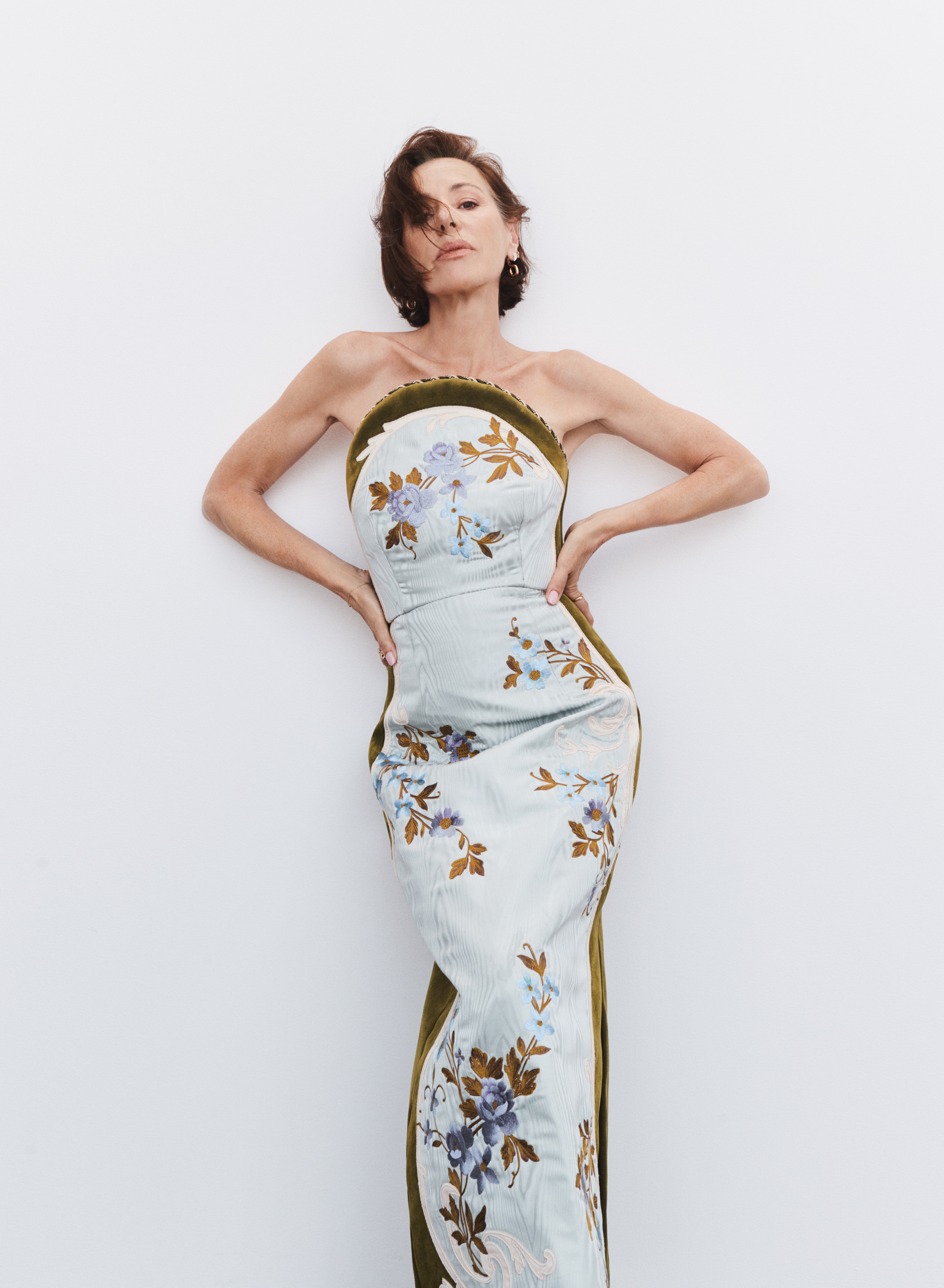
Alémais dress, $890; Swarovski earrings, $259, and rings (from left), $199 and $339; Arena’s own bracelet (worn throughout). �

“It’s no wonder people �in the public eye suffer �from extraordinary bouts of insecurity. Women �are objectified from the minute they get into it”

One of the main rules of journalism is that you shouldn’t insert yourself into a story unless there’s a really good reason for it, especially not if it’s a profile, and extra-especially not if it’s a profile on a celebrity. So bear with me while I explain why I’m making Tina Arena’s marie claire profile all about me.
� It was the summer of 1997, and I was nine years old, standing in the music section of Grace Bros, ready to buy my first-ever CD. I had the Spice Girls’ Spiceworld in one hand and Tina Arena’s In Deep in the other. To be clear, I had come here for the Spice Girls (they’d recently changed my life at a pool party sleepover) but I’d been distracted by Tina Arena.
�
On the cover of In Deep, she’s emerging from the water (or sinking into it, depending on your outlook), her brunette hair in a messy bun with trendy “bits” around her face; a hairstyle I’d been trying to achieve all year, only hers didn’t involve any butterfly clips. In Deep is not an obvious choice for a child’s first CD, but who among us had not belted out “Chains”, the banger from her previous album, Don’t Ask, when it came on Rage �on Saturday mornings?
� So there I was, with enough pocket money for only one CD, faced with a nine-year-old’s equivalent of Sophie’s choice. To the soundtrack of my mum telling me to hurry up or she was going to leave without me, I put Spiceworld back.�
“I’m angry now,” she says. “I’m angry because I allowed people to mistreat me. I’m trying to transform that anger now and leave a good example. If there is something that has upset me, I will now go straight to the source and tell them how I feel. There’s a lot of that happening at the moment. I will no longer be disrespected by anybody.”
�
Female anger is not typically an accepted emotion, but Arena doesn’t care. Not holding onto those feelings has made room for other things. The documentary, for one; a new EP, Way of the World, on which she’s covered six formative songs from her lifetime; a tour in France that she’ll leave for in a couple of days; a re-recorded greatest hits album set to be released in June 2027; and a first-of-its-kind residency at Crown Melbourne that kicks �off next August. After that, she says, no-one will know where to find her. She’ll turn off her phone and disappear. Tina Arena is done being told what to do. She’s no longer in chains.���
Farage blazer, POA, and pocket square, $95; Emporio Armani shoes, $1150; Swarovski earrings, $460, and ring, $339; stylist’s stockings (worn throughout).
Farage blazer, $1295, vest, POA, and pants, $595; Jimmy Choo shoes, $2275; Swarovski ear cuffs, $229, earrings, $149, necklace, $760, and rings, $339, $229 and $189.
Left: Gucci jacket, $7500, and skirt, $4480; Swarovski ear cuffs, $229, earrings, $149, and necklace, $760. �Below: Romance Was Born dress, $6500; Swarovski earrings, $410, and ring, $229.
By breaking that journalism rule and making marie claire’s interview with Tina Arena all about me (we did eventually move on), I got to see the real Tina Arena. She’s no diva, but likewise is she not going to suffer any fools; she’s humble and quick to laugh – a lot and loudly, doubled-over with a hand on your shoulder – but she’s not ashamed of appearing vulnerable or even angry (she has a lot of reasons to be angry, but more on that later).
�
It’s this Tina Arena who appears in her biographical documentary �Unravel Me, which hit cinemas in August and aired on Channel 7 in October. Directed by Adrian Russell Wills and produced by Mark Fennessy and Jessica Carrera, it’s the story of her life in her own words. When she was approached for the project, she tells me, “I said, ‘I’m really sorry, I will not relinquish my life in anybody’s hands. I will not give you that power, and you will not take it from me. This is my story. I respect you, but you’re going to have to go on my journey my own way.’ And to their credit, they did.”
�
Arena has spent 50 years feeling misunderstood and misrepresented. So much of what the public knows about her has come from the men in charge of her career. Unravel Me is not Arena’s attempt to control the narrative; it’s her attempt to correct it.����
Arena stumbled along the child-star-to-adult-musician pipeline 20 years before certain Disney stars toppled off it. It’s not an easy transition to make. Unravel Me shows just how tumultuous that time was for Arena, and how poor her management’s direction had been. She was surrounded by men in suits who were telling her to sexualise her look, and then she was punished by critics for appearing too sexual. She was objectified, yet bullied for not upholding the conventional beauty standards of the time. She was also coming up against rampant misogyny and xenophobia for being Southern European in Australia in the 1980s, a time when our pop stars were blonde, à la Kylie and Olivia.
�
“I didn’t fit in,” she says now, still looking hurt. “It’s no wonder people in the public eye suffer from extraordinary bouts of insecurity. Women are objectified from the minute they get into it. You’re sexualised, you’re constantly gaslit, you’re manipulated, you’re not taken seriously. You’re not �allowed to be proud; you constantly have to be a shrinking violet. Australia has a real problem with tall poppy syndrome.”
�
Arena finally cracked the mainstream with her second album, 1994’s Don’t Ask. It became the highest-selling album of 1995 in Australia, and remains one of the biggest-selling albums by an Australian female singer. Rich in car sing-a-long bangers such as “Chains”, “Heaven Help My Heart” and “Sorrento Moon”, it earned her six ARIA nominations and four wins that year, plus five more nominations and another win (Highest Selling Album) in 1996.
�
It was all coming up Tina Arena, and in December 1995, she married her manager of three years, Ralph Carr. It was when she was writing In Deep that she saw the reality of their relationship – referring to the song “Burn”, she says, “I realised no-one was burning for me.” They divorced in 1999. In Unravel Me, she speaks about not being listened to in her marriage or her work relationship with Carr. “My opinion didn’t count,” she says. “It was like, ‘You don’t know what you’re talking about.’ You’re purposely kept on a treadmill because once a cash cow, always a cash cow.”��
A week-and-a-half before Unravel Me premiered at the Melbourne International Film Festival in August, a suppression order was lifted that revealed that Carr was the Melbourne businessman who’d been convicted in July of raping a woman in his home in 2023. (Another devastating moment occurred within days of the premiere: Arena’s mentor and “second dad” Johnny Young died of pancreatic cancer.)
�
After the breakdown of her marriage, Arena moved to France, learnt to sing in French and started a whole new career there, where no-one knew “Tiny Tina”. While she’s currently back living in Melbourne, she’s moved away from Australia a number of times in her career and still has a complicated relationship with the country.��
Gucci dress and shoes, both POA; Swarovski bracelet, $359, drop earrings, $339, �and rings (from left), $339, $339 and $189; Arena’s own stud earrings.

“I’m angry because I allowed people to mistreat me. I’m trying to transform that anger now and leave a good example”
TINA
BREAKS FREE

Romance Was Born dress, $6500; Swarovski earrings, $410, and ring, $229.
O
In the car, I slapped In Deep into my silver Discman, snapped it shut and fixed my headphones over my elaborately decorated hair. When the opening guitar strum of “Burn” came through the tinny earpieces and drowned out my little siblings’ arguing, I knew I’d made the right decision. From then on, it was Tina Arena or nothing.
�
The reason I’m telling you all of this is because a few weeks ago I told Tina Arena all of this. I hadn’t planned to – I didn’t want my fan-girl hat to cover my journalist hat during our interview – but I let the story slip to Arena’s publicist who insisted I tell her. And so, during the lunch break on our photoshoot, about five minutes after we’d been introduced and while she was in a fluffy robe picking at a green salad, I told her everything.
�
And instead of treating me like I was some sort of grovelling, suck-up loser (which is how I felt), she looked visibly touched. This is a woman who’s been in the public eye for 50 years. She was a child star. She’s one of our highest-selling artists with more than 11 million records sold globally. She’s won a BRIT, seven ARIAs (she was the first woman to win the ARIA for Album of the Year) and two World Music Awards, and is a member of the Order of Australia. She sings in English, Italian, French and Spanish. After she moved to France in the late 1990s, they knight ed her, for God’s sake, for her contributions to French culture. And here she was, in a Sydney studio, amazed that her music would mean something to this stranger.��


Erik-Yvon dress, $5680; Swarovski ear cuffs, $229, earrings, $149, �and necklace, $760.
Harris Tapper jacket, $3129; Christian Louboutin sunglasses, $1300; Swarovski earrings (from left), $149 and $359, bracelet, $359, and rings (right hand), $229, (left hand, from left) $339, $189 and $229.
It all started with Young Talent Time, Johnny Young’s Mickey Mouse Club-style variety show. In 1974, a seven-year-old Arena appeared as a contestant and, two years later, joined the regular cast. For nearly eight years, the second-generation Sicilian-Australian schoolkid from Melbourne beamed into Australian living rooms every Saturday night and charmed her way into hundreds of thousands of hearts.
�
By the time she left in 1983, just before her 16th birthday, she was the show’s longest-serving cast member (pause to google her final performance of “MacArthur Park”). The show stipulated that members must leave by 16 to make room for the next generation, but Arena was also ready to make her way as a pop star in her own right.
�
It’s hard enough to get family members to stop seeing you as a child, let alone the hundreds of thousands of strangers whose living rooms you appeared in every week for your entire childhood. So many people thought they knew “Tiny Tina”, but chances were they didn’t even know her real �name. Born Filippina “Pina” Arena, she was encouraged to use a stage name that was thought to be more palatable for an Australian audience.�
When Arena left the show, she couldn’t shake off the child star associations – and not for a lack of trying. In a formative moment, Unravel Me shows everyone freaking out about her cleavage in the video for her 1990 single “I Need Your Body”. (It also shows her joking about it 25 years later when she was inducted into the ARIA Hall of Fame.)���� �
I
“The arts are what keep us connected, what keep �us dreaming, what give us an opportunity to reflect”

We’re speaking in the days after sexual assault allegations had been laid against Sydney Swans players. “There’s too much focus on sport in Australia; it’s a big drinking culture,” she says. “There’s no philosophy; nobody speaks about philosophy, and the humanities and arts take a back seat. They’re the things that make us human and make us feel alive, and the arts are what keep us connected, what keep us dreaming, what give us an opportunity to reflect.
�
“There’s so much aggression; the women want more softness, and the men feel they have to behave a certain way …” she catches herself. “Not all men, of course. I love the men in my life. I absolutely adore the men I surround myself with; they’re inspiring, loving, nurturing.”��
“There’s so much aggression; the women want more softness, and the men feel they have to behave a certain way”
U
Speaking of the good men in her life brings us to her 21-year-old son, Gabriel, who she shares with her former partner, French artist Vincent Mancini. After nearly 20 years living abroad in France and London, �Arena moved back to Australia in 2017 with Mancini and Gabriel. �
When I ask her about raising a good man, she replies, “It’s been hard.” Vulnerable again. “Gab was a victim of Covid – I saw all those boys struggle, and their mothers were struggling with the prepubescent aggression, and that’s already a hard time, and then you add the poison they poisoned us with – vaccinations.” She pauses, sensing my hesitation. “You have to keep that line in,” she says. “I don’t want you to take it out.” I promise I will keep it in.
�
It’s important to her, because after that, Gab moved back to France and the separation was painful. “They poisoned us, they took our kids away from their schools, their social circles, their normal stages of growth and life in a crucial time for development,” she continues, “and I will never forgive the Australian government for it. They destroyed our children, they destroyed us.” ���

Unravel Me details more obstacles than I can fit into this word count. “We left so much out [of the documentary], too,” she says. But it all comes down to this: in 2023, after so many years trying to kick against the system and screaming internally, Arena got sick – really sick. A severe kidney infection turned into septicemia, landing her in intensive care for nearly a week and forcing her to cancel dates on her Love Saves world tour.
�
She realised her body was shutting down due to sustained, chronic stress. “I wasn’t just sick, I was on the danger line,” she says. “It was incredibly scary, but it was a sign. I just looked around me and went, ‘Yeah, this is not working.’ I didn’t really feel I was in the right place, and I wasn’t – so my body fell apart. Women ignore a lot of stuff [to do with their minds and bodies], but ignoring that stuff brought me to my knees, literally. So I started cleaning my life up; I realised it was time for me to drive the car.”
�
If she always had a no-bullshit internal compass, now everyone was going to hear about it. Coming close to death can do that to a person: they quit a job, move countries, sometimes have affairs and other times recommit to marriages. Arena didn’t do any of those things. The reassessment of her life took the form of speaking her absolute truth at all times, no matter what.����
Farage blazer and shirt, both POA; Romance Was Born skirt, $2800; Jimmy Choo shoes, $1395; Swarovski ear cuffs, $229, earrings, $149, and rings (from left), $229, $189 and $339.