At just 49, my father died, and parts of that time remain blurred — maybe my mind’s way of shielding me from too much pain too soon. But I do remember what came next.
In March 1981, three months after my father died, I was 16 and looking for a job. A brand-new shopping mall was opening. A few major anchors were already up and running, but most of the place felt like a construction site — drills echoing through empty corridors, the smell of fresh paint, panes of glass being slid into storefronts. Still, there was movement. Would-be shoppers wandered, workers unpacked, and I had a plan: walk from store to store, resumé in hand, knock on doors, and give it to whoever would take it. I figured someone had to say yes.
�My first stop was a large chain sporting goods store called Athlete’s World. Through the window, I saw three people sitting on the Astroturf talking and assembling fixtures. I knocked. They looked up and then at each other, and one of them came to the glass. He looked to be in his early 20s. I’d later learn his name was Al and that he was the store manager. I handed him my resumé. I’d delivered newspapers and done the usual teenage hustle — so I thought I had a little something to offer. Al looked it over and said they weren’t hiring. I thanked him and kept moving.
�But as I walked down the hall, I heard footsteps behind me. It was Al. He called out, “When can you start?”
�This story doesn’t happen without Al. He gave me my first real job — and with it, trust, responsibility, and a chance. After a year that made no sense, he helped me take my first real step forward.
Written and illustrated by
Robert Poulton
I remember my first sale like it was yesterday. A customer pulled a shoe off the wall and looked at me — the kid in the white polo with the store logo stitched on the chest. I looked over at Al. He nodded. That was all I needed. The customer tried on the shoes, liked them, and, just like that, we had a sale.
�Each salesperson had a number we’d write on the shoebox or tag to track commissions. I picked 007 — for exactly the reason you'd expect a 16-year-old to pick it. That number stayed with me for years.
About a month in, I showed up for an evening shift and Al pulled me aside. “We’re short,” he said. “About three hundred dollars over the last few weeks.” I could tell it was bothering him. He had gone out on a limb hiring me, and now something wasn’t adding up. I told him the truth: I hadn’t taken anything. But the mistake was mine.
�Al took me off register duty, and sure enough, the till balanced every night after that. A few weeks later, he gave me another shot. During a credit card transaction, I was about to hand the customer their receipt when Al stepped in, completed the sale himself, and smiled at me.�
There are things you pick up fast working retail — especially in a sneaker store. You learn how to lace shoes quickly, fold clothes, and read a customer’s body language. Eventually, you learn how to measure feet properly, explain the difference between pronation and supination; you know the ins and outs of a slip-lasted versus a board-lasted shoe and can explain EVA versus polyurethane midsoles. A lot of that technical knowledge is still lodged in my brain. But the things that really stuck with me were the mistakes — and the lessons that came after.
In the early ’80s, credit card sales were analog. No chips, no swipes, no digital records. Just a three-part carbon-copy receipt: white for the store, pink for the bank, yellow for the customer. The machine pressed down on the stack to imprint the card details onto all three layers. I had never used a credit card myself. I hadn’t even seen my parents use one. So every time I rang in a sale, I was unwittingly giving customers both the pink and yellow copies — leaving the store with no deposit slip and no way to reconcile the sale. That’s how we ended up $300 short.
�Al could’ve fired me. I’m sure someone above him probably would have wanted him to. But he didn’t. He calmly walked me through the process again, step by step. No lecture. No raised voice. Just quiet instruction and a second chance. Then he put me back on the register.
�There were a lot of things I learned from Al over those years — how to sell, how to serve, how a store works. He even gave me rides home, shifting gears in his Pontiac Sunbird while eating a burger and steering with his knees. He introduced me to Gil Scott-Heron, UB40, and Lou Reed. But more than anything, Al showed me what it looks like to give someone grace. He taught me what it means to trust — and how powerful a second chance can be.
�I worked for Al for nearly three years, mostly evenings and weekends, until I finished high school. At one point, I became the ninth-highest seller in a chain of nearly a hundred stores — a rare feat for a part-timer in a small store. None of it would’ve happened without someone who chose to believe in me even after that early misstep. After high school, I took two years off before college and worked full time at the chain’s flagship and biggest store in the Toronto Eaton Centre — faster, busier, and higher stakes.
It’s impossible to tell this story without talking about race. The Black experience in Canada is long and complex. In some regions, it’s tied to the legacy of American slavery. In others, to immigration and colonialism. It’s a history marked by discrimination and struggle, but also by resilience, success, and opportunity.
By the time I started selling sneakers, I had already experienced more racism than any young person should. I had learned to fight early and, unfortunately, got good at it. Before he died, my father, who once believed in turning the other cheek, reluctantly taught me how to use my fists and I became a decent high school wrestler. Looking back, I see how scarred I was. Beneath the face I showed the world, a bright, positive kid had become angry, deeply wary of everyone, and self-protective. It took decades for me to begin letting people in.
�The store wasn’t immune to the culture outside. Everything, good and bad, hopeful and harsh, walked through those doors with the customers.
�There was the teenage boy who called me the N-word repeatedly as I laced up his sneakers. His red-faced mother apologized, explaining that her son had Tourette’s syndrome. I felt sympathy for him. I knew his life would be harder than mine. But I couldn’t ignore how easily he connected that word to me. That said a lot about the world he lived in. �
Then there was the older white woman who, while I was ringing up her purchase, reached out and stroked my hair. “I’ve never touched a Black person’s hair before,” she said, almost sweetly. “I just wanted to know what it felt like.” These were strange, uncomfortable moments, but also reminders of how similar we all are and how far apart we can be at the same time. Separated mostly by ignorance and fear.
�
But there was one moment that left the deepest mark. �
What a misstep taught me about trust
LONG BEFORE I BECAME a creative director working for some of the world’s largest media organizations, one of my first jobs was selling sneakers for a sporting goods chain in Toronto. But this isn’t really a story about sneakers, sneaker culture, or sneakerheads. At its core, this story is about 16-year-old me and the lessons I learned from colleagues, characters, and customers about empathy, resilience, and paying attention.


REEBOK
FREESTYLE
NIKE
AIR FORCE 1
BROOKS
VANTAGE
Of all the worthy sneakers that dropped in 1982, I picked these three because they were game changers in design, innovation, or culture.
Launched in 1982, the Reebok Freestyle became the shoe of the aerobics craze and one of the first fitness sneakers made for women. It exploded in popularity and helped turn Reebok into a serious contender.
The original Air Force 1 debuted in ’82 as Nike’s first basketball shoe with Air technology. It would later become one of the most iconic lifestyle sneakers in history. At the time, it was a performance shoe, mostly worn on the court, especially by NBA players. The clean white-on-white version became a sneaker store staple by mid-decade.
For the running crowd. Brooks was respected in the running community, and the Vantage was one of its best-selling models, featuring a high-quality EVA midsole and good stability.
NIKE
AIR JORDAN 1
REEBOK PRINCESS
BROOKS
CHARIOT
1985 was the year sneakers truly left the gym and stepped into culture. Innovation, design, and identity converged — turning athletic footwear into symbols of self-expression that transcended sports and reshaped fashion, music, and everyday life.�
The game changer that launched a dynasty — banned by the NBA, embraced by the streets, and still one of the most reissued and collected sneakers of all time.
The Reebok Princess defined 1985 by blending fitness and fashion. It was designed for women, and its clean white leather and sleek comfort made it a symbol of confidence and a turning point when sneakers became part of everyday style.
The Brooks Chariot embodied 1985 running culture with its blend of performance and design. Built for serious runners, it had a layered suede and nylon upper, with a dual-density midsole. Stability features made it both technical and stylish — an early example of athletic innovation influencing everyday wear.
NIKE
AIR MAX 1
NEW BALANCE
996
NIKE
AIR TRAINER 1
1987 and ’88 were pivotal years for innovation, design, and culture. The sneakers that launched during these years pushed technology forward, elevated style to new heights, and shaped a cultural movement that continues to influence how we see and wear sneakers.
The first sneaker to reveal its Air cushioning, the Air Max 1 turned performance tech into a design statement. Tinker Hatfield’s bold idea redefined how sneakers could look and sparked a lasting fusion for Nike of innovation and style.
Precision-engineered with ENCAP cushioning and premium materials, the 996 embodied quiet performance and understated design. Its ENCAP midsole combined soft EVA with a firm rim for stability and comfort, setting the tone for New Balance’s blend of craftsmanship and innovation.
Built for the all-around athlete, the Air Trainer 1 launched the cross-training category with its versatile mid-cut design and forefoot strap. Bo Jackson later made it legendary through Nike’s “Bo Knows” 1999 advertising campaign, turning it into a true cultural icon.
The lasting impact of a small gesture
By then I was in college, commuting into Toronto for evening shifts. Some nights were slow, and this was one of them. Just me, another salesperson, and Joan, our store manager. I was standing in my usual spot by the men’s shoe wall when a man and woman walked in. I couldn’t tell who was shopping or what their relationship was, and by then I’d learned not to make assumptions about customers, so I greeted them as I did everyone: “Hi there, welcome.” The man mumbled, just loud enough for me to hear, “I don’t want to be served by no [N-word].”
I didn’t flinch. I was the most experienced person on the floor and proud of how much I knew about the shoes, the products, and the job. If he didn’t want my help, that was his loss.
�Later that night, in a matter-of-fact way, I told Joan what he’d said. I liked her. She was smart, tough, and fair. At a time when most sporting goods store managers were men, Joan had worked her way up to lead the flagship location. I’d heard what people said behind her back. I’m sure she had, too. But she never let it show. I respected that. I understood it.
�When I told her what happened, she looked me in the eye. “You should’ve told me,” she said. “I would’ve thrown him out.”
�And I knew she meant it. It bothered her more than it bothered me. Joan didn’t waste words. And in the 1980s, there were no DEI departments, no allies, no corporate guidelines for moments like this. These things were often endured in silence. I expected nothing more.
�But Joan didn’t dismiss it. She didn’t question what I said or try to explain it away. She just listened. She believed me and she cared, in a way I had stopped letting myself care.
�It was a small moment, but one stamped in my memory that showed me the quiet, lasting power of empathy.�
The Nike Dunk and Converse Weapon completed 1985’s lineup — the Dunk linking college pride with street style, and the Weapon embodying NBA rivalry and mid-’80s basketball culture.
Honorable mentions:
The return customer
Saturdays were always the busiest day in the store —and during the summer months, they were electric. The Eaton Centre sat in the heart of downtown Toronto. Back then, you could stand on Yonge Street, close your eyes, and hear the pulse of the city: multiple languages being spoken, street performers, music, and food vendors, all layered together. Weekdays brought the regulars — shoppers asking about the latest New Balance release or wanting to talk about last night’s Leafs or Blue Jays game. But Saturdays were different.
Sometimes, when a regular customer always bought the same shoes or had a strong preference for a particular brand, the store staff would associate them with it. One of those customers was known simply as the Tretorn Lady.
In the mid-’80s, Tretorn sneakers — especially the classic canvas style with the angled “V” logo — held a distinct place in both fashion and culture. Unlike the high-tech runners and court shoes dominating the era, Tretorns were understated: clean lines, minimalist design, and a kind of quiet cool. Popular among East Coast prep schools and the tennis and country club crowd, they became a symbol of casual sophistication. Worn by Ivy Leaguers, city dwellers, and style-conscious shoppers alike, Tretorns didn’t try to stand out — but in a store filled with Jordans, Adidas high tops, and high-performance gear, they did. For some, like the Tretorn Lady, those shoes seemed to hold a purpose far beyond the fit.
If weekday sales were steady, Saturdays were a sprint. There was a friendly rivalry among the staff, and everyone knew who was leading in sales. We’d joke, laugh, check the register, and keep score. With tourists, local traffic, and all that weekend energy, I could write more 007s on boxes in one shift than across several weekdays combined.
And that’s when the Tretorn Lady came in.
�
She was probably in her mid-60s, moved slowly, and brought a calm, quiet energy that cut through the buzz of the store. There were shoes that were better for walking, better for support, but she never looked at those. Only the canvas Tretorns. I served her several times. She wore a size 7 ½ or 8 and she was very particular about the fit. I’d bring her multiple boxes and line them up around the shoe bench. The 7 ½ was too snug, the 8 felt loose. The right shoe rubbed one toe. She’d pace slowly around the store, weaving through crowds and sales staff, trying to decide which pair felt best. It wasn’t unusual for her to be there for over an hour.�
She could be particular about the color of the “V” logo, too. Sometimes we’d find a fit that worked and she’d ask to see the same style in another color, and we’d start the process again. I was always polite. I’d been raised to be. I’d lace up the shoes for her, check the toe box, and make sure everything felt right. I treated her the way I’d want someone to treat my mom if she came into that store on a Saturday.
But if I’m being honest, I sometimes wished she’d come in on a weekday. Serving her meant stepping away from the sales competition, and while I helped her find a $60 pair of Tretorns, my coworkers might rack up hundreds in sales. They’d pass by the register with a smile or a knowing glance — I was out of the running for the day.
The hardest part? Most often she would return the shoes the following week.
This cycle went on for a few years: She’d come in on Saturday, spend an hour or more choosing a pair, and return them during the week. Eventually, the more seasoned staff — including me — started to quietly avoid her, leaving the newer employees to serve her. Then one day, she stopped coming in. But the stories lived on. “Remember that day The Tretorn Lady came in … ” became part of store folklore. Not cruel stories — just remembered.
It was years later, during one of those stories, that I realized something. She wasn’t really coming in for the shoes.
She came for the energy, the connection, the feeling of being noticed, maybe even cared for. She came because she was lonely. She liked the buzz, the attention, the music, and the back-and-forth of the store on a busy Saturday.
Looking back, I wish I had spent more time with her, taken the time to learn her name, what she did, and who she was. I wish I’d listened to her story if she had been willing to share it. I was too young, too “busy” to understand that a few extra minutes of my time might have made a difference in someone else’s life.
�
The Air Jordan II elevated sneaker design with Italian craftsmanship and luxury detailing, while early work on the Reebok Pump hinted at a future of innovation and customization in performance footwear.
Honorable mentions:
I also noticed that he listened. Paul didn’t push. He asked smart questions, paid attention to the answers, and took his time. His customers never felt rushed. While I might make three small sales in the time it took Paul to help one person, his one sale would often include premium shoes, socks, accessories — and, more important, the customer came back. They trusted him. And if he wasn’t working, some wouldn’t buy from anyone else.
�At first, I resisted the change. Slowing down didn’t feel natural and felt like a step backward. But the more I watched Paul, the more I understood: This wasn’t about going slower, it was about going deeper. His pace wasn’t passive, it was precise. He wasn’t sacrificing efficiency, he was intentional.
�I started to see something else. There are moments — during peak hours, big sales, or with customers in a hurry — when quick thinking and fast service are critical. Speed creates momentum. But if all you have is hustle, you burn out or miss the details that build loyalty. The real skill is knowing when to shift gears.
�Once I understood that, everything changed.
�I slowed down when it mattered. I sped up when it was right. I asked better questions, learned everything I could about all our sneakers and products, paid closer attention, and stopped treating every sale like a race. My returns dropped. My regulars grew. And over time, I became a staple atop the list of high performers.
�I didn’t always beat Paul — but I rivaled him. Some weeks I even led. I earned loyal customers who waited for me, who trusted me to get it right, who wouldn’t buy from anyone else. I wasn’t just fast anymore — I was consistent. I was respected.
�That lesson has stayed with me ever since. In creative work, in leadership, in life — it’s easy to mistake motion for progress. But doing something quickly isn’t the same as doing it well. Yes, hustle has its place. But real and lasting impact comes from quality. Knowing the difference changed everything.�
The flagship was another world — with three times the square footage, triple the inventory, and a deep bench of experienced salespeople. I tried to apply the formula that had always worked for me. I moved fast, took on as many customers as I could, and aimed to prove myself through sheer speed and effort. But after a few weeks of chasing numbers, the truth was clear: Speed wasn’t enough anymore. What had always given me an edge was now holding me back.
�That’s when I started watching Paul. He was consistently one of the store’s top performers.
�Paul was cool. I liked him a lot. He welcomed me from day one, made me feel at ease, and was always generous with his knowledge and experience. He had a calm, focused energy that put customers instantly at ease. He was also the drummer in a popular Toronto reggae band, which gave him an effortless charisma. What impressed me most was his depth of knowledge. You could pull any shoe from the wall and Paul could tell you something meaningful about it — not just the specs, but what made it matter, what made it special. He read all the product literature. He did his homework. I don’t know if he loved sneakers, but he understood that knowledge is power. �
When I started selling sneakers at the small neighborhood mall, speed was everything. I moved fast, juggled multiple customers at once, and rarely stood still. It worked. In that smaller store, where the pace was lighter and the setup more compact, hustle was an asset. I could run the floor, respond quickly, and close sales in minutes. It wasn’t unusual for me to help three people at once. That’s how I cracked the company’s top-seller list. Things changed when I transferred to the flagship store.
What hustle taught me — and what it couldn’t
After college, as I began to find my footing in what would become my career and life’s work, I took fewer shifts at the store until eventually, I stopped altogether. A decade had passed. I don’t remember if I formally resigned or just quietly disappeared from the schedule. What I do remember is this: Those early years on the sales floor surrounded by customers, characters, and coworkers left a lasting imprint. I didn’t recognize it then, but every shift, every conversation, and every quiet moment between sales was teaching me something real and enduring. I was learning about people, work, and life one sneaker at a time.
Editors: Kelly Horan, Brian Bergstein, David Scharfenberg, and Heather Hopp-Bruce
Creative direction, animation, project management, and development: Heather Hopp-Bruce
Digital editor: Rami Abou-Sabe
Audience engagement editor: Karissa Korman
Copy editors: Barbara Wallraff and Karen Schlosberg


Robert Poulton is senior vice president of Creative for CNBC and MS NOW (formerly MSNBC).


Ideas


REEBOK
FREESTYLE
Launched in 1982, the Reebok Freestyle became the shoe of the aerobics craze and one of the first fitness sneakers made for women. It exploded in popularity and helped turn Reebok into a serious contender.


REEBOK FREESTYLE
Launched in 1982, the Reebok Freestyle became the shoe of the aerobics craze and one of the first fitness sneakers made for women. It exploded in popularity and helped turn Reebok into a serious contender.

Of all the worthy sneakers that dropped in 1982, I picked these three because they were game changers in design, innovation, or culture.

NIKE
AIR FORCE 1
The original Air Force 1 debuted in ’82 as Nike’s first basketball shoe with Air technology. It would later become one of the most iconic lifestyle sneakers in history. At the time, it was a performance shoe, mostly worn on the court, especially by NBA players. The clean white-on-white version became a sneaker store staple by mid-decade.
BROOKS
VANTAGE
For the running crowd. Brooks was respected in the running community, and the Vantage was one of its best-selling models, featuring a high-quality EVA midsole and good stability.
1982�HONORABLE
MENTIONS
Still popular in 1982 and today — Adidas Superstar, Converse Chuck Taylor, and the Nike Cortez.
1985�HONORABLE
MENTIONS
The Nike Dunk and Converse Weapon completed 1985’s lineup — the Dunk linking college pride with street style, and the Weapon embodying NBA rivalry and mid-’80s basketball culture.
BROOKS
CHARIOT
The Brooks Chariot embodied 1985 running culture with its blend of performance and design. Built for serious runners, it had a layered suede and nylon upper, with a dual-density midsole. Stability features made it both technical and stylish — an early example of athletic innovation influencing everyday wear.
REEBOK
PRINCESS
The Reebok Princess defined 1985 by blending fitness and fashion. It was designed for women, and its clean white leather and sleek comfort made it a symbol of confidence and a turning point when sneakers became part of everyday style.
NIKE
AIR JORDAN 1
The game changer that launched a dynasty — banned by the NBA, embraced by the streets, and still one of the most reissued and collected sneakers of all time.
1985 was the year sneakers truly left the gym and stepped into culture. Innovation, design, and identity converged—turning athletic footwear into symbols of self-expression that transcended sport and reshaped fashion, music, and everyday life.

1987-'88�HONORABLE
MENTIONS
The Air Jordan II elevated sneaker design with Italian craftsmanship and luxury detailing, while early work on the Reebok Pump hinted at a future of innovation and customization in performance footwear.
NIKE
AIR TRAINER 1
Built for the all-around athlete, the Air Trainer 1 launched the cross-training category with its versatile mid-cut design and forefoot strap. Bo Jackson later made it legendary through Nike’s “Bo Knows” 1999 advertising campaign, turning it into a true cultural icon.
NEW BALANCE
996
Precision-engineered with ENCAP cushioning and premium materials, the 996 embodied quiet performance and understated design. Its ENCAP midsole combined soft EVA with a firm rim for stability and comfort, setting the tone for New Balance’s blend of craftsmanship and innovation.
NIKE
AIR MAX 1
The first sneaker to reveal its Air cushioning, the Air Max 1 turned performance tech into a design statement. Tinker Hatfield’s bold idea redefined how sneakers could look and sparked a lasting fusion for Nike of innovation and style.
1987 and ’88 were pivotal years for innovation, design, and culture. The sneakers that launched during these years pushed technology forward, elevated style to new heights, and shaped a cultural movement that continues to influence how we see and wear sneakers.

1990-'92�HONORABLE
MENTIONS
The Air Jordan 7 captured a global moment, carrying the energy of the Dream Team and reinforcing basketball sneakers as cultural symbols beyond the court. The Nike Huarache pushed boundaries with a radical approach to fit and form, while the ASICS GEL-Lyte III earned respect through quiet but meaningful performance innovation for serious runners. The Nike Pegasus rounded out the era as the dependable workhorse, trusted for its balance of performance, durability, and everyday versatility.
REEBOK
PUMP OMNI LITE
A true innovation moment that became a pop spectacle. The Pump wasn’t just tech. It was the conversation. Dee Brown cemented the legend by winning the 1991 Dunk Contest in these shoes , and Reebok’s distribution turned them into a playground and mall phenomenon.
NIKE
AIR JORDAN 6
The defining sneaker of the era. Jordan’s first NBA championship, Tinker Hatfield’s sculpted design, premium materials, and massive cultural visibility made this the shoe that symbolized greatness and aspiration across North America.
NIKE
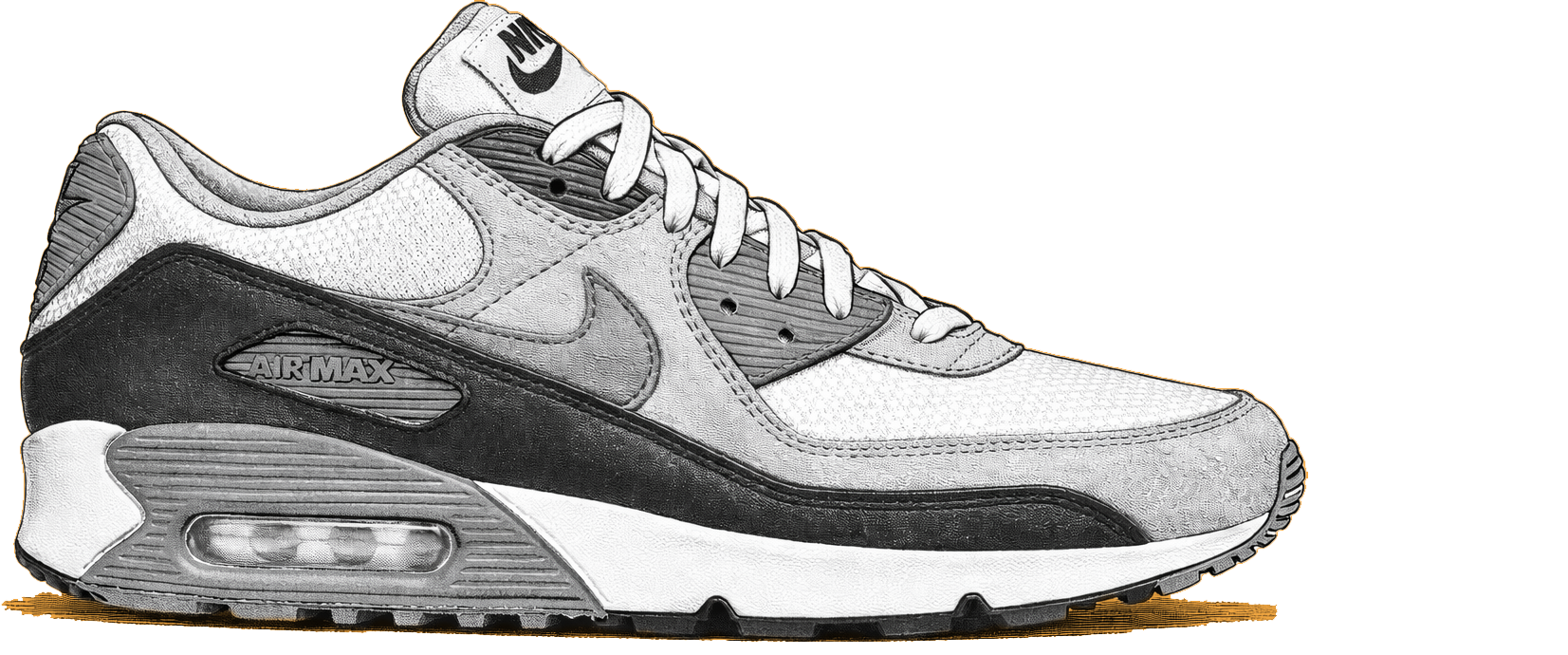
AIR MAX 90
The most important everyday shoe of the early ’90s. Boldly visible air pockets, unforgettable silhouette, huge retail presence, and a seamless crossover from running to lifestyle.
From 1990 to 1992, sneakers took a decisive step into the spotlight. Innovation became visible, design grew bolder, and culture played a bigger role in how shoes were worn and understood. Performance, style, and identity began to merge in a way that still defines the sneaker world.�