Button
The bullseye located at the center of the House.
Free Guard Zone
Stones set in front of the house that serve as defensive pieces later in the end.
House
The target that the curlers are aiming for, consisting of a 12-foot ring, 8-foot ring, 4-foot ring and the button.

After 10 ends have been played, the team with the most points wins.
Since the blue team scored in this end, the red team will get the advantage of the hammer in the next.
7
Final score

Because the blue team now has two stones closer to the button than the nearest red stone, the blue team takes two points in the end.
The blue team chooses to attempt a double takeout and succeeds.
6
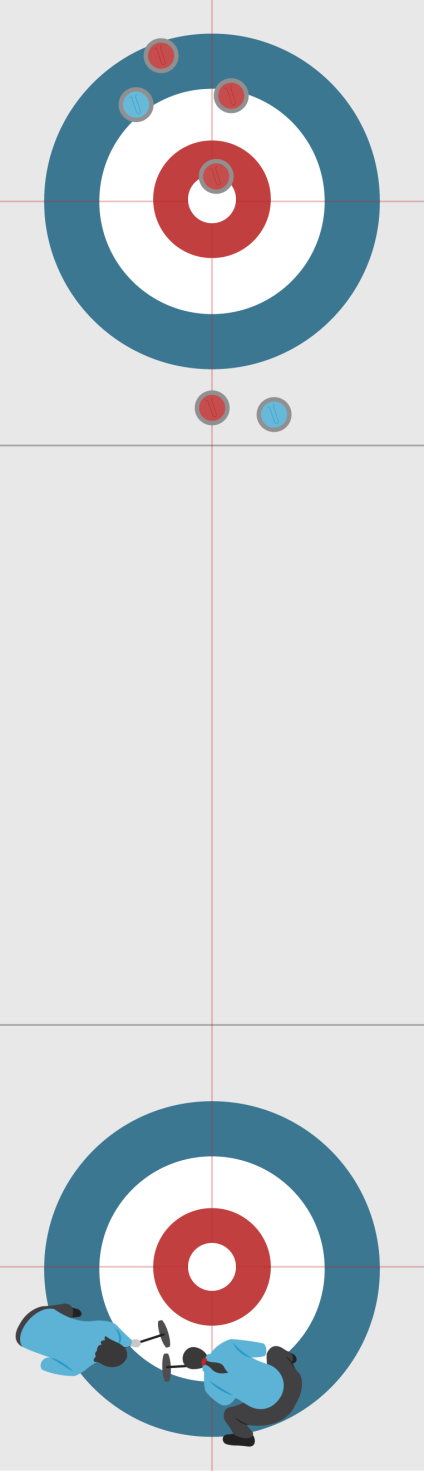
The blue team can change that by using a takeout shot to knock the red rock currently sitting on the button out of play. They could also attempt a double takeout — removing both red stones closest to the button with one shot.
The blue team can change that by using a takeout shot to knock the red rock currently sitting on the button out of play. They could also attempt a double takeout — removing both red stones closest to the button with one shot.
The red team has taken out the blue team’s scoring stone, and is currently in position to score two points, as they have two stones closer to the button than the nearest blue stone.
The team with the hammer is at an advantage to score during the end, as they get the final shot and can clear out an opponent's stone to ensure that their team ends up closest to the button.
The process of trading shots continues until only one stone is left — the hammer.
The hammer
Teammates that are brushing must be careful not to touch or move any of the stones already in play — should they touch one of their own stones, it will be removed from play or "burnt."
5

As the shot leaves the shooters hand, they’ll call out to teammates with orders to sweep more or less, depending on what the stone looks like it needs as it approaches the house.
Shooting a draw, the blue team curls around both guards that are in play to land close to the button.
Hit the button
The blue team can elect to try and place their rock as close to the button as possible and become the scoring rock of the round should it last.
It looks like the red team had a bit of a mishit, leaving the button wide open for the blue team to take a shot at.
With guards in place, both teams proceed to shoot for the house.
4

Mid-end throws
3
Setting the guard

As the shooter takes aim, a teammate stands opposite their release to help them line up their shot.
Once four stones are in play, either team can elect to employ a takeout shot on one of the guards to open up space.
The blue team is matching their guard, on the right, which will make it difficult for shots later in the end to draw in to the house from right to left unimpeded.
Here, the red team has already set a center-guard above the house.
2

If a stone in the free guard zone is knocked out of play before four stones are in play, the stone is replaced.
This allows teams to set guards in front of the house that cannot be removed until each team has thrown two stones.
At the start of an end, the “Free Guard Zone” is in play.
Opening shots
Button
Free guard zone
House
1

Hover the plus signs to learn more

The team with the most points after 10 ends wins the game.
When an end is complete, the team that is closest to the button will receive a point for every stone closer to the button than their opponents closest stone.
The goal is to finish the end closer
to the “button” or center of the
target, than your opponent.
As one player throws each stone, teammates sweep in front of the stone to smooth its path, speeding up or slowing down the stone and manipulating its curl.
During each end, each team will throw 8 stones, alternating shots as they go.
Teams compete over 10 “ends,” which can be thought of like innings in baseball.
Curling consists of 2 teams of 4
or 2 teams of 2 for mixed doubles.
The rules
7
6
5
4
3
2
1
Click to navigate through the steps

