
Carbon capture
Hydrogen
Electrification & renewables
Systemic efficiency
PSA Jurong Island Terminal expansion
Transportation of container-on-barge is a greener way to move cargo compared with trucking, as it generates about 30 per cent less carbon emissions. The terminal will be expanded by 2025 to satisfy a growth in demand for barge-sailing services from Jurong Island industries. Volumes at PSA's Jurong Island Terminal had grown 13 per cent on the year to hit a record 149,000 20-foot equivalent units of containers in 2023.


Croda x Nano Sun wastewater treatment trial
A result of the Jurong Island Innovation Challenge, where EnterpriseSG and JTC roped in startups and SMEs to develop water, energy and chemical waste solutions. The match between speciality chemicals maker Croda and Nanyang Technological University spin-off Nano Sun is progressing towards proof of value, with a trial in place. If all works out, Croda wants to take it forward and build a water treatment plant with a monthly capacity of 2,300 cubic metres and 55 per cent water recovery rate, to deliver some 1,265 cubic metres of recycled water for process use monthly.

JTC circular economy study
Stated net zero ambition
51 Jurong Island companies came together for the first time in 2019 in an attempt to optimise resource use by sharing energy, water and waste data. JTC followed up with the launch of two innovation calls in 2021 to spur collaboration between industry, academia and government to bring some ideas to fruition. The calls – the Jurong Island Innovation Challenge and Jurong Island Renewable Energy Request for Proposal – drew 45 and 39 proposals, respectively.

Shell x NEA plastics recycling study
Shell linked up with the National Environment Agency (NEA) in 2020 to study turning hard-to-recycle plastic waste into higher-value products like pyrolysis oil. Shell later invested in a pyrolysis oil upgrader unit at its Pulau Bukom cracker facility, which can process a load equivalent to the weight of about 7.8 billion plastic bags. This is to meet growing customer demand, with Shell having signed its first circular chemicals agreement in Asia with Asahi Kasei.
Hover over nodes for more information
Photo: Yen Meng Jiin, BT
Photo: Shell
Photo: Zachary Tang, BT
Photo: PSA
Carbon capture
Hydrogen
Electrification & renewables
Systemic efficiency

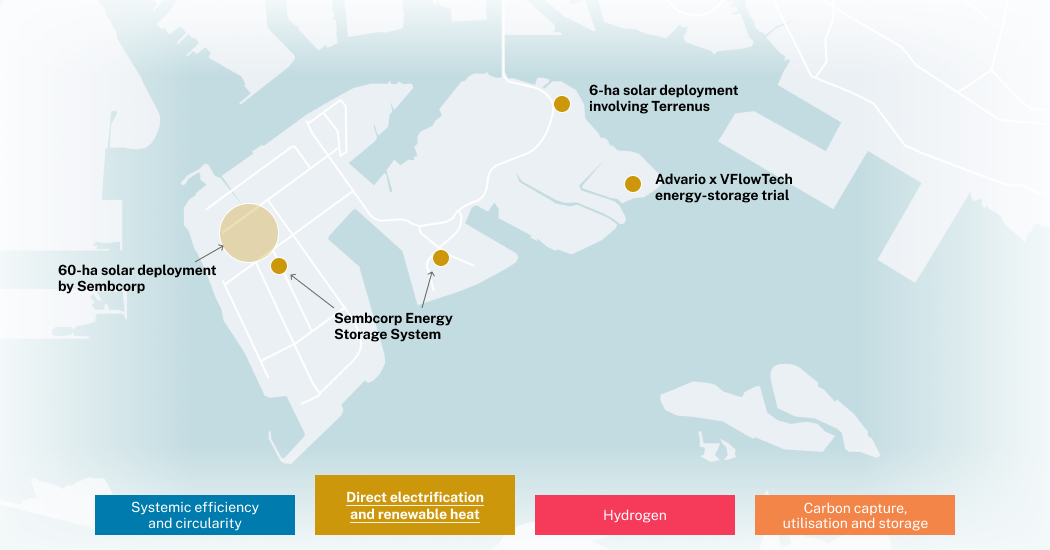
6-ha solar deployment involving Terrenus
In 2018, JTC awarded Terrenus Energy and SME Electrical a contract to set up the first grid-connected solar farm on an unoccupied 3.9-hectare site at Jurong Island. In 2020, Terrenus was awarded the extension project to deploy more solar panels, plus vertical wind turbines that can operate in Singapore’s low-wind environment, on adjacent sites totalling 2.55 hectares. The extension is set to complete in mid-2024.
Photo: JTC


60-ha solar deployment by Sembcorp
In December 2023, JTC awarded Sembcorp Solar Singapore a tender to raise Jurong Island's solar-generation capacity by six times to support solar demand from another 12 companies on the island. Only 20 companies had access to solar energy. The solar deployment, expected to be ready in 2025, will be on 60 hectares in interim vacant plots across the island, as well as the rooftops of five JTC buildings, including Jurong Rock Caverns' above-ground facilities.
Photo: JTC

Sembcorp Energy Storage System
South-east Asia's largest system of "giant batteries". The 285-megawatt-hour system – which Sembcorp was appointed by the Energy Market Authority in 2022 to build, own and operate – supports the country's growing deployment of solar energy by storing excess solar energy generated in the day to be used at times of higher electricity demand. In a single discharge, it can meet the electricity needs of around 24,000 four-room HDB households for one day.
Photo: Sembcorp

Advario x VFlowTech energy-storage trial
The first project to proceed from the 2021 Jurong Island Renewable Energy Request for Proposal. The trial will demonstrate that existing storage-tank infrastructure can be used for energy storage. The idea is to fill up some of Advario's steel storage tanks with vanadium electrolytes, which are used in redox flow batteries and can be produced by recycling industrial waste found on Jurong Island. Parties are currently obtaining authority approvals. Full deployment is aimed for end-2024. The solution, when scaled up, can shift the island's energy-storage capacity from megawatt-hour to gigawatt-hour scale.
Photo: VFlowTech

Carbon capture
Hydrogen
Electrification & renewables
Systemic efficiency

Hydrogen-ready cogeneration plants
Three power-generation players are paving the way for renewable integration by developing hydrogen-ready power plants. Keppel's S$750 million plant is scheduled for completion in the first half of 2026, while Sembcorp Industries' – to be located at its upcoming S$900 million multi-utilities centre – is expected to be operational by 2026. YTL PowerSeraya's S$800 million build is expected to be commissioned by end-2027. Each plant will host a 600-megawatt capacity.
Photo: YTL PowerSeraya
Carbon capture
Hydrogen
Electrification & renewables
Systemic efficiency

Carbon capture and utilisation translational test bed
Testing emerging low-carbon technologies can be a lengthy and costly process. A*Star is working with public and private partners to create a facility that will allow companies to pilot and scale emerging CCU technologies more efficiently and cost-effectively by tapping plug-and-play, modular reactor-catalyst set-ups. Companies present during the public-private partnership's MOU signing in 2021 include Chevron Singapore, Evonik (SEA), ExxonMobil, Keppel Infrastructure, Pan United Corporation, and Surbana Jurong.
Photo: A*Star

Catalysts for CO2 upcycling
Researchers support the conversion of CO2 into useful chemicals and fuels by using machine learning to speed up the development of new catalysts. This comes under A*Star's Accelerated Catalyst Development Platform.
Photo: A*STAR

Creating new materials with captured CO2
By combining captured CO2 with various materials, such as incineration ash, construction waste and natural minerals, A*Star researchers were able to create a new type of sand that can potentially be used for land reclamation, building footpaths, and constructing coastal protection solutions such as sea walls to guard against rising sea levels. The solution can, in turn, cut the waste residue sent to Semakau Landfill.
Photo: A*Star

Electrification & renewables
Electrify low-to-medium temperature and pressure processes
Generate low-cost, renewable electricity and heat onsite (e.g. rooftop solar)
Pursue shared infrastructure (e.g. microgrid, storage)
Parties involved�PSA, JTC
Parties involved�Croda, Nanosun, JTC, EnterpriseSG
Parties involved�JTC, various companies including Chevron, ExxonMobil and Shell
Parties involved�Shell, NEA
Systemic efficiency
Increase circularity through cross-entity waste utilisation
Integrate processes to share energy and material streams
Provide cost-effective systems benefits outside the cluster
Parties involved�Terrenus Energy, SME Electrical, JTC
Parties involved�Sembcorp Solar Singapore, JTC
Parties involved�Sembcorp Industries, EMA
Parties involved�Advario Singapore Chemicals, VFlowTech, EMA and JTC, with support from EnterpriseSG


Carbon capture
Capture carbon dioxide (CO2) from energy and hydrogen production
Use captured carbon for industrial and manufacturing processes
Store carbon underground where feasible

Cross-border carbon capture and storage project
ExxonMobil and Shell are working with the Singapore government as lead developers for the project capable of capturing and permanently storing at least 2.5 million tonnes of CO2 a year by 2030. Called S-Hub, the project plans to store emissions from Singapore deep underground or under the seabed. This was after ExxonMobil said in 2021 that it was planning a CCS hub concept in Singapore to capture, transport and store CO2 generated in the Asia-Pacific.
Photo: Yen Meng Jiin, BT
Parties involved�ExxonMobil, Shell, EDB, Singapore government
Parties involved�A*Star, EDB, JTC, with various companies
Parties involved�A*Star
Parties involved�A*Star

Parties involved�Sumitomo Chemical, EDB
Sumitomo Chemical's CO2 utilisation test
In December 2020, the major Japanese company said the Economic Development Board was supporting an initiative at its petrochemical complex on the island that explores using CO2 and hydrogen by-products from propane dehydrogenation – a process that produces propylene, a raw material for synthetic resins – to make methanol, a chemical building block for many everyday products.
Photo: Sumitomo Chemical

Parties involved�Chevron Singapore, Keppel, Pan-United Corporation, Surbana Jurong, Air Liquide Singapore, Osaka Gas Singapore, Pavilion Energy
Low Carbon Technology Industry Consortium
In January, Chevron Singapore, Keppel, Pan-United Corporation, Surbana Jurong, Air Liquide Singapore, Osaka Gas Singapore, and Pavilion Energy signed an MOU to accelerate the development of cost-effective CCUS solutions. Parties are now exploring opportunities around CO2 mineralisation for use within the build and construction sector. This is an extension of a previous MOU signed in July 2020 (pictured), which led to a few partnerships, including the one involving Chevron and Surbana Jurong where novel hollow-fibre membranes were developed for CO2 capture.
Photo: Surbana Jurong

Parties involved�Chevron Singapore, Mitsui OSK Lines
Chevron x Mitsui OSK Lines study
In November 2022, Chevron unit Chevron New Energies International and Mitsui OSK Lines agreed to jointly study the feasibility of transporting liquefied CO2 from Singapore to permanent storage locations offshore in Australia. Chris Powers, the vice-president for CCUS at Chevron New Energies, said the agreement was expected to advance the technical and commercial foundations for a regional approach to CCUS.
Photo: Chevron
Hydrogen
Produce low-to-zero-carbon hydrogen by cracking ammonia or other carriers
Use hydrogen as an alternative fuel for hard-to-electrify industrial processes
Parties involved�YTL PowerSeraya, Keppel, Sembcorp, EMA

Parties involved�EMA, Maritime Port Authority of Singapore
Low- or zero-carbon ammonia solution
A lead developer will be selected among six consortiums to provide a low- or zero-carbon ammonia solution for power generation and bunkering on Jurong Island. The project will position Singapore as one of the first countries to test and deploy a direct ammonia combustion power plant, as well as support the assessment of ammonia bunkering for both international shipping and domestic harbour craft.
Photo: Zachary Tang, BT

Parties involved�A*Star, Ministry of Trade and Industry
R&D under the National Hydrogen Strategy
S$129 million is set aside under phase two of Singapore's Low-Carbon Energy Research programme. According to the Agency for Science, Technology and Research, projects under this phase are looking into:
Ammonia cracking: Developing a more efficient catalyst and reactor system to get hydrogen from ammonia with better heat utilisation and energy efficiency.
Coatings: Hydrogen gas will embrittle steel pipelines. The research will support the development of new surfaces for hydrogen transport and storage applications.
Photo: A*Star

Parties involved�Vopak, Air Liquide
Vopak x Air Liquide ammonia cracking study
French industrial gases company Air Liquide, which is building an industrial-scale ammonia cracking pilot plant in Belgium, is looking to apply its expertise to crack ammonia in Singapore as well. It has signed a memorandum of understanding with storage operator Vopak, which owns and operates Singapore's only ammonia tank, to explore the development of low-carbon ammonia supply chains in Singapore.
Photo: Zachary Tang, BT

Parties involved�Linde, Evonik
Linde x Evonik green hydrogen supply agreement
Industrial gas supplier Linde last year said it would build, own and operate a nine-megawatt alkaline electrolyser plant on Jurong Island to produce green hydrogen as part of a long-term supply deal with German chemicals firm Evonik, which wants to use it to manufacture methionine, a key component in animal feed. The new plant, to be ready by 2024, will be the largest electrolyser ever installed in Singapore.
Photo: Linde
Cracking the code
The World Economic Forum has a playbook for industrial clusters working on decarbonising. The Business Times rounds up the major initiatives on Jurong Island to see how far along Singapore is on each of the four identified pathways.


