The ‘BBC’ system
BT Explains
The Singapore dollar is managed against an undisclosed basket of currencies of Singapore’s main trading partners and competitors, weighted based on the city state’s trade exposure to each currency. This is more relevant to managing general price levels in Singapore – where goods and services bought and sold are priced in a variety of currencies – than pegging the Singapore dollar to a single currency.
�
The basket of bilateral exchange rates is combined into an index, known as the Singapore dollar nominal exchange rate (S$NEER).
This trade-weighted Singapore dollar is allowed to float within an undisclosed policy band, rather than kept to a fixed value. The band absorbs short-term market volatility and provides flexibility.
The band is reviewed four times a year to ensure that the Singapore dollar is aligned with underlying economic fundamentals. By adjusting the slope, width and level of the band, MAS allows the currency to ‘crawl’ higher or lower, rather than forcing it to move sharply. Businesses, institutions and traders can buy or sell the Singapore dollar to pay for goods and services, hedge against future movements, or trade in forex markets.



Adjusting the S$NEER band
MAS assesses the balance of risks to Singapore’s growth and inflation, particularly core inflation. Every January, April, July and October, it can decide to change none, or one or more of these policy levers. The central bank raised the frequency of its meetings this year, up from the previous twice-a-year scheduled decisions in April and October.
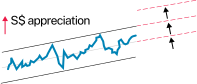
The slope of the policy band determines the pace of appreciation
Usually adjusted when MAS thinks that there is a change in the medium-term outlook
Off-cycle move in April 2022: slope increased slightly
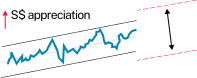
The width of the policy band determines how volatile movements can be
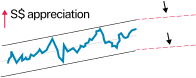
The level of the policy band reflects underlying economic fundamentals
Usually adjusted when there is higher volatility in international financial markets (such as fears that Greece would exit the eurozone in 2010)
In April 2012, for example: restored narrower band after October 2010 widening
Usually adjusted when the expected path of economic activity abruptly shifts the prevailing level of S$NEER
In October 2022, for example: policy band was shifted up to align midpoint with prevailing level of S$NEER
How the exchange rate affects inflation
Directly: tempers imported foreign inflation
Foreign prices of imports, such as food, apparel and raw materials, can push consumer price inflation higher. With a stronger S$NEER, the foreign prices of imports convert into lower Singapore prices.
Stronger S$Neer
Lower import prices
Lower inflation
Indirectly: tempers demand for Singapore’s exports
A stronger Singapore dollar makes exports less competitive, and export demand could�fall. Lower demand for inputs such as manpower and capital leads to lower pressure on costs to rise, thus tempering inflation.
Stronger S$Neer
Lower cost pressures
Lower demand for exports
Lower demand for inputs from Singapore firms
Lower inflation
Slower feed-through to prices
Singapore’s monetary policy settings were last changed in October 2022, when the midpoint of the S$NEER was re-centred upward to the prevailing level then, with no changes to the band’s slope or width. It was the last of five consecutive tightening moves.
Previous changes included a slight increase in the slope at October 2021’s scheduled meeting; a then-off-cycle slope increase in January 2022; a slight slope increase and an upward re-centring in the scheduled April 2022 policy review; and an off-cycle re-centring of the S$NEER’s midpoint upward, in July 2022.
BTVISUAL: C MARTIN