The Cambridge Dictionary
Word of the Year 2021 is…
19 February saw the highest volume of searches for perseverance on a single day, with 8,771 lookups.


perseverance
noun [ U ] approving
UK
/ˌpɜː.sɪˈvɪə.rᵊns/
US
continued effort to do or achieve something, even when this is difficult or takes a long time.
Cambridge Dictionary is the top dictionary website and grammar resource for learners of English in the world. A large number of keen learners used the dictionary to discover the meaning of the word perseverance in relation to the celebrated NASA mission.
Perseverance was chosen as Word of the Year not only because of the high volume of searches. This word captures the undaunted will of people across the world to never give up, despite the many challenges of 2021.
The word perseverance saw a high number of searches on Cambridge Dictionary throughout 2021, with more than 243,000 views so far this year.
The greatest peak in searches occurred during the week of 18–24 February, after NASA's Perseverance rover made its final descent to Mars.


Why perseverance?
What does the data show?
= page views

Click to
see more

6,000
= page views
4,000

2,000
In February there were 48,718 lookups in total for perseverance.
The largest spike in searches, with 30,487 lookups, was seen in the week of 18–24 Feb, after NASA's Perseverance rover made its final descent to Mars.
Before this year, perseverance hadn't appeared noticeably in search data on the Cambridge Dictionary website. That changed with the spike in searches for perseverance in February 2021.
It wasn’t just that single spike in lookups that prompted the Cambridge Dictionary team to choose perseverance as the Word of the Year. Over the following months, perseverance was looked up more frequently on the Cambridge Dictionary website than in previous years – a fact that resonated with the team.
What does it say about 2021?
“It suggested that the word perseverance was being encountered more frequently by Cambridge Dictionary users in 2021. Just as it takes perseverance to land a rover on Mars, it takes perseverance to face the challenges and disruption to our lives from Covid-19, climate disasters, political instability and conflict. We appreciated that connection, and we think Cambridge Dictionary fans do, too.”
Wendalyn Nichols, Cambridge Dictionary
We spoke to a few celebrities who wanted to share their thoughts about
our Word of the Year, and how they have persevered in 2021.
How people have persevered in
2021…


Watch the full video
Take a deeper look at how
perseverance is being used
Find out more
To see how perseverance is being used, we looked at a multi-billion-word collection of written and spoken language. Our team analyzed recent conversations, news, blogs, social media, and websites from around the world exploring what speakers and writers mean by perseverance, and in what contexts this word is typically used.

Expand your vocabulary and test yourself with our Words about being determined word list, specially created by the team at Cambridge Dictionary. You can find this word list and many more by signing up for free to Cambridge Dictionary +Plus.
Our Word of the Year word list
Learn more
As well as definitions, the Cambridge Dictionary shows how words are used in real-world contexts. Our blog, About Words, is written by language usage experts to help learners gain confidence in using vocabulary related to specific topics. How have you shown perseverance this year? Read our Word of the Year blog post and share your thoughts in the comments.
Learn about words on our blog
Read more
Check out the last six Cambridge Dictionary Words of the Year. How did they reflect what you were thinking about in those years?
Previous Words of the Year
2019 – upcycling
2018 – nomophobia
2017 – populism
2016 – paranoid
2015 – austerity
Even if we’re expert speakers of English, the way in which language is used isn’t always an easy thing to describe or explain. Language is nuanced and changeable, and varies from person to person. Often, word patterns and associations aren’t things we can easily pick out or describe just by reading newspaper articles or by scrolling through tweets. This is especially true with new words and meanings. So, to find out more about how words behave, we look at big collections of them – this is called a corpus.
Take a deeper look at how
quarantine is being used
Find out more
2020 – quarantine
/ˌpɝː.səˈvɪr.ᵊns/
•
If you want to learn about synonyms of perseverance, you can look it up in the Cambridge Thesaurus. There you'll find explanations of the differences in meaning between perseverance, determination, persistence, doggedness, single-mindedness, tenacity, resolve, will, and the US term stick-to-it-iveness. We also have a Cambridge Thesaurus article full of words that you can use to describe a person who shows perseverance, including persevering, determined and dogged.
Synonyms of perseverance
Explore the Cambridge Thesaurus


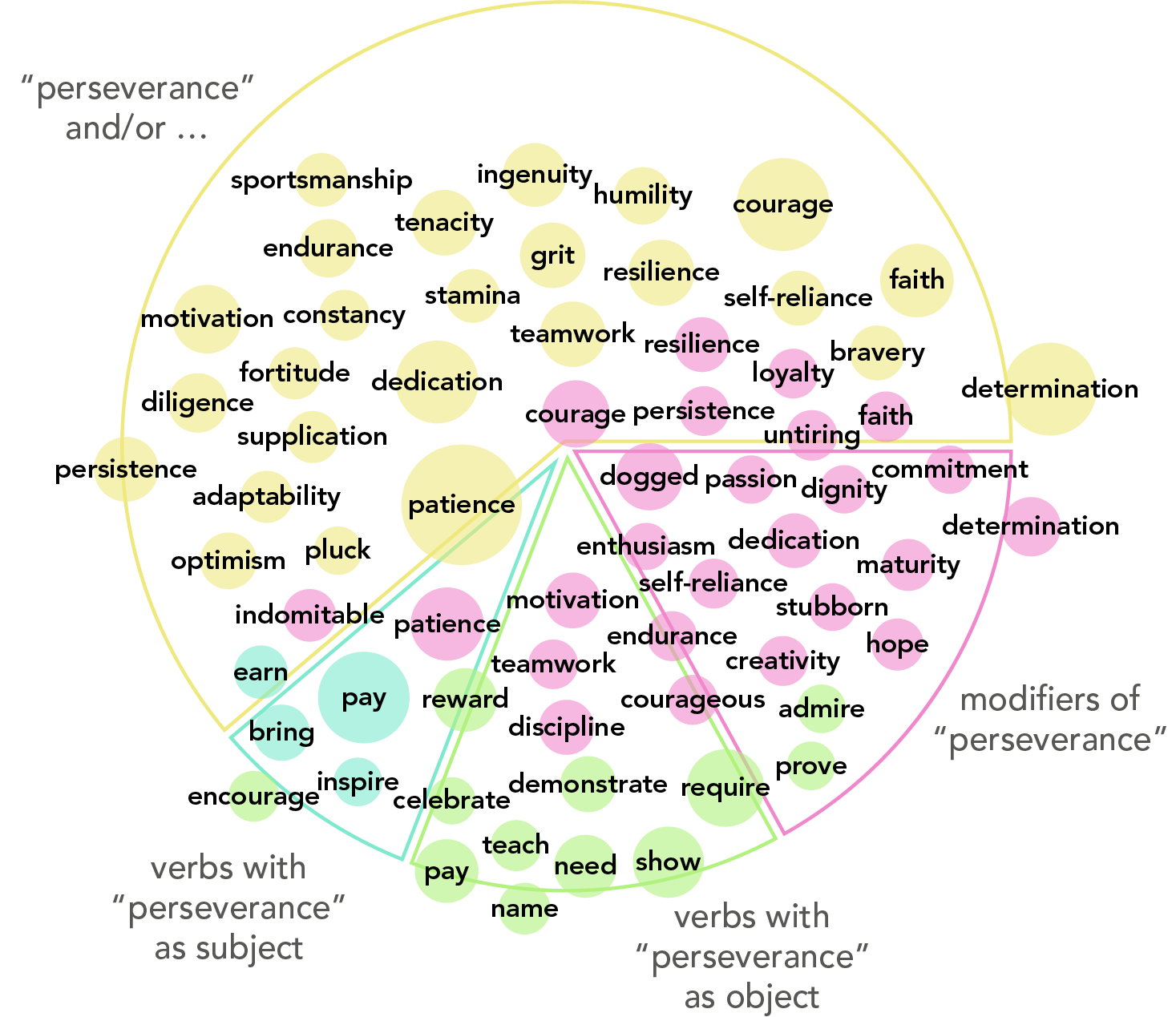
Looking at the words that people frequently use in combination with perseverance can tell us more about what the word means – and what it doesn’t mean. We can see that people perceive a difference between perseverance and either persistence or determination because they list these qualities separately when they write and speak. And the large number of words for other qualities on the map tells us that, while perseverance is seen as a strength, challenges that are met with perseverence often require other qualities too. With the map as our starting point, we analyzed the contexts of the words that occur with perseverance to tell us more.
What does it take to show perseverance?
This diagram is a map of how perseverance is used with other words. Each sector shows the grammatical contexts these words are found in, so we can see from the largest sector the most common pattern is the use of and to join perseverance with another word, and we can see that patience and perseverance is the most frequent combination. The size of the bubbles indicates how common the word is in the corpus, and the distance from the center shows how typical it is of perseverance that this word occurs with it. For example, determination is about as common as courage, but it is used with perseverance less often. We can see that the adjective used most frequently is dogged (which means ‘without giving up’), in sentences like Theirs is a story not just of survival but of dogged perseverance.
What did we find?
Take a deeper look at how perseverance is being used
Perseverance is used to refer to situations where people have achieved something over a long time or despite difficulties, and they did this by putting in an effort which others may find admirable. We often see this word used in lists or in combinations alongside other words for virtuous qualities, such as inspiration and courage. We find many examples of sentences like If it wasn’t for your hard work, dedication, resilience, courage, perseverance and sheer toughness, you might never have made it. Interestingly, perseverance often appears in lists like this of other qualities, and it frequently comes after the word resilience.
Words occurring with perseverance
So, the fact that stamina, endurance, grit, and courage are frequently mentioned along with perseverance tells us that physical strength is often considered to be important in facing challenges, which in turn suggests that the quality of perseverance is seen as primarily being about mental strength.
Mental versus physical strength
Back to previous page
less about the goal than about the ongoing effort, or the quality of being someone who makes this effort
Perseverance does not quite connote an epic struggle of life and death, good and evil, but it is an important tool in a hero’s belt.
The patience and self-reliance it requires perhaps depend, more than anything, on optimism.
Back to previous page
Even if we’re expert speakers of English, the way in which language is used isn’t always an easy thing to describe or explain. Language is changeable and varies from person to person. Often, word patterns and associations aren’t things we can easily pick out or describe just by reading newspaper articles or by scrolling through our tweets. So, to find out more about how words behave, we look at huge structured collections of them – this is called a corpus.
How do we investigate how words are used?
Words occurring with perseverance.
Modifiers include adjectives directly before the noun, as in stubborn perseverance, and nouns that are used before perseverance in a list preceded by only a comma, such as dignity, perseverance, and . . . overlap in circles across sections is due to the limitations of the graph size, so in order for the bubbles to accurately display frequency of use with perseverance, words that belong to a given pattern are shown in pink, green, blue, or yellow.
Some words appear more than once on the map above. This happens when a word occurs very frequently with perseverance in two patterns, either in a phrase with and (such as motivation and perseverance) or directly before it in a list (such as dignity, motivation, perseverance, . . .). So although the bubbles for motivation aren’t as big as some, the fact that it has two bubbles is meaningful. And we can see correlations between this word and others that appear on the map: when perseverance is used with a term like motivation, other positive terms such as passion, optimism and enthusiasm tend to share a similar context. A deeper look at positive contexts shows that the persevering person may be considered a hero or to have heroic features, such as being fearless, brave and unfazed.
However, the data also shows that besides courageous, there are only five adjectives used directly before perseverance that are frequent enough to be significant, and they tell a more mixed story of admiration and criticism: courageous, indomitable (‘not able to be defeated’) and untiring on the one hand, but dogged and stubborn on the other. Dogged acknowledges great effort without praising it, and stubborn suggests an unreasonable refusal to stop. Still, the overwhelming majority of the time, perseverance occurs in positive contexts.
A (mostly) positive picture
Context is key
Analyzing the corpus helps our Cambridge Dictionary editors identify what makes the meaning and usage of a word unique. A defining characteristic of perseverance is that it refers to effort that is sustained over a long time, and we can see this expressed in the language data with phrases of duration, such as I persevered with it for years. What do we persevere against? Obstacles, the odds, and particularly adversity – in the common phrase perseverance in the face of adversity (another idiomatic use of a term for a body part). What do we persevere through? Usually, very negative situations – as in The town of Mackenzie has persevered through epidemics, wars and two great fires. And when do we persevere until? Until the enemy is defeated. Inspirational phrases of promise like won’t stop until and never give up are commonly used in the same context as perseverance.
One way that our editors can distinguish the meanings of words that are very similar, such as the verb persevere versus the verb persist, is to look at the focus of the word: is it on the person, or on the problem? The diagram below shows words associated with persevere on the left and ones associated with persist on the right. We can see that persevere is associated with positive outcomes from people’s actions (succeed, overcome) while persist is used about the negative situations themselves (worsen, recur, intensify).
“If at first you don’t succeed,” the saying goes, “try, try again,” but perseverance and persevere are most often used to comment on someone’s effort after they have succeeded, as in I’m glad I persevered. If an effort fails, verbs other than persevered are used to characterize the attempt, such as tried or fought: We fought really hard but couldn’t quite make it. When perseverance is used about an ongoing effort, it’s assumed that the outcome will ultimately be worthwhile: I admire his perseverance.
A happy ending
An interesting word we can compare is determination. Though its meaning is very similar to that of perseverance – both words refer to continuing to do something although it is difficult – its context shows some key differences. One clue is in the fact that determination has more meanings than perseverance, one of which is ‘the process of controlling, influencing, or deciding something’, as in such phrases as the determination of prices. This sense of the ability to decide something carries over into the use of determination for situations when someone has made a decision to keep trying to achieve a goal even though they may face difficulties. So, unlike perseverance, which focuses on the continued effort and personal quality of being someone who perseveres, determination is more about ability, and is more often directed at a goal that may have an end.
Determination is also used more often with possessive adjectives and plural subjects, and can be completed by an infinitive, so that a sentence like We are united in our determination to win this war is completely grammatical, but perseverance would not make sense in that sentence. And while the word map of determination overlaps with that of perseverence, it also has marked differences, including the frequent use of the adjectives sheer, steely, and unwavering with determination, along with statements that someone’s determination never wavered. All but sheer are quite rarely used words, other than in specific circumstances.

In conclusion


characterized by mental strength
used in contexts that are overwhelmingly positive, with lists of other admirable qualities
From our analysis of Cambridge corpus data, we know that it is:
For example, we looked at the use of perseverance with stamina and endurance. Stamina is the strength that it takes to do something that is hard or takes a long time, and endurance is required when that thing is especially difficult or takes even longer – or is unpleasant or painful. Both words occur more frequently in reference to physical strength than to mental strength; could this be significant? Additional clues were found by looking at the contexts that perseverance shares with words like grit and courage, to see what other words occur commonly in those contexts. In this case, we found a connection to physical strength in the occurrence of several synonyms for grit and courage which come from terms for parts of the body, e.g.:
guts
heart
neck
cheek
gall
nerve
backbone

So... What do we know about the word perseverance?