Select a hotspot to view product details
Objective insights for clinicians, parents and caregivers


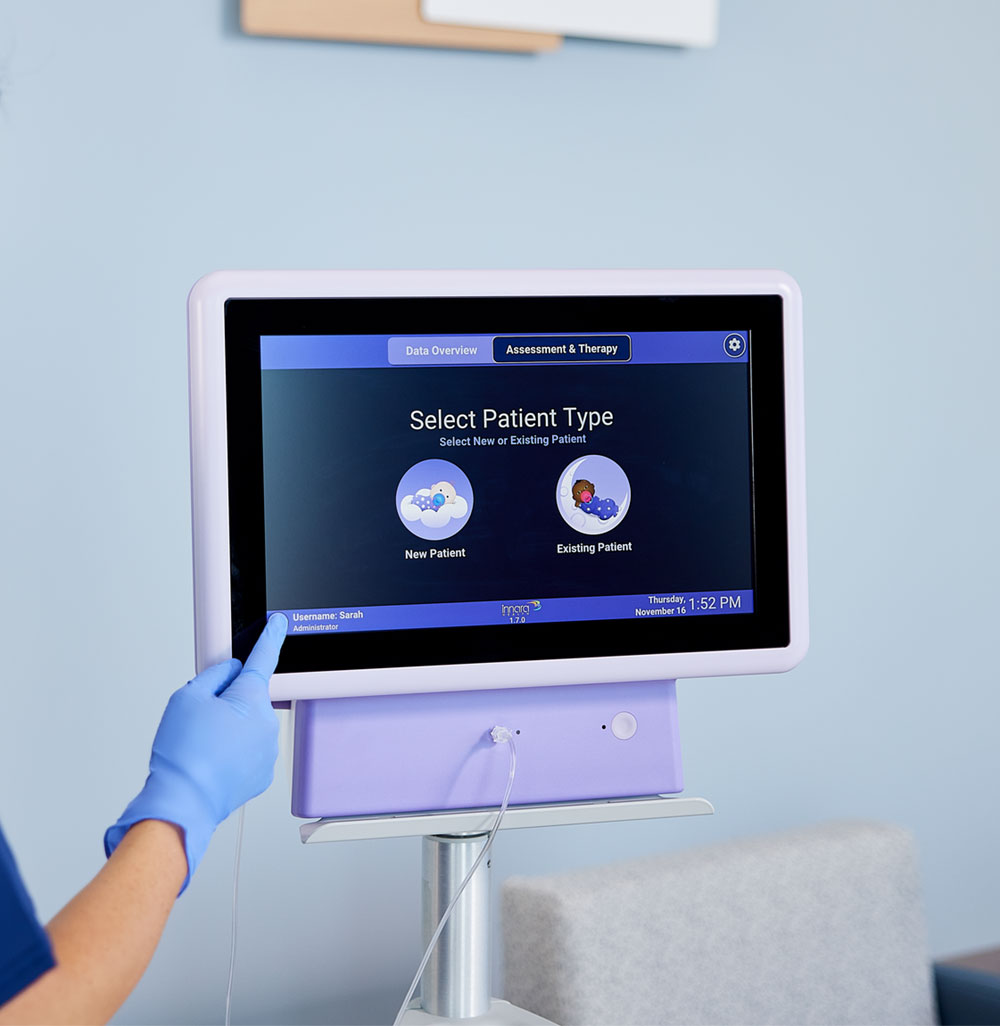
Touch screen monitor
Intuitive interface makes it simple to deliver and record a therapy session or assessment, monitor oral motor activity in real time and access historical data from up to 3,000 treatment sessions and 1,500 assessment sessions.
Necessary for the safe transition from tube feeding to independent oral feeding
The importance of non-nutritive sucking skills
Pacifier-enabled handset
The pacifier-enabled handset is used to provide oral stimulation and objectively capture full oral motor non-nutritive suck skill data. The handpiece pairs to the monitor via radio frequency technology. Approved pacifiers include:
• Philips NICU Soothie Pacifier, notched,
natural scent
• Philips Soothie Pacifier, natural scent
• Philips Wee Soothie Pacifier, notched,
natural scent
Proven pulse therapy
NTrainer™ Therapy trains and strengthens an infant’s non-nutritive suck skills. The pacifier-enabled handset provides consistent oral stimulation through a proven pulse pattern designed to mimic healthy non-nutritive suck patterns.
Real-time waveforms
Assessment waveforms on the monitor provide a real-time, visual representation of the infant’s full oral motor activity. Peaks in the waveform indicate sucking bursts, while the pauses represent their breaths.
Clinicians can record and analyze the waveforms to gain a better understanding of a baby’s progress toward readiness for full oral feeds.
Babies born prematurely need considerable support to develop the complex skill of non-nutritive sucking, which is the basic act of sucking without receiving nutrients. Non-nutritive sucking is:

A fundamental pre-feeding skill often underdeveloped
in preterm infants

A key milestone needed before being discharged from the NICU

An essential precursor to independent oral feeding

Demonstrated through the coordination of sucking, swallowing and breathing

The NTrainer™ System 2.0 helps clinicians deliver consistent, confident care by helping them to better understand a baby’s non-nutritive sucking skills and more quickly recognize the baby’s readiness to transition to breast or bottle feedings. Clinicians can provide bedside education to parents and caregivers on feeding positions, oral feeding cues, oral feeding readiness and developmental progress.
4