

Tips, tools and inspiration for effective campaigns
inspire
In partnership with Messenger Business by Facebook

ost multiscreening on TVs, laptops, tablets and smartphones occurs between 7pm and 9pm and coincides with the primetime TV viewing slot when people will split their attention between social media and the television.
M

He cites research by the Ehrenberg-Bass Institute for Marketing Science at the University of South Australia, which discovered that during a 30-second ad 50% of the effectiveness was delivered in the first five seconds. There is therefore little difference between a 15-second or a seven-second commercial when it comes to grabbing viewer attention.
“Brands must stop linking duration with effectiveness and instead have a strategy and be clear on the outcomes they want when media planning,” he says.
Buckley believes advertising is the most effective when it is easy to process; he wants all advertisers to follow the example of digitally native brands and test their creatives again and again.
This includes using more scientific testing to segment users who are multiscreening.
Advertising and messaging can still work quickly if positive brand associations are established, says Buckley. He suggests using randomised control tests to measure incremental change so that brand and business outcomes around sales and innovation are achieved.
The UK managing director of online dating website eHarmony, Romain Bertrand, agrees that as multiscreening increases, more accurate segmentation is crucial.
“You need to segment not just around age but also around personality and geography to ensure the creative and messaging is right,” he says. “Brands must also not lose sight of the benefits that multiscreening brings if you do have a strategy. It allows consumers to do some research or make a purchase in a different way.”
Grabbing consumers’ attention is harder than ever for brands that find themselves chasing their target audience across a multitude of screens at different times of the day.
How brands can thrive despite the squeeze on consumers’ attention
12 February 2019
The time people spend looking at social media apps on mobile while doing other things is increasing significantly, with Facebook and Instagram adding 10 million users since 2014.
Data from IPA Touchpoints confirms that 18-34s are the most likely group to switch between screens and, with consumer attention so fragile, advertisers need to know which screen someone is looking at and when.
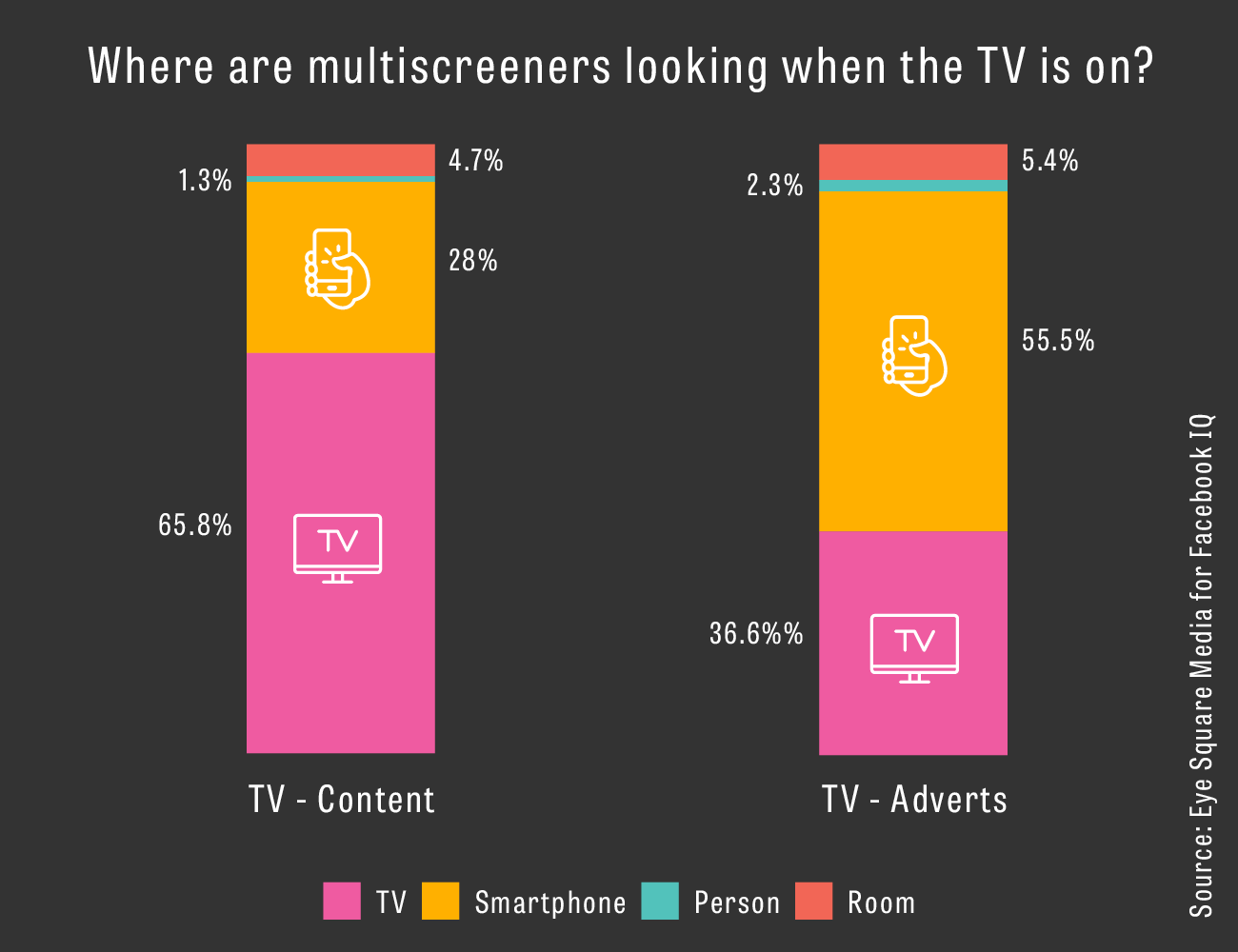
According to an eye-tracking study carried out by Eye Square Media for Facebook IQ, when a programme is being broadcast people are looking at the TV screen 65.8% of the time, but this slips to 36.6% when the commercials appear. Viewers will look at their mobile 28% of the time during the content but 55.5% during the TV ads.
“There are challenges for brands because, whatever the media channel, advertisers are only getting a few seconds of attention,” says Facebook comms planner Pete Buckley.

multitasking: doublescreening has become the norm when watching tv

Bertrand believes there are still opportunities for long, informative content even though people are using a second or third screen.
“At eHarmony we have created a breadth of content and creative ideas to tell our story in longer form to target specific consumers,” he says. “We use London Underground advertising where dwell time is a few minutes and have a 45-minute Facebook Live show.”
Independent marketing consultant Ryan Davis is a former head of CRM and loyalty
at Marks & Spencer and head of CRM, loyalty and insight at Mothercare. He says under-pressure retail brands can still grab consumers’ attention if the advertising and messaging is personally relevant and credible.
“Data can be used effectively to reach the right people quickly with advertising and to improve the shopping experience,” he says. “This could mean ensuring the products they want are on display or, if ordered online, can be delivered quickly.”
Davis adds that when attention is under pressure building brand awareness must be a priority. “Consumers will pay attention to the brands they know, trust, recognise, can afford or that they have heard someone else say positive things about.” ■
Facebook comms planner PETE Buckley addresses the shifts in consumers' attention
“Brands must stop linking duration with effectiveness and instead focus purely on the business and brand outcomes they want to achieve when media planning”

– Pete Buckley, Facebook