BNY Mellon Long-Term Global Equity Fund
Investors want it all. High returns are no longer the only priority, these days it’s also the environmental and societal impact they care about. And why wouldn’t they? Climate change and social inequalities are not going away, and it’s high time to take action, for example with the Responsible Horizons Euro Corporate Bond Fund. The strategy focuses on the top ESG performers and enables investors to get the best of both worlds: meaningful returns while investing responsibly.
FUND FACTS What’s the strategy about?
Bio
menu
Lutz Engberding Portfolio Manager, Responsible Horizons Euro Corporate Bond Fund
INVESTMENT PROCESS ESG is front and centre
Standout characteristics What sets the strategy apart?
Why BNY Mellon Investment Management What does BNY Mellon Investment management bring to the table?
Meet the manager
FUND FACTS INVESTMENT PROCESS Standout characteristics Why BNY Mellon Investment Management X
Contact our sales team
Responsible Horizons Euro Corporate Bond Fund
Terms & Conditions
Ian Smith Portfolio manager, Equity Opportunities team
Ian Smith Portfolio manager, Equity Opportunities team Ian is a member of Newton’s equity opportunities team. Ian joined Newton in October 2020 to manage global emerging markets portfolios. Prior to joining Newton, Ian was a global emerging market equity portfolio manager at AXA Investment Managers, where he had worked since February 2012. Prior to joining AXA Investment Managers, Ian was a research analyst covering Asian financials at Matrix Group. Before joining Matrix Group, Ian was a research analyst covering emerging market financials at Nevsky Capital. Ian has a BA in Economics and Politics from Durham University and gained ACA qualification in 2003. Outside of work, Ian enjoys travelling with family and friends. Joined Newton: 2020 Joined industry: 2000
Lutz joined Insight in 2011. He worked as a Fixed Income Product Specialist before joining the European Fixed Income Team in February 2017. Lutz began his career in 2008 as an analyst at Merrill Lynch working in the fixed income department. He holds an MA in Economics from Homerton College, Cambridge and is a CFA charterholder. CFA® and Chartered Financial Analyst® are registered trademarks owned by CFA Institute.
Managed by Insight Investment and brought to you by BNY Mellon Investment Management
Learn more about the fund
Past performance is based upon a simulated track record combining the performance of the Insight Sustainable Euro Corporate Bond Fund W shareclass up to 27 March 2021 and the Responsible Horizons Euro Corporate Bond Fund W shareclass thereafter. In March 2021, the Insight Sustainable Euro Corporate Bond Fund merged into the Responsible Horizons Euro Corporate Bond Fund.
Simulated performance results do not represent actual returns and are not a reliable indicator of future performance.
Brand Logo
Back
The Responsible Horizons Euro Corporate Bond Fund primarily invests in euro-denominated investment grade corporate bonds while also taking environmental, social and governance factors into account. To generate an attractive level of return, the strategy focuses on companies with good ESG scores and structurally allocates to positive impact issuers and instruments.
Fund Facts
What’s the strategy about?
Please note that the W EUR Acc share class is not registered in Portugal. The registered share class in these regions is the A Eur Acc. The A Eur Acc. currently has less than one years’ worth of performance track record.
2
back
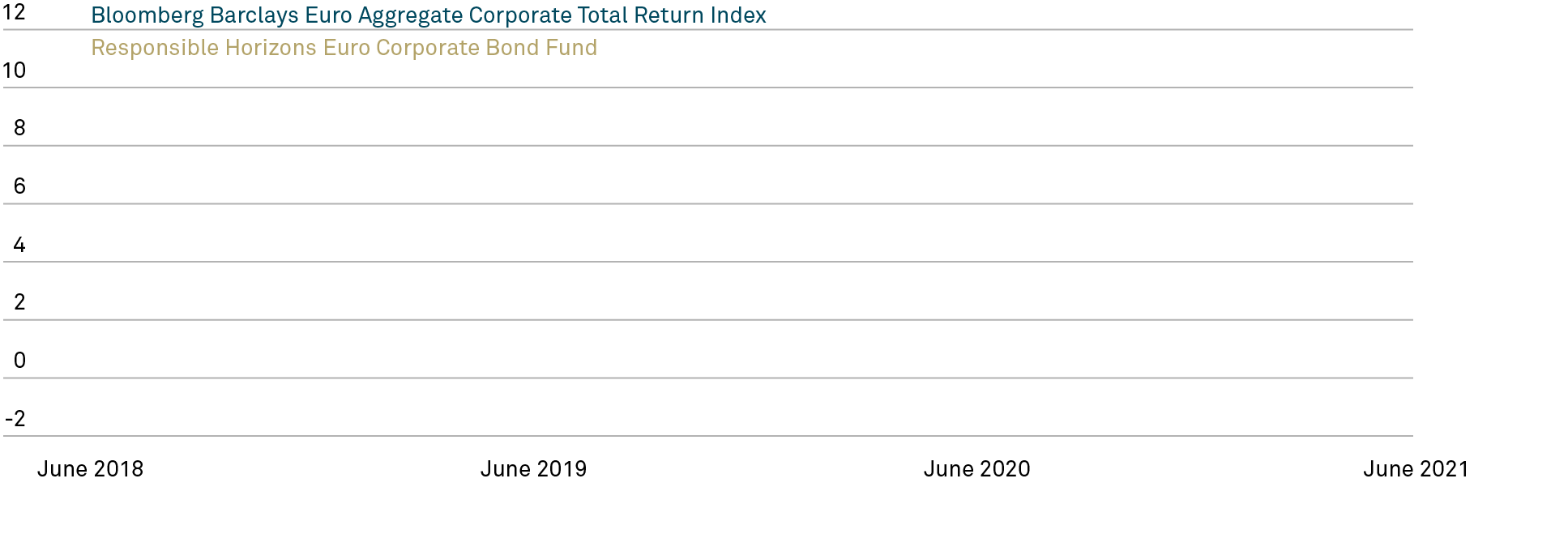
The fund is managed by Insight Investment (Insight), a specialist manager of active fixed income and a founding signatory to the UN’s Principles for Responsible Investment (PRI). As one of the world’s largest global asset management companies, Insight runs more than €830bn in AUM and has offices on four continents . Portfolio manager Lutz Engberding builds on Insight’s investment research and ESG analysis, coupled with ESG ratings from Prime, the firm’s proprietary model, to identify attractive opportunities in the fixed income space. ‘Many investors are looking for strategies that target both financial and sustainable objectives. At Insight, we always believed that combining active management with an ESG focus is the best way to outperform a conventional benchmark. Our approach also enables us to focus on better, more sustainable companies that can make a positive impact on people and the planet,’ Engberding said. The fund has been top quartile since it formally adopted an ESG strategy in 2017. It exceeded its benchmark, the Bloomberg Barclays Euro Aggregate Corporate Total Return index, by 1.9% over three years.
HOME
INVESTMENT PROCESS
1
Long-standing euro credit expertise
Rigorous ESG framework
Financial returns Responsible investment Positive impact
In March 2021, the Insight Sustainable Euro Corporate Bond Fund merged into the Responsible Horizons Euro Corporate Bond Fund. Performance data covering periods prior to 27 March 2021 correspond to the Insight Sustainable Euro Corporate Bond A Acc Eur. The Fund formally adopted an ESG Strategy from 29 September 2017.
Source: Lipper IM. Fund performance Euro W (Acc) calculated as total return, based on net asset value, including charges, but excluding initial charge, income reinvested gross of tax, expressed in share-class currency. The impact of the initial charge, which may be up to 5%, can be material on the performance of your investment. Performance figures including the initial chart are available upon request.
‘At Insight, we always believed that combining active management with an ESG focus is the best way to outperform a conventional benchmark’
Lutz Engberding Portfolio manager
Three-year cumulative performance
Performance as at 30 June 2021
1. Underlying strategy dates back to 2005 2. Well resourced credit team complemented by wider fixed income group
1. Proprietary ESG ratings and analysis fully integrated into investment process 2. - Negative screening - Positive allocation themes - Engagement
1. Seeking attractive returns compared to a major euro corporate benchmark 2. Portfolio tilted to issuers based on ESG factors and impact criteria
1. Investment Managers are appointed by BNY Mellon Investment Management EMEA Limited (BNYMIM EMEA), BNY Mellon Fund Managers Limited (BNYMFM), BNY Mellon Fund Management (Luxembourg) S.A. (BNY MFML) or affiliated fund operating companies to undertake portfolio management activities in relation to contracts for products and services entered into by clients with BNYMIM EMEA, BNY MFML or the BNY Mellon funds. 2. As at 31 March 2021. Assets under management (AUM) are represented by the value of cash securities and other economic exposure managed for clients. Figures shown in EUR. FX rates as per WM Reuters 4pm spot rates. Reflects the AUM of Insight, the corporate brand for certain companies operated by Insight Investment Management Limited (IIML). Insight includes, among others, Insight Investment Management (Global) Limited (IIMG), Insight Investment International Limited (IIIL), Insight Investment Management (Europe) Limited (IIMEL) and Insight North America LLC (INA), each of which provides asset management services.
Investment philosophy
Marrying active management with ESG
ESG is front and centre
The investment approach behind the Responsible Horizons Euro Corporate Bond Fund is based on four key stages.
FUND FACTS
STANDOUT CHARACTERISITICS
The fund follows a strict exclusion policy that avoids: ‘worst-in-class’ companies based on ESG ratings and carbon intensity criteria companies in breach of UN Global Compact directives companies deriving significant revenue from tobacco, defence, gambling, coal extraction But that’s just one aspect. As fixed income investment specialist Lutz Engberding pointed out, ‘we don’t run this strategy only on exclusions. Our goal is to open capital markets to issuers that are leaders in the ESG space.’
Engagement
Positive allocation
Core process
Optimised universe
1. Optimised universe
Worst-in-class Poorest performing companies based on ESG criteria Highest carbon intensity
Controversy Companies which breached UN Global Compact requirements
Sector Screen Exclude companies from unsuitable sectors: gambling, defence and tobacco
Environmental Companies with significant involvement in coal mining and coal power generation
ESG optimised universe
The fund combines top-down macro analysis with bottom-up credit research. The top-down analysis informs credit market and sector allocation by focusing on the current and future macroeconomic environment and the impact it may have on the credit landscape. Bottom-up analysis includes relative valuation analysis and fundamental credit research, both of which feed security selection. The entire core process fully integrates ESG principles and complements the rigorous risk management framework. ‘ESG integration is key for us. We create proprietary ratings for all our holdings, regardless of whether they are part of a standard or an ESG-specific strategy,’ Engberding said.
2. Core process
Credit and sector allocation
Core process overview
Security selection
Market allocation
Currency selection
Duration and yield curve
ESG
The team behind fund manager Lutz Engberding uses Insight’s proprietary ESG rating tool Prime to tilt the portfolio towards companies with better ESG ratings. Prime draws on data from external providers like MSCI ESG, Sustainalytics and Vigeo Eiris to generate ESG ratings that more accurately and reliably reflect associated risk. ‘The divergence of ESG risks between the different data providers is huge,’ Engberding explained. ‘Prime enables us to make objective, well-founded decisions by providing a 360-degree view of everything we need to know. The platform gives us a good understanding of the potential pitfalls and drivers in each sector.’ The fund actively allocates to positive impact instruments and issuers, including green, social and sustainability bonds as well as bonds that are in line with the UN Sustainable Development Goals (SDGs).
3. Positive allocation
If a holding’s ESG performance is deteriorating, Engberding engage with the company’s management team to address the issue. They believe holding companies accountable is crucial, especially in light of rising greenwashing concerns. ‘Asset managers need to drill down and analyse the information, they need to figure out what’s going on within the corporations. Are they setting themselves realistic targets or are they just jumping on the greenwashing bandwagon?’ Engberding said. ‘The success of your ESG strategy is questionable if you set yourself a target of 2050 but don’t really do anything until then. It’s our job to engage with businesses and find out how committed they are to contributing to a low carbon economy.’ Accordingly, if a company’s ESG credentials haven’t improved 12 months after the issue has been raised, the respective bond is no longer part of the portfolio.
4. Company engagement
Source: Insight as of January 2021.
Insight Investment – Engagement activity by theme
Impact framework
Structurally allocate to positive impact instruments and issuers
What sets the strategy apart?
standout characteristics
WHY BNY MELLON INVESTMENT MANAGEMENT
‘We’ve been running this strategy for an extremely long time,’ fixed income investment specialist Lutz Engberding said. ‘That means we are overlaying an area of comfort - our deep knowledge of the fixed income space - with the expertise in responsible investing that we have developed over the last decade.’
1. Underlying euro credit strategy dates back to 2005
2. Well resourced credit team complemented by wider fixed income group
1. Proprietary ESG ratings and analysis fully integrated into investment process
2. Negative screening Positive allocation themes Engagement
Screenings focus on exclusions and impact. That means the fund favours holdings with higher scores as well as ESG issuers that are able to make a positive contribution towards people and the planet. Engberding defines positive impact companies as businesses whose revenues are more than 25% linked to one of the SDGs. ‘We look at the area of responsible investing from all angles and try to tackle all different facets. We’re not restricted to a certain area, for example exclusion lists,’ she noted.
1. Seeking attractive returns compared to a major euro corporate benchmark
2. Portfolio tilted to issuers based on ESG factors and impact criteria
Fund manager Lutz Engberding has his principles: if holdings can’t deliver on their ESG promises, they’re out. A powerful tool to support him in his endeavour is Prime, Insight’s proprietary rating system. ‘Prime covers 33 key ESG factors and over 95% of global investment grade debt ,’ he said. ‘It assesses 700,000 entities globally to reflect how different industries face different challenges.’ The Prime climate risk model provides additional support in identifying where climate risks matter most. It generates high-quality ratings that are particularly relevant for fixed income investors and offers a transparent and powerful interface for Engberding and his team. Analysts are able to understand exactly why an issuer or sector receives a particular rating.
1. As measured using the Bloomberg Barclays Global Aggregate Credit Index, excluding non-corporate and non-debt constituents. This index consists mostly of investment grade corporate bonds. As at 30 June 2021. 2. Insight, as at 31 March 2021
‘We’ve been running this strategy for an extremely long time’
Isabelle Mayer Fixed Income Specialist
Strong commitment to ESG goals
Sophisticated management of ESG factors
The Responsible Horizons Euro Corporate Bond Fund combines Insight’s deep expertise in responsible investments with the firm’s fixed income capabilities. But that’s just the tip of the iceberg.
Long track record
What does BNY Mellon Investment Management bring to the table?
Why BNY Mellon Investment Management
BNY Mellon Investment Management’s model encompasses the specialist skills and expertise of eight world-class investment firms. Each brings its own unique investment philosophy, process, approach, and culture—while enjoying the international distribution channels, brand equity, operational infrastructure, support, assistance, and global influence that comes with being part of BNY Mellon. The blending of unique cultures and specialisms in a structure of shared values to power the creation of solutions for clients around the world. For our clients, it feels like investing as it should be.
Investing as it should be
US$Trillion AUM
Investment firms
Largest asset manager
NEXT ARTICLE
We are BNY Mellon Investment Management. Our goal is to build and manage investments strategies that meet the ever-changing needs of our clients. BNY Mellon Investment Management’s model offers the best of both worlds: specialist expertise from our forward-thinking eight investment firms, offering solutions across every major asset class, backed by the strength, scale and proven financial stewardship of BNY Mellon.
2.2
8
7th
1. BNY Mellon, 31 March 2021 2. Pensions & Investments, 1 June 2020
The BNY Mellon Global Emerging Markets fund is managed by Newton Investment Management. Newton is one of BNY Mellon Investment Management’s specialists, they are a global investment house with expertise in a range of disciplines, including global, regional and emerging-market equities.
BNY Mellon Investment Management puts clients at the centre of everything we do, offering a wide range of strategies designed to meet investors’ varying objectives. Our best of both worlds approach—specialisation wedded to scale—provides our clients access to a comprehensive range of investment capabilities, covering every major global asset class. We partner with clients to deliver bespoke investment and wealth management strategies and solutions to meet their individual needs. Drawing on our investment firms’ expertise and investment insights, we collaborate with clients to tailor our best ideas and resources to meet their goals. We translate creativity, independence, insight, and trust into solutions and opportunities. With extensive experience in anticipating and responding to the investment and financial needs of the world’s governments, pension plan sponsors, corporations, foundations, endowments, advisers, intermediaries, individuals and families, and family offices, BNY Mellon Investment Management is seen by its clients as navigator, curator – a safe pair of hands.
Investment objective and performance: Objective: To generate a total return comprised of income and capital growth by investing primarily in a broad range of Euro-denominated debt and debt-related securities and related FDI, whilst taking environmental, social and governance (“ESG”) factors into account. Benchmark: The Fund will measure its performance against the Bloomberg Barclays Euro Aggregate Corporate Total Return Index (the "Benchmark"). The Fund is actively managed, which means the Investment Manager has discretion to invest outside the Benchmark subject to the investment objective and policy. However, as the Benchmark covers a significant proportion of the investable universe, the majority of the Fund's holdings will be constituents of the Benchmark and the weightings in the portfolio may be similar to those of the Benchmark. The investment strategy will restrict the extent to which the portfolio holdings may deviate from the Benchmark and consequently the extent to which the Fund can outperform the Benchmark.
Performance of the Responsible Horizons Euro Corporate Bond Fund
A best of both worlds approach
Past performance is not a guide to future performance. The value of investments can fall. Investors may not get back the amount invested. Income from investments may vary and is not guaranteed. Key investment risks: Objective/Performance Risk: There is no guarantee that the Fund will achieve its objectives. Derivatives Risk: Derivatives are highly sensitive to changes in the value of the asset from which their value is derived. A small movement in the value of the underlying asset can cause a large movement in the value of the derivative. This can increase the sizes of losses and gains, causing the value of your investment to fluctuate. When using derivatives, the Fund can lose significantly more than the amount it has invested in derivatives. Changes in Interest Rates & Inflation Risk: Investments in bonds/money market securities are affected by interest rates and inflation trends which may negatively affect the value of the Fund. Credit Ratings and Unrated Securities Risk: Bonds with a low credit rating or unrated bonds have a greater risk of default. These investments may negatively affect the value of the Fund. Credit Risk: The issuer of a security held by the Fund may not pay income or repay capital to the Fund when due. Emerging Markets Risk: Emerging Markets have additional risks due to less-developed market practices. New Fund Liquidity Risk: This Fund is not expected to hold investments which would be considered illiquid, however, while the Fund is being established, it is possible that the liquidity profile of the Fund may fluctuate. CoCo's Risk: Contingent Convertible Securities (CoCo's) convert from debt to equity when the issuer's capital drops below a pre-defined level. This may result in the security converting into equities at a discounted share price, the value of the security being written down, temporarily or permanently, and/or coupon payments ceasing or being deferred. Environmental, Social and Governance (ESG) Investment Approach Risk: This Fund can be considered to follow an ESG investment approach or incorporate elements of an ESG investment approach, which may cause it to perform differently than other funds that have a similar objective but which do not integrate an ESG investment approach (or elements thereof) when selecting securities. In addition, in following an ESG investment approach, the Fund is dependent upon information and data from third parties (which may include providers for research reports, screenings, ratings and/or analysis such as index providers and consultants). Such information or data may be incomplete, inaccurate or inconsistent. Counterparty Risk: The insolvency of any institutions providing services such as custody of assets or acting as a counterparty to derivatives or other contractual arrangements, may expose the Fund to financial loss. Share Class Currency Risk: Share classes may be denominated in a different currency from the base currency of the Fund. Changes in the exchange rate between the share class currency and the base currency may affect the value of your investment. Share Class Hedging Risk: The hedging strategy is used to reduce the impact of exchange rate movements between the share class currency and the base currency. It may not completely achieve this due to factors such as interest rate differentials. For Professional Clients and, in Switzerland, for Qualified Investors only. This is a financial promotion and is not investment advice. Any views and opinions are those of the interviewee, unless otherwise noted and is not investment advice. This is not investment research or a research recommendation for regulatory purposes. For further information visit the BNY Mellon Investment Management website.
The BNY Mellon Investment Management difference. Powering investment success.
Our investment firms
BNY Mellon Investment Management provides a robust corporate foundation, together with worldwide resources and administrative support that allow our investment firms the freedom to concentrate on what they do best—deliver specialist and focused investments to clients. From mainstream equities to private debt markets; alternatives to the world of fixed income – each of our investment firms has its own unique investment philosophy, proprietary process and is a recognised leader in its field. Our structure encourages an entrepreneurial, focused approach to investment. This creates an environment in which each firm can perform and build on its individual experience and strengths in the development of new products.
Source: Lipper IM as at 30 June 2021. Fund performance for the Euro W (Acc.) share class calculated as total return, based on net asset value, including charges, but excluding initial charge, income reinvested gross of tax, expressed in share class currency. The impact of the initial charge, which may be up to 5%, can be material on the performance of your investment. Performance figures including the initial charge available on request.
Please note that the W EUR Acc share class is not registered in Portugal. The registered share class in these regions is the A Eur Acc. The A Eur Acc. currently has less than one years’ worth of performance track record. On 26 March 2021, the Insight Sustainable Euro Corporate Bond Fund merged into the Responsible Horizons Euro Corporate Bond Fund. Performance data covering periods prior to this date correspond to the Insight Sustainable Euro Corporate Bond A Acc. EUR. Effective 29 September 2017, the investment objective of the Insight Euro Corporate Bond Fund was amended to include taking sustainability and ESG factors into account, whereupon the fund was renamed the Insight Sustainable Euro Corporate Bond Fund. The fund’s reference index Performance changed then from Markit iBoxx Euro Corporates TR to Bloomberg Barclays Euro Aggregate Corporates TR. Performance prior to the change in the fund’s investment objective (29 September 2017) is shown for reference.