BNY Mellon Long-Term Global Equity Fund
Investors need income and to achieve it they no longer need to put aside their desire for responsible investment. The Responsible Horizons Strategic Bond Fund aims to help investors meet their non-financial objectives, while also looking to achieve financial returns from a global fixed income universe. By screening for ESG laggards and allocating capital to the best-in-class issuers the fund integrates a responsible investment approach within its investment process.
FUND FACTS What’s the strategy about?
menu
INVESTMENT PROCESS FOUR KEY STAGES
Standout characteristics What sets the strategy apart?
Why BNY Mellon What does BNY Mellon Investment management bring to the table?
Meet the MANAGER
FUND FACTS INVESTMENT PROCESS Standout characteristics Why BNY Mellon Investment Management X
Contact our sales team
Learn more about the fund
Terms & Conditions
Responsible Horizons Strategic Bond Fund
Managed by Insight Investment and brought to you by BNY Mellon Investment Management
Bio
Adam Whiteley, CFA Senior Portfolio Manager
Adam Whiteley, CFA Senior Portfolio Manager Adam joined Insight in September 2007 as a Credit Analyst in the Fixed Income Group before becoming a Credit Portfolio Manager at the end of 2008. Adam graduated with a BSc (Hons) degree in Economics from Nottingham University. He holds the Investment Management Certificate from the CFA Society of the UK and is also a CFA charterholder. CFA® and Chartered Financial Analyst® are registered trademarks owned by CFA Institute.
Brand Logo
Back
The Responsible Horizons Strategic Bond Fund primarily invests in investment grade bonds, but has the flexibility to allocate to government bonds, high yield, emerging markets, and asset-backed securities. With this diversified allocation, the fund aims to balance income with growth. While it screens out companies and governments based on environmental, social and governance (ESG) criteria, it also allocates to positive impact bonds and issuers. The fund aims to outperform the Investment Association Sterling Strategic Bond sector by investing across global fixed income markets, with a focus on sustainability. The fund typically invests 80% of its capital in sterling-denominated debt. The fund excludes some investments based on various responsible investment criteria, including companies in breach of UN Global Compact directives; companies generating material revenues from tobacco production, alcohol production, gambling, adult entertainment, defence or coal mining; and companies with material revenues generated from coal power and unconventional oil and gas.
Fund Facts
What’s the strategy about?
back
Investment philosophy Investment goals and universe
PREVIOUS ARTICLE
NEXT ARTICLE
Comparator: IA £ strategic bond sector
Utilising our Fixed Income Group
Dynamic diversification
Achieve an attractive total return from fixed income
Active top down and bottom up approach
Flexibility to invest in a wide variety of asset classes
As of 1 November 2021, the fund is currently more focused on relative value than big, directional movements, according to senior portfolio manager Adam Whiteley. The fund currently has a bias to lower levels of overall duration. Whiteley believes government bonds are offering some value in Europe compared to the UK and US. In addition, Whiteley is investing in high yield where he thinks that ‘there’s quite compelling risk-adjusted value and the reason that investment grade looks expensive versus all other areas of credit is, it had direct central bank support during the pandemic’.
Key opportunities
• Earnings and ratings cycle positive • Management confidence leading to shareholder friendly actions • Opportunities in all regions
• Limited dispersion • Searching for mispriced COVID risk premium • Opportunities in aviation, retail property
ESG
Climate change Social inequality and instability Circular economy
Macro credit RV
Beta management
Sector strategy
Security selection
• Developed IG expensive • Better value in DM HY, EM and ABS • Long dated EUR attractive versus USD
• Strategic credit score mildly positive • Tactically more cautious • Small unit overweight
Four key stages
INVESTMENT PROCESS
The fund has strict sustainability criteria that applies a hurdle for investment based on four factors and is informed by Insight’s proprietary Prime ESG and climate risk ratings: • Climate risk: The poorest performing companies on overall climate risk and those with poor carbon metrics, as well as those involved in coal liming, coal power and unconventional oil and gas, are excluded from the fund. In addition, the fund’s exposure to the energy sector is kept at a maximum 5% and only those deemed ‘best in class’ are included in order to enable the required energy transition. • Worst in class: The poorest performing companies and sovereigns are excluded based on ESG criteria. • Sector screen: Companies with material involvement in gambling, defence, tobacco, alcohol and adult entertainment are excluded. • Controversy: Companies that violate minimum standards of business practice including the UN Global Compact are left out.
Optimised universe
Sustainability criteria retains 75% from the global credit universe
Source: Insight, Bloomberg Barclays as at 31 July 2021. For illustrative purposes only. ¹ ‘ESG 5’: worst in class ESG profile in the opinion of the manager. ‘Global norms’: minimum standards of practice represented in widely accepted global connections such as the UN Global Compact. Multiple criteria: this adjustment reflects the need to avoid double-counting for issuers that meet more than one of the specified exclusion criteria.
The fund combines a top-down macroeconomic, credit and sector analysis with bottom-up security selection. The top-down analysis requires understanding current and future macroeconomic trends and how these may impact the investment landscape. This then informs the government bond, credit market and sub-sector allocation. As part of bottom-up analysis, the manager conducts a relative valuation analysis alongside fundamental credit research that translates into security selection. Throughout this process, the manager aims to integrate analysis of relevant and material ESG risk factors.
Core process
Credit industry sector process • Identify independent business and value cycles • Fundamentals and relative value
Credit allocation process • Cross currency, DM versus EM, IG versus HY, corporate versus secured, physical versus synthetic • Quantitative and qualitative relative value
Global analyst model • Identify opportunities across regions, ratings and balance sheets • Proprietary cashflow models and internal ratings
Credit strategy process • Directional credit risk • Strategic, valuation and tactical
It is not all about negative screening for the fund. Whiteley and his team target a minimum 10% exposure to positive impact bonds and companies, including those that generate substantial revenues linked to UN Sustainable Development Goals. They also aim to ensure the carbon intensity (a measure of CO2 emissions) of the fund is at least 25% below the global credit market and that the fund's ESG proprietary score, as measured by Insight’s Prime ESG ratings, is better than global credit markets. The Weighted Average Carbon Intensity of the fund will be a maximum of 75% of the Weighted Average Carbon Intensity of the Bloomberg Barclays Global Aggregate Credit Index. ‘We have a dedicated responsible investment team embedded within our fixed income platform and we aim to integrate analysis of ESG risks in our investment processes,’ Whiteley explained. ‘Whether that’s bottom-up, thinking about suitability of the companies, the governments we’re investing in, but also, top-down, thinking about the thematic views that we need to consider and how to take advantage of them.’ To protect against greenwashing, for the fund to invest in a green or labelled bond, the bond must pass Insight’s proprietary impact bond analysis framework.
Positive allocation
Engagement is a big part of the strategy and of Insight’s investment process overall. In 2020, of 1,210 engagements Insight had with companies, 90% included some form of ESG dialogue. The fund will not invest in companies with the worst possible Prime corporate ESG rating – but if a current holding’s ESG rating drops to that level, the team may seek to remove the position, or to engage with management on the issues driving the deterioration. If the problem is not fixed within 12 months, then the team will consider selling the debt from the portfolio.
Company engagement
Source: Insight. January 2021
How we engaged in 2020
Engagement by sector in 2020
• Group call 33.3% • Group meeting 25.0% • Private call 23.1%
• Financial 38.8% • Consumer, Non-cyclical 12.6% • Basic Materials 9.7% • Energy 8.4% • Communications 6.9%
• Private meeting 8.4% • Presentation 7.5% • Other exchange 2.7%
• Consumer, Cyclical 6.9% • Industrial 7.0% • Other 1.2% • Technology 1.2% • Utilities 7.4%
What sets the strategy apart?
standout characteristics
Insight was a founding signatory to the UN-supported PRI in 2006 and has been seeking to integrate analysis of relevant and material ESG factors into its credit investment processes for over a decade.
Market-leading credentials
LDI and Fixed income results sourced from Greenwich Associates 2021 UK Investment Consultant Research. LDI: results are based on interviews with 10 UK consultants evaluating LDI. Fixed income: results are based on interviews with 11 UK consultants evaluating fixed income managers. Greenwich Quality Index Overall is a composite of Investment and Service scores. Quality client service award sourced from the 2020 Greenwich Quality Leaders for ‘Overall UK Institutional Investment Management Service Quality’ having achieved a high score based on positive citations from 100 UK institutional clients. Awards do not constitute a recommendation of Insight or its services. Awards are not wholly indicative of past or future performance. The description and the selection methodologies of awards may be subjective and will vary.
There are five key drivers of return within the strategy’s investment process. These are market allocation, duration and yield curve, credit and sector strategy, security selection and currency selection.
Five key drivers of return
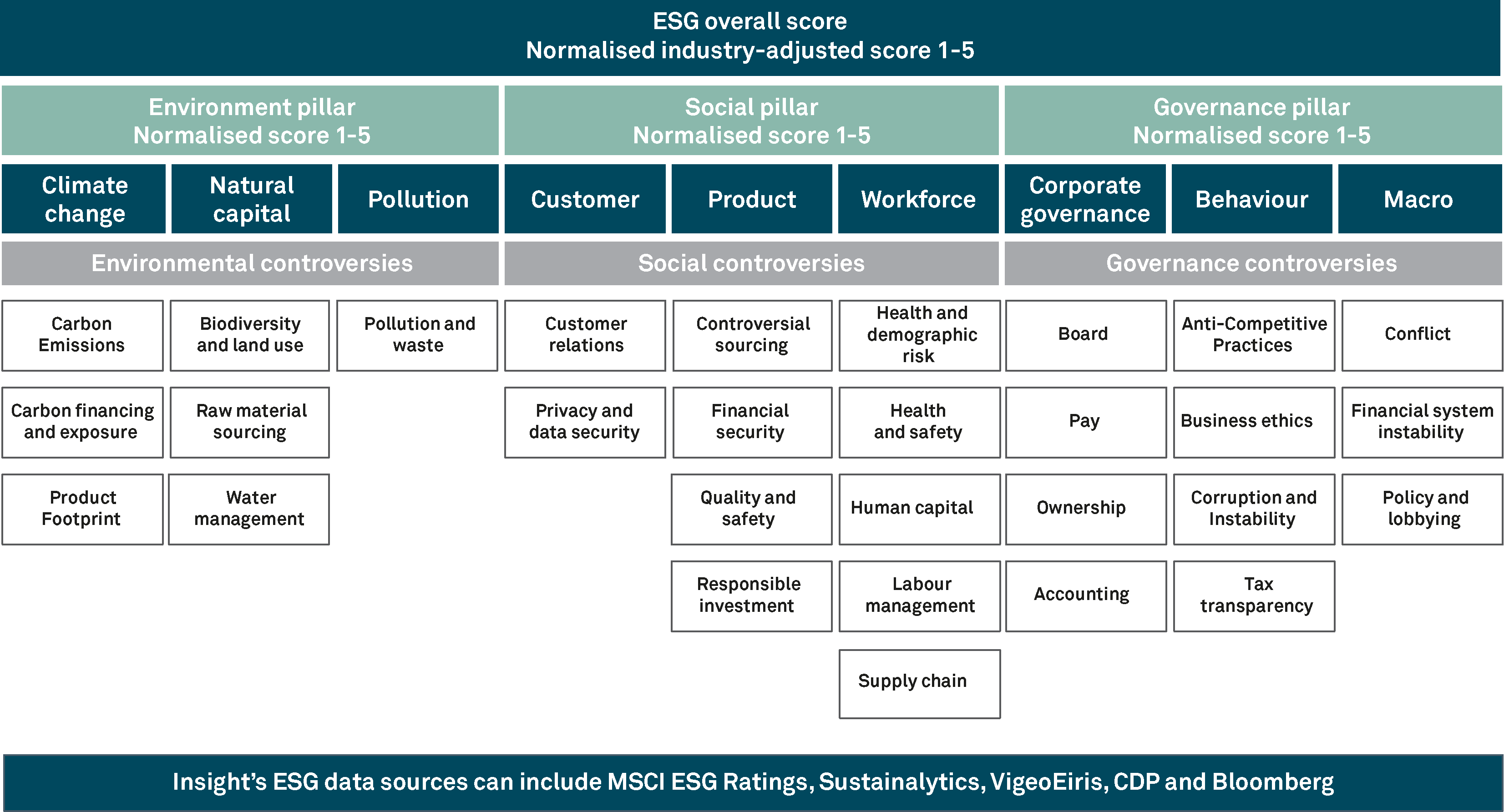
Insight has a dedicated ESG team and proprietary ESG and climate risk ratings, known as Prime. The Prime corporate ESG ratings are generated based on data sourced from MSCI, VigeoEiris, Sustainalytics and CDP, with metrics mapped to key ESG issues and weighted for relevance, quality, and materiality based on input from their credit analysis team. Where data isn’t available, Insight seeks to fill the gap using proprietary ESG questionnaires.
Bespoke ESG research
Insight has a proprietary fixed income corporate ESG ratings and ESG momentum model
Top decile every year since 2013
10 out of 10 for Overall Quality
Winner: 2020, 2019 and 2017 Highly Commended: 2018
What does BNY Mellon Investment Management bring to the table?
Why BNY Mellon
4. BNY Mellon, 31 March 2021. 5. Forbes, 31 October 2019.
Our goal is to build and manage investment strategies that meet the ever-changing needs of our clients. BNY Mellon Investment Management’s model offers the best of both worlds: specialist expertise from our forward-thinking eight investment firms, offering solutions across every major asset class, backed by the strength, scale and proven financial stewardship of BNY Mellon Investment Management. BNY Mellon Investment Management provides a robust corporate foundation, together with worldwide resources and administrative support that allow our investment firms the freedom to concentrate on what they do best - deliver specialist and focused investments to clients. From mainstream equities to private debt markets, alternatives to the world of fixed income – each of our investment firms has its own unique investment philosophy, proprietary process and is a recognised leader in its field. Our structure encourages an entrepreneurial, focused approach to investment. This creates an environment in which each firm can perform and build on its individual experience and strengths in the development of new products.
‘Best of both worlds’ approach Global footprint
BNY Mellon Investment Management’s model encompasses the specialist skills and expertise of eight world-class investment firms. Each brings its own unique investment philosophy, process, approach, and culture, while enjoying the international distribution channels, brand equity, operational infrastructure, support, assistance, and global influence that comes with being part of BNY Mellon Investment Management. The blending of unique cultures and specialisms in a structure of shared values to power the creation of solutions for clients around the world. For our clients, it feels like investing as it should be.
Specialist expertise
Performance
Due to the Fund's recent launch, past performance data will not be available until the Fund has been running for a complete 12-month period.
12-month returns (%) Responsible Horizons Strategic Bond Fund Benchmark Calendar year returns (%) Responsible Horizons Strategic Bond Fund Benchmark
AUG 16 - AUG 17 N/A N/A 2016 N/A N/A
AUG 17 - AUG 18 N/A N/A 2017 N/A N/A
AUG 18 - AUG 19 N/A N/A 2018 N/A N/A
AUG 19 - AUG 20 N/A N/A 2019 N/A N/A
AUG 20 - AUG 21 N/A N/A 2020 N/A N/A
Objective: To generate a return through a combination of income and capital returns, whilst taking environmental, social and governance ("ESG") factors into account. Benchmark: The fund will measure its performance against the UK Investment Association Sterling Strategic Bond Sector as a comparator benchmark (the "Benchmark"). The fund will use the Benchmark as an appropriate comparator because it represents a broad range of similar Sterling denominated bond funds that invest in corporate bonds. The fund is actively managed, which means the Investment Manager has discretion over the selection of investments, subject to the investment objective and policies as disclosed in the Prospectus.
Investment objective and performance
Past performance is not a guide to future performance. The value of investments can fall. Investors may not get back the amount invested. Income from investments may vary and is not guaranteed. Key investment risks: Objective/Performance Risk: There is no guarantee that the fund will achieve its objectives. Currency Risk: This fund invests in international markets which means it is exposed to changes in currency rates which could affect the value of the Fund. Derivatives Risk: Derivatives are highly sensitive to changes in the value of the asset from which their value is derived. A small movement in the value of the underlying asset can cause a large movement in the value of the derivative. This can increase the sizes of losses and gains, causing the value of your investment to fluctuate. When using derivatives, the fund can lose significantly more than the amount it has invested in derivatives. Changes in Interest Rates & Inflation Risk: Investments in bonds/money market securities are affected by interest rates and inflation trends which may negatively affect the value of the fund. Credit Ratings and Unrated Securities Risk: Bonds with a low credit rating or unrated bonds have a greater risk of default. These investments may negatively affect the value of the fund. Credit Risk: The issuer of a security held by the fund may not pay income or repay capital to the fund when due. Emerging Markets Risk: Emerging Markets have additional risks due to less-developed market practices. CoCo's Risk: Contingent Convertible Securities (CoCo's) convert from debt to equity when the issuer's capital drops below a pre-defined level. This may result in the security converting into equities at a discounted share price, the value of the security being written down, temporarily or permanently, and/or coupon payments ceasing or being deferred. Sustainable funds Risk: The Fund follows a sustainable investment approach, which may cause it to perform differently than funds that have a similar objective but which do not integrate sustainable investment criteria when selecting securities. The fund will not engage in stock lending activities and, therefore, may forego any additional returns that may be produced through such activities. Counterparty Risk: The insolvency of any institutions providing services such as custody of assets or acting as a counterparty to derivatives or other contractual arrangements, may expose the fund to financial loss. A complete description of risk factors is set out in the Prospectus in the section entitled "Risk Factors". Important Information For Professional Clients only. This is a financial promotion and is not investment advice. For a full list of risks applicable to this fund, please refer to the Prospectus or other offering documents. Before subscribing, investors should read the most recent Prospectus and KIID for each fund in which they want to invest. Go to www.bnymellonim.co.uk. The Prospectus and KIID are available in English and in an official language of the jurisdictions in which the Fund is registered for public sale. The Fund is a sub-fund of BNY Mellon Investment Funds, an open-ended investment company with variable capital (ICVC) with limited liability between sub-funds. Incorporated in England and Wales: registered number IC27. The Authorised Corporate Director (ACD) is BNY Mellon Fund Managers Limited (BNY MFM), incorporated in England and Wales: No. 1998251. Registered address: BNY Mellon Centre, 160 Queen Victoria Street, London EC4V 4LA. Authorised and regulated by the Financial Conduct Authority. Any views and opinions are those of the investment manager, unless otherwise noted BNY Mellon is the corporate brand of The Bank of New York Mellon Corporation and its subsidiaries. Issued in the UK by BNY Mellon Investment Management EMEA Limited, BNY Mellon Centre, 160 Queen Victoria Street, London EC4V 4LA. Registered in England No. 1118580. Authorised and regulated by the Financial Conduct Authority. Document ID: 733404.