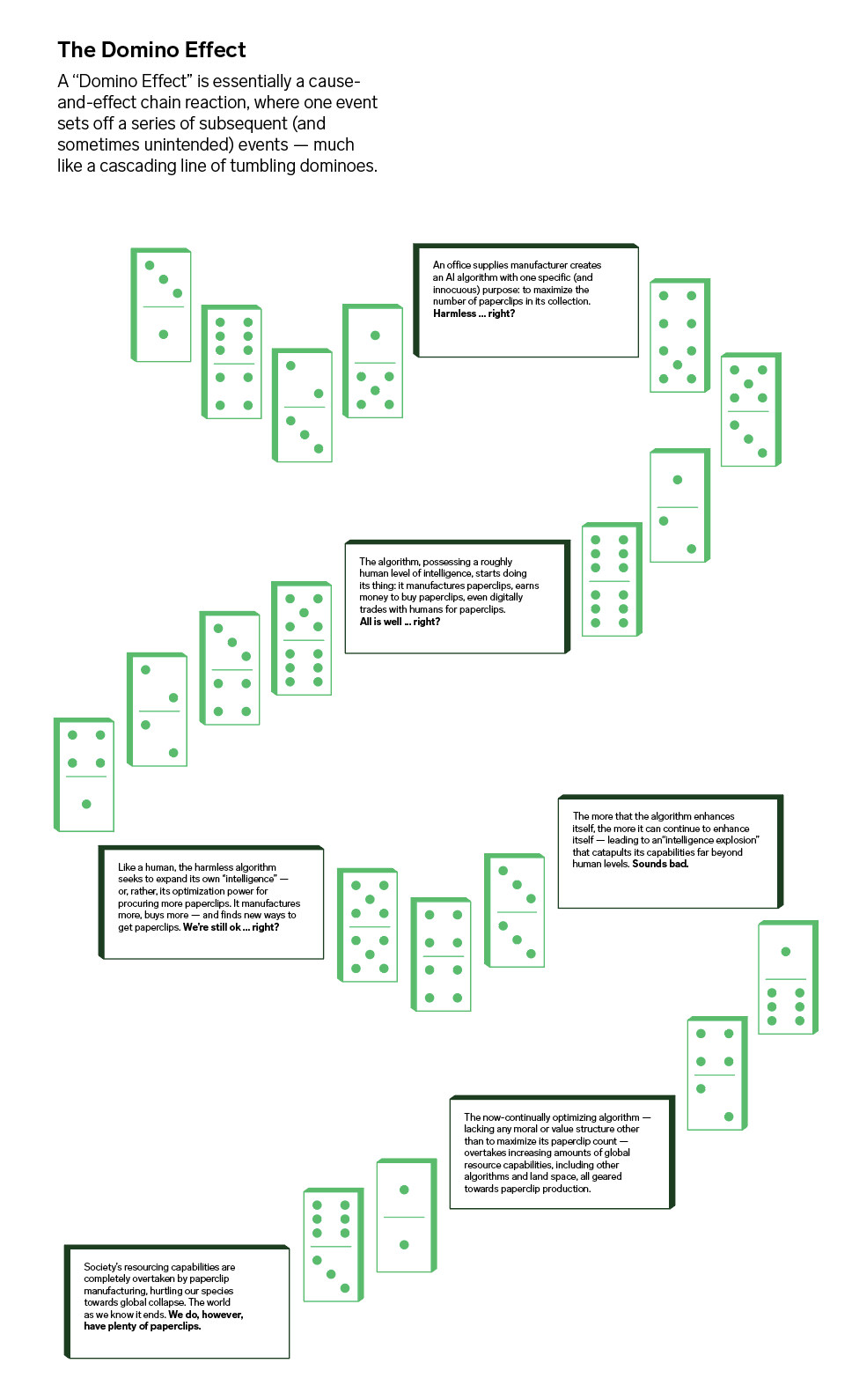
The Domino Effect
A “Domino Effect” is essentially a cause-and-effect chain reaction, where one event sets off a series of subsequent (and sometimes unintended) events — much like a cascading line of tumbling dominoes.


An office supplies manufacturer creates an AI algorithm with one specific (and innocuous) purpose: to maximize the number of paperclips in its collection.
Harmless … right?


All is well … right?
The algorithm, possessing a roughly human level of intelligence, starts doing its thing: it manufactures paperclips, earns money to buy paperclips, even digitally trades with humans for paperclips.


We’re still ok … right?
Like a human, the harmless algorithm seeks to expand its own “intelligence” — or, rather, its optimization power for procuring more paperclips. It manufactures more, buys more — and finds new ways to get paperclips.


Sounds bad.
The more that the algorithm enhances itself, the more it can continue to enhance itself — leading to an“intelligence explosion” that catapults its capabilities far beyond human levels.


The now-continually optimizing algorithm — lacking any moral or value structure other than to maximize its paperclip count — overtakes increasing amounts of global resource capabilities, including other algorithms and land space, all geared towards paperclip production.

We do, however, have plenty of paperclips.
Society’s resourcing capabilities are completely overtaken by paperclip manufacturing, hurtling our species towards global collapse. The world as we know it ends.