Historically Speaking
The LES doesn’t idly coast on preconceived notions of vibes. In addition to a thriving present to know and love, there’s a rich history to understand and appreciate.
Bands of Native American tribes (primarily thought to be the Lenape or Canarsee) once had encampments they traveled between throughout the year. Their so-called “main trail” sprawled from Inwood to the Battery and branched off toward Corlears Hook on the LES, where you can presently catch NYC Ferry’s South Brooklyn route. During Dutch dominion, most New Amsterdam residents lived below Fulton Street, with points above serving as large farms known as boweries or “bouwerij.” Today’s mononymous Bowery thoroughfare once connected directly to the farm of New Netherland director-general Peter Stuyvesant.
During the mid-18th century, these working farms became the property of, and country retreats for, the city’s wealthiest families. Most notable among them were the Delanceys — British Crown Loyalists who fled during the American Revolution and were forced to relinquish a land stake encompassing much of the present-day Lower East Side. Despite picking the losing side in the war, the Delancey family fundamentally shaped the LES.
The reality of Lower East Side tenement living is an unpalatable element of the neighborhood’s history, but one crucial to understanding it today. It underscores how life has always seemed to find a way in this neighborhood. Whyever it is you’re there, the Lower East Side has been a place to find yourself at home and make a life against all odds.
Culturally Legendary
Okay, your walking shoes are on, your dinner fork is prepped, and your art critic’s monocle is polished and adequately set between your cheekbone and brow. Luckily, the Lower East Side’s specialty in having options also applies to public transportation. Multiple letters form the neighborhood’s subway language — B, D, F, M, J, and ever-mythical Z. An alphabet like that keeps the Lower East Side extremely well-connected to Greenwich Village, the Upper West Side, and more. Many Manhattan bus routes also traverse the LES, adding public transit flexibility.
DUMBO and Brooklyn Heights are one trip across the Manhattan Bridge and the Brooklyn Bridge, respectively, whether your journey commences on a pedestrian or bike path, or travels via subway or car. The Williamsburg Bridge sits apart from the Manhattan/Brooklyn duo, but is a span that firmly makes its Manhattan landfall on the Lower East Side — its other end, perhaps predictably, is in Williamsburg.
Those with automobile access are proximal to the FDR Drive, which turns into the Harlem River Drive and has exits for the George Washington Bridge and beyond.
As previously mentioned, NYC Ferry’s South Brooklyn route docks at Corlears Hook and reaches the Financial District, Red Hook, and more before arriving at its other terminus in Bay Ridge.
If you’ve never had the pleasure, stop reading immediately and start wandering!
Getting There


Essex Street’s Jack Kirby dreamed up the visionary art style that defined Marvel’s groundbreaking comics and, later, its blockbusting movies — Captain America was a Lower East Side kid, too. Comedian George Burns grew up on Rivington Street and enjoyed a storied career spanning vaudeville, radio, film, and television, living to 100 all the while; must have been that NYC tap water. Sonny Rollins perfected his tenor sax craft on the Williamsburg Bridge pedestrian walkway with only the train’s clattering percussion to accompany him, culminating in 1962’s celebrated album ‘The Bridge.’ Decades on, Lady Gaga started her climb to pop superstardom while living on Stanton and playing at clubs like Pianos on Ludlow and the original Knitting Factory location on E. Houston. Street artist Angel Ortiz, AKA LA II, was born and raised in the neighborhood and became a close friend and collaborator of Keith Haring, responsible for the infill squiggles now so synonymous with the late artist’s most famed work. And sure, some infamous gangsters like Lucky Luciano rose to prominence in the area, but you didn’t hear that from us, got it?
Social movements and iconoclasm have historically found their foothold on the LES. Concurrent with the country’s 1890s–1920s Progressive Era (and the tenement reforms), large-scale protests like the 1902 kosher meat boycott and the Uprising of the 20,000 in 1909 successfully took on big industries. Much later, a generation of roving mid-20th-century beatniks indebted to Kerouac, Ginsberg, et al. brought a Greenwich Village sensibility to the LES’s northern portion, facilitating its eventual spin-off into the East Village. The area was also party to cultural revolutions as punk and hip-hop emerged across the city at large, and collectives like ABC No Rio fostered community through art.
These days, it is impossible to deny that the LES has changed or is currently changing. Indeed, more outwardly sleek condominiums are popping up alongside the classic brick low-rises with zig-zagging front fire escapes, and, yes, the cost of a pizza slice would make your ancestors fumble their subway tokens in shock.
This neighborhood’s story is constantly redefined and reshaped by those living there, each person forming a proverbial branch in the tree, link in the chain, or braid in the freshly baked challah. There is no past without the present to uphold it. Likewise, the present is as meaningless as AI slop when removed from the context of the past. It’s a vital symbiosis, one honed with aplomb on the LES.

Meet Agents
Search Homes
James Delancey Jr. laid out the LES’s street grid well before the rest of Manhattan above 14th Street received one. He also coined several street names we continue to use, including Essex, Orchard, and (of course) Delancey. Most streets not subject to Delancey’s whims were later dedicated in honor of War of 1812 veterans (Chrystie, Forsyth, Ludlow), U.S. presidents (Jefferson, Madison), and Henry Rutgers (so popular he earned two: Henry and Rutgers).
As land became subdivided, Greek Revival and Italianate rowhouses rose. Many were later converted to multi-family residences. Still, it wasn’t enough to house a rapidly booming population. In five short decades, from 1820 to 1870, the city’s headcount rose from approximately 125,000 to just shy of one million. By some estimates, the LES had a population density during this period of 250,000 people per square mile. The neighborhood had become particularly popular with new arrivals, who formed thriving communities in the area. But where would everyone live in a place with such limited space? Enter the tenement building.
Whyever it is you’re there, the Lower East Side has been a place to find yourself at home and make a life against all odds.
Experience the balance between past and present on the LES first-hand by digesting a food scene that hosts long-renowned standbys we alchemically know, alongside craveable fare routinely making dents on best-of lists and social media algorithms.
Three eateries on E. Houston form what could be considered a holy trinity of the Lower East Side’s enduring history, but is more accurately a hamentash: Katz’s Delicatessen, Yonah Schimmel Knish Bakery, and Russ & Daughters Cafe.
Katz’s (205 E. Houston St.) is the longest-running institution of the three, open since 1888 and in its current location since the 1930s. Is it a tourist trap? Almost definitely. Are the delectable meats — brisket, corned beef, pastrami, etc. — worth it? Definitely definitely. Lines can get long, but deli hack: Pick a random rainy Monday, and you’ll hardly wait to have what she’s having.
Lower Eats Side


Yonah Schimmel (137 E. Houston St.) has been around since 1910, but originated in 1890 as a Coney Island pushcart. A knish is one of the dumpling’s many faces, here assuming the form of a mashed potato wrapped in dough and baked. There’s a sign on the counter that reads, “A knish a day keeps the doctor away,” and even though that’s probably not true — if anything, it’ll bring the doctor closer — a dense Yonah Schimmel knish dappled in mustard is comfort food defined.
Russ & Daughters (179 E. Houston St.) also has street food roots. Joel Russ began selling schmaltz herring out of a barrel in the early 1900s before opening the first physical Russ & Daughters shop in 1914 on Orchard; it moved to E. Houston in 1920. Russ and his daughters worked in the store, hence the name. As you contemplate the pure smoky-salty-creamy flavor of a classic bagel and lox sandwich, or the universes contained within their chocolate babka’s deep swirls, you’ll understand why Russ & Daughters has not only lasted but expanded to locations in Midtown West and the Brooklyn Navy Yard.
Like an Everlasting Gobstopper, Economy Candy (108 Rivington St.) has shown no signs of shrinking from its long-time post. NYC’s oldest retail candy shop — now in its fourth generation of original family ownership — began as a shoe and hat repair store with a pushcart outside for sweets before pivoting full-time to candy in 1937 amid the Great Depression. Put a cavity in your sweet tooth with any confectionery you can think of. Anyone for a pound of sour gummy sharks? Hey, junk food is still food.
Although Essex Market (88 Essex St.) has moved across double-wide Delancey from its original location to the gargantuan Essex Crossing development — also site of a multiplex movie theater, sparkling residences, and a rooftop urban farm — the retail hub remains true to the vision behind its 1940 founding. It’s a public forum for vendors of all stripes to sell their wares, be they coffee roasters, cheesemongers, beer merchants, or anything else.
Meanwhile, Son Del North (177 Orchard St.) makes waves with its authentic Northern Mexican flavors, wrapped and rolled up into Sonoran flour tortillas, proudly served with bounteous beans and no rice. Stop by during lunchtime, and the line to order may very well be 20 people deep. Worry not; the queue is worth it for burritos bursting with flavor, whether you go carne asada, pollo asado, or get the most bean for your buck with the frijol con queso.
Supermoon Bakehouse (120 Rivington St.) rotates parts of its menu every month, giving folks ample reason to return again and again. The storefront is rather unassuming, yet the goods flowing out are anything but. One bite swiftly leads to all the bites of concoctions like the Ferrero Rocher cruffin — croissant dough prepared in a muffin tin, an ingenious Frankenstein’s monster of deliciousness. Look baked bliss in the face and sink your teeth into the much-lauded white chocolate macadamia nut cookie, topped with honey-roasted cornflakes for a heavenly blend of soft and crunch.


This is the
Lower East Side
Wandering around New York City searching for the best bite of your life? Scouring the various streets and avenues for a sense of cultural context? Your brother-in-law’s birthday is coming up, and you don’t have a gift idea, but word is he’s got a fondness for first-edition books and half-sour pickles? If you want it, the Lower East Side has it — and really, you don’t have to look so hard.
Even if the pinpoint coordinates of the Lower East Side (LES if you’re in a hurry) are often in the eye of the individual cartographer, the neighborhood’s location within Manhattan is basically where its name implies. Houston Street commonly sets the northern boundary, Bowery the western, Canal Street the southern, and the East River the eastern. Some may go further and wrap in parts of Chinatown and Little Italy, the Two Bridges area, or even the East Village if they’re really old-school. Honestly, though, you’ll know you’re there when you’re there.
People have felt the LES’s draw for centuries. It shines on celluloid, leaps off the page, and carries one hell of a tune.
The neighborhood’s metaphorical electricity is literally irresistible.


Is Where It's At
The Lower East Side
Choose your own adventure. Pick a block
and see what you might find.
Meet Agents
Search Homes
NEIGHBORHOOD INFO
Ready to see more of the LES?
by JEREMY KLEIN

In the strictest of terms, a tenement is any dwelling divided into multiple apartments. But as the LES ballooned, a more inelegant definition emerged and took communal living to an extreme. Photojournalist Jacob Riis exposed the squalid conditions of these notorious buildings in his groundbreaking 1890 work ‘How the Other Half Lives,’ which helped spur concrete change.
New York’s Tenement House Act of 1901 furthered previous reforms, requiring indoor plumbing, proper ventilation, outside-facing windows for every unit, and various fire safety measures. Because of these quality-of-life improvements, many historic tenements are still home to thousands of New Yorkers today, in (thankfully) fully remodeled form.
You can get the full picture of what LES tenement living was once like at the Tenement Museum (103 Orchard St.), a National Historic Site, which offers immersive tours that keep many eras of residents’ stories alive.


Did you think we’d forget pizza? The LES is blessed in this most vital department, enabling one to essentially pop in wherever for a superior slice. Scarr’s (35 Orchard St.) is often at the top of people’s minds, but Jonny’s (173 Orchard St.), Grand Street Pizza (384 Grand St.), and Pizza Loves Sauce (147 E. Houston St.), plus outposts from Williamsburg Pizza (277 Broome St.) and Cuts & Slices (321 E. Houston St.) are equally deserving of some cheesy cerebral real estate.
On the Neapolitan side of the spectrum, Una Pizza Napoletana (175 Orchard St.) may be in a class above, one that often sees its naturally leavened, wood-fired pies ranked one of the world’s top pizzas. Whether that adulation is an indisputable truth is up to personal preference. What’s not in doubt, however, is that the Bianca pie here is so deliciously smooth and velvety it practically melts in your mouth. Chef-owner Anthony Mangieri has built scarcity into his restaurant, which is open for only a few hours out of a few days per week and makes a predetermined amount of dough daily. Snag a reservation, or you will likely get turned away hungry.
In frankly honest terms, too much happens on the Lower East Side to do all of it proper justice. All of the above is just that extra fleck of frost at the tip of the iceberg. You’ll never see it all, yet isn’t that magical? The purest joy you’ll find on the Lower East Side is stumbling onto something great you never would have known existed before.
Globetrot from Spain’s Basque Country (Ernesto’s, 259 East Broadway) to a South Korean roadside (Kisa, 205 Allen St.) to Vietnam by way of France (Ha’s Snack Bar, 297 Broome St., and Bistrot Ha, 137 Eldridge St.), using only your taste buds. Swoon over a whimsical vegetarian tasting menu boasting Michelin-star credentials (Dirt Candy, 86 Allen St). Throw a few back responsibly at a dive bar with the aesthetics of a 1970s rec room (Welcome to the Johnsons, 123 Rivington St.) or sip a glass of natural wine in a setting you’d swear was Paris (Le Dive, 37 Canal St.) Catch a slate of repertory cinema that’s been meticulously curated to embrace films of all genres and origins (Metrograph, 7 Ludlow St.) Stroke your chin in admiration or perplexity at the cumulative miles of artwork on exhibit at galleries throughout the neighborhood. Get that brother-in-law of yours his old book and fresh pickles from under the same roof (Sweet Pickle Books, 47 Orchard St.) It’s all here.


VIEW LISTING
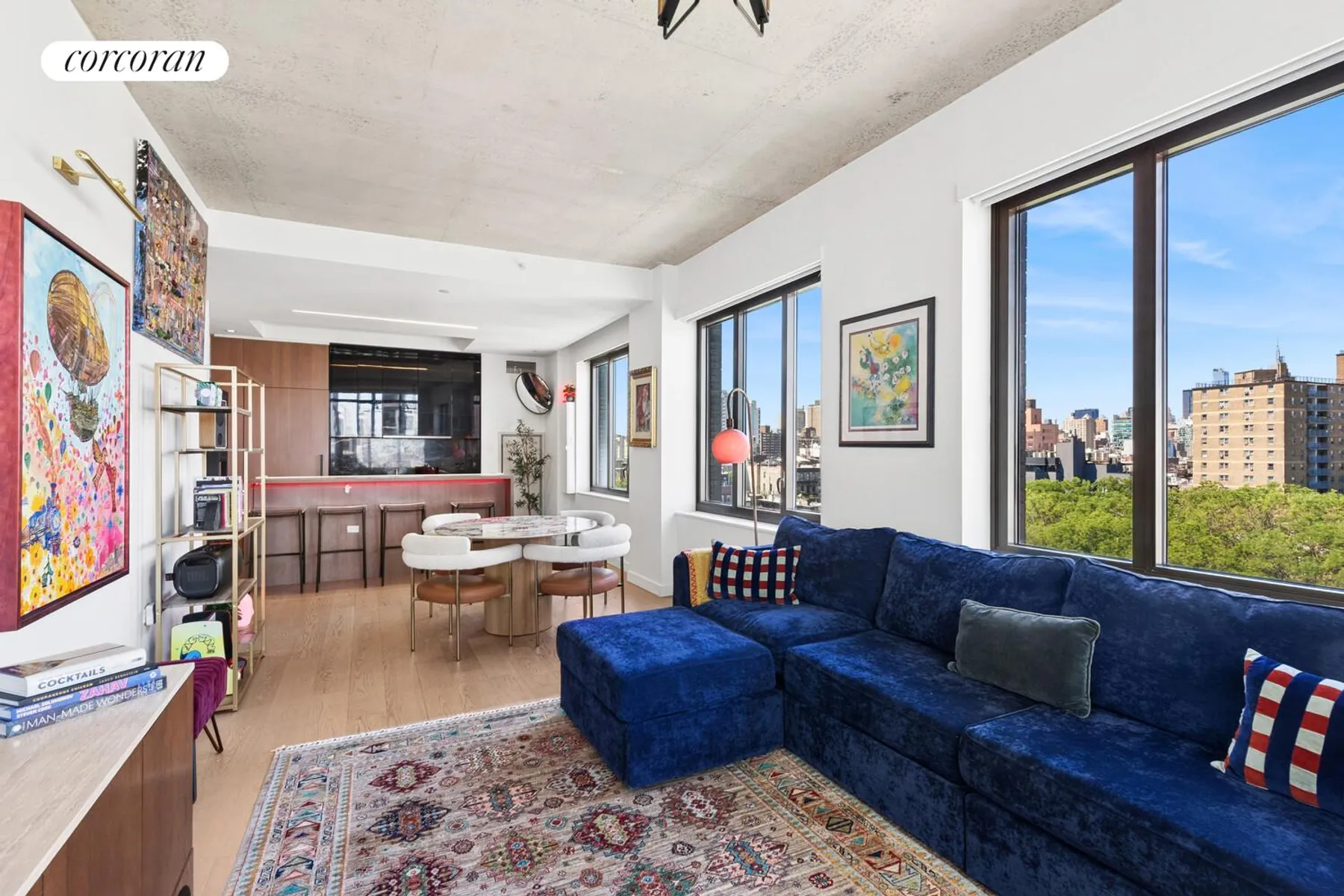
A contemporary Lower East Side condo with sun-filled interiors, refined finishes, and boutique amenities, all moments from Essex Market, Equinox, Dimes Square, and major transit.
Available Properties
VIEW LISTING
A light-filled 1,831 square foot corner residence with refined industrial design, generous proportions, luxe bedrooms, and standout amenities in the heart of Downtown.