Rosario Candela buildings have defined some of New York City’s toniest neighborhoods — and a century later, his name remains every bit a selling point.
It’s hard to imagine that a single architect almost singlehandedly transformed Fifth Avenue from a boulevard of stately mansions to an unbroken wall of skyward manses. Italian-born Rosario Candela (1890-1953) accomplished just such a feat, both through his own commissions and the trends he’d set. Candela also gifted Park Avenue with a similar status during the building boom that emerged as the railroad tracks, then recently electrified, were decked over. And, he helped conceive of Sutton Place, expanding what had been a tucked-away row of brownstones into a larger enclave of luxury towers, four of which he designed.
“More than just an architectural story, Candela and his work represents a story of social and urban transformation,” said Donald Albrecht, who curated Elegance in the Sky, the 2018 Candela exhibit at the Museum of the City of New York. “He actually designed more buildings on the Upper West Side, but the exhibition concentrates on the Upper East Side residences because of the New York elite who called them home, people like John D. Rockefeller, Jacqueline Kennedy Onassis, and Mrs. [Brooke] Astor.”
Candela — and the people who hired him — thought carefully about how to introduce a new way of living to their wealthy clients, as evidenced from their floor plans and marketing materials. “Their ads and brochures pointed out some of the advantages,” Albrecht says, “such as river and park views from high up and the organizational structure of the co-op itself, which was a fairly new concept at the time and allowed the owner to buy shares of their home while exercising control over just who their neighbors were. There’s that extra whiff of exclusivity. At the same time, they were showing potential buyers how the apartments still can feel like a house, with a clear separation between public and private spaces.”
With their steel construction and sheer massing, the towers brought another appeal: the sheen of modernity. While most of Candela’s buildings feature rather restrained exteriors, they also contain happy surprises. The red brick 41 Fifth, in Greenwich Village, includes Florentine-inspired motifs. And in a series of towers on Park Avenue, he fashioned elaborate terraced setbacks out of over-the-top compositions of pediments, pavilions, and bay windows that read, observes Albrecht, “like Italian hill towns in the sky.”
Above all, it was his masterful approach to space-planning that stood out most. “Typically, you walk into a spacious foyer that visually orients you to the main rooms — the library, the living room, the dining room — that come off of it,” Albrecht says. “Then there’s usually a separate corridor leading to the bedroom area.” Another characteristic innovation, continues Albrecht, was Candela’s “ingenious introduction of duplex and even triplex units into the mix.” Higher ceilings, thicker walls, larger windows — all were Candela signatures, too.
“There’s an urbanist quality to his life, as well as an architectural one,” Albrecht says. “A practical one along with an artistic one. Those fusions have had real and lasting impact on the shape of the city.”
“On the Upper East Side, few architects—even a century later—carry the cachet of Carpenter."


Licensed RE Salesperson
- Cathy Franklin
BY INHABIT EDITORS

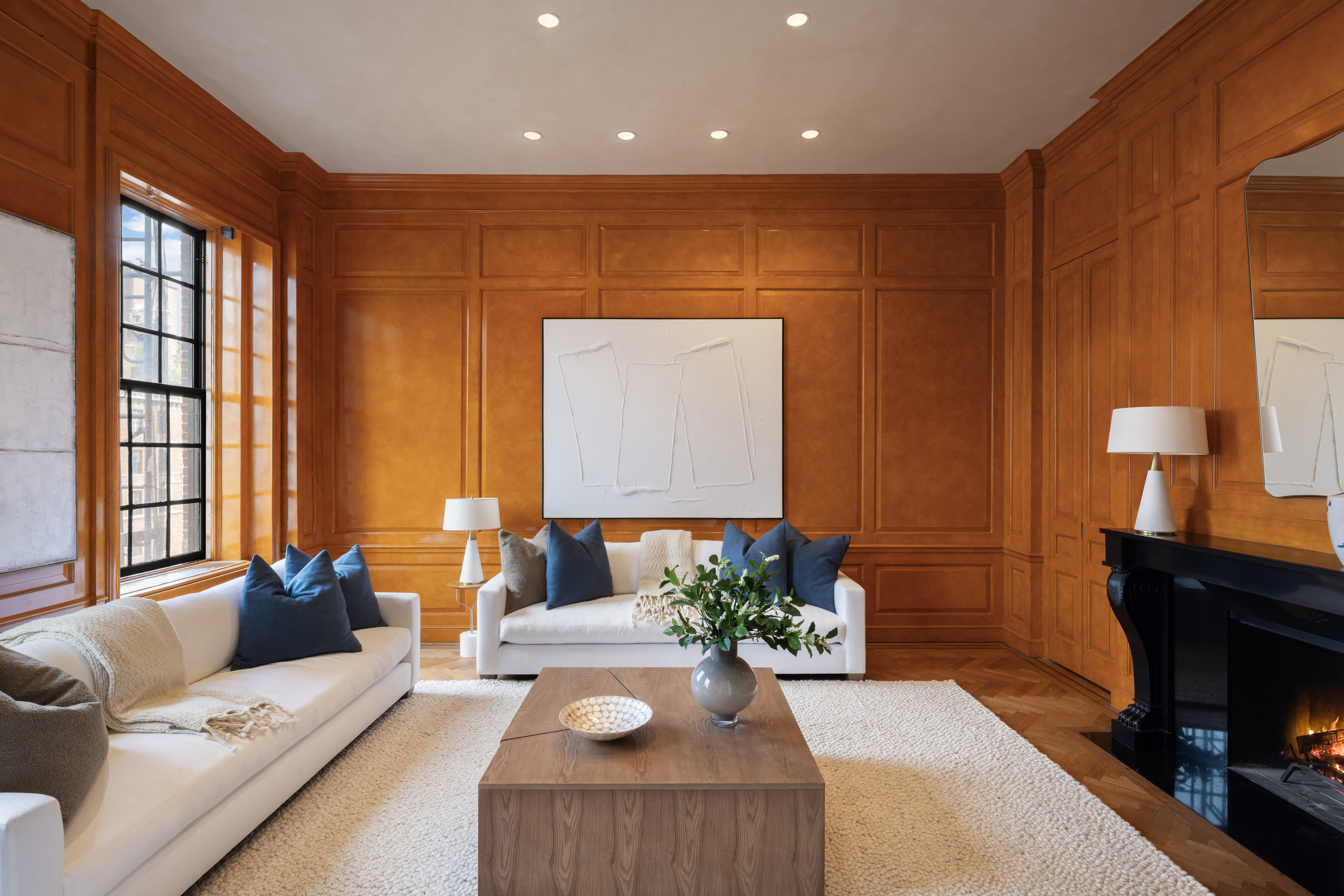
This full-floor home, one of only 18 in the building, is a veritable showcase for Candela’s hallmarks. When the private elevator opens onto the grand entrance gallery, you’ll be ushered into a self-contained world of lavishness. Picturesque views are all around, with every west-facing room offering stunning Central Park glimpses. Ceilings soar to nearly 12 feet, elevating the sense of scale from the herringbone floors up to the crown moldings, and the ease of flow is effortless between each impressive space. A triumphant triumvirate awaits directly off the gallery, each featuring a stately wood-burning fireplace — a massive, sun-drenched living room, a winning wood-paneled library, and a splendid formal dining room. For casual meals, the windowed eat-in kitchen has a center island and adjoins a corner breakfast room. All five of the home’s bedrooms occupy a separate wing. Most impressively, the primary combines two bedrooms into one and encompasses a corner sleeping quarters, a windowed ensuite, and an extensive dressing room. Four additional bedroom suites are luxuriously large, and there are three more full bathrooms — plus four staff bedrooms and a staff bathroom. Designed in the English Renaissance style and completed in 1931, 778 Park is a full-service, white-glove building with amenities including a gym, a yoga room, and an on-site beauty parlor.
Three stories up in the Wellston awaits this two-bedroom residence, gloriously renovated and offering an idyllic type of Upper West Side living — after all, you’re about halfway between Central and Riverside parks. The entry gallery splits into two ways. To the right is the living room, which has the kind of prewar detailing you’d expect from a Candela work, such as parquet floors and subtle crown moldings. There is also space for multiple seating areas for hosts and guests alike, including one by the windows and the treetops along West 76th. Navigate left, and you’ll arrive at a formal dining room that incorporates baseboard moldings and has room for eight people around the table. One room over, the fully renovated windowed kitchen boasts copious custom cabinetry as well as plentiful preparation space on its marble countertops. Both bedrooms are separated from the rest of the home by a hallway, ensuring privacy. The primary sports the same leafy overlook as the living room, two closets, and a marble ensuite. Similarly, the second bedroom has a big closet of its own and is bathed in sunlight through its south-facing windows. Historic and composed of brick, stone, and terra cotta, the Wellston building was completed in 1924 between Amsterdam and Columbus avenues. In addition to two lobbies (each with a full-time doorman and live-in resident manager), this co-op claims two standout communal areas — an interior courtyard and a roof deck.
Taking full advantage of its 60 feet of Central Park frontage is a priority at this Upper East Side three-bed, a melodic duet of grandeur and charm. Enter onto black-and-white marble flooring and instantly feel the great room’s gravity, pulling you in with its wood-burning fireplace on one wall, built-in seating on the other, and natural light swirling all around. Two immense windows gaze across the park’s treetops in panoramic fashion — you’ll even be able to spy the San Remo, a beloved building by Emery Roth, another defining architect of parkside Manhattan. The aura is similar in the adjacent formal dining room, where another wood-burning fireplace and even more green vistas are bound to stun, whether you’re feeding upwards of 14 or cooking for one. If you subscribe to all these views, then you’ll also love the corner office, which has an oversized window and is spacious enough to be converted into a bedroom. For a more casual gathering ambience, try the den off the kitchen, complete with a bar and banquette seating along a curved wall. Oval-shaped and sprawling, the primary suite is a serene sanctuary flaunting two ensuites, two dressing rooms, and vast amounts of covetable closet space. This Candela work was completed in 1938 and is now a full-service co-op building with a landscaped roof terrace peering across the cityscape and, of course, Central Park.


740 Park, 6-7C
770 Park, 2C
No. 16 at 995 Fifth Avenue boasts more than 8,000 square feet.
VIEW LISTING
778 Park Avenue, 12th Floor
CO-OP | 5 BEDS | 5.2 BATHS
174 West 76th Street, 3H
WELLSTON | CO-OP | 2 BEDS | 2 BATHS
955 Fifth Avenue, 9AB
CO-OP | 3 BEDS | 3.1 BATHS
VIEW LISTING
VIEW LISTING
Located on a gorgeous block between Central Park West and Columbus Avenue, 40 West 67th Street offers 40 apartments spread across 10 floors. Flooded with bright natural light, the seamlessly combined and fully renovated 5AB has four en suite bedrooms and a handsome powder room. One of the bedrooms is now a sitting room/den with a TV. From the windowed foyer, you step into side-by-side living and dining rooms, each with working fireplaces, window seats, and leaded Grisaille stained glass windows. The open kitchen offers a center island, Caesarstone countertops, a walk-in pantry, a service door, and Sub-Zero and Viking appliances. All of the bathrooms have windows, and fixtures by Lefroy Brooks and Dornbracht. Other winning architectural details include a tucked-away home office, lots of built-in bookcases, new double-hung, and double-paned windows throughout, along with a neutral color palette, and period hardware, sconces, and hardwood floors. The building is half a block from Central Park and two blocks from Lincoln Center.


40 West 67th Street, 5AB
CO-OP | 4 BEDS | 4 BATHS
VIEW LISTING
Represented by The Cathy Franklin Team.
Represented by the Deborah Grubman Team
Represented by Douglas J Albert, Brian G Rice, and Rob Jackson
search homes
Find your place in Manhattan.


ROSARIO CANDELA (1890-1953).
Marketing materials for 3 East 77th (c.1928), a collaboration with Grand Central architects Warren & Wetmore, showcase a variety of smart floor plans — something Candela was famous for.

Represented by Caitlin Williams