Shelter Island:
Where Tides Converge
This bucolic 29-square-mile landmass, sandwiched between the tines of Long Island’s East End, is an island through and through — literally, in that it’s surrounded by water on all sides, and figuratively for its relative insularity. The result? An allure that belies trends, and an enchantment that’s every bit intentional.
Shelter Island’s beauty lies in absence. It has no traffic lights, nor any bridge crossings to reach it. Most folks arrive by one of two ferries: the South Ferry or the North Ferry, which shuttle cars, bikes, and pedestrians across the straits in as few as five minutes.
Let’s get in line, buy our proverbial ticket to ride (bring cash!), and start exploring.
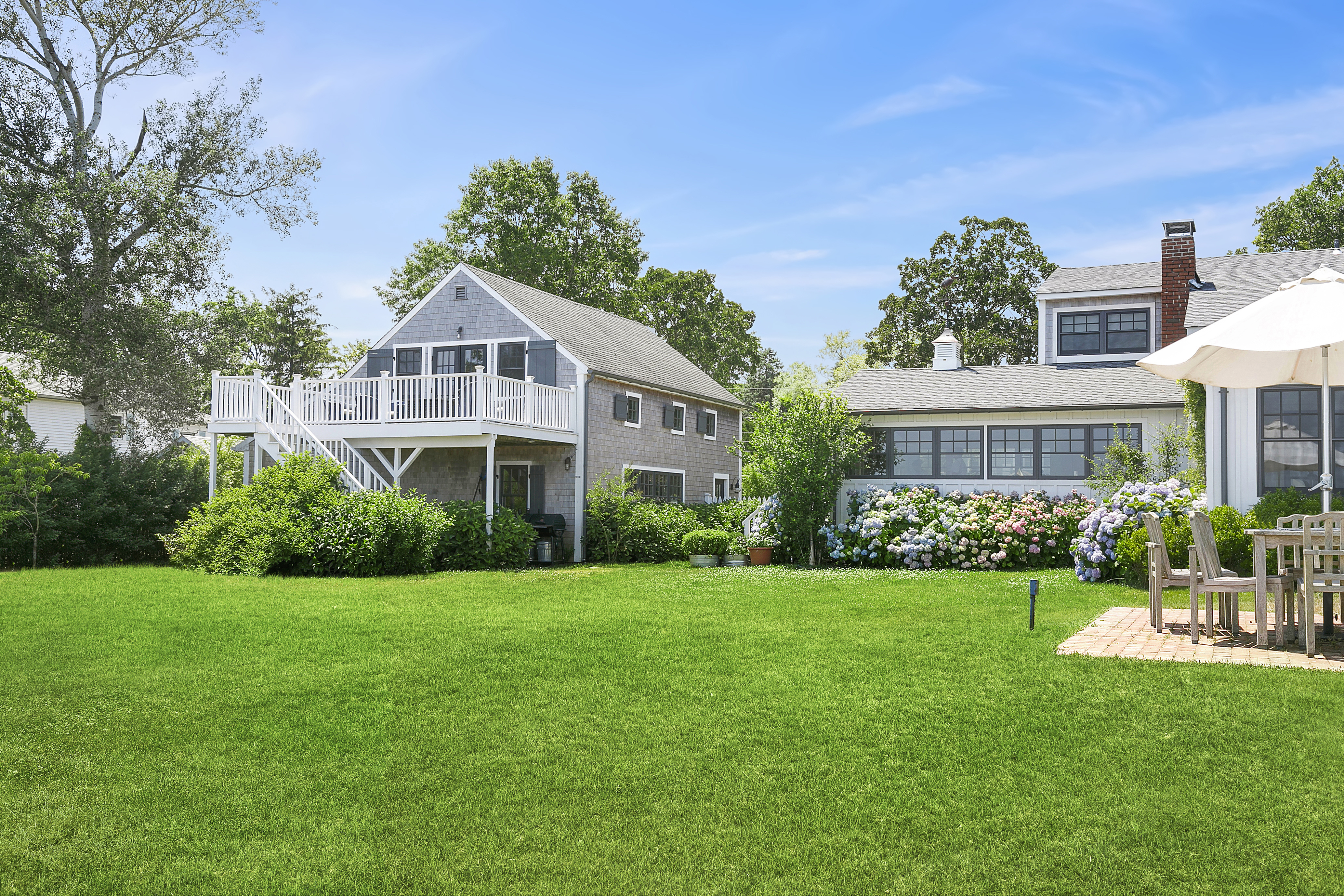
180-degree views frame this new construction waterfront, set on two acres with a private, sandy beach and a pool.
LEARN MORE
Nestled between the high gloss of the Hamptons and the pastoral charm of the North Fork, this wonderland of woods and waters awaits with open ferry terminals.
by JEREMY KLEIN
Today’s Shelter Island was first inhabited by the Manhanset people, who utilized the area as a hunting, fishing, and farming ground. They dubbed it Manhansack-aha-quash-awamock, or “an island sheltered by islands.” Four sugar merchants purchased the island in 1652, after which it became known as Shelter Island. In that quartet was Nathaniel Sylvester, who bought out his partners in 1763 — his family’s imprint on Shelter Island has remained a constant ever since.
Sylvester Manor (80 N Ferry Rd.) is a living, breathing, evolving symbol of Shelter Island history. Notably, its grounds include a c. 1737 Georgian-style residence, a shingle-style windmill built in Southold during the early 1800s (relocated to the manor in 1926), and two acres of gorgeous gardens thaxt have been well-tended for centuries. The manor also roots itself in Shelter Island’s agricultural past via an active 60-acre vegetable, fruit, and livestock farm. Before you ask, yes, there’s an on-property farmstand — this is still the East End, after all.
The Past


Available Properties
Meet Agents
Search Homes
EXPLORE NEIGHBORHOODS
Discover Shelter with Corcoran.

No sail into Shelter Island history is complete without further discussing its ferries. These services trace their lineages back centuries to when the only means for escorting travelers across the respective half-mile aquatic expanses, often foggy, clogged with ice floes, or busy with birds, were a rowboat and a healthy set of muscles. Today, they’re still the only public conveyance onto the island, accommodating private cars, trucks, bikes, and pedestrians. The North Ferry departs from the north in Greenport, steps from the last LIRR stop on the North Fork, while the South Ferry launches from the south in North Haven, outside Sag Harbor. While you might guess they’re public utilities, they’re operated by not one, but two, private companies. The Clark Family has operated the South Ferry for seven generations, starting in 1790. And don’t stress about missing the boat: they run every few minutes, 365 days a year.
Need to make your home-cooked meal feel restaurant-quality? Vine Street Cafe (41 South Ferry Rd.) has sated Shelter Island appetites year-round with its locally sourced seasonal fare since 2003. Or maybe you’ve already got a wine picked out but need the perfect charcuterie board elements to complement it. Then, hitch your metaphorical horse to King Andrew Cheese, which slings curds of all kinds out of a trailer ingeniously masquerading as a Conestoga wagon that wouldn’t look out of place on the Oregon Trail.
Feeling a scene? Sunset Beach (35 Shore Rd.), a restaurant, club, and 20-room boutique hotel by André Balazs of Standard Hotels fame, flaunts a distinctly Côte d'Azur vibe, turning clubby by moonlight as DJ sets oontz-oontz into the night.
Another perfect pairing, particularly in the summer, is miniature golf and ice cream. Luckily, Whale’s Tale (3 Ram Island Rd.) packs in each, boasting 18 hyper-locally themed holes and scoops on scoops of craveable flavors — it’s also open late.
Black Cat Books (54 N Ferry Rd.) began its nine lives in Sag Harbor in 1996 before relocating to Shelter Island in 2006. The eclectic shop prides itself on a captivating collection of used and rare books, with everything from well-worn paperbacks to pristine vintage collectibles (and vinyl records to boot) stocking the stacks. Assuming you aren’t buying a rare first-edition, tote your tome across the street to Shelter Island Craft Brewery (55 N Ferry Rd.) and crack it open alongside a refreshing tall pour — if not a round of bivalves from the aforementioned Peeko Oysters barn (58 N Ferry Rd.) up the block. A slate of creative brews includes the 114 IPA (named after New York State Route 114, the island’s main road), a beach plum sour, or a pilsner based on the original 1842 recipe.
Coecles Harbor, as seen from the Ram's Head Inn. In 1947, J. Robert Oppenheimer joined the world's leading nuclear physicists here for the first Shelter Island Conference on the Foundations of Quantum Mechanics — a second, led by Stephen Hawking, was held in 1983.
The historic Sylvester Manor windmill, built in Southold c.1810 and barged to the island in 1840.
Shelter Island is both a physical island and a town of conterminous borders. It’s one of just five townships on the entire East End, along with East Hampton and Southampton, on the South Fork, and Southold and Riverhead on the North Fork. Throughout, you’ll discover pockets of thriving life, each adding an individual wrinkle to the island’s character. Just about 3,000 people reside here year-round, a figure that grows to over 12,000 during the peak summer season.
As you’ve probably gathered, Shelter Island isn’t the Hamptons, and it’s not the North Fork. It has, however, captured the moods, styles, and attitudes of each and coalesced them into an entirely singular mode of living. Contrasting nearby corners in these parts, where the scene is all about the latest and greatest, Shelter Island is indebted to timelessness, moving forward with its heritage always in focus. It’s something of a coastal Neverland — which makes sense, when you consider that J.M. Barrie drew direct inspiration from the place when writing Peter Pan.
The Place
If you’ve only been skimming or generally haven’t picked up on the clues yet, THE FERRY. Not even prime Katie Ledecky or Michael Phelps are crossing the water to Shelter Island by any other means.
Despite ferry being the island’s sole method of access, cars are more than welcome to drive along Shelter Island’s tranquil interlocking roads. However, the place was made for biking. Truly, what could be a better feeling than coasting down a country lane, the wind at your back, and nothing other than bucolic beauty ahead? Even walking, if you’re able, can be its own treat.
Getting There
Shelter Island's North Ferry, the longer of the two routes, crosses to Greenport in as few as eight minutes. Once there, the LIRR is platform a shell's throw from the dock.
Sunset Beach, built by André Balazs of Standard Hotels fame, has brought many a first-time visitor to the island.

in the 1870s with a summer camp meets seaside resort feel. Victorian cottages — similar to those in Oak Bluffs on Martha’s Vineyard and Ocean Grove in Monmouth County, New Jersey — were constructed in the first wave of development, with Queen Anne, Colonial Revival, and other home styles diversifying the stock later on. Stuck in time but endlessly enticing, Shelter Island Heights is a nationally recognized historic district.
Although Ram Island and Shelter Island are geographically distinct entities, with only a thin sandbar road linking them, the former is considered part and parcel with the latter — adding an individual kind of reserved stillness to the greater space.
Humans in search of solitude aren’t the only ones “sheltered” on this island. Mashomack Preserve encompasses an entire third of the island, 2,350 acres of protected land. You’re bound to spot more than a few ducks and turtles (and more) cohabitating the preserve’s trails, tidal creeks, oak woodlands, and other habitats.
Although homes on Shelter Island run the full gamut of coveted styles, from magnetic Victorians to reimagined farmhouses to mold-shaking moderns to many other architectural forms, there’s a common refrain of embracing rolling landscapes and waterfront vistas, wherever possible. Protected Coecles Harbor and Dering Harbor (also the name of the island’s lone incorporated village) offer ample real estate with docks and private water access. Those without such a benefit, however, can take advantage of multiple marinas.
On the island’s north side, Shelter Island Heights appropriately provides some of the East End’s highest-elevation properties, with some on the neighborhood’s west side enjoying the view from atop steep bluffs. Robert Morris Copeland, a landscape architect who favored naturalistic design, designed the hamlet
“Downtown” isn’t a concrete concept on Shelter Island, as there’s no true population center. Rather, most commercial activity is concentrated in two business districts that hold all you could want. One sits around the Victorian waterfront on Dering Harbor in Shelter Island Heights, while the other is a loose conglomeration of attractions near town hall on N Ferry Road. Across both, the happenings are happening, melding a more typical East End elegance with a Smalltown, USA atmosphere.
Marie Eiffel Market (184 N Ferry Rd.) offers a curated taste of France by way of local ingredients, covering breakfast, lunch, dinner, and every little snack in between. It has the kind of menu where you can easily lock in on a few go-tos, yet also have room to step outside the norm, surprising yourself and the cashier who exclusively knows you as the ham and brie sandwich person. Whatever you’re feeling like on a particular day, come for the food and stay for the unobstructed boat-gawking.
After chowing down dockside delights, head next door to Bliss’ Department Store (186 N Ferry Rd.), a longstanding family-owned has-it-all that’s shockingly organized for its breadth of inventory. Whether you need beach gear, housewares, or that quintessential Shelter Island t-shirt, you’ll find it here.
Peak bites and peak vibes permeate Léon 1909 (29 West Neck Rd.), where an open-hearth, wood-fired oven is the means of preparing some of the East End’s best-regarded food. The cuisine in-house applies a Provençal-style spin on local ingredients, utilizing your taste buds to shorten the gap between the French-Italian coast and scenic Long Island. Léon 1909 is a known favorite for celebrities who want to get out while laying low, so keep an eye out, be respectful, and blow up the group chat once you get home.
Shopping & Dining


One family has operated the South Ferry for seven generations —
since its first voyage in 1790.


Thanks to reliable steam-powered ferry service, Sag Harbor flourished as a Victorian-era seaside retreat, with grand resort hotels providing seasonal respite and unrivaled elegance. Among the first built were Prospect House in Shelter Island Heights and Manhanset House in Dering Harbor, both setting a benchmark for summer luxury. Folks resided in cottage communities while the sprawling hotels provided access to everything one could hope to enjoy during their vacation (beach pavilions, tennis courts, bicycle paths, etc.), not to mention daily meals and entertainment. These were the kinds of places where you’d expect to devote the extended daylight hours to swimming, boating, and fishing before evenings gave way to live music over dinner, followed by dancing. Though many are long gone, a few remain today: The Chequit (23 Grand Ave.) opened its doors over 150 years ago in Shelter Island Heights and, with the help of some extensive 2020s renovation work after an ownership change, retains its glory as an ever-inviting host. Along the coast a short distance away, the enduringly quaint Pridwin (81 Shore Rd.), dating to the mid-1920s, recently emerged from a comprehensive overhaul. The Ram’s Head Inn (108 Ram Island Dr.) is a hillside postcard come to life, offering a seaside solace that has enchanted guests for generations.
Another industry that kept Shelter Island afloat was oystering. For well over a hundred years, the briny crown was bestowed upon Shelter Island Oyster Company, which operated out of Dering Harbor, touted the area’s most beloved bivalves, and gave us Oscar the Oyster — a still cherished character from the halcyon days of anthropomorphic food mascots. Though the ebbs and flows so common in business caused Shelter Island Oyster Company to close in the 1950s, the oystering tide has come back in. Companies like Peeko, which operates out of New Suffolk and has a barn outpost on N Ferry Road, keep the regional tradition alive and make people give a shuck again about oysters.
Dinner and a show. The wood-fired kitchen at León 1909, serving regionally-inspired Provençal fare in the Heights, is a sight to behold.
A staple in Dering Harbor, Marie Eiffel Market offers prepared and made-to-order culinary delights to take back to your boat — or enjoy on the dockside tables out back.
A fromagerie on the move. It's a good day when the "OPEN" flag is out at King Andrew Cheese, which usually parks at Kilbs Farm Stand.
Whatever way you opt for getting around, take it easy. Shelter Island is the rare kind of place where someone can implore you to get lost and mean it only in the most positive sense. So much awaits your exploration and admiration.
Time slows for no one, but on Shelter Island, it certainly lingers.


There's no true ”downtown” on Shelter Island, though its two pint-sized business districts hold everything you need.


LEARN MORE
Set on a full waterfront acre, this renovated classic boasts a deep water dock and over 220 feet of bulkheaded shoreline.