SCROLL

HEADLINES
OVERVIEW
ALTERNATIVE SECTORS�& NEW ENTRANTS
MORE OR LESS?
WHERE ARE�THEY MOVING
WHO IS MOVING?
MORE AND BETTER
SO WHAT?
NATIONAL�OFFICE�MOVES
2026
THE COMPREHENSIVE ANALYSIS OF THE WHO, WHAT, WHY and WHERE�of OFFICE RELOCATIONS ACROSS THE UK REGIONAL MARKETS.
Established companies
Comprises all occupiers that already have an office in a market.
MOVER
An office relocation�within the same market.
An office expansion, either within the existing office location or an additional location within the same market.
EXPANSION
Comprises all occupiers that have relocated their office from outside a market�or are a new occupier.
NEW�ENTRANTS
Comprises all education & medical occupiers who have taken office space in a market - not included in the relocations data.
EDUCATION & MEDICAL
Comprises all flexible workspace providers who have taken a traditional lease or signed a management agreement in a market - not included in the relocations data.
FLEXIBLE WORKSPACE
CONTACT US

Richard Wadham
National �Capital Markets
richard.wadham@cushwake.com
Head of National�Office Agency
charles.dady@cushwake.com
Charles�Dady
Midlands�Office Agency
scott.rutherford@cushwake.com
Scott Rutherford
National Occupier Representation
mark.denford@eur.cushwake.com
MARK DENFORD
Head of Offices Sector, �UK
alistair.brown@cushwake.com
Alistair Brown
National�Capital Markets
andrew.meikle@cushwake.com
Andrew�Meikle
South West �Office Agency
steve.lane@cushwake.com
Steve�Lane
North West�Office Agency
rob.yates@cushwake.com
Rob�Yates



HOVER ON EACH BOX TO LEARN MORE





Despite this, take-up for 2025 across these markets totalled 6.4 million sq ft, which represents a 9% decrease on the 2024 total of 7.0 million sq ft, remaining 5% below the five-year average.
Over half of these deals took place in the South East, with a total of 164 transactions representing a 15% increase from 2024. Birmingham and Bristol also recorded modest growth, with transaction volumes rising by 7% and 8%, respectively. In contrast, activity declined across Edinburgh (-36%), Leeds (-12%), and Manchester (-14%), highlighting a more subdued leasing environment in these markets.
CENTRAL LONDON OFFICE�LEASING COMPOSITION
Activity from existing occupiers remained a key driver of leasing across regional markets, with �228 transactions completed by businesses already present in these locations.
Of these, 40 companies expanded their footprint—either by growing within their current premises or by adding an additional office space to their portfolio—accounting for a net expansion of 712,700 sq ft and representing a sizeable 149% increase on the 285,900 sq ft expansion recorded in 2024. The number of occupiers transitioning from serviced office space into conventional office space also grew, with the 263,700 sq ft across 27 deals reflecting a 187% increase on the 92,000 sq ft reported in 2024. Furthermore, 161 occupiers expanded or contracted their office space through relocating to new office space within the same market, or by contracting within their current premises.
Over recent years, the education, medical, and flexible office sectors have become increasingly prominent in the regional office market, providing an important source of resilience in the post-COVID office landscape.
Take-up from the Education sector totalled 277,700 sq ft across 18 deals. This take-up represents a 39% annual decrease, though it was buoyed by Aston University’s 189,100 sq ft lease at 10 Woodcock Street in Birmingham. Both of the largest education transactions in 2025 occurred in Manchester, namely Arden University taking 55,500 sq ft at 2 Hardman Street, and Elizabeth School �of London taking 24,800 sq ft at Arthur House.
ABOUT CUSHMAN & WAKEFIELD
Cushman & Wakefield (NYSE: CWK) is a leading global commercial real estate services firm for property owners and occupiers with approximately 52,000 employees in nearly 400 offices and 60 countries. In 2023, the firm reported revenue of $9.5 billion across its core services of property, facilities and project management, leasing, capital markets, and valuation and other services. It also receives numerous industry and business accolades for its award-winning culture and commitment to Diversity, Equity and Inclusion (DEI), sustainability and more.
For additional information, visit www.cushmanwakefield.com.
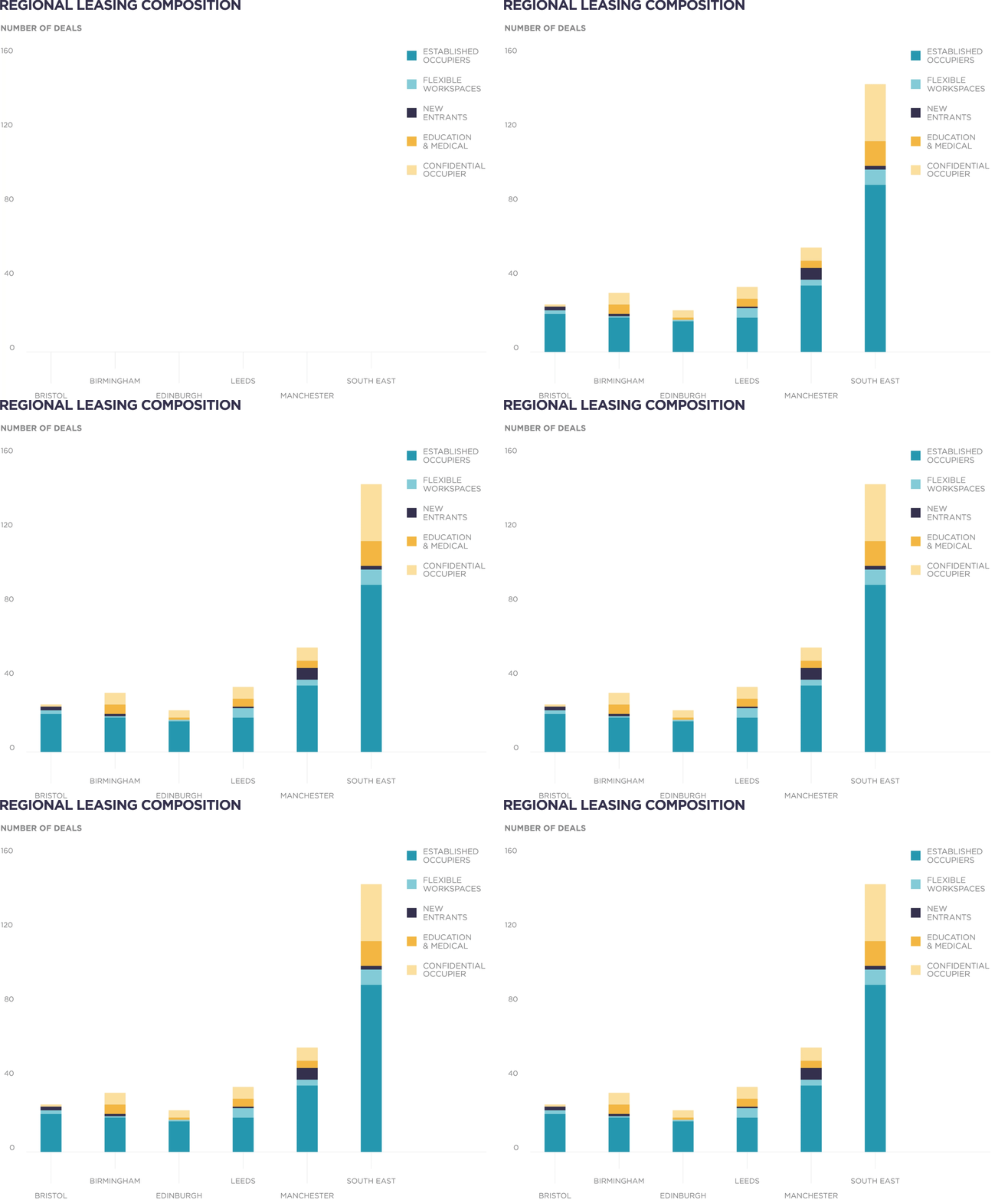

There were 314 office transactions in excess of 5,000 sq ft across the Big Five markets and the South East in 2025. This was 2% above the 308 deals reported for 2024.


OVERVIEW
2025 IN HEADLINES

DEAL OVERVIEW
THE�EXPANDERS
THE CONTRACTORS

THE�NET EFFECT
Over half of the total deals took place in the South East, with a total of 164 transactions representing a 15% increase from 2024. Birmingham and Bristol also recorded modest growth, whilst activity declined across Edinburgh, Leeds, and Manchester.
There were 314 office transactions in excess of 5,000 sq ft across the ‘Big Five’ markets and the South East in 2025. This was 2% above the 308 deals reported for 2024. Despite this, take-up for 2025 across these markets totalled 6.4 million sq ft, which represents a 9% decrease on the 2024 total of 7.0 million sq ft.
Education & Medical occupiers across the Big Five leased �415,700 sq ft across 29 transactions.
New market entrants contributed to 25 additional transactions, with over half of them taking space in the South East.
Flexible Workspace operators leased 325,700 sq ft �across 15 transactions in 2025, representing a 30% decrease �on the space taken in 2024.
Established occupiers within the Big Five and South East regions �accounted for 228 transactions.
Of the 228 deals, 156 (68%) involved footprint growth — either through additional offices, moves from serviced space, or relocations into larger offices — accounting for 3.12 million sq ft of take-up, equating to a total net expansion of 1.70 million sq ft.
The remaining 72 deals (32%) involved firms reducing their footprint through downsizing or relocation, generating 1.14 million sq ft of take-up but resulting in a net loss of 1.03 million sq ft compared to their previous space.
Accounting for both occupiers expanding and contracting their space, the Big Five regional markets and the South East recorded an overall net expansion of 668,900 sq ft in 2025.
Occupiers increasingly consolidated into high-quality, amenity-led offices, with 123 expansions and 58 contractions occurring in Grade A space, highlighting enduring occupier preferences towards premium office space.
Grade A offices recorded a net expansion of 515,800 sq ft, pointing towards the emergence of a ‘more and better’ dynamic across regional office markets.
All analysed markets across the Big Five and South East experienced net gains in office space, with expansionary deals making up the majority of activity.
With the exception of Insurance, Manufacturing & Energy, and Business Services, all other analysed sectors were net expansionary, reflecting a more universal application of return-to-work mandates across different types of occupier.
GET IN TOUCH

GET IN TOUCH


Meanwhile, Grade B/C space showed a more modest net expansion of 153,100 sq ft.
Occupiers whose previous move occurred post-2020 show a clear skew towards expansion (56 expansions vs 13 contractions), suggesting firms that took space after the pandemic are now increasing their footprint as requirements are reassessed.
Leasing activity across all markets continue to be supported by an increasingly diverse occupier profile. Flexible Workspace operators leased a total of 325,700 sq ft across 15 transactions, though this represented a 30% decrease on the 468,600 sq ft taken in 2024. The presence of Education & Medical occupiers in the regional office markets continued to grow in 2025, with these tenants leasing an additional 415,700 sq ft of office space across 29 transactions. Beyond these sectors, new market entrants contributed to 25 additional transactions, with over half of them taking space in the South East.
Education
ALTERNATIVE SECTORS & NEW ENTRANTS
EDUCATION
MEDICAL
In total, Manchester saw the largest level of take-up �from the education sector at 101,300 sq ft, with the South East following in second with 52,200 sq ft.
Demand from higher education institutions has �emerged as a notable trend in recent years, with occupiers increasingly acquiring office space to support administrative functions, research activity, and specialist teaching. This has been particularly evident in city �centre locations, where opportunities for traditional campus expansion remain constrained.
Whether this demand persists in the future is questionable. IBISWorld forecasts that Industry �Value Added (IVA) for universities will decline �between 2026 and 2031, reflecting funding pressures.1
1Industry value added (IVA) is defined as the market value of goods and services produced by the industry minus the cost of goods and services used in production. IVA is also described as the industry's contribution to GDP, or profit plus wages and depreciation.
In contrast, take-up from Healthcare and Medical occupiers increased in 2025, with the 123,700 sq ft leased representing a 12% increase on the previous year.
The South East accounted for 64% of this activity, supported by all four of the largest Medical leases recorded during the year. Notable transactions �included CareTech acquiring 46,800 sq ft at Parkview �in Uxbridge, and NHS Blood and Transplant leasing 11,800 sq ft at Reading Bridge House. Elsewhere, �Neko Health - a provider of AI-driven full-body diagnostic scanning - leased 12,500 sq ft across �sites in Birmingham and Manchester.
MEDICAL
Firms with an established presence in the Big Five and South East markets accounted for 228 office deals.
Of these, 40 companies expanded their footprint within the same market in addition to their existing portfolio - either by taking additional space within their current premises or opening a second office - resulting in 712,700 sq ft of additional take-up. In addition, 27 firms transitioned from serviced offices to leased space, contributing a further 263,700 sq ft of take-up.
Conversely, six companies reduced their footprint �by downsizing within the same building, leading �to a combined contraction of 57,400 sq ft.
�The remaining 155 deals involved occupiers relocating within the same market, equating to 2.66 million sq ft �of take-up.
DEAL OVERVIEW
Out of these 228 eligible deals from established occupiers, 156 (or 68%) involved an addition to the firm’s footprint — either through the acquisition of an additional office, a move from serviced office space, or acquiring more space than their previous office through relocation.
In aggregate, these expansions accounted for 3.12 million sq ft of take-up, equating to a total net expansion of 1.70 million sq ft.
The two largest expansions both occurred in the South East, including the largest regional office deal of 2025— BAE Systems expanding its presence in the South East by 155,500 sq ft across two sites at Green Park, Reading, as part of the Global Combat Air Programme.2 In Cambridge, Arm took the entire 94,800 sq ft at The Optic in Peterhouse Technology Park, expanding its presence from six to seven buildings on the park. Across the Big Five, Auto Trader took 130,000 sq ft at 3 Circle Square, increasing its footprint in Manchester by 71% following the move. In Bristol, Burges Salmon renewed at One Glass Wharf, taking the entire building and an additional 41,600 sq ft in the process.
THE EXPANDERS
DEAL OVERVIEW
THE EXPANDERS
MORE OR LESS?
THE CONTRACTORS
THE NET EFFECT
The number of firms either reducing their space within their existing premises or through relocation totalled 72 (or 32%) �of deals from established occupiers.
In total, take-up from firms reducing their office footprint amounted to 1.14 million sq ft, representing a net loss of 1.03 million sq ft compared with their previous space. As in 2024, all five of the largest downsizes in 2025 occurred in the South East. The largest involved RSA Insurance Group taking 20,500 sq ft at Chart Way, Horsham, reducing its footprint by 82%. In Uxbridge, China National Offshore Oil Corporation (CNOOC) took 28,500 sq ft at Building 3, Arc Uxbridge, shedding nearly two-thirds (65%) of its space through the move.
Across the Big Five, the largest contraction involved OVO Energy and Kaluza vacating 69,700 sq ft at 1 Rivergate, before taking a combined 30,700 sq ft at The Crescent and Assembly C, respectively. In Birmingham, the largest contraction saw Squire Patton Boggs take 22,200 sq ft at 19 Cornwall Street, reducing its footprint by 49% following the move.
THE CONTRACTORS
Accounting for both occupiers expanding and contracting their space, office deals across the �Big Five and South East markets resulted in an overall net expansion of 668,900 sq ft in 2025.
This marks a clear contrast to 2024, where despite a greater number of occupiers expanding rather than reducing their footprint, the overall net loss reflected the larger scale of downsizes and relocations, indicating a continued trend of consolidation and a more measured approach to long-term office commitments. In 2025, however, the expansionary activity and net increase in occupied space suggests that the post-COVID trend of consolidation may be beginning to reverse.
Net expansion occurred across all size bands of office footprint. The 100,000+ sq ft segment saw exclusively expansionary activity, delivering a substantial net increase of 393,500 sq ft. Indeed, all four of the largest expansions outlined in the ‘The Expanders’ section above involved activity within the 100,000+ sq ft category.
The largest deal involving a new market entrant was Glencore Industrial Assets’ relocation from London, securing 19,870 sq ft at One Bell Street in Maidenhead.
THE NET EFFECT
The 50,001–100,000 sq ft category recorded six expansion deals against just two contractions, resulting in a net gain of 90,800 sq ft. Similarly, �the 20,001–50,000 sq ft band saw robust expansion activity, with 36 expansion deals compared to 14 contractions, translating into a net increase of �150,691 sq ft—representing the largest net expansion outside of the 100,000+ sq ft segment.
Small-to-medium sized occupiers also contributed positively, albeit to a more modest extent. The 10,001–20,000 sq ft range recorded 48 expansions against 21 contractions, resulting in a net gain of 24,400 sq ft, reflecting a more balanced dynamic between growth and consolidation. At the smaller end of the market, the 5,000–10,000 sq ft band saw the highest volume of expansion deals (60), alongside 35 contractions. However, the relatively even scale of space taken and released resulted in �a more modest net gain of 9,500 sq ft.�
All analysed markets experienced �net gains in office space, with expansion deals making up the majority of activity.
Manchester led the way, with 86% of all analysed deals being expansionary, resulting in the largest net gain of 308,500 sq ft—an increase on the 93,700 sq ft recorded in 2024. Expansionary activity was driven by a diverse range of occupiers. The largest expansion involved Auto Trader increasing its footprint by 71% through its 130,000 sq ft move to 3 Circle Square. The Legal sector was also active, recording eight expansions alongside the market’s largest contraction (JMW Solicitors), resulting in a net expansion of 66,700 sq ft. The Banking & Finance sector also contributed positively, with all four deals - including Fitch Ratings and The Co-operative Bank - resulting in a combined expansion of 51,900 sq ft.
The South East ranked second, with a net gain of �182,900 sq ft. This represents a marked turnaround from 2024, when the region recorded a significant net loss of 793,800 sq ft.
Excluding activity from alternative sectors, New Entrants to the regional markets accounted for 100,000 sq ft of take-up across 12 transactions during 2024.
Notably, half of these deals took place in Manchester, reinforcing the city’s status as a leading destination and key hub for business expansion. Among the New Entrants were three occupiers from the Retail & Leisure sector—Shein, Levy Merchandising, and VF Corporation—who collectively took up 26,700 sq ft across three deals. Another significant transaction saw communications regulator Ofcom lease 9,400 sq ft at 1 Circle Square, establishing a new digital and technology hub in the city.
The largest deal involving a new market entrant was Glencore Industrial Assets’ relocation from London, securing 19,870 sq ft at One Bell Street in Maidenhead.
NEW�ENTRANTS
WHERE ARE THEY MOVING?
ALTERNATIVE SECTORS�& NEW ENTRANTS
Edinburgh (62,400 sq ft), Birmingham (58,000 sq ft), and Leeds (51,100 sq ft) recorded more modest, but still positive, levels of net expansion. In Edinburgh, 75% of analysed moves were expansionary, with Royal London increasing its footprint by 50% through a 70,000 sq ft move to St Andrew House. The largest contraction involved Wood Mackenzie, which reduced its footprint by 22% in a 29,700 sq ft move to Waverley Gate.
In Birmingham, 72% of relocations were expansion-led. �The largest deal (and expansion) involved EY increasing �its footprint by 49% through a 93,800 sq ft move to 3 Chamberlain Square. The largest contraction saw Squire Patton Boggs reduce its footprint by 49% in a 22,200 �sq ft move to 19 Cornwall Street.
Leeds recorded a net expansion of 51,100 sq ft, following a particularly strong 2024 driven by Public sector activity. This trend continued in 2025, with DfT-operated Network Rail and Northern Rail accounting for two of the four largest expansionary deals.3 The remaining two were driven by the Banking & Finance sector, with Interactive Investor and TPT Retirement Solutions increasing their footprints by 150% and 119%, respectively, in moves of approximately 23,300 sq ft. The largest contraction involved Jacobs, which reduced its footprint by 52% in a 17,400 sq ft move to Aire Park.
ALTERNATIVE SECTORS�& NEW ENTRANTS
A KEY THEME THAT HAS SHAPED THE REGIONAL OFFICE MARKET OVER RECENT YEARS IS THE CONTINUED EMERGENCE OF THE ’LESS BUT BETTER‘ TREND. THIS REFLECTS A GROWING SHIFT AMONG OCCUPIERS TOWARDS REDUCED OVERALL SPACE REQUIREMENTS, WHILE PLACING GREATER EMPHASIS ON QUALITY.
Rather than simply cutting space, businesses are consolidating into higher-grade, amenity-rich, and energy-efficient offices that better support collaboration, well-being, and talent attraction and retention.
�A central aim of the National Office Moves analysis was to test whether this trend remains enduring across regional markets. In 2024, the data supported this trend, with 78% of analysed moves occurring within Grade A space, and these moves resulting in a net contraction of 691,600 sq ft. In contrast, the 2025 data points towards the emergence of a different trend.
MORE AND BETTER
The expansionary demand trends outlined in this report point towards a rebounding regional occupier market. �All analysed regions recorded net expansion in aggregate, with a broader shift towards expansionary activity across sectors. In addition, occupiers that �moved in the immediate post-COVID period are increasingly reassessing their space requirements and, �in many cases, choosing to increase their footprint.
�At the same time, the emergence of a ‘more and better’ dynamic encapsulates this shift, with occupiers continuing to target newly built or refurbished space while, in aggregate, taking more space when doing so.�
SO WHAT?
Excluding activity from alternative sectors, New Entrants to the regional markets accounted for 100,000 sq ft of take-up across 12 transactions during 2024.
Notably, half of these deals took place in Manchester, reinforcing the city’s status as a leading destination and key hub for business expansion. Among the New Entrants were three occupiers from the Retail & Leisure sector—Shein, Levy Merchandising, and VF Corporation—who collectively took up 26,700 sq ft across three deals. Another significant transaction saw communications regulator Ofcom lease 9,400 sq ft at 1 Circle Square, establishing a new digital and technology hub in the city.
The largest deal involving a new market entrant was Glencore Industrial Assets’ relocation from London, securing 19,870 sq ft at One Bell Street in Maidenhead.
NEW�ENTRANTS
ALTERNATIVE SECTORS�& NEW ENTRANTS
Office relocation activity in 2025 shows greater homogeneity in occupier behaviour across sectors, with more industries actively expanding their footprint while others continue to consolidate.
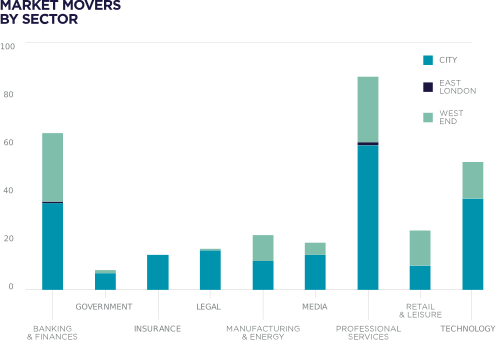
Technology was the most active sector by number of deals, recording 28 expansions and 13 contractions. This translated into the highest level of net expansion across sectors, with 241,200 sq ft recorded, marking a sharp contrast to the net contraction seen in 2024.
The Science and Innovation sector also recorded a notable shift in behaviour, rebounding from the largest net contraction of 222,000 sq ft in 2024 to a net expansion of 146,200 sq ft in 2025.4 While the 2024 total was largely driven by a single contraction of approximately 200,000 sq ft, the net gain this year can partly be attributed to BAE Systems taking 155,500 sq ft at Green Park under the Global Combat Air Programme. While this represents a positive shift for the sector, it also highlights how outcomes can be influenced by a small number of large transactions.
WHO IS MOVING?
A strong return to work mandate may also be linked
to this change, with research suggesting that over
three quarters of financial services firms are planning
to increase office attendance over the course of 2025.
It is particularly notable that the Media sector recorded only expansions, with seven deals and no contractions — resulting in a net gain of 63,400 sq ft. This suggests a clear growth trajectory among media occupiers in 2024. Business Services also showed strong expansion, with nine expansions and just one contraction, contributing
a net gain of 62,200 sq ft.
A reduction in space within the existing office location.
CONTRACTION
SENIOR Research Analyst - National Offices
joshua.woolnough@cushwake.com
Joshua Woolnough
Scotland �Office Agency
stewart.mcmillan@cushwake.com
STEWART MCMILLAN

Head of�UK Research
daryl.perry@cushwake.com
DARYL�PERRY
Regional �Office Agency
david.tonks@cushwake.com
DAVID �TONKS








314�OFFICE�TRANSACTIONS
164�TRANSACTIONS�IN SOUTH EAST

EDUCATION &�MEDICAL�OCCUPIERS

FLEXIBLE�WORKSPACE�OPERATORS

NEW�MARKET�ENTRANTS

ESTABLISHED�OCCUPIERS

EXPANSIONARY ACTIVITY

CONTRACTIONARY�ACTIVITY

THE�NET EFFECT

REGIONAL�VARIATION

SECTORAL �VARIATION

GRADE A �ACTIVITY

GRADE A �EXPANSION

SECONDARY �MARKET �EXPANSION

POST-�PANDEMIC REBALANCING


Cushman & Wakefield (NYSE: CWK) is a leading global commercial real estate services firm for occupiers and investors with approximately 53,000 employees in over 350 offices and nearly 60 countries. In 2025, the firm reported revenue of $10.3 billion across its core service lines of Services, Leasing, Capital markets, and Valuation and other. Built around the belief that Better never settles, the firm receives numerous industry and business accolades for its award-winning culture.
For additional information, visit www.cushmanwakefield.com.
ABOUT CUSHMAN & WAKEFIELD





These include frozen tuition fees, limited revenue growth, declining international student numbers, �and proposed restrictions on overseas graduates remaining in the UK. While this backdrop may soften office demand from higher education occupiers, some offsetting growth is expected from the technical & vocational education sub-sector. This segment is projected to expand, supported by increased government funding and policy initiatives aimed at addressing skills shortages, including the introduction of the Growth and Skills Levy at the close of 2024.
The two largest expansionary deals—BAE Systems taking 155,500 sq ft at Green Park under the Global Combat Air Programme, and Arm taking 94,800 sq ft at Peterhouse Technology Park—both involved occupiers establishing additional offices within the same market. Other notable expansions included Tomato Energy transitioning from serviced space to 31,000 sq ft at PLANT, Basingstoke, �and Skechers expanding its footprint from 17,000 sq ft to 47,000 sq ft at Centrium Business Park, St Albans.
Despite this, the South East also recorded several large contractions, with all five of the largest downsizes occurring in the region. The largest involved RSA Insurance Group reducing its footprint by 82% in a 20,500 sq ft move to �Chart Way, Horsham. In Uxbridge, China National Offshore �Oil Corporation (CNOOC) reduced its space by 65% in a 28,500 sq ft move to Arc Uxbridge. Elsewhere, a number �of occupiers relocated from long-term headquarters into Grade A space, including Boehringer Ingelheim, which reduced its footprint by approximately 60% in a move to Winnersh Triangle, and Canada Life, which reduced its space by over 75% in a 15,300 sq ft move to Clarendon Works, Watford.
In terms of the ‘better’ element of the equation, �deals in Grade A space accounted for 79% of all transactions analysed, with 181 of the 228 deals occurring in newly built or refurbished office space. This volume of deals significantly exceeded the 47 recorded in Grade B and Grade C space, reinforcing �a clear and sustained occupier preference for higher-quality buildings.
Within this Grade A activity, 123 deals (or 68%) involved occupiers expanding their footprint when moving into newly built or refurbished space. In aggregate, these moves resulted in 1.48 million sq ft of additional space being taken, compared with 965,600 sq ft released by occupiers contracting into Grade A space. Overall, moves into Grade A space delivered a net expansion of 515,800 sq ft.
�
Meanwhile, Grade B/C space showed a more modest net expansion of 153,100 sq ft, which was relatively similar to the net gain of 160,100 recorded in in 2024.�
Taken together, the 2025 data suggests that the ‘less but better’ trend may be beginning to shift. While occupiers continue to prioritise best-in-class space, last year’s data indicates that this is, in aggregate, being accompanied by expansion rather than contraction, pointing towards the emergence of a ‘more and better’ dynamic across regional office markets. This mirrors occupier behaviour in London, where across 2024 and 2025 firms have similarly been taking more space while continuing to prioritise higher-quality buildings.�
NUMBERS OF EXPANSIONS & CONTRACTIONS�(PRE & POST COVID)
PRIME OFFICE �RENTS
FUTURE PIPELINE BY REGION



Nonetheless, these findings sit against a broader policy backdrop in which the UK government has identified Life Sciences as a priority sector within its Industrial Strategy and committed to increased investment, alongside plans to raise defence spending to 5% of GDP by 2035. This suggests that occupier demand from both sectors could remain supportive in the longer term.
Clearly, there is overlap between the Technology and Science & Innovation sectors, with many occupiers sitting at the intersection of multiple categories. We expect this convergence to continue, particularly as artificial intelligence increasingly blurs the boundaries between Technology and the sectors it is set to reshape.
Despite recording only four transactions over 5,000 sq ft in 2025, the Media sector stands out as the only sector to record exclusively expansionary activity, resulting in a net gain of 45,000 sq ft. This was also the case in 2024, meaning the sector has been consistently expansionary over the past two years. The nature of media and content production, which often relies on in-person collaboration, may be a contributing factor to this trend.
Rising activity from this sector represents an increasingly established trend within regional office markets. This growth is being driven by structural expansion in the Healthcare sector, alongside greater flexibility in the use of office space following the 2020 amendments to Use Class regulations, which allow office-to-healthcare conversions without the need for full planning consent. Looking ahead, demand is expected to remain robust in the near term. Demographic pressures such as an ageing population and rising obesity rates are set to drive increased demand for healthcare services, while an increase in NHS funding and deeper collaboration between the �NHS and private providers are likely to further support occupier activity.
FLEXIBLE WORKSPACE OPERATORS
Take-up from Flexible Workspace operators totalled 325,700 sq ft across 15 transactions, representing a 30% decline on the 468,600 sq ft recorded in 2024.
This follows a strong wave of activity in the previous year, with operators now more firmly embedded in regional markets, leading to a natural slowdown in take-up as many requirements have already been fulfilled. The South East accounted for approximately half of this activity, with notable transactions including Spaces taking 38,400 sq ft at Mocatta House in Brighton, and Co-Space leasing 28,200 sq ft at Jubilee Square in St Albans.
Across the Big Five, key deals included Cubo securing 31,900 sq ft at 55 Colmore Row in Birmingham, 2-Work taking 26,900 sq ft across two leases in Leeds, and IWG leasing a total of 25,300 sq ft in Bristol and Leeds.
Despite this slowdown in activity, the sector remains �an important component of regional office markets, particularly for occupiers seeking short-term, flexible, and cost-efficient workspace solutions with minimal lead times. Its role as a entry point for smaller businesses and those in transition continues to be evident, supporting occupiers as they scale into conventional space. This is reflected in the volume of occupiers transitioning from serviced to traditional leases, which totalled 263,700 �sq ft across 27 deals, representing a significant 187% increase on the 92,000 sq ft recorded in 2024.
Flexible Workspace Operators
NEW ENTRANTS
Excluding activity from alternative sectors, New Entrants accounted for 307,000 sq ft across 25 transactions in 2025, marking a significant increase on the 100,000 sq ft recorded across 12 deals in 2024.
Notably, over half (56%) of these New Entrants took space for the first time in the South East. Analysis of these new entrants suggests the market is a hub for clustering of certain sectors. One such sector is Science and Innovation, where Roark Aerospace (12,800 sq ft) and Cambridge Aerospace (11,500 sq ft) both stand out as defence companies taking space in Cambridge, as well as consumer health company Kenvue taking up 34,600 sq ft at One Station Hill in Reading in their first lease after becoming independent from Johnson & Johnson.
Energy was another sector of note, with Amentum (34,400 sq ft), Enovate Systems (10,000 sq ft), and Cleanova (6,200 sq ft) all establishing a presence in the South East for the first time. Technology also featured prominently, led by Alianza (23,400 sq ft) taking space in the South East following its acquisition of Metaswitch from Microsoft. Furthermore, semiconductor design automation firm Silicon Frontline Technology (5,000 sq ft) and AI-enabled HR software company Zellis provide examples of firms that sit at either end of the AI-supply chain, and provide indicative examples of the types of demand we could see emerge in the future as AI matures as a technology.
NEW ENTRANTS
Elsewhere, Government & Public sector occupiers were also well represented among New Entrants in 2025. Examples include the Information Commissioner's Office relocating from Wilmslow to Manchester’s CBD, taking 19,800 sq ft at 3 Circle Square, and the Health and Safety Executive leasing 5,400 sq ft at 100 Temple Street, Bristol, having previously been housed within the Government Office for the South West at 2 Rivergate. This trend likely reflects the ongoing decentralisation of government functions into well-connected regional hubs, and reinforces the role of public sector demand in the regional office market.
2BBC (2025), HQ opens for next-generation fighter jet project, July.
The Global Combat Air Programme (GCAP) is a joint UK-Japan-Italy initiative to develop a next-generation sixth-generation fighter jet, led by BAE Systems, Mitsubishi Heavy Industries, and Leonardo S.p.A.
Overall, with net expansion recorded across all size bands, the combined effect was a 19% increase in occupied office space across the Big Five and South East markets.
For the second consecutive year, Bristol recorded the lowest level of net expansion among the Big Five, although the 5,900 sq ft gain represents an increase on the 1,400 sq ft recorded in 2024. A total of 59% of moves were expansionary, with Burges Salmon expanding by 41,600 sq ft to occupy the entirety of One Glass Wharf, the largest expansion in Bristol and the second largest across the Big Five. The largest contraction across both Bristol and the wider Big Five involved OVO Energy and Kaluza vacating 69,700 sq ft at 1 Rivergate before taking a combined 30,700 sq ft at The Crescent and Assembly C. In addition, the largest transaction in Bristol involved Hargreaves Lansdown taking 90,400 sq ft at the Welcome Building, enabling it to ‘right-size’ and reduce its footprint by 9% after being in its previous premises since 2009.
Overall, net expansion across the Big Five totalled 486,000 sq ft. While the scale of expansion varied by market and relative to 2024, analysis across both years indicates that expansionary activity continues to account for the majority of moves, both in terms of deal volume and floorspace. Collectively, the 2025 data suggests that occupier activity in regional city centres is beginning to rebound following a period of post-COVID adjustment, with firms now more likely to expand rather than reduce their office footprint when relocating.

EXPANDERS & �CONTRACTORS BY REGION
The South East’s rebound in 2025 is a notable and �positive narrative. However, when considered alongside the significant contraction recorded in 2024, the region still reflects a net reduction in occupied space over the two-year period.
3DfT = The Department for Transport
4We have classified defence and pharmaceutical / life sciences office occupiers under the ‘Science and Innovation’ sector for the purposes of this report. Only office-led deals have been included, with leases required to be majority office use rather than laboratory space.
Edinburgh (62,400 sq ft), Birmingham (58,000 sq ft), and Leeds (51,100 sq ft) recorded more modest, but still positive, levels of net expansion. In Edinburgh, 75% of analysed moves were expansionary, with Royal London increasing its footprint by 50% through a 70,000 sq ft move to St Andrew House. The largest contraction involved Wood Mackenzie, which reduced its footprint by 22% in a 29,700 sq ft move to Waverley Gate.
In Birmingham, 72% of relocations were expansion-led. �The largest deal (and expansion) involved EY increasing �its footprint by 49% through a 93,800 sq ft move to 3 Chamberlain Square. The largest contraction saw Squire Patton Boggs reduce its footprint by 49% in a 22,200 �sq ft move to 19 Cornwall Street.
Leeds recorded a net expansion of 51,100 sq ft, following a particularly strong 2024 driven by Public sector activity. This trend continued in 2025, with DfT-operated Network Rail and Northern Rail accounting for two of the four largest expansionary deals.3 The remaining two were driven by the Banking & Finance sector, with Interactive Investor and TPT Retirement Solutions increasing their footprints by 150% and 119%, respectively, in moves of approximately 23,300 sq ft. The largest contraction involved Jacobs, which reduced its footprint by 52% in a 17,400 sq ft move to Aire Park.
For the second consecutive year, Bristol recorded the lowest level of net expansion among the Big Five, although the 5,900 sq ft gain represents an increase on the 1,400 sq ft recorded in 2024. A total of 59% of moves were expansionary, with Burges Salmon expanding by 41,600 sq ft to occupy the entirety of One Glass Wharf, the largest expansion in Bristol and the second largest across the Big Five. The largest contraction across both Bristol and the wider Big Five involved OVO Energy and Kaluza vacating 69,700 sq ft at 1 Rivergate before taking a combined 30,700 sq ft at The Crescent and Assembly C. In addition, the largest transaction in Bristol involved Hargreaves Lansdown taking 90,400 sq ft at the Welcome Building, enabling it to ‘right-size’ and reduce its footprint by 9% after being in its previous premises since 2009.
Overall, net expansion across the Big Five totalled 486,000 sq ft. While the scale of expansion varied by market and relative to 2024, analysis across both years indicates that expansionary activity continues to account for the majority of moves, both in terms of deal volume and floorspace. Collectively, the 2025 data suggests that occupier activity in regional city centres is beginning to rebound following a period of post-COVID adjustment, with firms now more likely to expand rather than reduce their office footprint when relocating.
More broadly, all but three sectors recorded net expansions, both in terms of deal numbers and floorspace. While there is no single driver behind this trend, a more widespread return to office-based working �is likely to be a contributing factor. Data from Remit Consulting’s �Return Report indicates that UK office occupancy has reached approximately 44%, the highest level since the survey began in May 2021.5 Furthermore, despite some peaks and troughs occupancy levels have trended upwards throughout 2025 and have remained above 40% since mid-January 2026. This suggests that while hybrid working remains embedded, increasing attendance and more consistent return-to-work mandates may be translating into greater space requirements.
However, these expansionary trends were not universal across all industries. The Insurance sector recorded the largest net loss of office space, with four expansions outweighed by six contractions, resulting �in an overall reduction of 153,100 sq ft. All four of the largest contractions in the sector occurred in the South East, the largest of which involved RSA Insurance Group reducing its footprint by 82% when moving from an office it had occupied since 1997, reflecting a significant right-sizing exercise.
Business Services was also a net contractor in the aggregate, with �four expansions and six contractions resulting in a net loss of 30,200 �sq ft of office space.
Despite the number of expansions (17) exceeding the number of contractions (7), the Manufacturing and Energy sector recorded a net loss of 51,900 sq ft. This was driven by several large consolidations, including China National Offshore Oil Corporation (CNOOC) and Centrica, both of which reduced their footprints by over 50,000 sq ft while taking 28,500 sq ft and 42,000 sq ft respectively.�
5Remit Consulting (2026), UK office occupancy stabilises above 40% as sector divide widens, February.
MORE
BETTER
A key question for the regional office market is whether occupiers that moved in the immediate post-COVID period underestimated their long-term space requirements. Analysis of 2025 moves provides some insight into this, comparing occupiers whose previous move occurred pre-COVID with those who relocated more recently.
For occupiers whose prior move took place before 2020, behaviour remains relatively balanced, with 61 expansionary moves compared with 57 contractions. This suggests that, for more established office footprints, the decision to expand or reduce space remains finely balanced and reflective of individual business requirements.
�In contrast, a clear divergence emerges among occupiers whose previous move occurred post-COVID.6 Of these, 56 moves involved expansion, compared with just 13 contractions. This indicates a strong skew towards expansionary activity among firms that have more recently reset their office strategy.
POST-PANDEMIC REBALANCING
Whilst each occupier has its own circumstances and requirements that influence decisions to expand or contract, data from 2025 presents a clear narrative: firms that took space in the aftermath of the COVID-19 pandemic are, in aggregate, taking more space. This suggests that some occupiers may have initially adopted a more cautious approach to space requirements, and are now recalibrating as workplace attendance stabilises and operational needs become clearer.�
While this does not represent a universal trend, the data provides evidence of a post-COVID adjustment in occupier behaviour, with a subset of firms expanding following earlier, more conservative leasing decisions.
EXPANDERS & CONTRACTORS�BY GRADE
Occupier Market
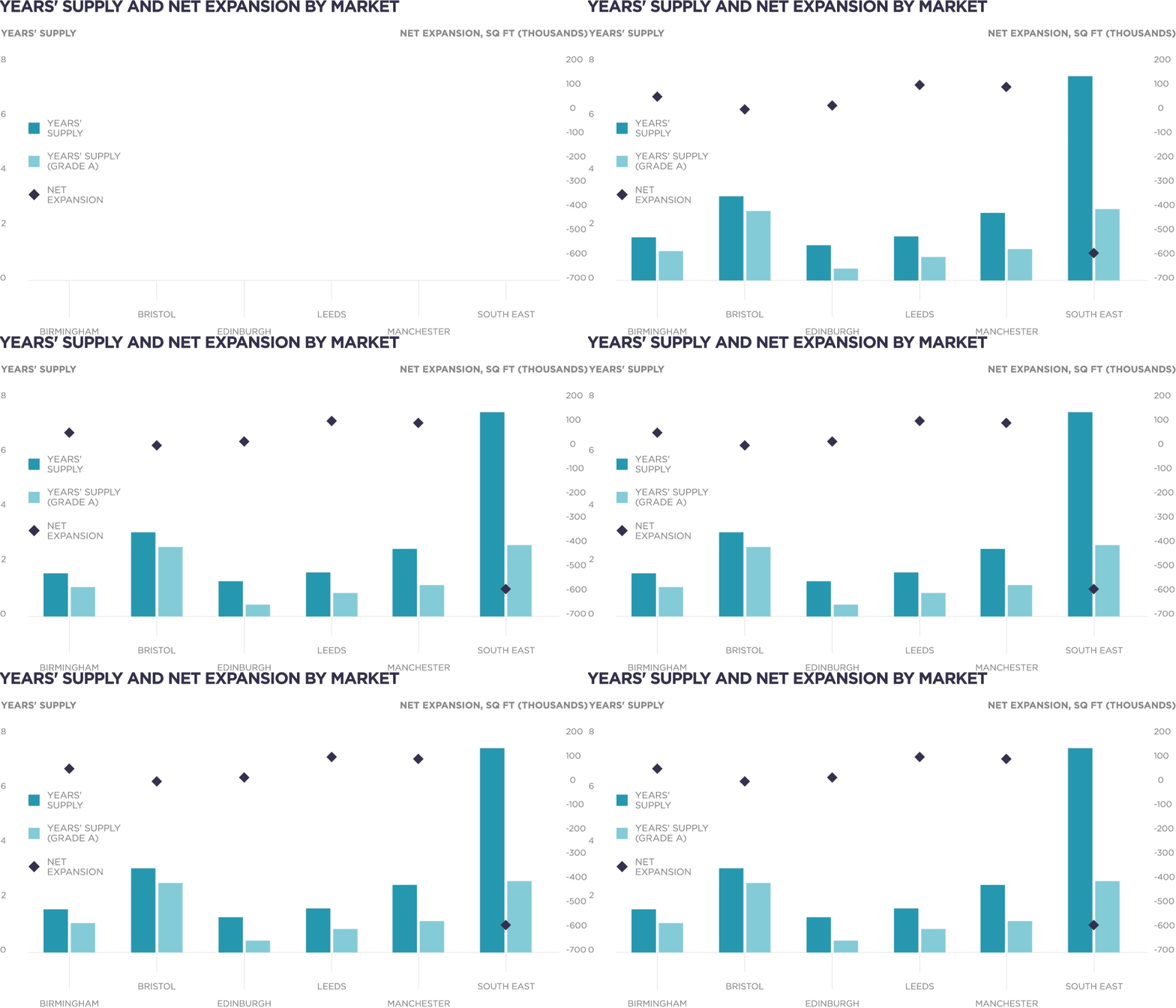
The lack of large-scale leases is a key driver. In 2025, there were 13 leases above 50,000 sq ft totalling 1.14 million sq ft, a 27% decline on the 1.57 million sq ft generated by 16 such leases in 2024.
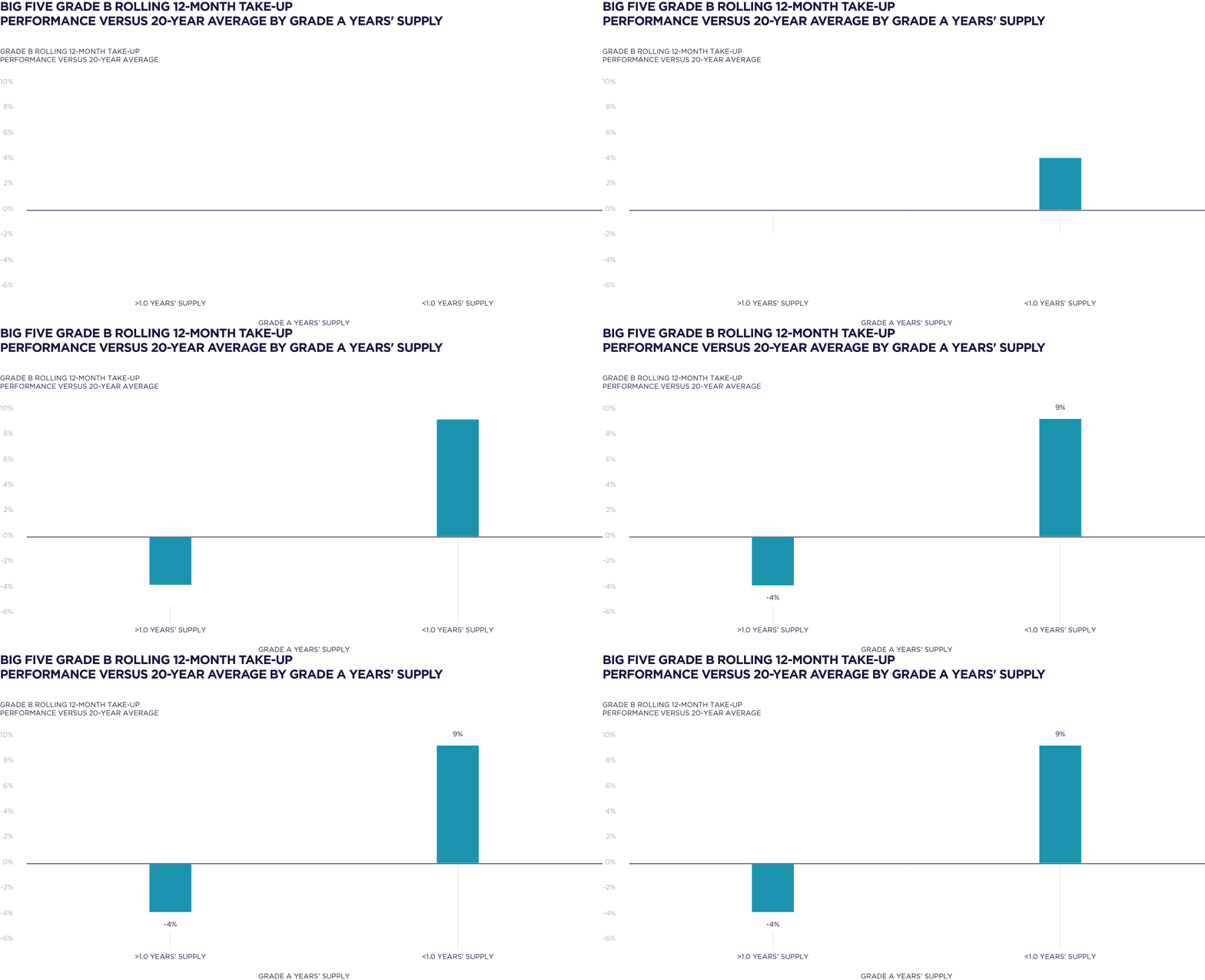
�In addition, For occupier demand to be realised, it must be supported by adequate supply. At the close of 2025, the Big Five markets bar Bristol, as well as the Big Five average, had less than one year’s supply of Grade A office space. This indicates that, based on three-year average demand levels, available supply could be absorbed within a year. In practice, this constraint is likely to suppress take-up as occupiers delay moves, opting instead to re-gear or renew in their existing space, if circumstances allow, while waiting for new supply to come forward. While re-gears are not consistently captured within our datasets, it follows �that the combination of strong demand for high-quality space and constrained Grade A availability is resulting �in more occupiers choosing not to move.
These supply constraints are not expected to be alleviated in the near term. At the time of writing, 2.8 million sq ft of new or comprehensively refurbished space is under construction across the Big Five and South East on a speculative basis.
How does this reconcile with declining take-up levels?
This equates to approximately 61% of the five-year average Grade A take-up, suggesting that a supply shortfall is likely to persist and may intensify in the short term.
One potential catalyst for unlocking new development is further rental growth. The supply-demand imbalance has already placed upward pressure on prime rents, which have increased by approximately 30% on average since 2021, equivalent to an annual growth rate of over 6%. Bristol and Birmingham have both surpassed the £50.00 per sq ft threshold, currently standing at £52.00 per sq ft. More broadly, rents may need to approach closer to £60.00 per sq ft to support speculative development viability. Given the pace of growth in recent years, this threshold may be reached in the near term and has already been achieved in parts of the South East and Greater London.
Until then, supply constraints, combined with rising occupational costs, are likely to drive further increases �in re-gears and renewals. In addition to rental growth, occupiers face rising fit-out costs and the impact of �the 2026 business rates revaluation, which will see higher-value properties in markets such as Reading, Birmingham, and Bristol experience increases in �rateable values of more than 20%.7
The findings from National Office Moves 2026 point towards a more constructive outlook for regional office capital markets. The ‘more and better’ dynamic of 2025 signals improving occupier confidence. This is supportive for leasing fundamentals, underpinning rental growth prospects and enhancing income visibility for well-located, Grade A assets.
This dynamic is reinforced by current pricing. Prime regional office yields remain at a significant discount to both Central London and other asset classes, offering a compelling income opportunity and suggesting that values are more reflective of sentiment than underlying fundamentals.
However, this improving occupier backdrop contrasts with subdued investment activity, with office investment volumes outside of Central London totalling £2.7 billion in 2025, the lowest level in over a decade. This historic low suggests there is potential for volumes to rebound as market conditions stabilise and confidence returns.
Capital Markets
That said, these positive fundamentals are likely to be tempered by ongoing geopolitical and macroeconomic uncertainty, which may continue to weigh on investor confidence and delay the recovery in transaction volumes in the near term. While liquidity remains constrained in the short term, the combination of expansion-led demand, limited supply, and attractive pricing is likely to support a gradual recovery in investor activity. As such, capital is expected to remain focused on prime and value-add opportunities that can deliver or reposition assets into Grade A office space in supply-constrained markets.
Nationally, 88% of core Grade B take-up over the past 20 years has been leases between 5,000 and 50,000 sq ft. This reflects both the clustering benefits of core locations and the availability of smaller, often fitted, secondary spaces.
As such, in a supply-constrained market, we expect an increase in both Grade B and non-core take-up as occupiers compromise on their requirements to secure space.
6For the purposes of this analysis we have define post-COVID as 2020 or later.
7https://www.cushmanwakefield.com/en/united-kingdom/services/business-rates/reviewing-rating-assessments
TAKE-UP PERFORMANCE BY GRADE A YEARS' SUPPLY
POST-PANDEMIC REBALANCING
ADDITIONAL TAKE-UP FROM ALTERNATIVE SECTORS


Overall, the analysis presented in National Office Moves 2026 points to a market where demand is strengthening �but increasingly constrained by supply. While the shift towards ‘more and better’ space highlights growing occupier confidence, the ability of the market to accommodate this demand will depend on the pace at which new, high-quality supply can be delivered.
When occupiers do decide to move, a lack of suitable Grade A supply may force compromises on either location or quality. The nature of this trade-off is often influenced by company size. Larger occupiers are more likely to prioritise scale, moving to non-core locations where larger floorplates remain available. This is reflected in leases above 50,000 sq ft accounting for 49% of non-core take-up since 2005.
In contrast, smaller occupiers tend to prioritise core locations, instead compromising on quality. This is reflected in higher levels of Grade B activity when Grade A supply is constrained, with the Big Five office markets reporting a 9% increase in Grade B take-up when Grade A years’ supply falls below 1.0, compared with a 4% shortfall when supply is above this level.