WORDS: Bakul Patki
Description: XXX
Description: XXX
Description: XXX


SHARE THIS STORY
“I say ‘work in progress’ a lot or ‘this too shall pass’. Also: ‘don’t forget to have fun’.”
What is your mantra?
“A very old Hermès trench, which I got when I worked at the [brand’s] sample sale in the ’90s, plus a McQueen embroidered cape.”
What is your most treasured fashion item?
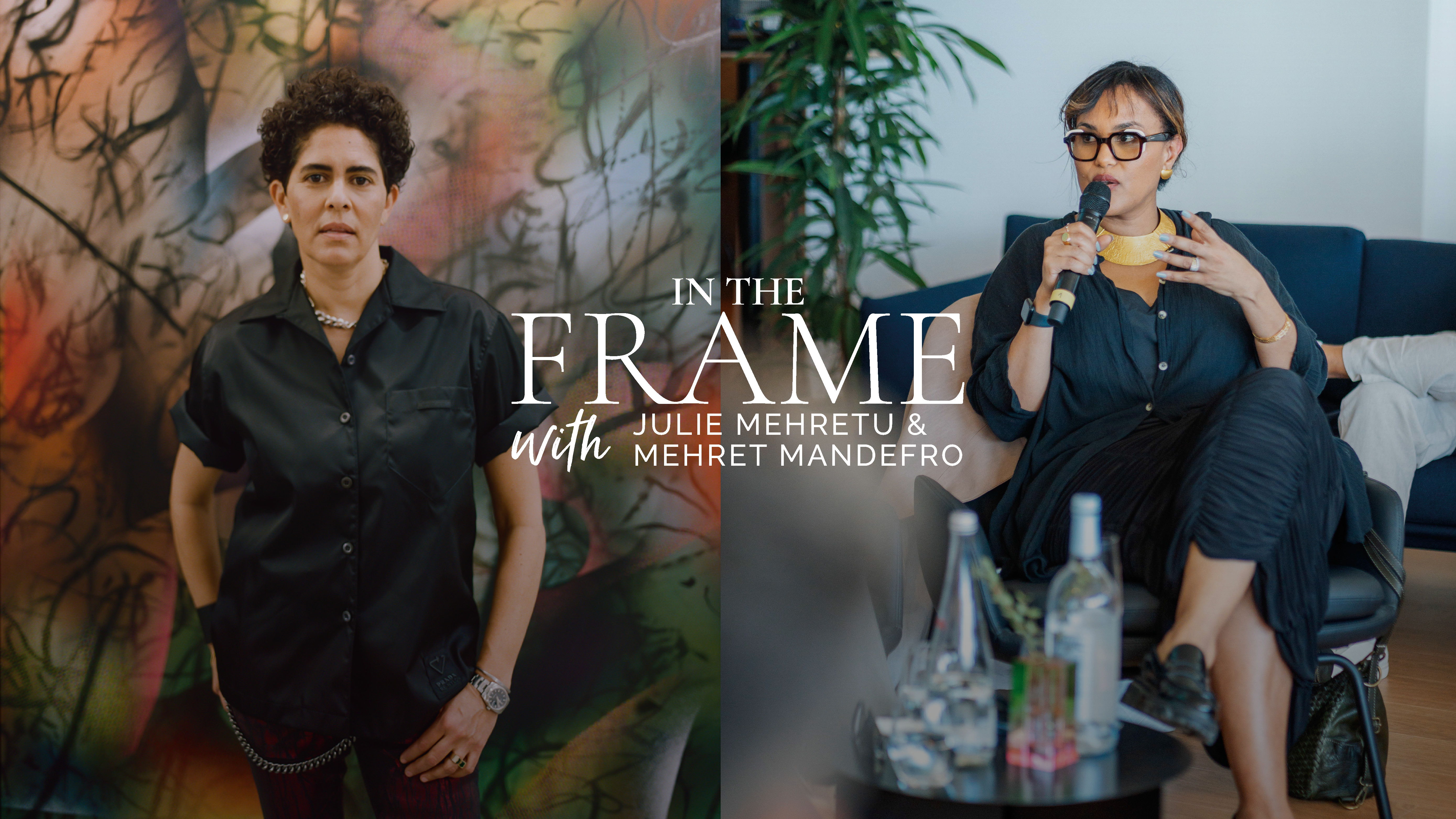
In a first for In the Frame – our series celebrating women in the arts and creative industries – we speak to two women together: artist Julie Mehretu and filmmaker Mehret Mandefro, co-founders of the African Film and Media Arts Collective - a global project strengthening African voices in film and art. Here, they discuss their approaches work, how discomfort can lead to breakthrough, and the double standards faced by women working in culture.


Filmmaker and entrepreneur Mehret Mandefro originally graduated in medicine from Ivy League Harvard University, moving into writing and production, with credits as broad as Netflix’s Little White Lies and Ethiopia's first teen drama series Yegna. She was a White House Fellow under the Obama administration and has a long history of mentoring artists and creative entrepreneurs.
The two formidable women, both Ethiopian-born and New York-based, have a history of collaborating and in 2025, as Mehretu debuted her BMW Art Car, announced the launch of the African Film and Media Arts Collective (AFMAC) - founded to create sustainable infrastructure and strengthen community for artists living in Africa and from the global African diaspora.
We speak to them about inspiration, the power of art and storytelling, and what it means to see this project come to life.
A

One of my favourite musical collectives is The Multi-Story Orchestra who Abimaro, my sister, regularly collaborates with. They’re based in Peckham and often perform in the multistorey car park at [arts organisation] Bold Tendencies; they’re deeply rooted in community and working with local young people. They make beautiful music together – I’m always inspired by their performances.
An artist I’m excited about right now is Halina Edwards. The rawness of her work is beautiful. I really admire what she’s doing with her practice, and I look forward to seeing what she does next. And I’m a big fan of Alvaro Barrington, who seems to be everywhere right now. I love the materiality of his work, and how it engages with wider culture. It’s also just very beautiful.
A must-see show right now is Joy Gregory’s Catching Flies With Honey at Whitechapel Gallery. It’s the first major survey of one the UK’s most innovative photographers and is absolutely brilliant. I’m excited to see the new Beatriz Milhazes exhibition, Além do Horizonte at White Cube Mason’s Yard in Mayfair. Her paintings are so vibrant. Finally, I can’t wait to check out Nike and Palace’s new space Manor Place in South London. They’ve turned a Victorian bathhouse into a beautifully-designed skate park and football cage – and both are accessible for free. They’re also planning to house creative residencies in the building, which is something we definitely need more of.
Creativity is a long game and resilience is essential. I think this is one of my greatest learnings. Forging a career as a creative requires grit, determination and the ability to never give up. Ideas and imagination are at the heart of what we do in the creative industries, but the really hard bit is realising them. How many times have you listened to a film director say ‘this movie took me ten years to make?
If I was to give any other advice I’d say, beware of group think! The late John Ashford, a pioneering curator in contemporary dance and an early mentor told me “It’s essential you form your own taste”. Even in a creative field like the arts, a sense of who’s ‘in’ and who’s not can take hold. Don’t be afraid to disagree, champion ideas and people on the outside, develop our own direction, and stay true to your own taste. Having said that, it’s still important to find your crew and support each other. The majority of creative roles are freelance, with challenging working conditions, so this really helps to make sure no one feels alone.
Hold the door open. When you do get an opportunity or become successful, remember to hold the door open for others. The person who did that for me – took a risk and kick started my career – was the formidable Ruth Mackenzie CBE, who ran the Cultural Olympiad in 2012 and is now DIrector of Arts for the British Council. She was instrumental in awarding me an Arts Council traineeship, which meant I got to work across the dance world in various institutions and be mentored by Ruth and other leaders. Incidentally, my dear friend Indhu Rubasingham got the award for theatre at the same time and is now Artistic Director of the National Theatre. It was life-changing for both of us.
Lola Young OBE (the Baroness not the pop star!) gave me my first job at City Hall. Lola grew up in foster care and her journey to where she is now – a brilliant campaigner and advocate in the House of Lords – is unbelievably inspiring. I highly recommend reading her book ‘Eight Weeks’, which tells the story powerfully.
Mehret Mandefro & Julie Mehretu
Save the date
Turner & Constable
at Tate Britain
1
Julie Mehretu and Mehret Mandefro’s current must-see
UK exhibitions and films to visit and watch.
JMW Turner, Dolbadern Castle, North Wales, 1800 Photo credit © Royal Academy of Arts, London; photographer Prudence
A Flock of Keen-Eyed and Far-Seeing Magpies
at Ibraaz
2
The Otolith Group Library in Residence at Ibraaz @photo Ollie Hammick
My Father’s Shadow
3
My Father's Shadow @Courtesy of Mubi
Lakwena Maciver, How We Build A Home is at Vigo Gallery until 14 December.
The Dior Lady Art project launches its 10th anniversary edition on 13 November, with Maciver’s bags available in select Dior boutiques.
Maciver’s bandana’s and afro combs are available from 29 November via the artist’s official channels, including lakwena.com.
One of my biggest breakthroughs was understanding ‘no permission needed’.
No one needs to pick you”
IMAGES: Danika Magdalena
‘There’s something very powerful about turning everyday things into something extraordinary’
rtist Julie Mehretu is a graduate of the prestigious Rhode Island School of Design, was named one of TIME magazine’s 100 most influential people of 2020 and, last year, was made an officer of the Ordre des Arts et des Lettres by the French Ministry of Culture.
LAKWENA ATELIER © JAMES ROBJANT
AFMAC Workshops
Justine Simons at Blast. Credit: BLAST/Sophie Skittle

Cultural firsts
and creative influences
Julie Mehretu: My first memory of art is incredibly clear, and it came through a gift from my parents. My mother gave me a book on Rembrandt – one of the few things we brought with us when we left Addis Ababa. I vividly remember lying on the floor as a kid, tearing through it and being almost brought to tears by The Sacrifice of Isaac.
The painting, the light, the idea that Abraham’s belief in God would drive him to kill his son… It’s such a moving work.
As a child of Africanists who were trying to build a very different world in the 1960s and 1970s, my parents themselves were also very inspirational. My father was a professor at Addis Ababa University, my mother a Montessorian educator, and both were really formative in how I look at the world, the kinds of questions I ask, the way my perspectives are shaped.
Mehret Mandefro: My first interactions with art also came through my parents. Addis in their era felt like a cultural utopia, and many of their friends were artists. I grew up surrounded by paintings, and I think it’s interesting that I’m now collaborating with a painter.
When it comes to film, my earliest memory is Aliens. I had never met a character like Sigourney Weaver's. She’s really the first kick-ass woman that I remember seeing on screen. Spike Lee’s Do the Right Thing, was equally jolting, but in a very different way. It was those films that started to signal the power of story to me. Safi Faye – the first African woman to have a feature film distributed – was also a major early inspiration. She was an ethnologist, asking big questions about everyday people in a way that felt true to what I was trying to do.
Julie Mehretu, Photo @Jacquie Manni


Mehret Mandefro
Julie Mehretu working working on HOWL, eon (II), , Photo @Tom Powel
Mehret Mandefro: I was a doctor on a physician scientist’s pathway when I realised that stories were at the heart of everything I was doing. I had a PhD in anthropology and was trying to understand health from my patients’ perspective. The minute you start to really focus on people’s lives, inevitably you get to stories – and my research was swimming in them. That’s how I became a filmmaker. My very first film followed me as I tried to find new language to talk about HIV and why HIV was, at the time, killing Black women at an incredibly high rate.
Perspective is key. Careers are not always linear – there are spirals and circles and other diversions. So, when I’m mentoring, I always remind people it’s important to take the long view, because you understand you’re in conversation with so many other people who came before and who are yet to come. I also encourage my mentees to examine how they actually spend their time. Because if you’re not spending most of your time doing the main thing you should be doing, if you’re not driven to do that, then you’re not going to grow. And growing is really the point of it all.
Julie Mehretu:There is no roadmap. No single linear way to do this. Each individual follows their work, so the most important thing is to find your personal connection to your work. Understand what the imperative of making your work is, and where that comes from internally. That will be your driving force. It won’t come from following someone else’s path. For me, that came when I realised abstraction and painting were where I felt like I had the most potency.
Mehret Mandefro: One of my biggest breakthroughs was understanding “no permission needed”. No one needs to pick you. It’s such a scam that whole way of thinking. Film is such an expensive endeavour and requires so many resources, so there are a lot of gatekeepers. But I’ve realised you don’t need to wait – you can just start. And you can go pretty far if you surround yourself with like-minded individuals and do what I call the real work – which is being clear about what you want to say and how you want to say it, and focusing on getting better and better at that.
Julie Mehretu: Learning to deal with discomfort has changed my practice. It has been challenging, but being able to sit with the uncomfortable place of unknowing in the studio – welcoming that even – really learning how to be being patient and present was a breakthrough for me.
The long view – what it takes to
sustain a creative career


BMW Art Car 20 by Julie Mehretu, Photo @Tereze Mudilová
Mehret Mandefro: Around the world culture has been ultra-commodified and sold to the highest bidder. I feel grateful to be working in settings where culture has always been more about the non-monetary value. This is where I see how much women contribute and the continuity they provide through care. For that I celebrate the position women have in culture. Having said that, I’m also a filmmaker who started in production in America, and I know how abysmal the gender politics of Hollywood are. But, again, keeping the longer view helps see where things are changing, and some of the most exciting producers I’ve worked with are women.
Julie Mehretu: As a woman artist, I’ve always made what I want to make and haven’t felt the need to change. But I’ve been surprised by how rigid expectations are – how much the world wants to understand women artists’ work through their gender. I think it’s the same for artists of colour. That doesn’t seem to be the case for artists who are white men. They seem to get the opportunity to just make, and the work is regarded for its own sake, nothing else. This has always really confounded me.
I’m proud of my younger self for being insistent and courageous – and I’m proud of having been able to build a life painting. I’m also glad I’ve been able to contribute to what the world can be for other artists. Denniston Hill – the residency I co-founded over 20 years ago with artist Paul Pfeiffer and architect Lawrence Chua – is one of my proudest achievements. And now AFMAC, of course – the African Film Media Arts Collective that Mehret and I have founded in collaboration with BMW Arts & Culture.
Women in culture – power,
influence and prejudice
‘
I’m proud of my younger self for being insistent and courageous”


Denniston Hill, Photo @WhitneyBrowne
Julie Mehretu: With AFMAC we wanted to bring together a group of artists, through a series of workshops taking place across Africa. The idea of moving workshops came out of my commission to design the BMW Art Car. I was thinking about what the car represented – mobility, space, shelter – and the idea of a creative caravan came to mind. Although the concept has evolved, by hosting workshops in different cities and countries, we’ve been able to reach creative communities across the continent, and built on the interconnectedness of what’s happening in pan-African arts.
Mehret Mandefro: This was one of our key ambitions – to create a collective learning project. One that explores media, because we’re all living in a hypermediated moment. We invited people who are at the top of their game when it comes to media arts – both from cinema and the fine arts, which don’t get combined enough in my opinion, especially in Africa.
Julie Mehretu: Also, we wanted to explore how media arts and filmmaking can be liberatory again. And to push that even further – what about social media, which is so full of fluff? How do we use the mediated environment for radical, liberatory creative and imaginative work?
Mehret Mandefro: We’re incredibly excited to see the first AFMAC exhibition come to life. The workshop phase is done and now we’re working on producing the works of each invited artist that will be shown at Zeitz MOCAA Cape Town. The artists — Jim Chuchu, Robin Coste Lewis, Mati Diop, Wanuri Kahiu, Zeresenay Berhane Mehari, and The Otolith Group – had never been in conversation with each other before they joined AFMAC. Three of them have never exhibited in a museum before. So, we’re really looking forward to seeing what they produce.
The birth of AFMAC and
what it means for African
artists and film


Julie Mehretu (L), Mehret Mandefro (R) AFMAC X DJIBRIL DRAME
JulieMehretu, Photo @Josefina Santos
Zeitz Mocaa
I feel grateful to be working in settings
where culture has always been more about the non-monetary value”
Mehret Mandefro
‘
Julie Mehretu
Mehret Mandefro
Mehret Mandefro: Beyond our own projects, other films coming out of Africa that I’m excited about include On Becoming a Guinea Fowl by Rungano Nyoni, Black Burns Fast by Sandulela Asanda, which just screened at the Berlin Film Festival, and Haile Gerima’s epic 10-hour series Black Lions – Roman Wolves, about the Ethiopian-Italian War. He’s been making it for 30 years, so there’s a lot of anticipation.
Julie Mehretu: There’s lots of great things to see in the UK right now too. Turner & Constable at Tate Britain is a landmark exhibition that plays on the rivalry between the two artists. It’s incredible and definitely worth visiting. AFMAC participants The Otolith Group have a year-long installation at Ibraaz, a new space for art from the global majority, which opened in London last October. They have installed a library, which isn’t just a great resource, but also a really lovely place to hang out.
Mehret Mandefro: And there’s My Father’s Shadow by British-Nigerian director Akinola Davies Jr, which is in cinemas now. The film’s incredible – Davies just won a BAFTA – and everyone in the UK should support that.


‘
Denniston Hill, Photo @WhitneyBrowne
Julie Mehretu, Photo ©Josefina Santos
Mehret Mandefro, Photo courtesy of Mehret Mandefro
on their radar
Find out more about Julie Mehretu and Mehret Mandefro and follow
@juliemehretu and @drmehret
Kairos/Hauntological Variations is open now at the Museum of Modern Art Warsaw
Find out more about AMFAC and its projects