WORDS: Bakul Patki
Description: XXX
“I’ve always been particular about my brows—even on shoots with incredible make-up artists, I’d insist on doing my own.”
Description: XXX
Description: XXX


SHARE THIS STORY
“Of course, I’m very grateful for the successes we have achieved, and yes, we can celebrate these milestones. But I’m always cautious – I never believe I have ‘arrived’. To me, one day you’re in and the next you could be out. You can’t rest on your laurels.”
“I say ‘work in progress’ a lot or ‘this too shall pass’. Also: ‘don’t forget to have fun’.”
What is your mantra?
“In the beginning, the biggest challenge was
doing everything with a small team, but I truly believe it’s important to be hands-on to understand what your business really needs”
“A very old Hermès trench, which I got when I worked at the [brand’s] sample sale in the ’90s, plus a McQueen embroidered cape.”
What is your most treasured fashion item?
I was lucky to be exposed to culture early in life. With hindsight, I realise that one of the biggest gifts my parents gave me was to not put any pressure on me. There was zero academic snobbery in our house; they just wanted me to do things I enjoyed (and I did!). I grew up in Stoke-on-Trent – home of the potteries – and when I think back to my earliest memory of art, that’s what comes to mind. My dad is a professional musician and my mum a self-taught dressmaker alongside her career as a social worker, so home was a creative space too.
Many fundamental life skills that I depend on as Deputy Mayor today, I can connect directly back to my early days of dancing. Discovering dance was a real turning point. It all started at primary school. Rather than learning set techniques or routines, the emphasis was on our own imagination and creativity – and on exploring ideas like love and hope through dance. Dance taught me so many things I wasn’t learning in a traditional classroom: how to work as a team; how to resolve conflict with other people; how to form my own ideas and communicate them. I have so much to thank my brilliant teacher, Dee de Wet, for.
Contemporary dance is where I began my career – as a producer and director. I moved to London in the early 1990s and started programming festivals, managing tours and running venues. After a decade, I found myself becoming interested in life beyond dance and wondering about the bigger story for culture in the city.
When I joined City Hall, London’s creative landscape was very different. At the turn of the millennium, the capital elected its first mayor. There had never been a cultural framework for the city before, Tate Modern hadn’t opened, there was no Frieze Art Fair or New Year’s Eve fireworks. There had never been a real strategy for the creative economy, and now it’s worth £64 billion.
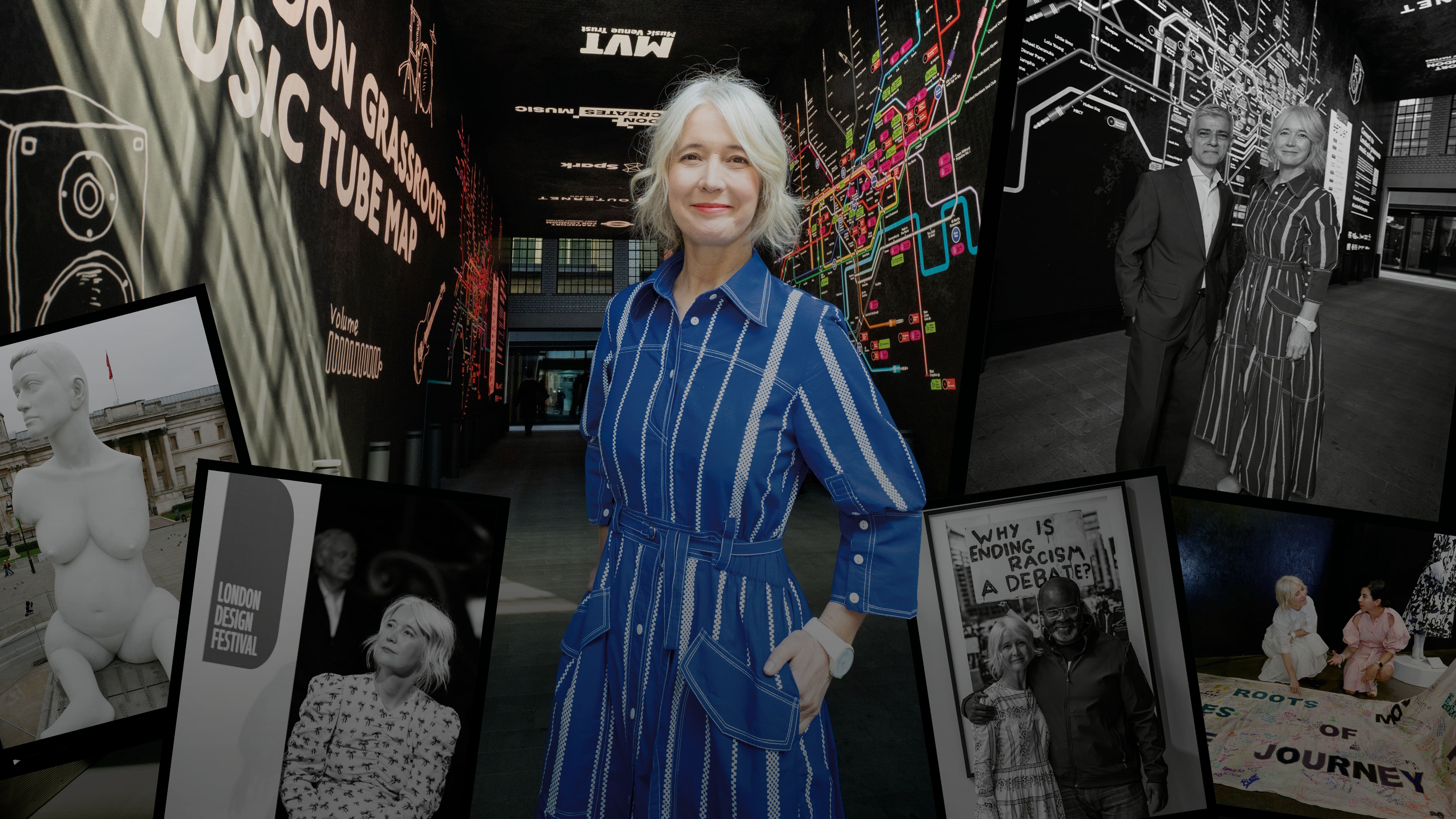
Our mission was clear early on – to make London a global cultural capital where people can lead a creative life, and where everyone can access culture. Culture is our DNA in London. We are a world hub for the creative industries, a filmmaking capital, and the leading incubator for new fashion designers. We have protected grassroots music venues and reversed the collapse of artist studios. The London Design Festival has been copied hundreds of times around the world, and the Fourth Plinth sculpture programme in Trafalgar Square is a global exemplar. This was my first big project at City Hall.
Marc Quinn’s statue of Alison Lapper showed me how powerful art can be. It was the first Fourth Plinth commission I worked on – a bold marble figure of the disabled artist, naked and pregnant. The response was pretty wild – people loved and hated that work. It revealed how much prejudice there is about disability, but it was also a huge boost for the positive representation of disabled people. I’m really proud the project has become so renowned and has inspired so many similar initiatives around the world.
As part of our series In The Frame showcasing inspiring women shaping the arts, we meet London’s Deputy Mayor for Culture and Creative Industries, Justine Simons. She reflects on her inspirations, her future plans, and her role in turning London into one of the great international capitals of culture.
It’s really important to remember the crucial role culture plays and the contribution it makes to all aspects of society”


“Like a building, I understood the business’ foundations. Next, came the challenge of how high we could build it; how many more layers we could add.”
for its independent flair, street culture, and major museums, but without cohesion or any full acknowledgement of the potential impact of the arts to the city and its citizens. Simons – who has supported all three of London’s elected mayors and was appointed Deputy Mayor for Culture and Creative Industries by Sadiq Khan in 2016 – has played a major part in changing that. In the process, she has helped turn the city’s annual creative economy into the £64m behemoth it is today.
For Simons, however, it’s about building community as much as capital. A fierce advocate for everything from the rotating commissions of contemporary art on Trafalgar Square’s Fourth Plinth, to London’s newest cultural district, East Bank, she is determined to bring culture to every corner of the city. Here, she reveals how art in all its forms has shaped her life, as well as her work.
I
Creativity is a long game and resilience is essential. I think this is one of my greatest learnings. Forging a career as a creative requires grit, determination and the ability to never give up. Ideas and imagination are at the heart of what we do in the creative industries, but the really hard bit is realising them. How many times have you listened to a film director say “This movie took me ten years to make”?
If I was to give any other advice I’d say, beware of group think. As the late John Ashford, a pioneering curator in contemporary dance and an early mentor told me: it’s essential you form your own taste. Even in a creative field like the arts, a sense of who’s in and who’s not can take hold. Don’t be afraid to disagree, champion ideas and people on the outside, develop your own direction, and stay true to your own taste. Having said that, it’s still important to find your crew and support each other. The majority of creative roles are freelance, with challenging working conditions, so this really helps to make sure no one feels alone.
When you do get an opportunity or become successful, remember to hold the door open for others. The person who did that for me – took a risk and kick started my career – was the formidable Ruth Mackenzie, who ran the Cultural Olympiad in 2012 and is now Director of Arts for the British Council. She was instrumental in awarding me an Arts Council traineeship, which meant I got to work across the dance world in various institutions and be mentored by Ruth and other leaders. Incidentally, my dear friend Indhu Rubasingham got the award for theatre at the same time and is now Artistic Director of the National Theatre. It was life-changing for both of us.
Lola Young (the baroness not the pop star) gave me my first job at City Hall. Lola grew up in foster care and her journey to where she is now – a brilliant campaigner and advocate in the House of Lords – is unbelievably inspiring. I highly recommend reading her book Eight Weeks: Looking Backwards, Moving Forwards, Defying the Odds, which tells the story powerfully.

One of my favourite musical collectives is The Multi-Story Orchestra who Abimaro, my sister, regularly collaborates with. They’re based in Peckham and often perform in the multistorey car park at [arts organisation] Bold Tendencies; they’re deeply rooted in community and working with local young people. They make beautiful music together – I’m always inspired by their performances.
An artist I’m excited about right now is Halina Edwards. The rawness of her work is beautiful. I really admire what she’s doing with her practice, and I look forward to seeing what she does next. And I’m a big fan of Alvaro Barrington, who seems to be everywhere right now. I love the materiality of his work, and how it engages with wider culture. It’s also just very beautiful.
A must-see show right now is Joy Gregory’s Catching Flies With Honey at Whitechapel Gallery. It’s the first major survey of one the UK’s most innovative photographers and is absolutely brilliant. I’m excited to see the new Beatriz Milhazes exhibition, Além do Horizonte at White Cube Mason’s Yard in Mayfair. Her paintings are so vibrant. Finally, I can’t wait to check out Nike and Palace’s new space Manor Place in South London. They’ve turned a Victorian bathhouse into a beautifully-designed skate park and football cage – and both are accessible for free. They’re also planning to house creative residencies in the building, which is something we definitely need more of.
It’s been hard holding on to my practice since becoming a mother. I think this is where I’ve most seen the impact of being a woman in the arts. My husband is the most amazing father to our children. He’s so involved and engaged, and puts an incredible amount of energy into them, so I would never undermine the part fathers play. But I think there’s something all-consuming about motherhood: the breastfeeding, the sacrificing of your body – it’s completely life-altering. I’ve had three kids, who I really want to give lots of time to, so with each I have worked part-time until they turned three. (My youngest is two.) It’s totally worth it, and I’m so grateful I’m able to do it like this, but it means I’ve had to learn to make peace with less capacity for work. I have to constantly remind myself to accept when my capacity is limited and just to follow my own path.
Working in the arts in government can be challenging. The harsh reality is there are no votes in culture, even if it’s top of the list of what people say they want and love. So, for me, it’s really important to remember the crucial role culture plays and the contribution it makes to all aspects of society. Luckily our mayor, Sadiq Khan, really gets the value of culture too and has given it priority status. That’s been a game changer, in terms of what we can achieve.
For example, for the last decade I’ve been stewarding the cultural legacy of Queen Elizabeth Olympic Park. City Hall has invested more than £600 million into East Bank – the biggest cultural district to be created in over 150 years, with spaces such as V&A East, Sadler’s Wells, BBC Music Studios, and educational institutions, including London College of Fashion. It will attract 1.5m visitors and give a £1.5bn boost to the economy, and I couldn’t be prouder of the long-term impact this will make.


Creativity is a long game and resilience is essential. I think this is one of my greatest learnings. Forging a career as a creative requires grit, determination and the ability to never give up. Ideas and imagination are at the heart of what we do in the creative industries, but the really hard bit is realising them. How many times have you listened to a film director say ‘this movie took me ten years to make?
If I was to give any other advice I’d say, beware of group think! The late John Ashford, a pioneering curator in contemporary dance and an early mentor told me “It’s essential you form your own taste”. Even in a creative field like the arts, a sense of who’s ‘in’ and who’s not can take hold. Don’t be afraid to disagree, champion ideas and people on the outside, develop our own direction, and stay true to your own taste. Having said that, it’s still important to find your crew and support each other. The majority of creative roles are freelance, with challenging working conditions, so this really helps to make sure no one feels alone.
Hold the door open. When you do get an opportunity or become successful, remember to hold the door open for others. The person who did that for me – took a risk and kick started my career – was the formidable Ruth Mackenzie CBE, who ran the Cultural Olympiad in 2012 and is now DIrector of Arts for the British Council. She was instrumental in awarding me an Arts Council traineeship, which meant I got to work across the dance world in various institutions and be mentored by Ruth and other leaders. Incidentally, my dear friend Indhu Rubasingham got the award for theatre at the same time and is now Artistic Director of the National Theatre. It was life-changing for both of us.
Lola Young OBE (the Baroness not the pop star!) gave me my first job at City Hall. Lola grew up in foster care and her journey to where she is now – a brilliant campaigner and advocate in the House of Lords – is unbelievably inspiring. I highly recommend reading her book ‘Eight Weeks’, which tells the story powerfully.
Justine Simons with tapestry. Credit: GLA/JamesOJenkins
Save the date
Frida Khalo
at Tate Modern
1
Justine Simons’ must-sees – in London and elsewhere

Frida Kahlo, Self Portrait with Thorn Necklace and Hummingbird 19
Nickolas Muray Collection of Mexican Art, 66.6 Harry Ransom Research Center, University of Texas, Austin
Southbank Centre 75th Anniversary
2
Royal Festival Hall accross Thames.
@Morley von Sternberg
V&A Wedgwood Collection Stoke-on-Trent
3
Plate from the series 'Harlem Toile de Jouy', printed bone china, Sheila Bridges for Josiah Wedgwood and Sons, 2022 © Victoria and Albert Museum, London
Justine Simons at Chiswick House and Gardens) Credit: GLA/JamesOJenkins
Marc Quinn’s statue of Alison Lapper. Credit: JamesOJenkins
Lakwena Maciver, How We Build A Home is at Vigo Gallery until 14 December.
The Dior Lady Art project launches its 10th anniversary edition on 13 November, with Maciver’s bags available in select Dior boutiques.
Maciver’s bandana’s and afro combs are available from 29 November via the artist’s official channels, including lakwena.com.
Forging a career as a creative requires grit, determination and the ability to never give up. Ideas and imagination are at the heart of what we do in the creative industries, but the really hard bit is realising them”
‘
The best advice I can give is to be sincere, and to tell your own story in your own way. That’s what I’ve always tried to do, and I think it speaks to people’
IMAGES: Danika Magdalena
‘There’s something very powerful about turning everyday things into something extraordinary’
t’s hard to imagine a time when London wasn’t the locus of contemporary culture it is today. But back in the late 1990s and early 2000s – around the time that Justine Simons first joined City Hall – the capital was a very different place. Full of heritage, yes, and famous


Justine Simons at London Design Festival launch. Credit @BenEvansphotography


The suffragettes used the phrase “Deeds not words” – and that’s my mantra too. There’s no point writing a well-meaning policy document about equality, if nothing changes in real life. Women are more likely to be employed in arts and culture, but leadership and decision-making roles are still predominantly male. So, there is a long way to go. Women artists are also still underrepresented in exhibitions and gallery collections. I love the artist activists Guerrilla Girls, whose work makes this point brilliantly. They’ve been going for 40 years and still deliver the hard-hitting facts with searing humour.
Art has always pushed boundaries, whether socially, politically or technologically. Today, we see this happening with AI and digital tech, and – as with all innovations – there are benefits and threats. There is no denying these developments are reshaping the cultural and creative industries – accelerating, disrupting, and making way for new forms of cultural expression, as well as transforming traditional ones. But we must get it right with tech in the creative industries, particularly AI. I believe passionately that we must value human creativity, not exploit it. If your business model depends on stealing other people’s ideas, then that’s not a business model.

‘
Don’t be afraid to disagree, champion ideas and people on the outside, develop your own direction, and stay true to your own taste”
There’s lots to look forward to in 2026. The new London Museum will open in the historic Smithfield Market, and next door to that we’ve developed the Fashion Residency at Studio Smithfield with Paul Smith’s Foundation and Projekt. It gives fashion designers the chance to take their careers to the next level, with free studio space and mentoring – all in the heart of the London. Look out for these Fashion Residency names in the year ahead: Harri, Joyce Bao, Masha Popova, Petra Fagerström, Eden Tan and Renata Brenha. You heard it here first.
I’m really excited for the upcoming Frida Kahlo show, Frida: The Making of an Icon, at Tate Modern next summer, which will tell the story of how she became one of the most influential artists of all time, and a cultural phenomenon. I’ve had the privilege of visiting her house in Mexico City – she was an extraordinary woman.
2026 marks 75 years since the Festival of Britain, and the creation of the Southbank Centre, which will host a year-long programme celebrating the anniversary and looking to the future. There’s going to be something for everyone – across literature, music, theatre, visual arts – and everything in between.
Outside London, I’d really recommend the extraordinary V&A Wedgwood Collection in my home town, Stoke-on-Trent. The exquisite ceramics, the artistry and the innovation are mind blowing. While you’re there, there are brilliant factory shops around the city, so you can come home with some proper souvenirs.


LAKWENA ATELIER © JAMES ROBJANT

Justine Simons & Sinead Burke at London Design Festival Credit: LondonDesignFestival Iona Wolff


Culture is our DNA in London. We are a world hub for the creative industries, a filmmaking capital, and the leading incubator for new fashion designers”
We must get it right with tech in the creative industries, particularly AI. I believe passionately that we must value human creativity, not exploit it. If your business model depends on stealing other people’s ideas, then that’s not a business model”
Mayor of London Sadiq Khan & Justine Simons at Fashion Awards 2025.
Credit: British Fashion Council/Shaun James Cox
Talent House Credit: GLA/CarolineTeo
Topshop fashion show at Trafalgar Square. Credit: GLA/CarolineTeo

Justine Simons at V&A East David Bowie Centre. Credit: GLA/CarolineTeo
TfL tube Credit: GLA/CarolineTeo
Justine Simons x 100 years female voting rights) Credit: GLA/CarolineTeo
Justine Simons at Tate Modern) Credit: GLA/JamesOJenkins
Justine Simons at Blast. Credit: BLAST/Sophie Skittle
‘
‘
‘
‘