of this, along with other key rules: Treat all guns as if they’re live and loaded. No fingers on triggers unless they’re ready to fire. ��They are a small group of women—one with a tiny turquoise gun in her hand, another wearing a “Wanna Bang” shirt—six in total. Each gathered on this wintry Wednesday evening for one of Samms’s Girls’ Night Out events, a bi-monthly meet-up she hosts to provide firearm training specifically to women. The group is part of A Girl & A Gun, a women-only shooting league with chapters all across the country and members in every state. This is the newest and smaller of Samms’s chapters, she tells me. She also runs a larger group, with about 130 women, in Baltimore. ��
Before the women hit the range for target practice, Samms begins the night with an hour-long interactive lesson. The educational component is super important, she says. It’s not enough that a woman knows how to shoot a gun; she needs to know how to be safe and confident with one as well. Sometimes Samms teaches the women about how to better grip their weapons or how to handle recoil, but tonight, the focus is on “dry fire drills,” a practice of shooting guns without ammunition to improve on the fundamentals.��
As the women work through their reps—locking the slide, racking the slide, quick drawing their weapons—Samms paces the room, providing tips and advice as she passes by each station.��
“Think about what’s happening with your gun when you flinch.”��
“Be more mindful of your pressure and grip.”��
“If you aren’t shooting well, that’s a sign to stop shooting and figure out why.”��
Samms moves through the space with an easy confidence. She grew up in upstate New York, where guns weren’t taboo, but she didn’t really have exposure to them. Eventually, she moved to Maryland to go to college, got a job in the Army as an engineer, and met her fiancé. Sometimes for date night, they’d go to the gun range, and eventually she realized that she wasn’t just going along for him—she enjoyed it.��
She also realized that she was often the only woman in the room and there were never female instructors. To help fill that gap, six years ago she got certified to teach and started her company Honeybear Tactical to provide lessons, before eventually joining A Girl & A Gun as a chapter facilitator.
�
“At one point, I was like, there’s no need for women-only classes,” she says. “I can do anything a man can do, probably better. But when I thought about the uniqueness of a women-only environment, you can just see and feel it’s different. We’re more supportive of each other; we’re not judging. It’s not about the machismo of it all.” �
O
ne’s gun should never be pointed at anything they’re not willing to destroy. Standing in front of the room at Precision Point Shooting and Training Center in Frederick, Maryland, holding a heavy black pistol, Charneta Samms reminds them
(Dylan Burges) Left: Sandra Woodruff and Robyn Sandoval speak to a group of women at A Girl & A Gun gathering.
her contractions started, she left home, but chose not to go to Al-Awda Hospital because of the danger. Instead, she went to a tent clinic newly set up in central Gaza by the International Medical Corps. Pain relief was not available for her eight-hour delivery, so she had to work through excruciating contractions. Against all odds, her baby boy was born healthy. She named him Yamen, which meant “generosity and ease,” something she longed for.
�Abed stayed at the hospital for just a few hours after the birth and then went home because there wasn’t space to keep women for long. There, she groaned in pain and bled for days. But she was able to breastfeed, and Yamen thrived. Food was scarce but enough. She imagined a better future, of taking him to schools and parks and restaurants. Of having ease again.
�At Al-Awda Hospital, Al-Nashef was nearing the end of her six-week medical mission. When a bomb went off, she instinctively knew to jump away from the glass because the IDF usually struck a second time. One of her fellow midwives had nearly lost her arm to shrapnel. She'd spoken to young boys who acted like men, including one who held his brother in pieces. She'd watched as more women gave birth to preterm babies, like Alreqeb’s wife had, likely from the stress of war.
�One day in July, Al-Nashef heard a drone outside the hospital that she thought was a “zenana,” which means “buzzing” in Arabic—an IDF drone that is loud on purpose to let people know they’re under surveillance. But it was a quadcopter, a far more terrifying drone with four rotors that can kill people at close range. Al-Nashef was helping a woman push out her baby when the quadcopter started shooting. The woman panicked. “I said, ‘Forget about it, no one is coming close, just have the baby,’” Al-Nashef said. “I’m suturing her and hearing the firing, trying to calm her down, and you just have no idea what’s going on.”
�Where before her colleagues were overworked, now “they are holding on by a thread,” she said. “They went to work, helped people have their babies…but they’re so exhausted, they kind of dissociate.” When Al-Nashef finally left Gaza for home, she immediately began thinking about returning later this year. She struggled with guilt at having left her colleagues behind. “Something about Gaza takes a piece of your heart and leaves it there,” she said.
�In Cairo, Alreqeb’s daughter, Salma, received a much-needed surgery. Between shifts at the hospital, Alreqeb speaks to his wife and daughters over WhatsApp as often as he can. All he wants, all any ordinary person in Gaza wants—the mothers, the humanitarian agencies, the doctors and midwives—is a ceasefire so the war can end. Some days he sounds deeply sad, other days he speaks with fight in his voice. “Maybe you hear that people of Gaza, they love death, or they know nothing except death,” he said by voice note in June. “But actually,” he told me, “we people of Gaza, we love life.”
�Abed had loved her life before the war; being a mom, working with her husband on building their own graphic design company as they saved for a house. Alreqeb loved his life, too: watching romantic movies with Issra at home, taking his daughter to restaurants, bringing life into the world without bombs. His tent clinic, he said, is the seed of a larger idea; he wants to build his own maternity hospital after the war, when all of Gaza is rebuilding—and being reborn.�
her contractions started, she left home, but chose not to go to Al-Awda Hospital because of the danger. Instead, she went to a tent clinic newly set up in central Gaza by the International Medical Corps. Pain relief was not available for her eight-hour delivery, so she had to work through excruciating contractions. Against all odds, her baby boy was born healthy. She named him Yamen, which meant “generosity and ease,” something she longed for.
�


All across the country, on any given night, ladies from a wide range of ages, beliefs, and backgrounds come together to make friends and shoot firearms. This is what it’s like.
BY ANDREA STANLEY
Inside a Gun Club for Women�

Read more stories from our Women and Gun series.


“When I thought about the uniqueness of a women-only environment, you can just see and feel it’s different.”
the holidays, and there are prizes for anyone who can take out Frosty, an ominous-looking snowman that seems ready to wreak havoc.��Until 2019, Woodruff never really had an interest in guns. Her husband, who grew up on a farm, kept them around the house, but she avoided them, worried that one would go off. As her husband continued to encourage her to get her license, Woodruff decided it was “an opportunity to overcome her fear” and took a lesson. “What I initially was seeking was knowledge,” Woodruff says. “Then when I tried it, I felt calm, and I was shooting pretty well at my first attempt. It was such a sense of accomplishment and empowerment to shoot and hit what I was aiming at.”��
Woodruff was hooked—and about to retire from her 35-year career as the deputy director of school management for the state of Texas, so she had extra time on her hands. Woodruff decided to go through training to become an instructor, which led her to A Girl & A Gun, where she leads two chapters of around 300 women, and now serves as the organization’s COO. ��
Working with women was important for Woodruff. While she had been a natural when she picked up a gun, she didn’t naturally fit into the gun scene. “Women think about things differently, and we use different words to describe things. We have different life experiences. Being around women is a safe place and a safe way to ask questions without feeling judged,” she says. “It still happens to me. I’ll be in a gun store and ask a question, and the guy will look at my husband to answer my question.”��
I
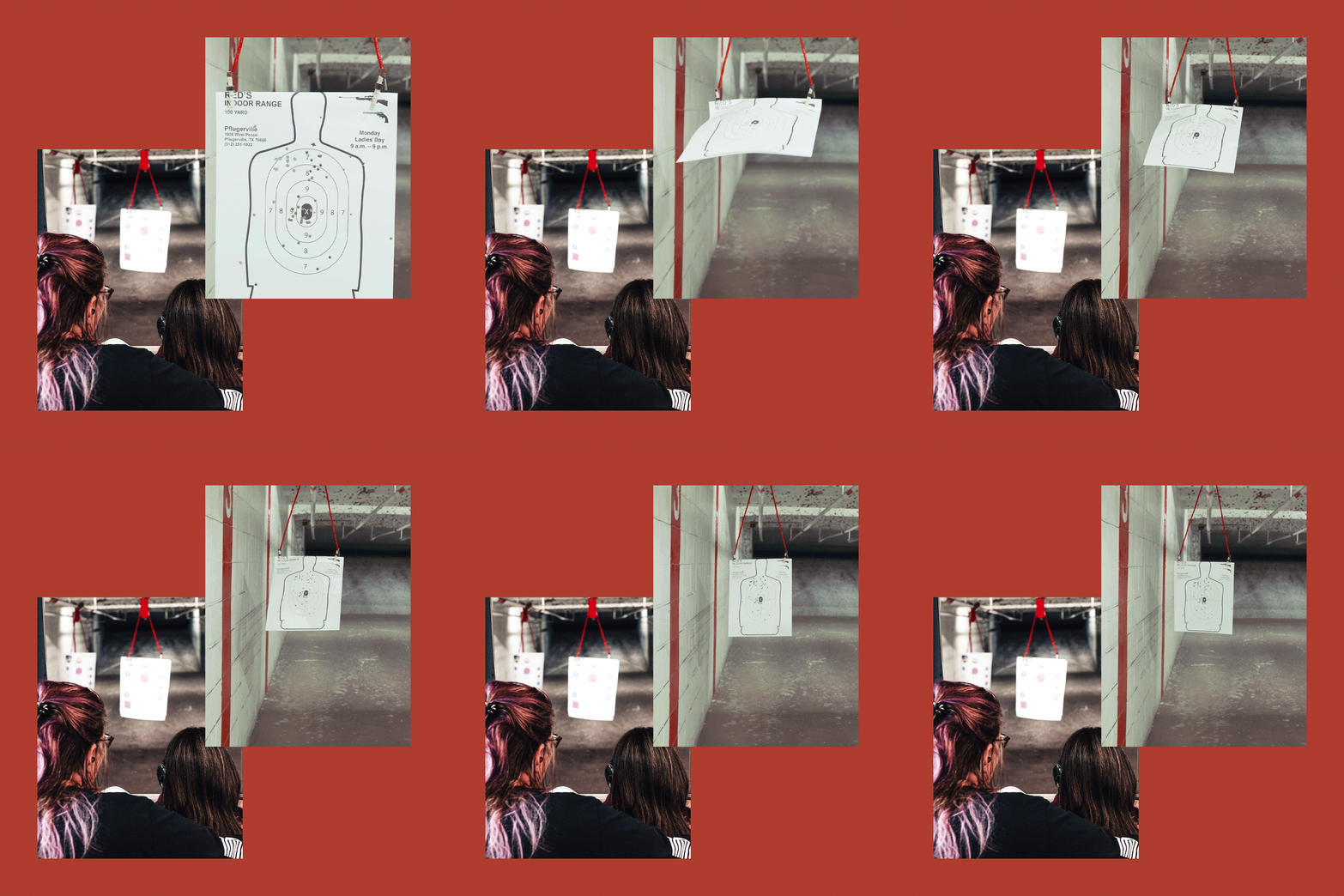
t’s ladies’ night at Red’s Indoor Range outside of Austin, Texas, and Sandra Woodruff is preparing a group of women for a night of target practice. They’ll shoot for an hour or until they run out of bullets, whichever comes first. It’s shortly before�
“I’ll be in a gun store and ask a question, and the guy will look at my husband to answer my question.”
As the women file into the range, goggles over their eyes and ear protection on, Kelsey Crouch, who’s been going to A Girl & A Gun meet-ups since 2021, tells me, “I just wanted a way to further my self-defense skills and make friends with women who had the same interests as me. I love that there’s space for everyone here.”
�When she gets to her lane, Crouch unzips a black bag and pulls out a handgun. She lays it on its side, fills a chamber with bullets, and eventually pops it into the butt of her weapon. She pulls back the rack, points it at the target, and fires a few rounds. A wave of gold bullet casings falling at her feet. Oh wow, says a woman standing nearby. At first, in amazement, and then: “Mind if I try?” ��
After the range, the women gather to eat grilled shrimp and sirloins at a nearby Texas Roadhouse. Every meet-up ends with dinner, a chance for them to connect and have conversations about everything from how they talk to their kids about guns to how they handle it when someone they work with discovers they own a weapon. It’s there that they all tell me similar versions of the same thing: They learned to shoot to protect themselves. ��
Julee Karr tells me she’s six feet tall and not scared of a lot of people, but learning how to be proficient with a firearm gave her a whole new level of confidence. Teresa Sykora tells me she learned to shoot after her husband passed away; she lives in a rural area, and having her gun makes her feel like she can take care of herself. Grace Latour told me she was working in a dangerous area; having a weapon made her feel like she was in a “whole new world.” Crouch experienced a break-in; having a gun could have changed everything.
This is something Samms has seen in her group, too. “I’ve had women coming in to take a class because their husband has a gun in the house and they want to be comfortable using it or they’ve actually been robbed at gunpoint or assaulted. But a lot more of what I hear is that the world is crazy and I need to protect myself,” she says.��
But the notion that a gun will protect you does not always prevail. A report by the Giffords Law Center, a gun violence prevention organization, found that the presence of a gun in a domestic violence situation increases the risk of death for women, with more than two-thirds of intimate-partner homicides of women involving a gun. A separate study in the American Journal of Public Health reported that firearm access by abusers is a major predictor of femicide. ��
Many of the women I spoke to explain that this is precisely why women need training. For too long, there was a gap. In the world of guns, men often had the upper hand. “A gun is not a talisman that keeps you safe by owning it,” Erin Palette, a national coordinator for the Pink Pistols, an LGBTQ+-friendly shooting group, writes to me in an email in early March. “Rather, it’s a tool that you must practice with to use safely and effectively.”��
But whether they’d like to admit it or not, it’s also not just about safety. Many of the women I spoke to also discovered that shooting guns was just fun, signing up for competitions where they could show off their skills. “Women often say they buy guns for self-defense—and that’s real—but it’s also the most socially acceptable reason for women to give,” Kelley says. “In my research, many women also say, often more quietly, that they shoot because it’s fun, skill-based, and enjoyable, even if that pleasure sits alongside careful safety practices and moral limits.” �
of her own whose safety she worried about in school, that aversion only grew. Every time she cast a ballot, she voted for the candidate who she thought would be strict on firearms.��But then her husband bought one. He wanted her to get more comfortable with it and discovered a meet-up in their community with other women. It felt like the right setting for Sandoval, and she left feeling empowered and enlightened. Her experience got Sandoval thinking about guns and how a lot of what she’d been told about them no longer felt right. She saw the media as having an agenda, focusing more on opinion than fact. ��
With her job in publishing changing, she decided to focus full-time on helping a friend launch A Girl & A Gun. That was 15 years ago. Now, the organization boasts 33,000 members and is the largest women’s firearm training organization in the country, training an average of 50,000 women a year. ��
“A lot of women come because they find out that they can,” Sandoval says. “They find out that they don’t have to be a man or a cop or have military experience. You can just be a regular mom that shows up to the range, and having that opportunity is something that a lot of people didn’t know they had. Once they know they have it, it’s something they want to take advantage of.”��
She adds, “We really want—it sounds silly—but to appeal to the whole woman. She’s not just learning firearms. She’s on a journey, and she’s part of a community. What I have found watching women, is I have witnessed them living their best lives, and the confidence I see them gain on the range translates to so many other areas of their lives that they never thought possible.” ��Sandoval doesn’t just want the women who come to A Girl & A Gun to find information, but a “community.” She says, “I want you to make friends and be connected to where you feel like you have mentorship and a peer group.”
When people speak of community, often what they mean is inclusivity. Places more open to diversity of thought or appearance. “There’s a number of women-focused organizations because they want to hang out with people who aren’t misogynist pigs,” Gardner says, adding that it’s not just true for women. “There are LGBTQ+ organizations because they want to shoot guns with people who don’t want them dead. There are organizations for Black folks because they want to shoot guns with people who don’t want them dead. There’s a theme here. We want to hang out with people who don’t question our existence.”�
B
efore she was the president and CEO of A Girl & A Gun, Robyn Sandoval was against guns. “I’m a native Texan, but my parents were California transplants, so guns were not a part of our life,” Sandoval says. As she got older, and had a kid
“Demographics aren’t monolithic, �and people have varied opinions about things.”
(Dylan Burges) Writer and Marie Claire executive editor Andrea Stanley (right) learning the basics.
That was true for Palette, too. “There is an assumption that queer people hate guns and love gun control. That isn’t true. Demographics aren’t monolithic, and people have varied opinions about things. Spaces like Pink Pistols are important because representation matters. Normalization matters. Acceptance matters. Queer people need to see that it’s okay to be a gun owner, and gun owners need to see that queer people also support the Second Amendment, enjoy recreational shooting, and believe in responsible armed self-defense.”��
Inclusive spaces also address some of the larger, stickier issues around gun ownership in minority communities. L.A. Progressive Shooters, for example, was founded by Tom Nguyen, an immigrant who fled a war. He understands “guns can be triggering and have traumatic associations in many BIPOC communities” and is against stereotypical gun culture. It’s why the group doesn’t practice in indoor ranges, so they’re not in close proximity to the “unsafe general public.”��
“Two things can be true at once: People of color may feel a heightened need for protection, and they may also face higher costs and risks in being armed, especially in relation to surveillance, stigma, and policing,” Kelley says. “In my book’s chapter on intersectional identities, I discuss how Black gun owners confront systemic challenges and the possibility of escalated police encounters, plus hostile or unwelcoming training environments that can push people toward affinity-based groups and separate organizations for safety and belonging.”
“People of color may feel a heightened need for protection, and they may also face higher costs and risks in being armed.”
Encountering firearms is not new to me. I grew up in a house with hunting rifles. My dad shot deer for meat, locked away his guns when not in use, and taught my siblings and I the importance of safety. Guns were not toys, and we abided by a deep respect for them. But as an adult, my interactions with guns is virtually non-existent. ��
The women huddle around me in a half-moon of support. Woodruff can see my shoulders stiff and rising into my ears. She places her hand on my back, pushes me forward, tells me to spread my feet apart just so. Crouch tells me not to fear any reverberation from the gun, imagine my body like a marshmallow, and just let it move through me.��
When I eventually line up the sight, press my finger against the trigger, and miraculously hit a near-perfect shot, everyone is genuinely happy for me. I feel: like what? Like the heavy birthright that lives in the body of every woman, the one that alerts her that she’s at a physical disadvantage just by being in the presence of a man, is lifted. For once, if just for a split second, it feels as if I’m in complete control.��
It all seems so tenuous, though. That fatalism is a foregone conclusion in the tenor of our culture feels like a problem. The idea that we live in such a constant state of fear seems to signal that something bigger is broken. The issues of misogyny, homophobia, racism, hate—the things that stoke violence and threaten harm—are issues that seem to require us, as a society, to reach higher for a solve. ��
Are guns really the answer?��
B
ack at the range in Texas, when I pick up a 9mm pistol for the first time, my hands are shaking. Even with ear protection, the room is loud, and every time I hear a gun go off, my body tenses; it’s hard to keep my eyes from blinking.


Right front: Charneta Samms, a chapter facilitator for A Girl & A Gun in Maryland, during a girls' night out event.
“I’m not a sociologist or a psychologist; I don’t know how to make us less violent toward each other,” Palette says. “I can state that American society is more peaceful and equitable now than at any other point in our history. But I can tell you that firearms are a peerless defense against violence.”��
When I pose this question to Samms, she doesn’t necessarily disagree, but also is quick to not want to get political. For her, anyone is welcome at her chapters, whatever their beliefs. “We want to make sure it’s an open environment for any woman who wants to come, for whatever reason, and so we try to keep politics out of it from that perspective,” she says.
�
She adds, “If you choose to not want to shoot guns, hey, more power to you. But I really hope that people will be more open to the conversation. It’s frustrating when it feels like there’s no room for discussions. Where’s the healthy debate? Where’s our ability to try and understand and see other people’s perspectives before we just shut it down?”��
If different people could come together, have meaningful, hard conversations, and walk away with an understanding of each other, wouldn’t that be nice? For Samms, maybe that’s the answer, if not entirely—and that’s worth aiming for.
“If you choose to not want to shoot guns, hey, more power to you. But I really hope that people will be more open to the conversation.”
Between 2020 and 2022, Americans purchased nearly 60 million guns, which was twice the average level, according to a report by The Trace, a nonprofit news organization. Many of those guns were purchased by people who already owned them, but there was also an increase in people purchasing a firearm for the first time. Many of those new owners came from groups that historically had lower ownership rates, including minorities and women; the latter making up 50 percent of new purchases. ��Similarly, a 2016 Marie Claire survey conducted in partnership with the Harvard Injury Control Research Center, showed that 12 percent of women owned a gun. In December 2025, we conducted the same survey again, which showed that number had risen to 19 percent. ��
And perhaps continues to grow. In a blog post on the A Girl & A Gun site in January of this year, it was noted that requests for instructor-led training rose to 52 percent, the highest in six months. A trend seen across the country. On a video call in late February, Ed Gardner, executive director of the Liberal Gun Club, told me he’s certainly seen more women reaching out recently too. ��
Driving the uptick is often a current event, Gardner says: COVID, the election of Donald Trump, the murder of George Floyd, the #MeToo movement, and most recently, the death of Alex Pretti, who was shot and killed by federal agents in Minneapolis, Minnesota. �
T
ake a second, and picture a gun owner. Most of us see the same thing: a man, probably white, his beliefs conventional and conservative and ministered from the pulpit of a domestically manufactured pick-up truck. That image is misleading.
“Women are often navigating gun culture itself, seeking ‘a room of their own’ where they can ask beginner questions and learn without being talked down to.”
With the rise in women’s interest in guns, comes a need for knowledge. “A woman’s pathway into gun ownership is a process: gathering information, locating a trusted instructor, learning storage practices, and trying firearms before choosing one,” says Margaret S. Kelley, PhD, a professor at the University of Kansas who studies the intersection of women and guns and the author of “A Gun of Her Own: The Everyday Lives of Women Who Shoot.” ��
In that process, Kelley adds, “women are often navigating gun culture itself, seeking ‘a room of their own’ where they can ask beginner questions, learn without being talked down to, and make choices based on their actual bodies and daily routines.” For many women, groups like A Girl and A Gun become that room.�
Reports suggest attitudes around firearms are changing. To understand, we partnered with the Harvard Injury Control Research Center on a survey that looks at everything from interest in guns to fears to political feelings.
How �Do Women Really Feel About Guns?
BY ANDREA STANLEY
Read more stories from our Women and Gun series.
“I had to tell myself it’ll never happen again—and then it did.”
“When I thought about the uniqueness of a women-only environment, you can just see and feel it’s different.”
“When I thought about the uniqueness of a women-only environment, you can just see and feel it’s different.”
“I’ll be in a gun store and ask a question, and the guy will look at my husband to answer my question.”
“I’ll be in a gun store and ask a question, and the guy will look at my husband to answer my question.”
“Demographics aren’t monolithic, �and people have varied opinions about things.”
“People of color may feel a heightened need for protection, and they may also face higher costs and risks in being armed.”
Content warning: The following story contains references to gun violence.
Content warning: The following story contains references to gun violence.
(Dylan Burges) Center: Sandra Woodruff, COO of A Girl & A Gun, gives a safety lesson before hitting the range.
(Dylan Burges) A December gathering of A Girl & A Gun in Austin, Texas.
(Photo credit: Salma Helmi Awni Kaddoumi)
(Photo credit: Salma Helmi Awni Kaddoumi)A meet-up of the Austin, Texas chapter of A Girl & A Gun, a women-only shooting league.
(Photo credit: Salma Helmi Awni Kaddoumi)A meet-up of the Austin, Texas chapter of A Girl & A Gun, a women-only shooting league.
(Photo credit: Salma Helmi Awni Kaddoumi)A meet-up of the Austin, Texas chapter of A Girl & A Gun, a women-only shooting league.
(Photo credit: Salma Helmi Awni Kaddoumi)A meet-up of the Austin, Texas chapter of A Girl & A Gun, a women-only shooting league.