Photographer: Monica Krystel Rose
Description: XXX
“I’ve always been particular about my brows—even on shoots with incredible make-up artists, I’d insist on doing my own.”
Description: XXX
Description: XXX

On Leading With Purpose, Championing a
More Responsible Business Model, and an
All-New Collaboration with Agolde


SHARE THIS STORY
“Of course, I’m very grateful for the successes we have achieved, and yes, we can celebrate these milestones. But I’m always cautious – I never believe I have ‘arrived’. To me, one day you’re in and the next you could be out. You can’t rest on your laurels.”
“I say ‘work in progress’ a lot or ‘this too shall pass’. Also: ‘don’t forget to have fun’.”
What is your mantra?

“In the beginning, the biggest challenge was
doing everything with a small team, but I truly believe it’s important to be hands-on to understand what your business really needs”
“When we got our first negative TikTok review, I panicked. I thought we’d ruined everything. But it turned into one of my biggest lessons.”
“A very old Hermès trench, which I got when I worked at the [brand’s] sample sale in the ’90s, plus a McQueen embroidered cape.”
What is your most treasured fashion item?
£695
SHOP NOW

£1,390
SHOP NOW

£1,850
SHOP NOW

£398
SHOP NOW
£698
AGOLDE x MARIA MCMANUS
A-Line Massive Coat
SHOP NOW
£428
SHOP NOW
I’ve worked in the industry for a long time. I first moved to New York over two decades ago. Over that time, a lot of people were talking about working more sustainably and creating more sustainable businesses, but I didn’t really feel like anybody was doing all that much. I figured I had worked in the industry long enough to navigate starting my own collection. So that’s what I decided to do – with sustainability at the forefront of our foundation and purpose.
We look at sustainability from a few different pillars. One being the actual materials themselves. I would say 90 to 95% of every collection is certified in some way, with materials that are organic, use responsible wool, are recycled, or sustainably farmed. The mills we work with are predominantly from Italy, Portugal and Japan. Though we don’t work with many, we make sure we trust their certifications when it comes to looking at the biodegradability of the collection.
We try to follow that 90 to 95% formula in that way too. This means 90 to 95% of the collection is also biodegradable. We recently launched a fully biodegradable legging. Whereas most are made from either nylon or polyester – which can take anywhere from up to 50 to 1,000 years to biodegrade – ours are made from food polymers, so the actual elastane and the nylon itself are fully biodegradable. And rather than having to be sent to an industrial composting facility, they’ll biodegrade in a regular landfill in just five years. They biodegrade themselves.
We try to be sincere and authentic in everything we do. We sometimes say that we are creating objects that are right in every sense of the word—the right proportions, the right level of practicality, and the right balance between the quality and the price. You have to have respect for the customer, and we’ve kept our prices quite consistent all these years. I don’t agree with the mentality of selling super expensive products just for the sake of it, and you don’t care because you know that someone will be ready to pay for it. When you do that, they probably won’t come back. You need to keep that link with the customer; that’s what builds a future.
The one thing I would never compromise on in business? Passion. It’s so important to have passion, and to transmit that to all the people around us. I think that only when you really do things with passion, that you can do them well.
What I’m proudest of is the fact that we have been able to evolve. In nearly 80 years, we have gone from being a tobacco store to a lifestyle brand with a presence all around the world. We didn’t do it in one dramatic revolutionary way—we did it with consistency. We have always evolved, we have always innovated, created, re-imagined. But we have also maintained strong roots and strong pillars, like our Le Pliage and Le Roseau designs. Those two bags are more than 30 years old, and to see women today still wanting them and wearing them is something I’m very proud of. We’ve managed to succeed in keeping them desirable all this time, which is not something that many brands have been able to do.
Success isn’t really what I’m looking for—it’s to feel that I have done my best. To know that I have achieved something in a good way, in the best way I could. And sometimes, of course, it doesn’t work, but I can still feel proud of it, and how I overcame difficulties or tried something different and innovative. We must always learn from our mistakes.
A special moment I will always remember was our collaboration collection with Tracey Emin. It was the first one I ever did, and it was to celebrate the 10th anniversary of Le Pliage in 2004. Collaborations were not so common then, few people were doing them—especially one that was so purely artistic. To meet her, to work with her, was incredible, and I think the result perfectly captured Tracey’s spirit, and Longchamp’s spirit too. It was really the beginning of a new page for the brand.
“I figured I had worked in the industry long enough to navigate starting my own collection. So that’s what I decided to do – with sustainability at the forefront of our foundation and purpose.”
Irish-born, New York-based designer Maria McManus had worked in the fashion industry for over two decades before establishing her eponymous label in 2020. Its focus on sustainability, social and environmental responsibility, combined with thoughtful design and masterful craftsmanship, earned McManus a reputation as a creator of the kind of timeless sartorial pieces that enhance any capsule wardrobe. Now celebrating the launch of her brand’s collaboration with LA-based denim brand, Agolde, she speaks to Sofia Piza for our latest Women Who Win.


“Our Le Pliage and
Le Roseau bags are more than 30 years old, so to see women today still wanting them and wearing them is something I’m very proud of.”


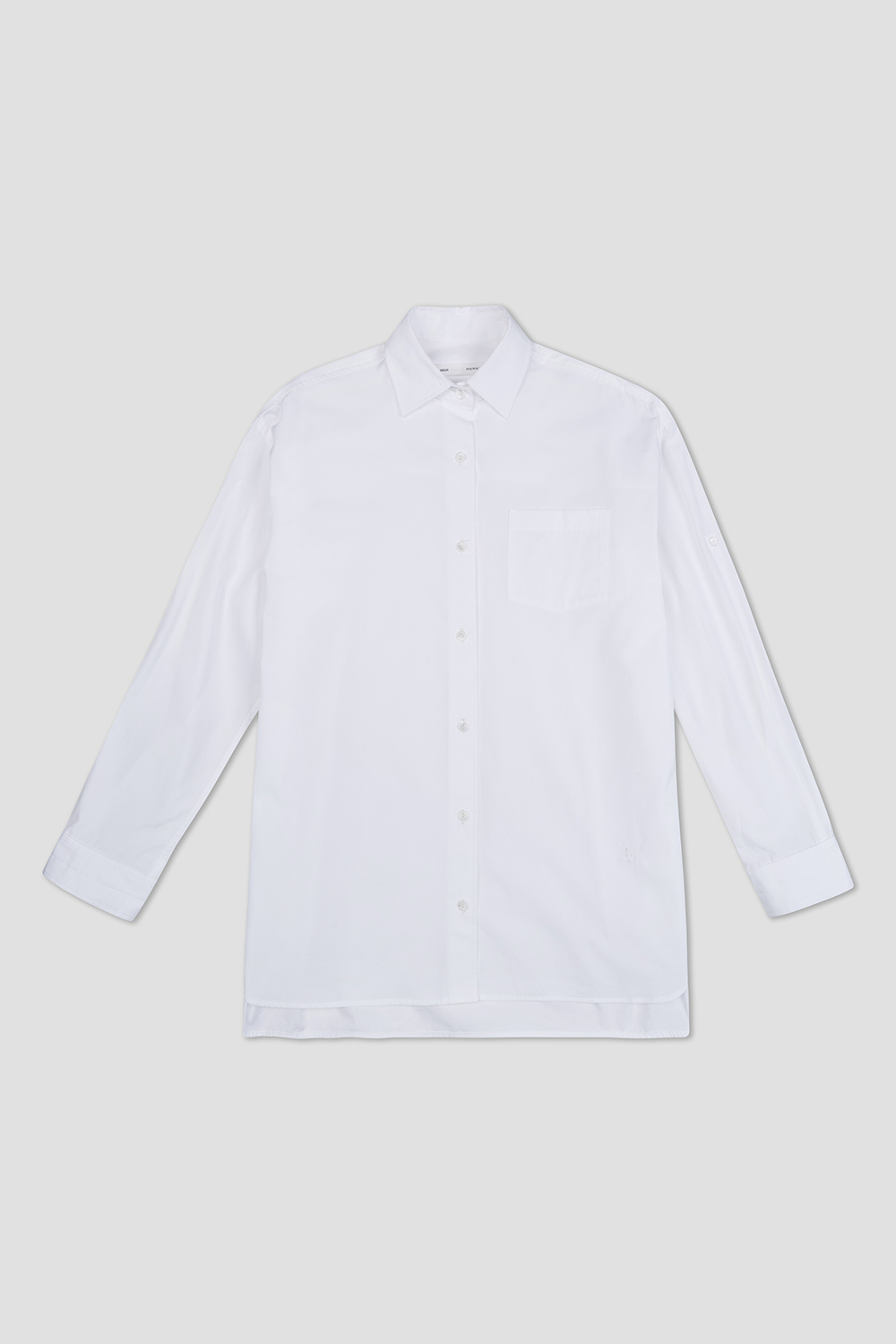
AGOLDE x MARIA MCMANUS A-Line Shirt
AGOLDE x MARIA MCMANUS Circle Skirt
Pleated wool-blend wide-leg pants
Scarf-detailed wool-blend blazer
Fleece coat
Maria
We consider every element of our designs. All our buttons are made from either shells, nuts or potato starch, for example. When it comes to manufacture, it’s harder to truly know – there’s a lot of contracting and subcontracting that goes on in the fashion industry – but we really try to ensure that the people working on our garments are paid a fair living wage.
I believe it’s something more businesses can do – if they want to. My goal is to prove that you can create a sustainable, responsible business that’s also profitable. There are other macro issues that make it more difficult. The political situation in the US has brought some instability in terms of duties and tariffs, for example, which has affected us. We do most of our production in Europe, so that was a challenge, but we’ve been able to overcome it.
Something I’m continually concerned about is sourcing in general. There are going to be more wildfires and floods and droughts in the years ahead, and that’s going to put a strain on natural resources – there just won’t be as much land to farm. I do think this is going to put a strain on the availability of cotton or wool, because we do predominantly work with natural materials.
When I started out in the industry, there were few women in leadership roles. It’s encouraging to see that changing. There are also a lot more women leading design fashion companies, which has been really positive. Maybe not at the bigger houses, but with start-ups there are so many more female-founded brands, and I think female clients are really responding to that.
Our first show was a standout moment. We opened Australian Fashion Week in 2023 and had never done a show before. I had no idea what I was in for. It was a wild time for the whole team; all hearts and hands on deck. I’ve never felt something so deeply meaningful and intuitive; everyone worked together to create that one moment. It felt like a real timestamp.
There was a skirt in the collection with a beautiful corseted waist and a tulle skirt. All the appliqué was done by hand. Our team worked on it. The artisans in India played a critical role, changing colours and giving creative input. The artist was involved. There were so many creative voices. Then the stylist brought it all together in a way I never would have imagined. It completely changed how the garment was worn. We design something and never know how it will be perceived, and she perceived it her way. For the show, it was set to a David Bowie song – my son’s name is Bowie – and it all felt very special.
Sustainability was at the heart of the brand from day one. To be fair, it was also the thing that nearly deterred me from starting a brand, but we came up with a few things that felt right with our conscience – ways we thought we could do a little bit better – so that we could set the brand up in a meaningful way. We always come back to those guiding principles. We talk about them all the time.


“I stopped chasing the idea that work-life balance has to be perfectly split”
McManus

“When I started out in the industry,
there were few women in leadership roles.
It’s encouraging to see that changing.”


Starting a business is difficult – you need to have your wits about you. And you need a lot of support.
I think that here in New York, there are a lot of other women who are just extremely supportive, whether they become your clients, want to guide you, give you advice, or share resources. I think it’s really important that you have support and build it over time.
I believe the idea of a very structured nine-to-six, five-days-a-week job is not realistic for many women. Flexibility is hugely important. Once you have children, and once people on your team have children, you just need to be adaptable to how and when people work. Allowing women that space is essential. Most people want to work very hard and do their best; they will compensate for that time at some point in the calendar.
We’re a community-led brand. We have an amazing cohort, predominantly female – though many men, including my husband, are supporting us. I often host everybody at my apartment, and it’s just about having those more intimate, community-led moments that matter so much.
We really love it when we see our direct-to-consumer sales growing. Recently, a customer reached out to ask us to custom-make one of her freshly purchased trousers in three different fabrications. She just said, “I’m a working woman, and once I find a pair of trousers that works for me, that’s it. I just want that pair of trousers, and I need multiples of them.” These are the things we, as a team, get very excited about. That’s why we started this: to create something that’s foundational while also being responsible.
After meeting Karen Phelps, the creative director of Agolde, we realised we had so much in common. We felt like a collaboration would be a very natural thing to do as Agolde also has a strong sense of responsibility, whether it comes to the way people work, the way they treat all their employees, or the materials that they use, which are so considered. Everything from the regenerative cotton farmers they partner with to their packaging is carefully considered from a sustainability and responsibility perspective. It was very organic – from both human and sustainability perspectives – for us to work together to create this collaboration.

Karen is just exceptionally talented as a creative director. She has such a wide understanding of design, fit, the integrity of the garments, and how to truly create a really great denim style. Working with her was very informative. I learned a lot.
We spent a tremendous amount of time on the integrity and fit of each garment in the collection. We definitely made sure we kept those foundational principles there. We looked at things that were iconic to us as a brand and found ways to recreate them into denim. For example, a jacket we had done in the past was reworked with a denim wash and a recycled-leather collar. It was a mix of both worlds, where you see denim paired with some of our more classic tailoring pieces.
Denim reacts very differently once you wash it. We had to be very thoughtful about how certain things were washed. Things shrink in different ways, and the colours react very differently in denim than they would in organic cotton or corduroy, so we just had to be more cautious in the fitting process. That’s one of the masterful things at Agolde – they’re able to work around that.
One of my favourite styles in the collaboration is a pair of wide-leg jeans with a trouser pocket. It felt like a mixture of tailoring with a more casual denim hand. It was very exciting to see these pieces come to life in true denim. We do denim ourselves, but it’s always a little cleaner, while Agolde’s wash techniques are just so incredible. It’s been amazing to see that journey. There’s also a pair of skater shorts I’m obsessed with. They’re made from a silk-like material made from 40% recycled materials mixed with tree pulp, and then created in a closed-loop facility, which means the water and chemicals are reused each time rather than being released into the environment.
As a founder, it’s important to put one foot in front of the other. This isn’t a race, and I think that’s really important to remember, because, especially in New York, it’s so fast-paced and competitive, but it’s important to remember that you’re building a brand, and brands take a long time to build. They’re not built overnight.