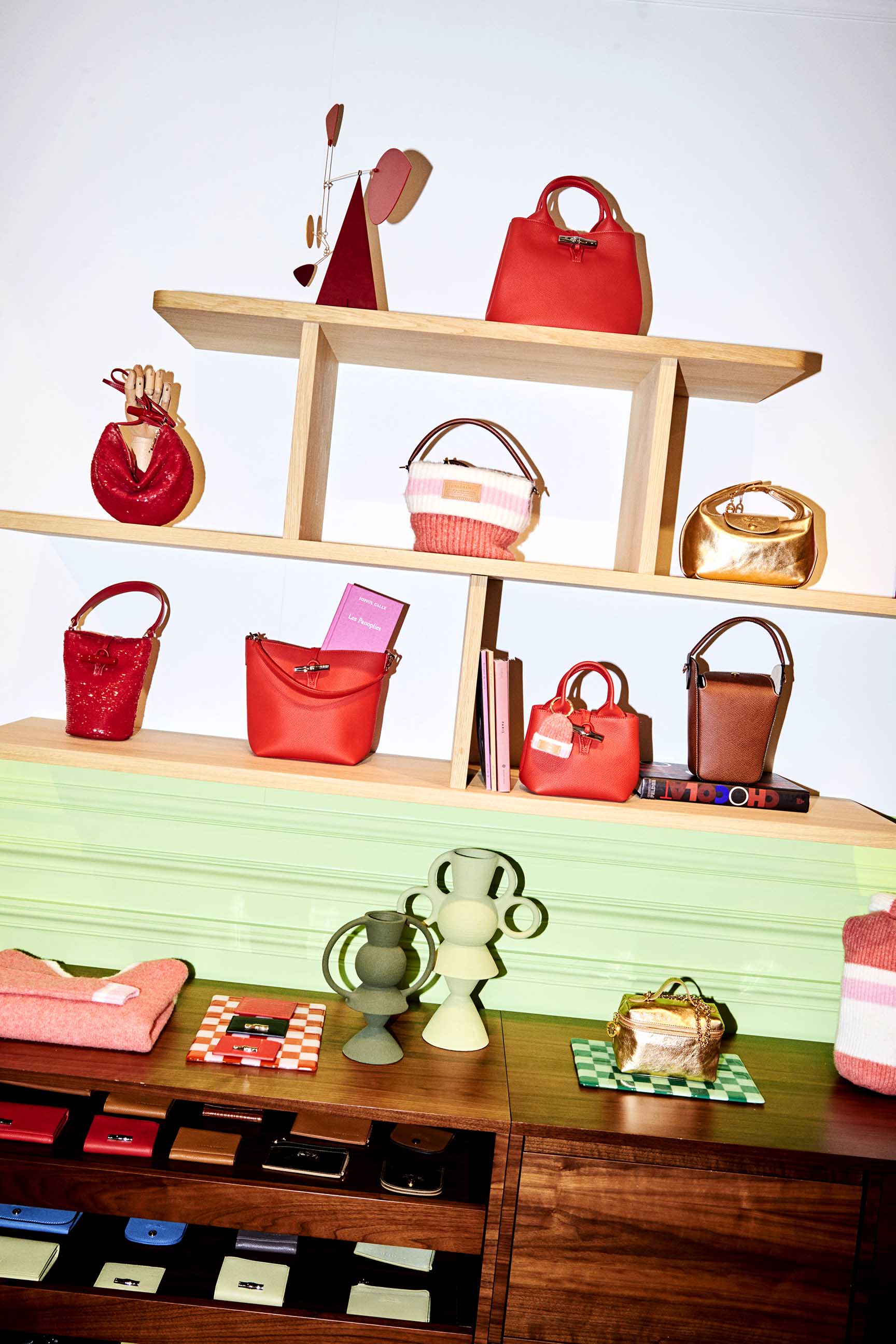
Photographer: Matias Indjic
Description: XXX
“I’ve always been particular about my brows—even on shoots with incredible make-up artists, I’d insist on doing my own.”
Description: XXX
Description: XXX

On straddling past, present and future at Longchamp


SHARE THIS STORY
“Of course, I’m very grateful for the successes we have achieved, and yes, we can celebrate these milestones. But I’m always cautious – I never believe I have ‘arrived’. To me, one day you’re in and the next you could be out. You can’t rest on your laurels.”
“I say ‘work in progress’ a lot or ‘this too shall pass’. Also: ‘don’t forget to have fun’.”
What is your mantra?

“In the beginning, the biggest challenge was
doing everything with a small team, but I truly believe it’s important to be hands-on to understand what your business really needs”
“When we got our first negative TikTok review, I panicked. I thought we’d ruined everything. But it turned into one of my biggest lessons.”
“A very old Hermès trench, which I got when I worked at the [brand’s] sample sale in the ’90s, plus a McQueen embroidered cape.”
What is your most treasured fashion item?
£2,320
SHOP NOW

£575
SHOP NOW

£325
SHOP NOW

£605
SHOP NOW

£360
My Pliage L Travel bag
SHOP NOW

£3,245
SHOP NOW
My grandfather [Jean Cassegrain] founded Longchamp in 1948, and began by making luxury leather covers for smoking pipes. Back then, my grandparents owned a tobacco store in Paris, and after the war they had a very large stock of wood pipes—this is how he had the idea. He used many different kinds of leather, and then began developing other products for smokers, and small leather accessories. My father [Philippe Cassegrain] joined the company when he was 16 years old, and started to travel all around the world to present my grandfather’s collections. As a result, he started to develop a range of travel bags, and he was the first person to really use Nylon for this purpose. It was quite revolutionary at the time—it’s a material that’s super light, super resistant and not delicate, and as someone who travelled a lot, he understood how important that was. My father has always had a very strong vision for products that mix functionality and style, where there’s nothing unnecessary and everything has its place.
I have been involved in the business in some way ever since I was a little girl. When I was a child, my father would bring his design prototypes home almost every day, which I loved. I was so happy to give my opinion, test them, and sometimes even bring them into school, switching my bags out to experience the new ones. It was super cool. But obviously when you’re a teenager, you just want to escape. You don’t want to work with your parents—you already have them at home!
I always knew I was going to work for Longchamp, but it was important for me to do something else. I needed to follow my passions and learn with other people, in order to come back more confident. I really wanted to work in kids’ ready-to-wear, so I studied as a fashion designer at ESMOD fashion school in Paris, and then went to work at Bonpoint. I stayed there for four-and-a-half years, and it was an amazing place. I loved the company, and was so happy to work with its founder, Marie-France Cohen. She is a brilliant woman. She taught me a lot.
When I finally joined the company thirty years ago, I wanted to bring more fashion spirit and femininity to the collections. I started out as a designer working alongside my father, and we worked on developing the collections as a whole, whereas before it was more about single items. So developing colour palettes, trying new materials, new shapes, making styles for the evening, for the day, for the summer… Speaking more to moments and occasions, and telling a full story with the collections.
I introduced ready-to-wear at Longchamp for the first time. It started with designing a few pieces to dress the mannequins which presented the bags, and after some time, I found that I was introducing more and more. It went from making a single coat and a dress, to then developing sweaters, trousers and jackets and other garments. Then I realised I was missing shoes to give the attitude, so I began developing footwear—then, the same with accessories like scarves, stoles, eyewear… And eventually, we had a full Longchamp look. We’re now starting to work on fragrance too, so it’s amazing to see the journey of our brand, starting from a tobacco store and now offering a complete fashion collection.
I have never found it difficult to work in a family business—if anything, working with family makes things easier. It’s an extraordinary opportunity. We have been raised with the same values, passions, culture, and vision, so we are confident in each other’s abilities and really trust each other. It allows you to take more risks, because you feel supported. It’s an environment that gives you confidence. It makes you almost relax, because you know that you can always find a solution.
Creating a company with a family atmosphere is so important. It’s central to who we are as an independent business that has always been family-run. It’s becoming more and more difficult to keep this spirit all around the world, as teams get bigger and we expand to so many countries, but we really try our best to keep that mindset. It’s important that everyone at Longchamp understands who they are working for, what we are about, and for them to feel that they have that connection with us. The same goes for the customer—we have worked a lot on the store experience, to make sure that whichever retail space or boutique they go into, they’ll have a warm welcome, feel at home, and understand the story behind the product.
“We celebrate wins—big and small—every day through a WhatsApp group with our leadership team. Everyone shares one big and one small win daily. It reminds us that progress, no matter how small, is still progress.
“It’s natural to take inspiration from others, but it’s tough when we see replicas of our products on the market. There are too many loopholes that let brands get away with it. I used to stay quiet about it, but now I see it as a compliment—it means we’re leading, not following, and that Refy is aspirational.
“I’m still learning to set boundaries with my phone. So much of my work and life happens there, but I can easily spend hours scrolling without being productive. I’m trying to create a new routine—once I finish work, I leave my phone on my desk for the evening
.
“I’m a chronic overthinker, and the best advice I’ve ever received came from my brother: whenever you have a problem, look in the mirror and ask, ‘Can I do anything about this?’ If yes, do it immediately. If not, let it go—it’s out of your control.

We try to be sincere and authentic in everything we do. We sometimes say that we are creating objects that are right in every sense of the word—the right proportions, the right level of practicality, and the right balance between the quality and the price. You have to have respect for the customer, and we’ve kept our prices quite consistent all these years. I don’t agree with the mentality of selling super expensive products just for the sake of it, and you don’t care because you know that someone will be ready to pay for it. When you do that, they probably won’t come back. You need to keep that link with the customer; that’s what builds a future.
The one thing I would never compromise on in business? Passion. It’s so important to have passion, and to transmit that to all the people around us. I think that only when you really do things with passion, that you can do them well.
What I’m proudest of is the fact that we have been able to evolve. In nearly 80 years, we have gone from being a tobacco store to a lifestyle brand with a presence all around the world. We didn’t do it in one dramatic revolutionary way—we did it with consistency. We have always evolved, we have always innovated, created, re-imagined. But we have also maintained strong roots and strong pillars, like our Le Pliage and Le Roseau designs. Those two bags are more than 30 years old, and to see women today still wanting them and wearing them is something I’m very proud of. We’ve managed to succeed in keeping them desirable all this time, which is not something that many brands have been able to do.
Success isn’t really what I’m looking for—it’s to feel that I have done my best. To know that I have achieved something in a good way, in the best way I could. And sometimes, of course, it doesn’t work, but I can still feel proud of it, and how I overcame difficulties or tried something different and innovative. We must always learn from our mistakes.
A special moment I will always remember was our collaboration collection with Tracey Emin. It was the first one I ever did, and it was to celebrate the 10th anniversary of Le Pliage in 2004. Collaborations were not so common then, few people were doing them—especially one that was so purely artistic. To meet her, to work with her, was incredible, and I think the result perfectly captured Tracey’s spirit, and Longchamp’s spirit too. It was really the beginning of a new page for the brand.
“In nearly 80 years, we have gone from being
a tobacco store to a lifestyle brand with a presence all around the world.
We didn’t do it in one dramatic revolutionary way—we did it with consistency.”
As the granddaughter of Longchamp’s founder, Sophie Delafontaine always knew she would eventually join the family business, but she never took her place within it for granted. After honing her craft elsewhere, she returned to the iconic Parisian maison to bring a fresh sense of femininity, fashion and modernity to its heritage—and as Creative Director, has helped propel the brand into a boldly successful new era. Here, she tells Clementina Jackson about why product should always come first, and the importance of maintaining the brand’s strong roots and values, while also embracing the incoming fourth generation’s infectious energy.

Delafontaine


“We sometimes say that we are creating objects that are right in every sense of the word—the right proportions, the right level of practicality, and the right balance between the quality and the price.”

“Our Le Pliage and
Le Roseau bags are more than 30 years old, so to see women today still wanting them and wearing them is something I’m very proud of.”


The best thing my father transmitted to me was the importance of the product. I wasn’t born with a marketing mentality, I was brought up to have a product-focused creative vision, thanks to him. There have been periods in fashion where marketing has been more important than product, but I feel like that’s changing now and people are realising that the product is the most important. Customers want to understand what they’re buying, where it’s made, how it’s made, the quality of the materials, the know-how... They want to understand who is behind the product. They’re happy to buy something new and creative, but it has to have a meaning behind it. I’m happy that this mentality was always instilled in me, and that the focus at Longchamp was always that the product has to be strong. It’s great to see that customers have this same spirit.
The fourth generation will push the company in an exciting direction. My two nephews and daughter have joined Longchamp, and I take my role of passing down what the last generation taught me very seriously. I feel that I am a guardian of those key values, and it’s important to keep our strong roots—but at the same time, it’s super interesting to work with this new generation because they bring a new perspective that can teach us a lot. They push us to innovate, to change, to transform, to go further, and they bring so much energy. The real challenge is to manage to keep up!
Olive Leather and Ecru Shearling Coat
Black Gabardine Dress
Burgundy Leather Jacket
Le Roseau S Handbag
Le Pliage Xtra Crossbody bag
Sophie