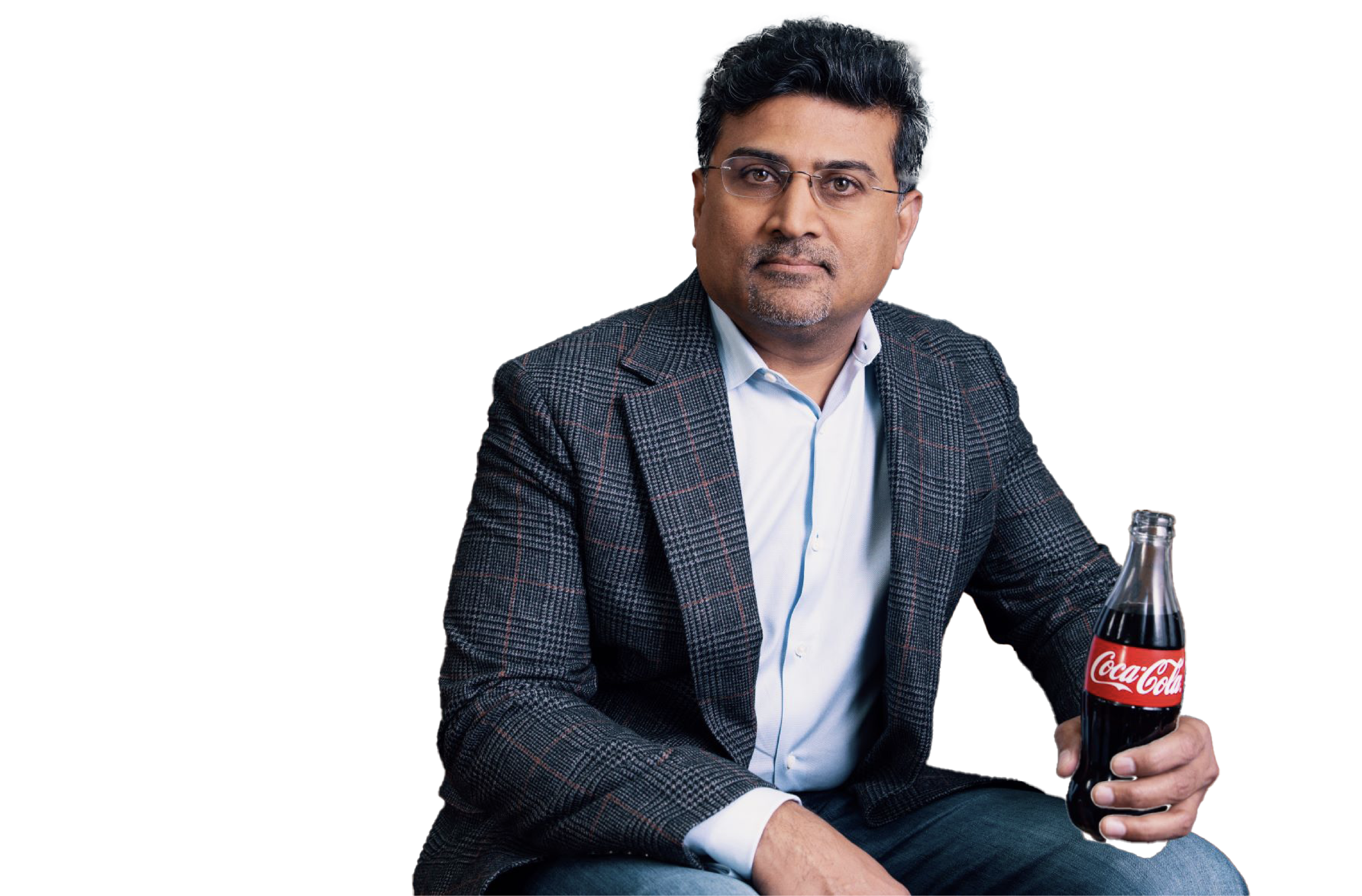
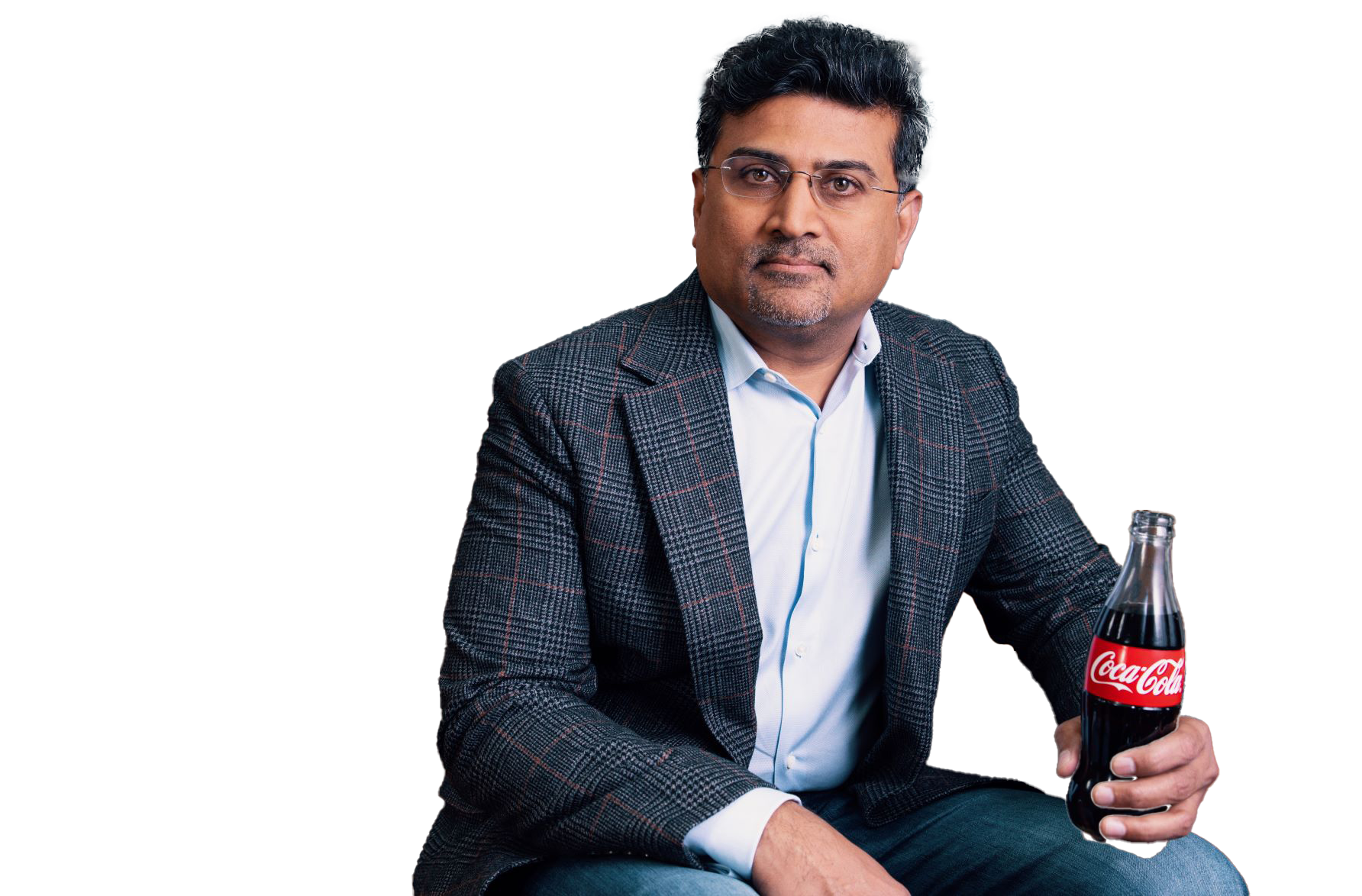
NEERAJ TOLMARE
PRESENTED BY

Leading an AI-Embedded Organization
Visionary leadership may set the direction of an organization, but for Neeraj Tolmare, SVP and global CIO at The Coca-Cola Co., true digital transformation is built on foundational change, persistent innovation and cross-functional collaboration.
Tolmare has been instrumental in leading the company’s modernization journey, overhauling legacy systems, championing AI integration and redefining what’s possible for a 139-year-old global powerhouse.
For his transformative impact and strategic foresight, CGT is proud to name Neeraj Tolmare as its 2025 CIO of the Year — a recognition of the critical role technology-enabled and innovation-driven leadership plays in driving business value at scale.
Now in its 13th year, the CIO of the Year Award honors a senior-most technology executive whose vision and execution have delivered measurable business success through the innovative use of IT.
BY Liz Dominguez


Past
Winners
CIO of the Year
Through the Years
2024: Ann Dozier, Southern Glazer's Wine & Spirits
2023: Susannah Greenberg, L'Oréal Americas
2022: Aaron Gwinner, Reynolds American
2021: Parag Agrawal, Chobani
Mike Crowe, Colgate-Palmolive
Rekha Ramesh, Tupperware
2020: Mark Vaupel, Hormel Foods
2019: Sandeep Dadlani, Mars Incorporated
2018: Jane Moran, Unilever
2017: Manjit Singh, The Clorox Company
2016: Sai Koorapati, Callaway Golf
2015: Mark Dajani, Mondelez International
2014: David Stahl, Hillshire Brands
2013: Ralph Loura, The Clorox Company

Tolmare believed he had seen scale before joining The Coca-Cola Co. Having nearly three decades of experience in the corporate world, working across Silicon Valley for high-tech manufacturing companies such as Cisco Systems, Infosys and Hewlett-Packard, he didn’t think anything would surprise him.
Joining Coca-Cola, however, had him doing a double take at the magnitude and vastness of the business, which faces unique network complexity as it accomplishes 2.2 billion servings per day as one of the world’s largest and oldest franchise systems.
“I had done some consulting work in my background, but it had always involved companies that make technology,” says Tolmare. “So my curiosity was, ‘What does the world look like on the other side of the table, where companies use this technology to grow their businesses?’ And that's how my journey brought me to Coca-Cola.”

Chief Information Officer, Global Head of Digital & Innovation
June 2018 to January 2021
Tolmare’s Timeline at Coca-Cola
Global Chief Information Officer
January 2021 to August 2022
SVP & Global CIO
September 2022 to Present

Moving Past Legacy Systems to Invest in the Future
�

Since joining in 2018, Tolmare has been at the helm of Coca-Cola’s digital transformation — leading the charge across AI, IT, data and cyber. He played a pivotal role in embedding artificial intelligence across the enterprise, laying the groundwork for a more connected, intelligent Coca-Cola system. It remains one of his proudest achievements — and a defining moment in the company’s modernization journey. A company with a 139-year history, however, brings a series of niche challenges.
“We had our share of legacy systems, and it very quickly dawned on me that if we want to innovate, if we want to leverage what technology is truly capable of, we're going to have to modernize first. We're going to have to build a strong foundation.” — Neeraj Tolmare
The journey to AI, then, required an overhaul of the company’s technology landscape, which had roughly 1,800 applications — now down to about 700 as part of ongoing optimization efforts to shift from fragmented systems to a globally connected digital ecosystem that fuels growth, accelerates decision-making and unlocks new value across the Coca-Cola system.
This included moving the company’s enterprise resource planning (ERP) system to the cloud, integrating the latest SAP S/4HANA version to simplify operations and the way business processes talk to each other.
As Coca-Cola advanced its digital modernization, Tolmare ensured cybersecurity remained a strategic priority. He led efforts to assess enterprise-wide risks and reinforced the company’s defenses — strengthening governance, controls, and protections to safeguard critical data and uphold trust across the global system.
Today, Coca-Cola operates as a cloud-only company. The company retired its data centers six years ago to implement a hybrid cloud model that works with companies such as Microsoft, AWS and Google Cloud Platform so that it could move workloads between three public cloud ecosystems.
Under Tolmare’s leadership, Coca-Cola modernized its core platforms, standardized digital capabilities across markets and implemented a global data foundation that powers AI-enabled insights and smarter business decisions.
Over the past few years, Coca-Cola has reimagined how it handles data — breaking down silos and enabling a more dynamic way to pull in information from across the system. With intelligence layered on top, the company can now more easily turn that data into insights that drive better business outcomes.
“We wouldn't have been able to do this had we not put in the hard work and built that foundation. That's the grind that everybody has to go through, and unfortunately, there are no shortcuts.”

AI-Curious to AI-Ready to AI-Embedded
Two years ago, the AI work really kicked off. And while it was not a new concept at the time, says Tolmare, with the advancement of computing power, AI tech became more affordable and accessible, giving way to new opportunities for experimentation.
As generative capabilities emerged, it set the company on an accelerated track of test-and-learn.
“We figured out that this can actually look at historical data, triangulate all the necessary data points and predict or create something that is perhaps better than what a human being is capable of producing,” he says.
From the start, Coca-Cola took a disciplined approach to AI, focusing not just on experimentation, but on impact. To keep up the momentum with ROI in mind, Tolmare helped establish a structure that enabled associates to participate in organized AI experimentation by launching a portal where they could submit their ideas. In addition to surfacing promising use cases, the portal also ensures each idea goes through an internal compliance review, aligning proposals to governance standards and responsible AI practices from the start.
“It doesn't mean that we don't continue experimenting, we don't continue innovating. We do that, but our efforts are a lot more organized,” says Tolmare, He points to the internal AI portal as an example: a tool designed not just to collect ideas, but to assess them against clear criteria — distinguishing between use cases that drive incremental business value and those that serve primarily as automation plays. “Eight times out of 10, we find that several of those ideas are connected to a bigger theme. So it gives us the ability to pull together all those ideas, and then we can invest a focused effort behind it — whether it's resources, funding, etc., and run a pilot to see if it actually delivers an outcome.”
The next question revolves around the potential for scalability. Small ideas that don’t scale don’t move the needle for Coca-Cola, he says. With 950 plants, 200-plus bottling partners around the world and 33 million outlets where products are sold, these ideas need to scale easily so bottlers aren’t recreating the wheel as they try to solve similar problems.
�
AI-Curious to AI-Ready to AI-Embedded
The platform is beginning to transform how Coca-Cola creates localized marketing content, achieving efficiencies in both time and cost.
Pilot Case Study: ShopX
In collaboration with NVIDIA and marketing partner WPP, Coca-Cola is leveraging generative AI to transform how the company and its bottlers create hyperlocal, custom merchandising and point-of-sales images.
*
*
In the near term, the company can more quickly build sales materials and menus with images of specific cuisine, Coca-Cola beverages and environmental graphics tied to an upcoming holiday or seasonal celebration.
*
Across its 200-plus brands, there are nearly 1 million different hyperlocal messaging opportunities daily. Adding to the complexity, there are 130-plus languages and many diverse consumer ethnicities. This technology enables Coca-Cola to create hyperlocal content at scale.
The results
In an initial pilot, using a combination of AI applications (computer vision, machine learning, etc.), Coca-Cola produced 20 pieces of content and deployed 10,000 variations. Early results showed an increase of 20% in efficiency and 3X faster speed compared to an earlier, less-customizable approach. The company is building on that success and expanding across markets.
Tolmare said the progress so far with ShopX and across various AI initiatives is encouraging. The company is focused on continuing to scale what’s working well and incubate the best new use cases through focused experimentation.
Coca-Cola’s Gen AI Journey
News Highlights
2025
The Coca‑Cola Co. is collaborating with Adobe on a generative AI pilot it calls Project Fizzion, a design intelligence system that will enable creative teams to produce content up to 10 times faster while aligning with brand guidelines. — Read More
2024
Coca-Cola bolstered its core technology strategy by committing $1.1 billion to cloud-based and generative AI-powered capabilities. — Read More
The Coca-Cola Co. began to scale its global marketing efforts with generative AI, configuring advertising materials on Prod X, a production studio experience that uses digital twin technology. — Read More
2023
RGM efforts included accelerating Coca-Cola’s digital B2B platforms for better tailoring of product, price and packaging architecture using generative AI push notifications, which looked to reduce out of stocks and optimize physical inventory placement. — Read More
�
Coca-Cola was one of the first early testers of OpenAI’s generative AI technology for marketing and consumer experiences, using the ChatGPT and DALL-E platforms to craft personalized ad copy, images and messaging. The company also partnered with Bain & Co. for this effort.
— Read More
�The beverage brand took consumers to the year 3000, using AI to design art for a new limited-edition product, Y3000, allowing users to generate images/videos with the help of generative AI. — Read More
Building a Culture as a Collaborative Growth Accelerator
“Historically, Coca-Cola has been a highly innovative company,” says Tolmare. “But within our technology organization, the real shift has been moving away from thinking of it solely as a cost center to running it as a growth accelerator. I actually think that's the reason that a brand can last for this long and be loved around the world, because you're constantly reinventing yourself. And technology has begun to play a pretty critical role in it.”
Because digital disruption is built into the company’s culture, and the company is constantly asking if it’s time to disrupt itself, associates are often the first to want to adopt new technologies and stakeholders are receptive when it comes to buy-in.
Coca-Cola was an early mover in deploying a secure, internal generative AI tool — CokeGPT — ahead of many large enterprises and even some tech companies.
“Even some of the tech companies hadn't yet done that, and we were ahead of them because the principle is, ‘Let's give our associates access to the best tools, the best technology and the simplest processes at their fingertips.’”
Tolmare has been careful to differentiate between technology for the sake of technology and implementing solutions that make it easier to interact with consumers, make it easier for bottlers to sell products, increase sales for mom-and-pop shops and so on.
Additionally, in Tolmare’s leadership role on the Coca-Cola Global Digital Council, he helps ensure technology is not just responsive to business needs across functions, geographies and bottling partners, but also anticipates and shapes them.
It often requires pushing the boundaries of where automation and AI play a role, where it makes sense to mature digital systems by building internal agents to simplify business operations. Every discussion in the strategy table begins with a business problem the company is looking to solve, he says. Technology is at the table, recognizing that it may even have an easy solution rather than a tech path to solving the problem.
By reducing complexity and working closely with strategic partners, Tolmare has helped create the conditions for greater cross-functional collaboration — breaking down silos and co-developing shared digital capabilities. These efforts are building the foundation for a more connected, innovation-focused ecosystem across the Coca-Cola system.
“It's very rare that you can do something by just going into a windowless room and trying to solve something by yourself. It doesn't work,” he says. “Partners are an important component of that.”
�


Mutual Momentum
The Business Case for Symbiotic Relationships
Coca-Cola has a vast network of technology partners, including Microsoft, Adobe, Salesforce, SAP and Accenture. Most of its relationships are at least a decade old, with the company looking at investments as long-term value exchanges with mutual benefits.
�
“We tend to co-create several solutions. If it works at The Coca-Cola Co., it's going to work for the rest of the world,” says Tolmare, adding that its tech partners often pilot at-scale use cases that mimic business challenges occurring around the world, allowing Coca-Cola to get ahead of the curve on solving them. “It's a symbiotic relationship with our partners, and we hold it sacred because we do believe that our partnership model is an important ingredient in our success.”
THE ENDGAME
Tolmare looks to continue pushing the envelope on how technology can solve the company’s business problems. He says it will require developing more bilingual talent — people who understand both business and technology. From a tactical standpoint, Coca-Cola has its sights set on the next big thing in artificial intelligence: agentic AI.
It has the potential to shape what the next decade of the industry looks like, and it’s only in the early stages, says Tolmare.
�
Tolmare’s Best Practices for
Digital Disruption
Do the hard work. Try to tackle the most difficult problems first because then the rest becomes quite easy.
1
Empower your people and encourage them to use and learn the latest innovations that are happening.
2
Have the mindset that failing at something is not necessarily bad, as long as you can learn from it and don't make the same mistake tomorrow.
3
Define what success looks like early in the game so people have a north star to go after.
4
Most importantly, there should be fun in work — it shouldn't feel like a drag.
5

PRESENTED BY

“Everything should not be just about the destination. The journey is just as important, and you've got to learn to have fun through it.”


“We don't sit here and claim to have the answers or keys to everything, but I think by the principle we have of ‘learn by doing,’ we're learning fairly quickly.” — Neeraj Tolmare