General Healthcare
The European Clinician's�Guide to AI Tools


How to use this guide
Each section contains a tool table, evidence summary, ‘Worth watching’ entry on emerging applications, and key clinical considerations. A source reference closes each section for independent verification.
Tools are included where they meet at least one of: CE marking under EU MDR 2017/745, MHRA registration, peer-reviewed published evidence, or significant active European rollout in 2025 to 2026. Regulatory status should be independently verified before adoption, as approvals change.

Status Key
The following status labels are used in all tables throughout this guide.

jump to:

General Healthcare
01

Documentation, decision support, triage, patient engagement: AI tools spanning all specialties are now operational infrastructure in European health systems.

Evidence summary
AI scribes have one of the strongest real-world evidence bases of any clinical AI category. A 2025 JAMA Network Open multicentre quality-improvement study of 263 clinicians across six US health systems found that after 30 days on an ambient AI scribe, burnout among ambulatory clinicians fell from 51.9% to 38.8%, alongside significant reductions in cognitive task load and after-hours documentation.
Dragon Copilot leads the enterprise market and is the default scribe for large-system secondary and tertiary care. Tandem/Accurx Scribe is positioned for primary care, embedded within the Accurx platform already in use across 98% of GP practices and 70% of NHS Trusts.
iatroX is the most accessible European option for clinician-facing evidence synthesis following OpenEvidence's withdrawal from the UK and EU in late April 2026, citing regulatory uncertainty
around the treatment of AI systems including the EU AI Act.
Ada Health is among the most extensively validated AI
symptom checkers in the EU, with accuracy data
published in BMJ Open.
Medwise AI is Innovate UK-funded, with a �Health Research Authority-listed pilot study �comparing AI guideline search against manual �intranet search.

Worth watching
AI agents capable of performing clinical tasks autonomously, �including medication adjustment, remote monitoring escalation, and triage routing. The European Health Data Space, entering implementation from 2025, will create new data infrastructure enabling AI tools to draw on cross-border health records, potentially transforming the relevance and accuracy of clinical decision support for European HCPs within five years.


Key considerations
SaMD compliance: Both AI scribes are classified as SaMD. In the UK, confirm compliance with NHS England's June 2025 ambient voice technology guidance and your organisation's information governance policy. In the EU, verify CE-MDR classification and Data �Processing Agreements under GDPR Article 28 before procurement.
Procurement routes: iatroX is free and immediately accessible to individual UK and EU clinicians without institutional procurement. For Trust-wide or health system deployment with local policy integration, evaluate Medwise AI through the NHS AI framework procurement route.
Data governance: All tools in this section that process patient data require a DPIA and a Data Processing Agreement. Where tools are hosted on non-EU servers, conduct a �Transfer Impact Assessment under GDPR Article 46 before deployment.
>
>
>
Source: JAMA Network Open 2025;8(10):e2534976 · iatroX MHRA registration and UKCA documentation (iatrox.com) · Telehealth.org / Lancet Regional Health Europe (OpenEvidence EU/UK withdrawal, April 2026) · Medwise AI Innovate UK documentation · BMJ Open Ada Health validation studies


haematology
02
AI in haematology is most mature in automated blood cell morphology, where CE-marked tools are routine across European laboratories. AI for haematological malignancy diagnostics is advancing rapidly, with several CE-marked tools now in specialist�clinical use.
Evidence summary
Worth watching
A November 2025 Blood review, published on behalf of the American Society of Hematology Subcommittee on Artificial Intelligence, confirmed that AI and ML hold significant potential across leukaemia, lymphoma and, multiple myeloma for diagnosis, prognosis and, treatment optimisation.
Automated blood cell differential analysis remains the only area of routine clinical AI adoption in haematology. Sysmex XN-Series and CellaVision DM are extensively validated across European laboratories, with AI used to prioritise abnormal blood films for expert review rather than replace morphological assessment. Scopio Labs extends this through full-field digital blood smear imaging, enabling remote review of entire slides.
Multimodal AI for haematological malignancies, combining peripheral blood morphology, bone marrow imaging, flow cytometry, and �genomic sequencing into a single diagnostic model. European �research collaborations are actively developing these systems; �clinical validation is underway, with regulatory submissions unlikely before 2028.
Key considerations
Routine adoption: Automated differential and digital morphology tools (Sysmex, CellaVision, Scopio) have the strongest evidence base in haematology and are appropriate for routine adoption where CE-marked and locally validated.
Specialist oversight: AI for bone marrow morphology and genomic analysis �should complement, not replace, specialist interpretation. Morphogo and �SOPHiA DDM™ Dx Myeloid support haematopathologists and molecular �laboratories but require expert review within established diagnostic workflows.
Local validation: Request analytical validation data for local disease populations �and sequencing workflows before deployment. Performance may vary �according to sample preparation, scanner hardware, sequencing platform �and, laboratory protocols.
Source: Blood (ASH) 2025;146(19):2283-2292 · EHA 2026 AI in Haematology programme
>
>
>


Beyond routine morphology, Morphogo automates bone marrow cell detection and classification, while SOPHiA DDM™ Dx Myeloid interprets NGS data in a single analysis, detecting SNVs, indels, CNVs, and gene fusions to support molecular classification of�myeloid malignancies.


dermatology
03
Dermatology was among the first specialties to demonstrate AI matching specialist performance. Clinical deployment across Europe is growing, though real-world integration remains most advanced in NHS England and the DACH region.
Evidence summary
Worth watching
A landmark 2017 Nature paper established that deep learning could classify skin cancer at dermatologist-level accuracy. European validation studies have since confirmed this, particularly for melanoma and basal cell carcinoma.
Real-world deployment is most advanced in NHS England, where AI triage tools have reduced wait times in two-week-wait skin cancer pathways. Skin Analytics DERM is the most embedded clinical tool in UK practice.
Multimodal skin AI combining dermoscopy with patient history,�genetic risk data, and longitudinal lesion tracking, moving beyond �single-image classification toward comprehensive cancer risk�stratification. European academic centres are leading this research; regulatory submission anticipated 2026-27.
Key considerations
Training data bias: AI skin tools trained predominantly on lighter skin tones underperform on darker skin. Request training dataset demographic breakdowns from vendors before adoption, particularly for use in diverse urban populations.
Consumer app validation: SkinVision and Miiskin are CE-marked but vary in clinical validation strength. Review published sensitivity and specificity data before recommending to patients, and clarify liability in patient communications.
Medico-legal documentation: Dermatology AI is a decision-support tool, �not a diagnostic replacement. Document AI use alongside your own clinical�reasoning. This applies equally under UK and EU medico-legal frameworks.
Source: Nature 2017;542:115-118 (Esteva et al.) · EMJ Dermatology June 2025 (multimodal AI systematic review) · NHS England Skin Cancer Faster Diagnosis Pathway evaluation · aiforradiology.com CE dermatology AI devices
>
>
>


FotoFinder AI is the most commonly encountered AI dermoscopy tool in the DACH market, integrated into imaging hardware �already widely installed across German and Austrian private dermatology. Consumer-facing apps SkinVision and �Miiskin hold CE marks and are increasingly integrated �into referral pathways across the NHS and EU. �SkinVision focuses on point-in-time detection and �Miiskin on longitudinal monitoring.
Multiple systematic reviews published by EMJ in �2024–25 have found that multimodal AI models �combining dermoscopy images with patient metadata �outperform single-modality models for melanoma �detection sensitivity.


oncology
04
Oncology is at the centre of AI's most clinically significant advances in 2026, from pathology slide analysis to radiotherapy planning and early cancer detection. The shift from research pilots to embedded clinical workflow is firmly under way.
Evidence summary
Worth watching
Oncology is where AI has produced some of its most significant published clinical results in 2025–26. The PANORAMA study, published in The Lancet Oncology in January 2026, found that AI outperformed pooled radiologist performance in pancreatic cancer �detection from standard CT. A February 2026 �Frontiers in Digital Health systematic review found AI tools show the strongest published evidence in �breast, prostate, and lung cancer.
Paige.AI secured the first FDA De Novo authorisation for AI in pathology. In its pivotal study, pathologists using Paige Prostate improved prostate cancer detection accuracy from 89.5% to 96.8%. Optellum Virtual Nodule Clinic was selected by NHS England in January 2026 for a landmark end-to-end lung cancer diagnostic initiative.
RaySearch RayStation is one of the leading radiotherapy planning platforms across EU and NHS centres. AI-assisted contouring reduces planning time by 60–70% in published studies. Owkin MSIntuit CRC is the first CE-IVD AI tool for MSI detection in colorectal cancer, validated in a Nature Communications blind study of 600 consecutive patients and in routine use across the Medipath network in France.
Hartwig Medical Foundation OncoAct is a significant differentiator for European oncology centres. Unlike US-based genomic platforms, it operates under Dutch and EU data governance frameworks, offering GDPR compliance by design.
AI image analysis predicting molecular subtype directly from �pathology slides could displace or augment genomic profiling �assays for some tumour types, compressing cost and turnaround�time. Currently experimental; regulatory pathways are undefined �but were actively discussed at ESMO 2025.
Key considerations
Training data caveats: AI pathology and radiology tools are trained on specific scanner hardware, staining protocols and patient populations. Request local validation data before deployment. Performance on your patient cohort may differ from published figures.
MDT integration: Optellum VNC and Paige.AI are decision-support tools designed to feed into multidisciplinary team (MDT) workflows, not to replace them. Establish clear protocols for how AI outputs are presented and weighted in MDT discussion.
Genomic data governance: For whole-genome sequencing platforms, confirm�data residency and processing location before procurement. OncoAct's�EU-native infrastructure is a material advantage for centres with strict�GDPR obligations.
Source: Lancet Oncology Jan 2026;27(1):116-124 (PANORAMA) · Frontiers in Digital Health Feb 2026 · Paige.AI CE certificate and FDA De Novo K213253 · optellum.com CE-MDR/UKCA documentation · Owkin MSIntuit CRC: Nature Communications 2023;14:6695; ESMO Annals of Oncology 30:1232-1243 · hartwigmedicalfoundation.nl
>
>
>


cardiology
05
Cardiology AI is centred on quantitative measurement from imaging data. The evidence base is strong, with several tools embedded in NHS and EU clinical pathways.
Evidence summary
Worth watching
Cardiology has one of the most developed clinical AI evidence bases of any specialty, with tools spanning non-invasive functional assessment, echocardiography and CT imaging embedded in NHS and EU pathways as standard practice.
HeartFlow FFRCT can reduce the need for invasive FFR measurement in appropriately selected patients with stable coronary artery disease, with multiple prospective studies validating its accuracy against invasive FFR as the reference standard.
Ultromics EchoGo reduces inter-observer variability in echo reporting, demonstrated in published Oxford validation studies. Caption AI, now owned by GE Healthcare, extends diagnostic echo capability beyond specialist settings, enabling non-specialist operators to acquire diagnostic-quality images through real-time on-screen guidance.
Aidoc Cardiac continuously monitors incoming CT scans for acute aortic syndromes, PE, and incidental cardiac findings, with real-world evidence from broader platform deployment supporting faster time-to-treatment for PE. Siemens AI-Rad Companion is the most commonly encountered cardiac imaging AI in daily European practice.
AI-derived virtual FFR from echocardiography alone, removing the�need for CT or invasive measurement in stable angina patients.�UK and Netherlands research teams are leading this work; CE submission anticipated 2027. If validated, this would substantially�extend FFR-guided decision-making to settings without CT capability.
Key considerations
Cardiac imaging governance: AI cardiac imaging tools reduce variability but do not eliminate it. Establish reporting governance that specifies when AI-generated measurements require human verification, particularly for borderline ejection fraction�values that may trigger treatment decisions.
Calcification and stenosis: HeartFlow FFRCT performs less reliably in heavily calcified vessels. Ensure referral protocols include explicit exclusion criteria and a clear pathway for patients who cannot be assessed by AI-assisted CT angiography.
Non-specialist deployment: Caption AI is designed for use beyond specialist settings. Local governance must cover image quality review and a clear escalation pathway to a trained sonographer or cardiologist before deployment in non-specialist environments.
Source: NICE HTG429 HeartFlow FFRCT (reviewed 2024) · Aidoc CE certificate and published deployment data · Ultromics Oxford validation publications · aiforradiology.com CE cardiology devices
>
>
>


neurology
06
Neurology AI is most mature in acute stroke pathway tools, with published RCT evidence and direct patient outcome benefit. Regulated remote monitoring for chronic neurological conditions, including Parkinson's disease, MS, myasthenia gravis, and epilepsy, is increasingly available in NHS and EU settings.
Evidence summary
Worth watching
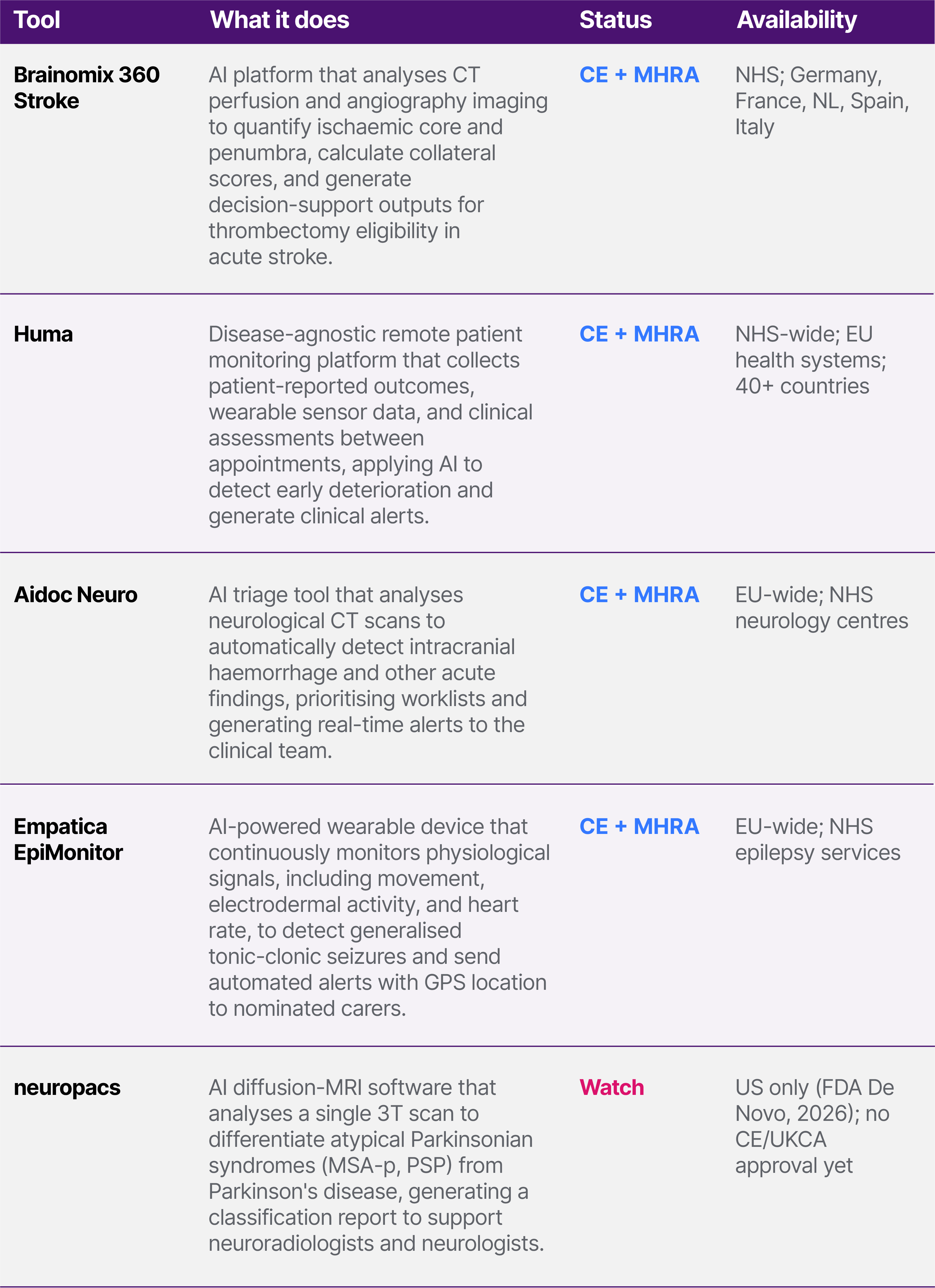
Stroke AI has the most robust evidence base in neurology. A December 2025 Lancet �Digital Health study across 26 hospitals and more than 71,000 patients found that �Brainomix 360 Stroke doubled EVT rates and reduced door-in-door-out time by 64�minutes. A 2024 Frontiers in Neurology study at the Royal Berkshire Hospital found �the number of patients achieving functional independence tripled from �16% to 48%.
Aidoc Neuro’s intracranial haemorrhage detection module is among �the most clinically validated AI triage tools in any specialty. Empatica �EpiMonitor is CE MDR-certified for seizure detection, with published �clinical studies demonstrating high accuracy for generalised �tonic-clonic seizure detection, deployed across NHS epilepsy �services to reduce caregiver response times and SUDEP risk.
Huma is one of the only disease-agnostic remote monitoring platform with CE-MDR Class IIb, MHRA, and FDA clearance, deployed across Parkinson's disease, myasthenia gravis, MS, and epilepsy. neuropacs addresses a persistent gap in neurology: separating atypical parkinsonian syndromes, frequently mistaken for Parkinson's disease, using automated analysis of a single MRI scan.
AI for early Parkinson's disease detection from voice analysis, �wearable movement data, and retinal imaging, converging biosensor signals into a single risk score. Detection up to seven years before symptom onset has been demonstrated in research settings; CE pathway under development. If validated, this would transform neurological preventive care across EU and UK health systems.
Key considerations
Acute pathway tools: Brainomix 360 Stroke and Aidoc's haemorrhage module have �the strongest evidence base and are appropriate for adoption within established �stroke and neurology triage protocols where CE-marked and integrated with local�imaging infrastructure.
Remote monitoring configuration: Huma is a platform, not a fixed product. Confirm which condition-specific modules are activated, what alert thresholds are set, and who is responsible for acting on remote monitoring alerts before deployment.
Imaging interpretation governance: neuropacs is a diagnostic aid, not a�standalone test. If approved in the UK and Europe, establish protocols for how its classification reports feed into clinical decision-making, and exclude other causes �of parkinsonism first.
Source: Lancet Digital Health 2025 (Artificial intelligence imaging decision support for acute stroke treatment in England: a prospective observational study) · Frontiers in Neurology 2024 (Nagaratnam et al., Royal Berkshire acute stroke pathway — observational study, not a review) · Brainomix 360 CE-MDR/UKCA documentation (brainomix.com) · huma.com CE-MDR, MHRA and FDA documentation; UK Parliament evidence session Nov 2025 · Empatica EpiMonitor CE MDR certificate and published 98% generalised tonic-clonic seizure accuracy validation
>
>
>