This infographic was�funded by argenx.

Exploring the Pathophysiology Behind Chronic Inflammatory Demyelinating Polyradiculoneuropathy

Neurology

The Heterogeneous Phenotype of CIDP
CIDP is a rare, severe, heterogeneous, and progressive immune-mediated disorder of the nervous system.1-3
Activated immune cells cause inflammatory demyelination of nerve fibers, which can lead to both distal and proximal weakness or sensory deficits.1-3
CIDP can cause disability due to:4-7
Dyck PJB, Tracy JA. Mayo Clin Proc. 2018;93(6):777-93.
Bunschoten C et al. Lancet Neurol. 2019;18(8):784-94.
Vallat JM et al. Lancet Neurol. 2010;9(4):402-12.
Mathey EK et al. J Neurol Neurosurg Psychiatry. 2015;86(9):973-85.
Gable KL et al. Muscle Nerve. 2020;62(6):673-80.
Michaelides A et al. Pain Ther. 2019;8(2):177-85.
Van den Bergh PYK et al. Eur J Neurol. 2021;28(11):3556-83.
Allen A. Neurol Ther. 2020;26(9):43-54.
Gorson KC. Ther Adv Neurol Disord. 2012;5(6):359-73.
Querol LA et al. Neurotherapeutics. 2022;19(3):864-73.
Querol L et al. J Neurol. 2021;268(10):3706-16.
Wolbert J et al. JCI Insight. 2020;5(3):e132411.
Magdalon J et al. Front Neurosci. 2020;14:23.
Nikitin PA et al. J Immunol. 2019;202(4):1200-9.
Mair D et al. J Neurol Neurosurg Psychiatry. 2024;96:38-46.
Allen JA et al. Lancet Neurol. 2024;23(10):1013-24.
References & Abbreviations
CIDP: chronic immune-mediated demyelinating polyradiculoneuropathy; CNS: central nervous system; GBS: Guillain-Barré syndrome; FcRn: neonatal Fc receptor; IVIG: intravenous immunoglobulin; MBL: mannose-binding lectin.

References & Abbreviations

MED-ALL-NON-2500133 V1 01/2026


CIDP is a heterogeneous syndrome that can be classified by “typical” and “atypical” variants, and presents with a wide range of clinical symptoms.8


This heterogeneity commonly leads to misdiagnosis; CIDP is often mistaken for other neurologic or neuromuscular disorders, resulting in delayed treatment, increased risk of irreversible nerve damage, and potentially, long-term disability.7-9

The heterogeneous biology and clinical phenotypes of CIDP indicate multiple overlapping processes that drive disease development.4
A complete understanding of the pathogenesis that causes CIDP is yet to be established.4
There is evidence for both:
MECHANISMS OF DISEASE IN CIDP
Cellular involvement + Humoral involvement

Both appear to relate to the phenotypic expression in CIDP, suggesting cellular and humoral components may act synergistically in the disease’s pathogenesis to damage peripheral nerves.4


IgG Autoantibodies
Approximately 40% of patients show antibodies against components of myelinated nerves, including pathogenic IgG autoantibodies. �Well-characterised forms are rare (<10%).11
IgG autoantibodies binding to the myelin sheath may result �in demyelination and subsequent nerve damage.4,12
�
By anchoring to the myelin sheath, IgG may:
activate the complement system; allowing
macrophages to bind to the Fc receptor, phagocytising the myelin.4,10,12


Complement System
Current/established treatment options for CIDP include:15
Treatment Landscape
Currently, a range of targeted treatments are being investigated for the treatment of CIDP:


IVIG
Corticosteroids
Plasma exchange
FcRn�blockers15,16
Complement�blockers15
B cell depleting�agents15


motor weakness


sensory disturbances


fatigue


sometimes pain


CIDP is slightly more common in males and can occur at any age, but is most commonly diagnosed between 40–60 years.9


Typical CIDP is defined as:7,9
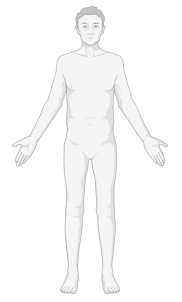
progressive or relapsing symmetric, proximal, and distal muscle weakness of upper and lower limbs
sensory involvement of at least 2 limbs developing over ≥8 weeks with absent or reduced tendon reflexes in all limbs

Distal

Proximal

The disease course can be progressive for more than 8 weeks, but can also be relapsing–remitting.7
Progressive CIDP
Relapsing–remitting CIDP


?

The complement system is implicated in the maintenance of the CNS and nerves:13�
protection from infection and inflammation;
removing damaged cells; and
supporting regeneration.
Dysfunctional activation of the complement pathway through autoantibodies may contribute to demyelination and axonal damage.10,14


Despite available treatments, 30% of patients remain refractory to traditional treatments, leaving an unmet need.15


Increased production �of complement
Transmigrating T �cells, complement, �immunoglobulins
Antibodies to�unknown antigens
Antibody binding to node of Ranvier or complement deposited to Schwann cells
Complement�activation