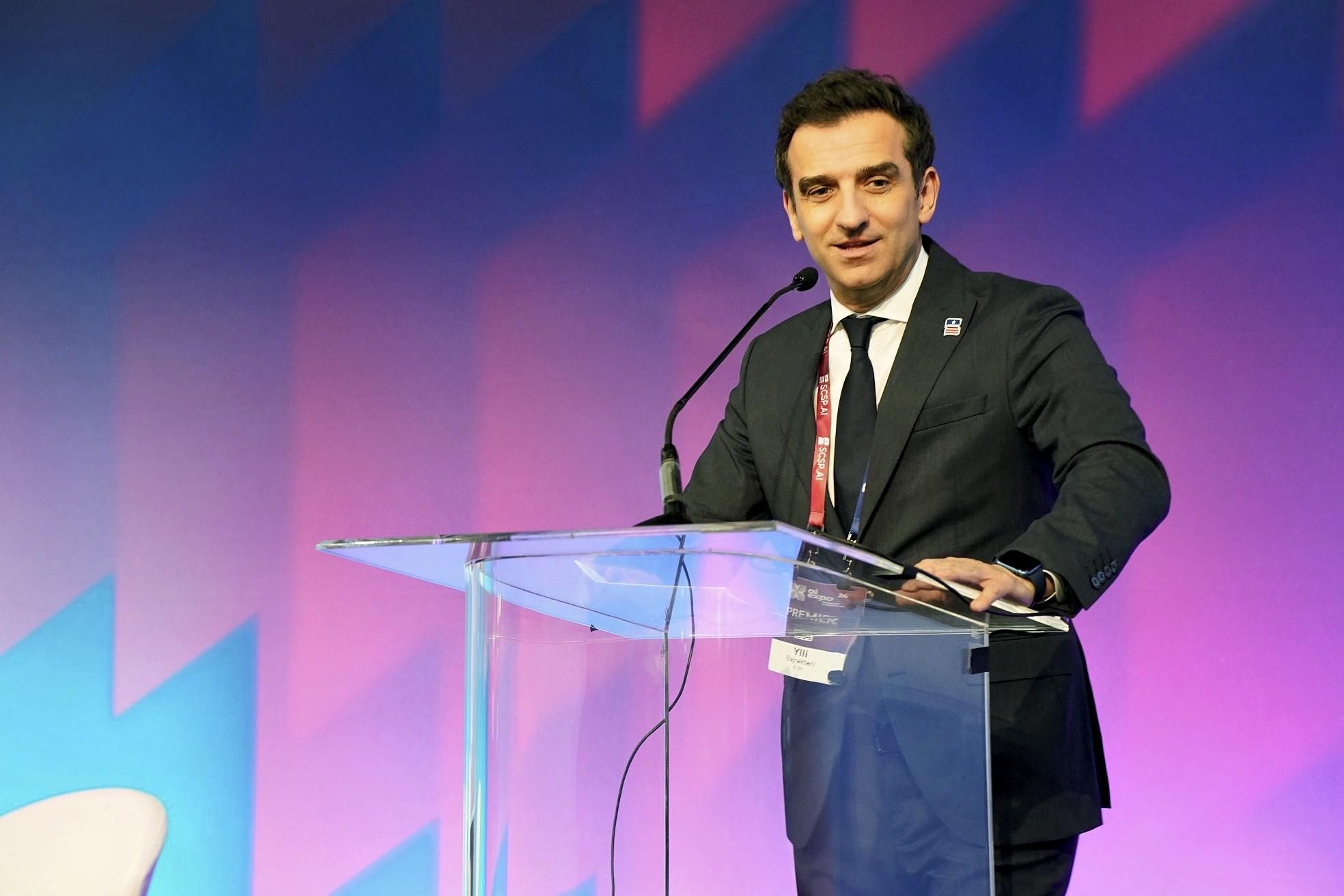
Ylli Bajraktari Has a New
Vision for U.S. Competitiveness, and It’s Laser Focused on AI
The president and CEO of the Special Competitive Studies Project explains how emerging technologies will reshape our national security, economy, and society—and why the critical time to act is now.
hen we imagine the future of artificial intelligence (AI), we often think about economic possibilities: greater efficiencies, innovation, speed, and scale. But what we might not be thinking enough about, argues Ylli Bajraktari, is the grave security risk of having another
�
As AI rapidly evolves from science fiction to societal bedrock, Bajraktari warns that the next five years will determine whether the United States or China sets the rules for the coming century. Drawing on his decades of experience at the U.S. Department of Defense, White House, and as executive director of the National Security Commission on Artificial Intelligence, he advocates for a “whole-of-nation” approach, bringing together government, industry, and academia to drive innovation and integrate AI across society and national security.
In an era in which algorithms may soon rival human intelligence, Bajraktari’s mission is nothing short of safeguarding democracy in the digital age. His vision of an “AI presidency” and a revitalized public-private partnership for innovation challenges Americans to reimagine their role in a world where bits and bytes wield as much influence as bombs and bullets.
Read SCSP'S Vision fOR Competitveness
prevent ethnic cleansing there. That was my first encounter with U.S. power used for good. When I moved to the United States, my dream was always to pay back that service. So after going to school in the United States, I joined the Department of Defense as a civil servant. That’s how I entered the national security field—because of that connection I had with U.S. forces and the idea of using American power for good causes.
How did your background shape your current work on AI and national security?
Q:
A:
I was born in Kosovo, and in 1999, I witnessed the U.S. military lead NATO actions against Serbian forces to
What is the core mission of the Special Competitive Studies Project?
Q:
A:
the technology competition, particularly in AI, will set the global rules. If we don’t win this competition, the rest of this century will be incredibly challenging for us and the democratic world. We’re focused on what that means for the time frame between 2025 and 2030, which we see as the most critical period. What are the core elements of “innovation power,” a term that Eric coined, that we have to double down on? And how do you use that power for the purposes of foreign policy, military, and intelligence?
Our fundamental belief is that this decade will set the foundations for the rest of this century. Whoever wins
What do you see as the greatest opportunities and risks of AI?
Q:
A:
and illnesses. Second, in education, AI can offer tailored opportunities to those who don’t have means, bringing up their knowledge and skills. Third is the economy—AI is projected to generate new levels of GDP growth.
On the risk side, any transformative technology brings massive changes to the workforce. We have to be mindful that AI will significantly change the labor market going forward. There are also risks of AI amplifying disinformation and misinformation. So AI will bring massive opportunities, but if we're not mindful of the risks, it will create new challenges for society, public discourse, and trust.
On the opportunity side, I’m really bullish on at least three aspects. First, AI can help address long-term health issues
Why do you emphasize public-private collaboration in AI development?
Q:
A:
changed after the Cold War, as we stopped investing at the same levels in government labs and the private sector took over the leadership role in innovation. Now we’re facing a competitor in China that has a “civil-military fusion.” In other words, there aren’t really barriers between their private sector and government.
So now, we need a new model of public-private partnership. We’re trying to bring the private sector, government labs, universities, and allies together so they can exchange ideas and talk about the latest innovations. We have to break down barriers between these communities, because the rest of this decade could be really challenging if we don't.
It’s critical. Historically during the Cold War, most innovation happened in government labs. But that
You’ve coined the term “AI presidency.” What does this mean?
Q:
A:
intelligence during the next presidency. If we’re not prepared for these powerful AI models, we’ll face major challenges. The next president will need to lead a whole-of-nation approach to AI, shaping not just our technological future but our society, economy, and global position.
The next four years will be transformative. We’ll likely see the first sparks of the impact of artificial general
What needs to happen for the U.S. to lead in AI?
Q:
A:
This content is made possible by our sponsor and is independent of the Foreign Affairs editorial staff.
We need to reorganize ourselves as a country, much like we did during the Cold War and after 9/11. This means
Sponsored by

Technology Battlegrounds
Hover to learn more
Biotechnology

Advanced
Networks

Advanced Compute & Microelectronics
Next-
Generation Energy

Advanced
Manufacturing

Changing how we grow and manipulate the essence of life as we know it
Transmitting data in nanoseconds
Scaling breakthroughs
in novel computing architectures and
post-Moore’s Law microelectronics
Converging strategic
sectors to explore new frontiers energy fusion, space-based solar power, and long-duration
energy storage
Transforming how things are made
Political strength
Economic strength
Military strength
Innovation strength
Opportunities for the United States
Key Risks:
The Axis of Disruptors
Iran
Russia
China
North Korea
Plausible Courses of Action Ahead
Click to learn more
Continuation of the Present Course
Disengagement
and Isolation
Mobilizing Free World Strength

Continuation of the Present Course
Treats China as the pacing threat and Russia as the most erratic disruptor
Continuation of the Present Course
Disengagement and Isolation
U.S. retrenchment across key aspects of foreign policy, the economy, the military, and technology

Mobilization of the Technological, Economic, and Military Strength of the Free World
Adopts a strategic framework that effectively rebuilds deterrence against the Axis of Disruptors; strengthens the existing economic, diplomatic, and military prowess of the United States and its partners; and harnesses the power of future technology as a new offset to ensure America's continued prosperity and global stability.
Disengagement
and Isolation
Mobilizing Free World Strength

W
Ylli Bajraktari
SCSP President & CEO

Historically, nations have been defined by the power of their military, their economy, or the reach of their foreign policy. But nowadays, a nation’s power is increasingly defined by its innovation power.
country such as China at the helm of this powerful emerging technology.
In the race for AI supremacy, Bajraktari stands as a sentinel at the crossroads of technology and national security. He was born in Kosovo and inspired by American intervention there.
Bajraktari’s own journey from immigrant to leader of the Special Competitive Studies Project (SCSP) embodies the very adaptability and innovation he champions for the United States now. The SCSP is a non-profit, non-partisan organization co-founded by Bajraktari and Eric Schmidt, who formerly served as CEO and chairman of Google.
“Historically, nations have been defined by the power of their military, their economy, or the reach of their foreign policy,” says Bajraktari. “But nowadays, a nation’s power is increasingly defined by its innovation power—its ability to invent, adopt, and integrate technologies as fast as it can in all aspects of life, in its economy, in its society, and ultimately in its national security.”


READ THE FULL REPORT
Sponsored by
significant investment in our universities and innovation ecosystem. “We need to re-create the innovation triangle of government, private sector, and academia. And importantly, we need to join with allies and partners to create a democratic framework and vision for how technologies should be developed and used—as an alternative to what China is proposing globally.
Learn More about the Vision for Competitiveness: Mid-Decade Opportunities for Strategic Victory