
Back to home





The Age of Enterprise AI
C3 AI’s Binu Mathew, senior vice president of products and engineering, discusses the critical importance of monitoring equipment health—and how artificial intelligence can streamline the process to save money and avert critical safety risks.
Predicting equipment failure before it happens—and avoiding unnecessary downtime—is critical for any business. Even with thousands of sensors on a single plant floor, getting a clear picture of asset heath at a given moment— and knowing exactly where and how to intervene—can be difficult, especially when companies are dealing with highly complex machinery, large fleets of machines, and a low ratio of signal to noise. Artificial intelligence (AI)–enabled asset management solutions, such as C3 AI Reliability, are already helping businesses in industries including manufacturing, utilities, and oil and gas— letting the software monitor and pull out the exact information needed, at the right time.
We sat down with Binu Mathew, senior vice president of products and engineering at C3 AI, to discuss the necessity of monitoring equipment health, from maximizing uptime and avoiding unnecessary repairs, to minimizing safety issues.
©2023 Fortune Media IP Limited. All Rights Reserved. Use of this site constitutes acceptance of our Terms of Use and Privacy Policy (Your California Privacy Rights) | CCPA Do Not Sell My Information Fortune may receive compensation for some links to products and services on this website. Offers may be subject to change without notice. Quotes delayed at least 15 minutes. Market data provided by Interactive Data. ETF and Mutual Fund data provided by Morningstar, Inc. Dow Jones Terms & Conditions: S&P Index data is the property of Chicago Mercantile Exchange Inc. and its licensors. All rights reserved. Terms & Conditions. Powered and implemented by Interactive Data Managed Solutions. | EU Data Subject Requests

The power of AI: Catching equipment problems before they happen
What are the biggest challenges organizations face monitoring equipment reliability and maintenance?
At C3 AI, we work with a lot of customers who have production or manufacturing facilities. There’s a lot of moving parts. There’s equipment of various kinds, and any equipment over time has trouble. While most of our customers have extensive maintenance schedules, you still have failures.
AI is changing the equation for sustainability teams in pretty much everything they do. AI is now being used to automate a lot of the burdensome work of ensuring data validity and mapping it to the proper frameworks and standards for reporting. And it is helping teams proactively address the shifting concerns and expectations across the stakeholder universe.
Lastly, for teams that don’t have enough time to think about their roadmaps to achieve their ESG goals, AI can be a tool to create specific, detailed plans and generate hundreds or thousands of different scenarios—the direction of energy prices, for example, or whether an organization is likely to hit the targets it’s been publicly announcing.
How is AI changing the ways organizations can address these challenges?
AI can serve as a hugely important value driver within the company by understanding the needs of customers and investors, suppliers, local communities, and our planet. Our C3 AI ESG solution helps give strategic direction and risk mitigation insights to large and complex organizations that really want to create value out of ESG.
How does C3 AI’s ESG solution use AI to help companies optimize their ESG strategies?
ESGBit™ is a term that C3 AI coined to describe a new concept that we introduced in our C3 AI ESG application. An ESGBit is an elemental unit of ESG information. Think a kilowatt-hour of electricity consumed, at a specific facility, in a specific region, and at a specific point in time. Or a single health
What are ESGBits™ and how does unifying disparate data into ESGBits™ enable more accurate and reliable ESG reporting?
One is our ability to deal with very large scale. For example, some of our larger customers deal with tens of thousands of pieces of equipment. You might have billions of rows of data coming in every day. Being able to process that kind of scale is crucial.
Another important feature is the ability to set this application up quickly and to extend it to all your equipment in a plant. You might have a failure linked to a critical piece of equipment—for instance, maybe a primary compressor in a manufacturing facility goes down, but the actual cause of the failure is a small pump on the side. If you don’t have a holistic view of the entire plant—if you think, like many of our competitors do, that you can focus on specific pieces of equipment to reduce your implementation costs—you may miss out on signals that are actually a problem.
What are the core features of the C3 AI Reliability application that enable enterprises to maximize uptime?
A lot of the sustainability goals today are long-term commitments. Think net-zero emission by 2040, or even 2050. Mature organizations are creating plans to achieve that goal over the next 20 or 30 years, but even the most mature organizations are still facing all of the uncertainty that comes with 25 years of shifting macroeconomic conditions, stakeholder expectations, and issue materiality. Not to mention uncertainties like how healthy your
What types of equipment and asset types can C3 AI Reliability monitor?
The most common data sources are sensors of various kinds. And once facilities get to a certain size, they usually store that sensor data into something called a “plant historian.” Usually, we’ll integrate with the historian for that information, and we’ll integrate with the enterprise research planning (ERP) system to get a sense of what the equipment is and how different assets relate to each other. We also typically integrate with the work maintenance system, so we know what maintenance has been done up to this point and how to trigger a maintenance order if we need to recommend action. But every asset type is unique, so if you’re dealing with dropped telephone calls or your patterns of customer use—that’s probably additional data sources. That’s another thing that makes C3 AI Reliability unique—underlying the application is the C3 AI Platform, which gives you the ability to integrate virtually any data source with minimum duplication of data.
What types of data sources does C3 AI Reliability integrate to provide predictive insights into equipment health?
That’s something we’re very excited about in terms of making our application more accessible to an average user, and it starts with the user interface. You might be a business user in the plant, and you want to know what your primary risks are. Thanks to C3 AI Reliability’s integration with C3 Generative AI, that user would be able to simply type in a question—“What are my top risks today?”—and the application will pull up that information.
But we also go beyond that, because when you’re dealing with a failure in a piece of equipment, one of the things you might want to know is how to troubleshoot it or what the maintenance recommendations are. With generative AI, we have the ability to take the operations manuals for that piece of equipment and pull that into the system as well. So if you do have a problem, you can immediately pull up troubleshooting instructions or information about any replacement or maintenance procedures you need to go through. Very often, just finding that information can take people hours or even days or weeks—especially if you have to call the vendor. We can help you really compress that.
How does C3 AI Reliability integrate with C3 Generative AI, and how does this enhance the user experience?


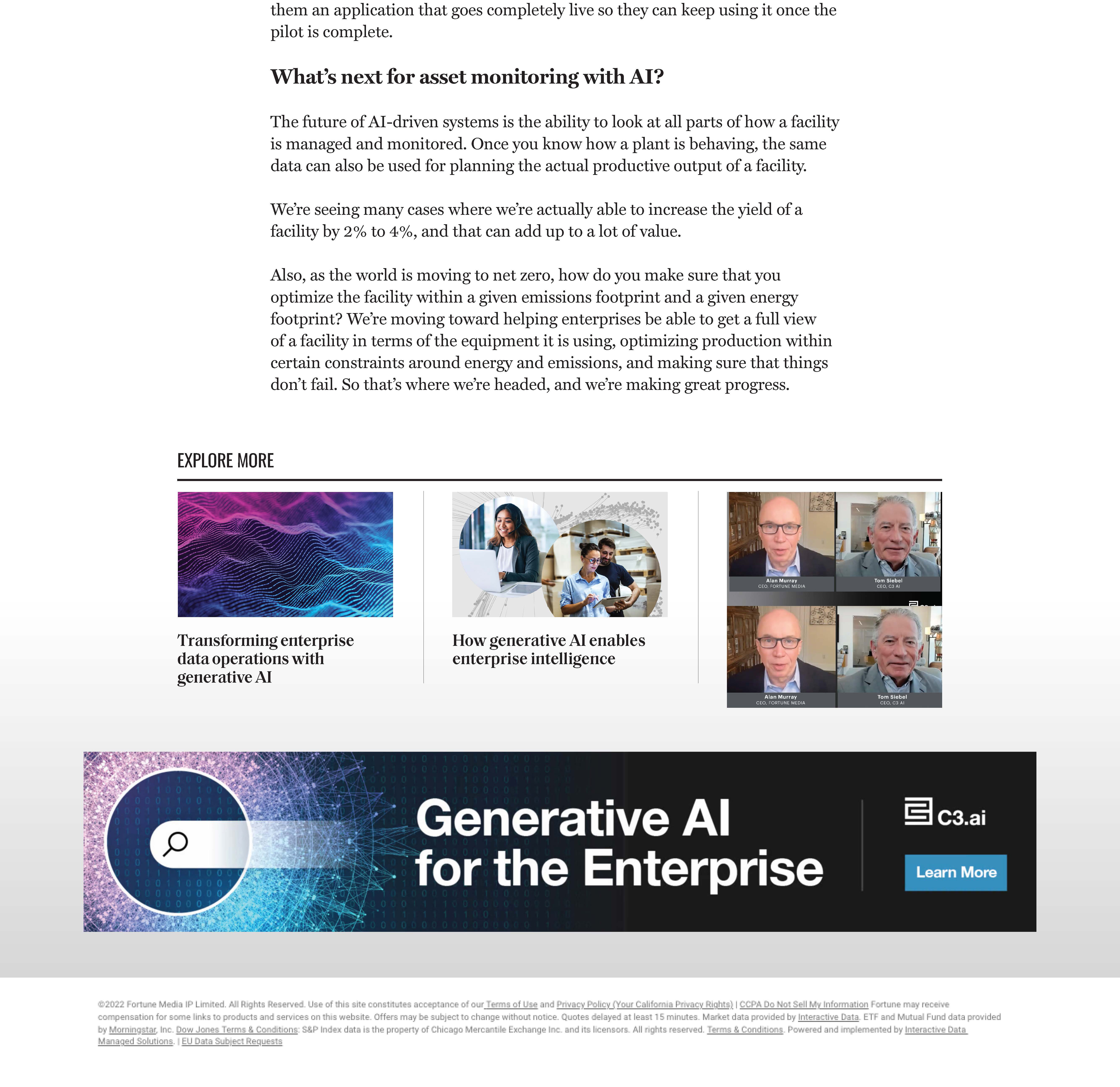
Listen to Binu Mathew on the benefits of streamlining monitoring systems into one platform.



C3 AI Reliability was designed to be completely general purpose. We can monitor virtually any kind of equipment or asset that will give you some sort of ongoing signal as to how it’s doing. We work extensively in continuous manufacturing such as oil and gas and chemicals, and we also do a lot of work with discrete manufacturing. But we even go into areas like electric utilities, where a grid transformer might be failing. We’ve even had cases where we are looking at network reliability or dropped calls for telephone companies.
On the one hand, we can apply ourselves to virtually any reliability use case. On the other hand, for a given asset class, the application also makes it very easy to configure specific asset templates. So if you’re an electrical utilities enterprise and you’re dealing with transformers, we’ll provide you with asset templates that describe how transformers behave, the things you want to monitor, and what the likely causes of failures are.
Generative AI, a new set of artificial intelligence and machine learning algorithms that allows for the creation of new content from existing data, is taking the consumer and business worlds by storm. And its adoption is anticipated to rapidly ramp up, with the generative AI market projected to reach $110.8 billion by 2030. For individuals, the use cases for the technology span from creative to recreational to practical, while for enterprises, properly and responsibly deployed generative AI has the potential to increase efficiencies, reduce costs, and boost profitability.
Tom Siebel, chairman and CEO of leading enterprise AI software provider C3 AI, believes generative AI is a technological breakthrough on par with the internet and the smartphone—and since 2020, his team has been building on the company’s 14 years of enterprise AI research and development (R&D) and industry-leading AI platform to capitalize on this breakthrough and bring it directly to customers.
We sat down with C3 AI’s president and chief technology officer (CTO) Ed Abbo and Nikhil Krishnan, the firm’s CTO of products, who have been instrumental in developing the C3 Generative AI Suite, which was released to the public this spring. We spoke to Abbo and Krishnan about the challenges that come with enterprise data operations and how the C3 Generative AI Suite is designed to not only address these problems head-on, but to also revolutionize the ability for users to access and interact with information across an organization.
C3 AI’s Binu Mathew, senior vice president of products and engineering, discusses the critical importance of monitoring equipment health—
and how artificial intelligence can streamline the process to save money and avert critical safety risks.
The power of AI: Catching equipment problems before they happen
The Age of Enterprise AI
Back to home
©2023 Fortune Media IP Limited. All Rights Reserved. Use of this site constitutes acceptance of our Terms of Use and Privacy Policy (Your California Privacy Rights) | CCPA Do Not Sell My Information Fortune may receive compensation for some links to products and services on this website. Offers may be subject to change without notice. Quotes delayed at least 15 minutes. Market data provided by Interactive Data. ETF and Mutual Fund data provided by Morningstar, Inc. Dow Jones Terms & Conditions: S&P Index data is the property of Chicago Mercantile Exchange Inc. and its licensors. All rights reserved. Terms & Conditions. Powered and implemented by Interactive Data Managed Solutions. | EU Data Subject Requests
Reimagining the enterprise with AI

How generative AI enables enterprise intelligence

Transforming the future of enterprise software with generative AI

EXPLORE MORE

What are some risks that come with asset downtime?
The worst-case scenario is a safety issue. If there is some kind of catastrophic failure in your plant, you do not want that to be a safety or emissions issue. But at the simplest level, if you have a machine that’s down, you’re losing production capability. In the chemical industry, in the oil and gas industry, in power generation, there’s not a huge amount of redundancy. If a critical piece of equipment goes down, your entire plant can go down. And at that point, you can almost take each hour as a fraction of revenue that you’re losing.
What AI brings to asset health management is the ability to process great amounts of information. In most cases, you are bringing in information from multiple sensors on different pieces of equipment. You might be measuring the speed of the equipment, the flow through the equipment, and the temperature. Traditional monitoring solutions will only show you one piece of the puzzle. AI can pull all those pieces together so you can look at all this information holistically.
For example, we have a customer that was using seven different systems to monitor one plant, and the company was getting approximately 1,400 alerts over a period of about one year. Out of 1,400 alerts, only nine were actual issues. If you’re getting that many false positives, most of that information is going to be ignored. When we came in, we were able to bring that down to 15 alerts for those nine events. So you can be confident that if we give you an alert, it’s likely a problem.
What are the key advantages of implementing AI solutions for asset health management?
What makes C3 AI Reliability the leading predictive maintenance application in the market?
Even at a small facility, you need to get information from machines sensors, but you also need to get information from activities. If maintenance engineers have gone out to fix a piece of equipment before, what did they do? C3 AI Reliability takes all that information—from sensors, from activity logs—and pulls it together into what we call a unified data image. That way, you have a comprehensive picture of what’s going on, and then you can run predictive algorithms that learn from existing behavior and let you know when there’s a problem. What’s more, you can access all that information via a single interface. It doesn’t help if you just have an AI model that’s running. It has to be presented to an operator in the form of an alert or some sort of recommendation that they can act on.
One of our biggest deployments of C3 AI Reliability is at Shell. Shell deploys C3 AI globally at its big plants. The company monitors tens of thousands of pieces of equipment and has saved, in terms of lost production, in the hundreds of millions of dollars a year. Another large customer of ours has a big offshore oil platform that produces billions of dollars of product each year, and the company has told us that we can reduce its unplanned downtime by almost 30%.
We also have a number of customers with different manufacturing plants. If a furnace is likely to fail, we’re able to give them that information two to three weeks in advance, compared to a few days in terms of the other solutions out there. At one cement manufacturing facility, we saw a reduction from 1,400 alerts to about 15. Across the board, we’re driving significant value in terms of the reduction of unplanned downtime, the ability to focus, and the ability to plan for maintenance rather than have a piece of equipment fail.
How has C3 AI Reliability made a significant impact on reducing downtime, decreasing costs, and improving productivity for clients?
Customers tend to be relatively conservative—and understandably so—when it comes to changing a big facility. The equipment has often been there for years or, in some cases, decades. There are defined ways of getting things done. So typically, we do what we call a production pilot, which usually lasts between three and six months. We come into an enterprise, integrate the data, and get them an application that goes completely live so they can keep using it once the pilot is complete.
What would you say to enterprise leaders who may be feeling a little hesitant about exploring AI for predictive maintenance?
Fridley: First, we have end-to-end, very granular AI-powered supply chain management. We are modeling every part, every stock keeping unit (SKU), every customer, every order, every supplier, every node in the supply chain, and every transportation lane. We keep track of how it changes over time, so you can replay that history and see how things changed, where they got delayed, and what it impacted. Then you can use that data to build predictive and optimization models.
Our customers are seeing 10% to 15% improvement in demand forecast accuracy, 10% to 20% improvement in inventory reduction and service level, and an improvement in order fill rate by 1% to 2%—which may sound small but is a direct tie to revenue and customer satisfaction.
Second, the C3 AI Supply Chain Suite tackles AI adoption challenges in two ways: one, a simple search and chat interface; two, rich evidence packages.
Customers quickly onboard to our simple C3 Generative AI interface. You can simply ask a question, and you’re directly routed to the information you need. The application synthesizes all your enterprise data so you can pinpoint what matters—without needing weeks of onboarding and software training.
To the point on evidence packages: this is really important to us. Most AI systems are black box—I ask a question to one of those large language models (LLMs), and I don’t know where the answer is coming from. They also hallucinate. At C3 AI, we want to build trust with our users. All of our applications expose detailed evidence packages that explain exactly why the AI model came up with the answer it did. They provide the source of truth for the underlying data that is powering that prediction so end users can route through to the underlying data to say, ‘Okay, yes, I agree with this.’
How does the C3 AI Supply Chain Suite enable companies to create efficient, agile, and resilient supply chains?
Barrett: AI is becoming a table stakes expectation for supply chain leaders. It is necessary to overcome all the complexities and challenges we’ve talked about, since manual decisions can’t keep up with the pace and magnitude of supply network complexity.
Companies that adopt AI in a way that helps them make decisions more quickly—by clearly presenting the accurate and precise predictions with evidence and impact of those decisions—are the companies that are going to thrive.
How do you see the future of AI and supply chain management evolving?
Over the past 10 or 20 years, there’s been a push to have sensors on a lot of this equipment, but there’s a lot of noise that comes with that. Even a small manufacturing facility will have at least 100 pieces of equipment. A large facility could have tens of thousands of pieces of equipment. You’re dealing with a tremendous amount of information, so the biggest challenge our customers face is focus. You could spend your days going after every signal there is and not really get anything done.
This is where C3 AI Reliability’s data processing and AI capabilities become extraordinarily valuable. We’re extracting the real information out of all that data, and we’re saying, “This is what you need to focus on. This is what your problem is.”
The future of AI-driven systems is the ability to look at all parts of how a facility is managed and monitored. Once you know how a plant is behaving, the same data can also be used for planning the actual productive output of a facility.
We’re seeing many cases where we’re actually able to increase the yield of a facility by 2% to 4%, and that can add up to a lot of value.
Also, as the world is moving to net zero, how do you make sure that you optimize the facility within a given emissions footprint and a given energy footprint? We’re moving toward helping enterprises be able to get a full view of a facility in terms of the equipment it is using, optimizing production within certain constraints around energy and emissions, and making sure that things don’t fail. So that’s where we’re headed, and we’re making great progress.
Learn how C3 AI Reliability can help your organization in a personalized demo. Schedule a briefing here.
What’s next for asset monitoring with AI?
Customers tend to be relatively conservative— and understandably so—when it comes to changing a big facility. The equipment has often been there for years or, in some cases, decades. There are defined ways of getting things done. So typically, we do what we call a production pilot, which usually lasts between three and six months. We come into an enterprise, integrate the data, and get them an application that goes completely live so they can keep using it once the pilot is complete.
What would you say to enterprise leaders who may be feeling a little hesitant about exploring AI for predictive maintenance?