



The Papahānaumokuākea Marine Debris Project’s ocean waste removal missions, community engagement, and educational resources are leading the fight against marine pollution.
About 200 miles northwest of the main Hawaiian archipelago, more than 7,000 species of wildlife, 23 endangered species, and 3.5 million acres of coral reef live in the Papahānaumokuākea Marine National Monument (PMNM). In native Hawaiian culture, this isolated 1,350 mile stretch of coral islands, seamounts, banks, and shoals represents the place where all life originates and where spirits return after death. Though this sacred and protected area should be pristine, it is littered with nearly 1 million pounds of marine debris.

Back to home
Back to home


Eco•pre•neur: an environmentally minded entrepreneur who leads and drives climate action worldwide
©2023 Fortune Media IP Limited. All Rights Reserved. Use of this site constitutes acceptance of our Terms of Use and Privacy Policy (Your California Privacy Rights) | CCPA Do Not Sell My Information Fortune may receive compensation for some links to products and services on this website. Offers may be subject to change without notice. Quotes delayed at least 15 minutes. Market data provided by Interactive Data. ETF and Mutual Fund data provided by Morningstar, Inc. Dow Jones Terms & Conditions: S&P Index data is the property of Chicago Mercantile Exchange Inc. and its licensors. All rights reserved. Terms & Conditions. Powered and implemented by Interactive Data Managed Solutions. | EU Data Subject Requests
Removing the world’s plastic waste from an endangered ocean


Listen to Sydney Luitgaarden on the dire plastics issue harming animals and humans.

[FPO Looping Video]
Papahānaumokuākea Marine Debris Project (PMDP)
KEVIN O’BRIEN, Founder & President,
“
Read More
BEHIND THE SCENES: Episode 11
of The Ecopreneurs in Hawaii.
Explore More
Read More
Read More
MEET THE ECOPRENEUR: Kevin O’Brien of PMDP.
How cleaning up marine debris on remote Hawaiian islands saves oceans for us all
This place is incredibly remote, yet it suffers
from an outsized effect of the plastic pollution problem and marine debris. Given how important it is in terms of our environment
and in terms of Hawaiian culture, it’s glaring how badly this place needs our help.”


Listen to Ka‘ehukai “Grant” Goin on our ancestral responsibility to care for our land and oceans.
EXPLAINER: See how PMDP is reducing the effects of marine debris to its
lowest levels.


[CUSTOM BANNER AD]

An increasing amount of plastic waste is threatening ocean ecosystems around the world: Scientists predict that there could be more plastic by weight than fish in the sea by 2050 if we don’t get the plastics problem under control. PMNM is a window into this critical issue. Due to its central location in the Pacific Ocean, currents continuously wash debris—such as discarded fishing gear, sporting equipment, toys, and milk jugs—onto the islands’ shorelines, damaging reefs and harming marine life in the process.
“This place is incredibly remote, yet it suffers from an outsized effect of the plastic pollution problem and marine debris,” says Kevin O’Brien, founder and president of the nonprofit Papahānaumokuākea Marine Debris Project (PMDP). “There’s no one living there to keep an eye on it; no one to clean it up. Given how important it is in terms of our environment and in terms of Hawaiian culture, it’s glaring how badly this place needs our help.”
A plague of plastic and “ghost” gear


O’Brien founded PMDP in 2019, after his work at the National Oceanic and Atmospheric Administration (NOAA) brought him to Papahānaumokuākea, where he saw firsthand the devastating toll plastic debris was taking on the land and marine life. Approximately 115,000 pounds of plastic waste is estimated to accumulate on the reefs and beaches of Papahānaumokuākea annually.

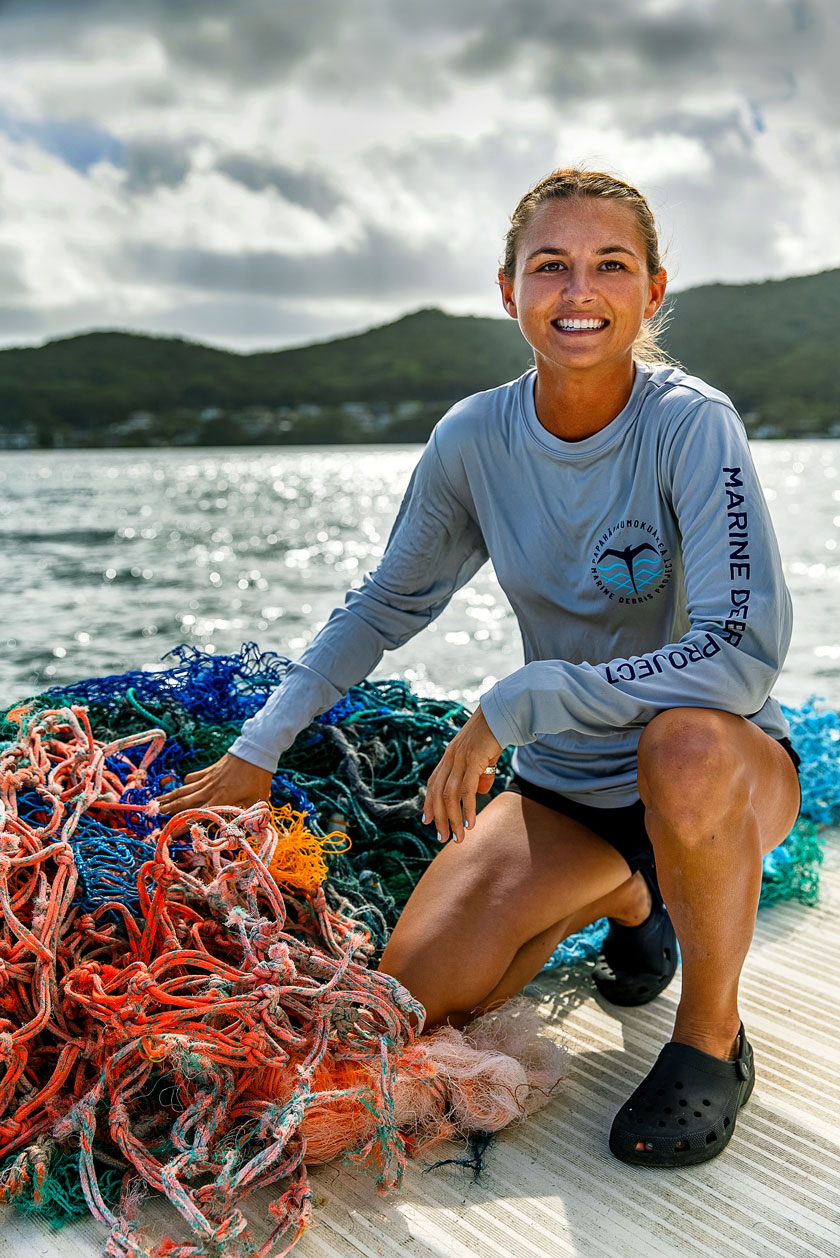
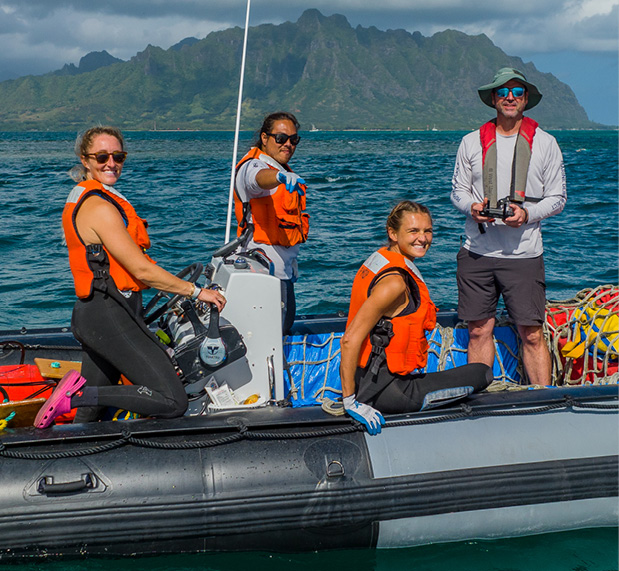
To remove this backlog of plastic waste, O’Brien and his team lead extensive biannual cleanup expeditions, chartering a 180-foot charter vessel to haul its fleet of smaller boats and a 16-person crew to the monument. It takes five days to get to the northwestern islands from PMDP headquarters in O‘ahu. Then, 20 days are spent manually collecting garbage and removing entanglement hazards that threaten oceanic life and sensitive coral reef ecosystems. The goal of each PMDP mission is to remove more than 100,000 pounds of marine debris and clean 1,000 acres of coral reef habitat. On average, the team removes 6,500 pounds of marine debris per day.
“There is so much plastic on these beaches that you physically cannot take one step without stepping on it,” says Sydney Luitgaarden, a marine debris technician at PMDP. “The animals that call these atolls home have nowhere to make their homes or lay their eggs—they end up laying them in laundry baskets and helmets because they have nowhere else.”
While PMDP dedicates time to cleaning the shorelines, most of the plastic waste PMDP collects on its missions is derelict fishing gear—specifically massive “ghost nets” that commercial fishing boats have abandoned in the ocean. During its 2022 missions, PMDP collected 202,950 pounds of marine debris—more than 93% of which (or 189,305 pounds) consisted of ghost nets.
“These nets are designed to catch. They are made up of high-density polyethylene, which is intended to last forever,” says James Morioka, the executive director of PMDP, who co-leads and manages PMDP’s large-scale marine debris removal operations alongside O’Brien. “For fishing vessels, it’s a great material, but there’s no way of appropriately disposing of it after its use. So even long after it’s been discarded in the ocean, the nets are going to continue to catch on coral reefs and destroy them.”
To retrieve these nets, a dozen PMDP team members work underwater to locate them, cut them into manageable pieces, and then lift those pieces into small boats. The divers are trained to breath-hold snorkel (free-dive) from zero to 30 feet depths—as a result, rigorous safety measures are in place in the event that a diver gets entangled in one of these massive nets (to date, the biggest net PMDP has removed weighed 11.5 tons).
“These nets tumble across reefs and pick up corals, and we find just the remnants of coral skeletons throughout the entire net,” says Luitgaarden. “We don’t know where it’s been, but we know that it has caused massive amounts of damage along the way.”

Diving in with cutting-edge tech
Removing enormous ghost nets comes with technical challenges. Locating them, surveying them, and extracting them from the water are difficult, time-consuming tasks that rely on human endurance. O’Brien, Morioka, and the PMDP team use cutting-edge technology and creative solutions to overcome these issues. The nonprofit is in the early stages of incorporating survey drones into its arsenal of tools. These drones use multi-spectral and near-infrared sensors to help the team easily differentiate between a reef and a net.
“With thousands of acres of coral reef, using a drone to pinpoint where these nets are in the reef in a span of one hour drastically increases the amount of plastic we can remove,” says O’Brien. “It makes us more efficient.”
Another program that has proven vital for the team is ArcGIS, a data visualization software program that helps PMDP pick survey locations and plan for removal operations. It uses historical data to determine high-density accumulation zones of plastic waste. The team is also developing solutions for unique challenges, such as cutting through the thick and tightly wound nets and getting them out of the water, by innovating its own lifting apparatuses and cutting tools.
“Nowhere else in the world are people affected by the problem of marine debris like we are,” says Morioka. “We are constantly proposing new tools, so we have more time to clean up these critical habitats.”
Catching up and keeping up through community
Since its founding, PMDP has been able to remove more than half a million pounds of debris from Papahānaumokuākea. In the last year alone, it removed 200,000-plus pounds—more than the combined weight of 10 school buses. Much of PMDP’s success can be attributed to its “catch-up-and-keep-up” strategy. Over the next five years, its goal is to catch up with the backlog of marine debris that has accumulated in Papahānaumokuākea, largely focusing on the reefs and the organization’s in-water operations. Come 2028, it hopes to pivot, spending more resources on tackling the shoreline and the debris that washes up on the beaches versus the reefs.
To scale at its current pace, a people-centric approach is crucial. PMDP’s diverse team is a combination of experienced divers, marine biologists, and medical personnel who excel at community outreach and have the cultural understanding that enables them to guide the rest of the team in Hawaiian cultural protocol and the significance of the sacred land.
“As Kānaka ‘Ōiwi or ‘Native Hawaiians,’ we are taught from a young age that ‘āina [the land] is our most important resource,” says Grant Ka‘ehukai Goin, a marine debris technician for PMDP. “If we let this destruction continue with marine debris just accumulating—not just in Papahānaumokuākea, but everywhere—it’s essentially the death of all of us. I hope that this work inspires more organizations to do marine debris cleanups and protect our waters and all these generational resources.”

Glossary
āina: land
akua: the gods
kuleana: responsibility
kupuna: ancestors
mālama āina: land
conservation
Building relationships with collaborative partners is a key priority, especially when it comes to unlocking creative solutions for reutilizing the plastic waste itself. Currently, PMDP is bringing it back to a power plant on O‘ahu, where it’s incinerated to generate electricity. And the company has partnered with Hawaii Pacific University and the Hawaii Department of Transportation to pilot a project where recycled fishing net will be added to asphalt mix for new roads.
“There’s a Hawaiian proverb that is the motto of our organization: Humanity is united by the ocean,” says O’Brien. “And I really believe it’s true. This is a problem that’s affecting us all. If we keep working together, I really think we have a chance of solving it.”