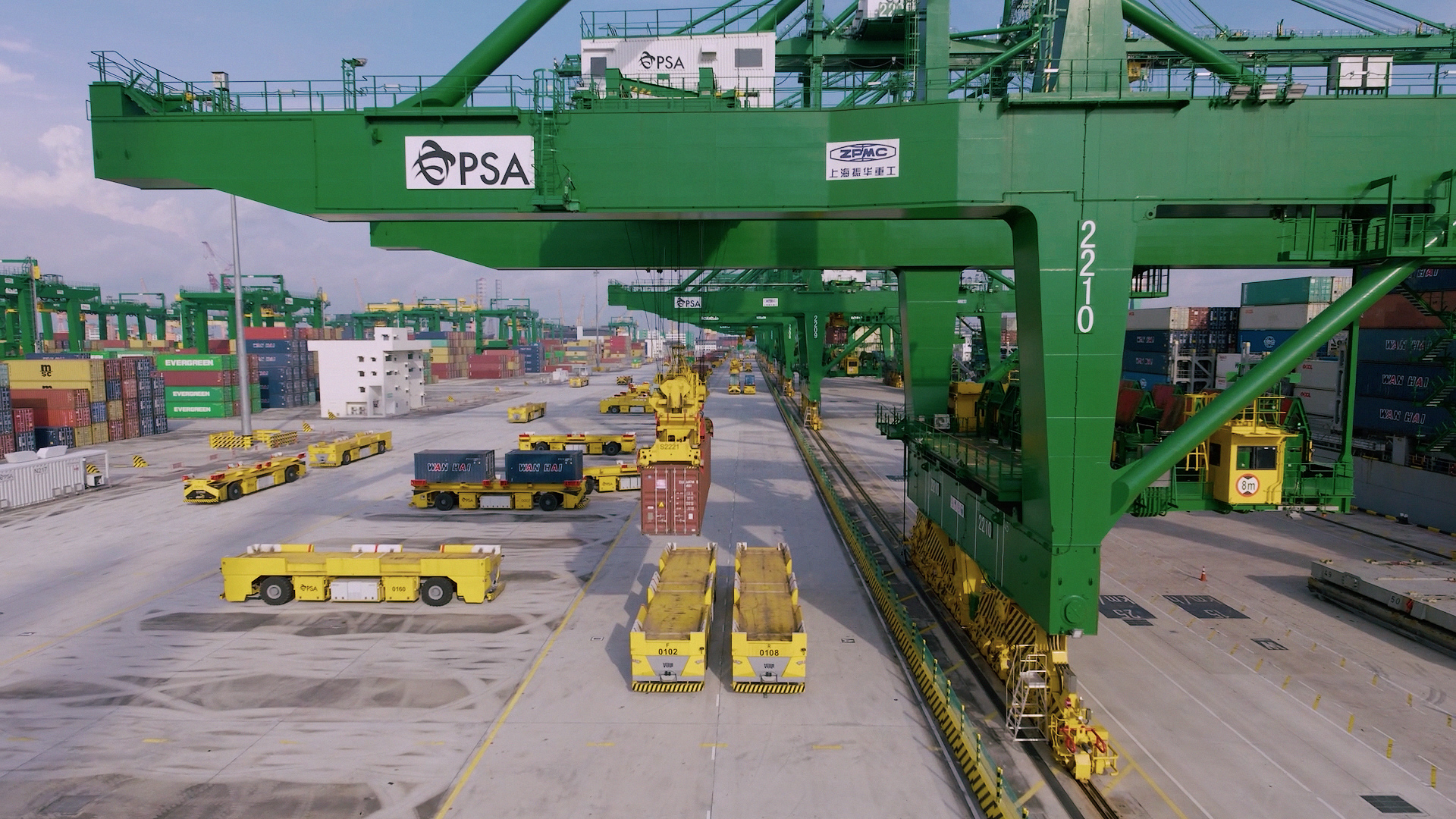




PSA Singapore is designing the world’s largest automated port


Back to Home

A tech-first port
The port has become a testbed for cutting-edge innovation, automation, and digital transformation—laying the groundwork for operational blueprints that PSA plans to scale across its global footprint.
Beyond its transformative infrastructure, Tuas Port’s fully automated nature leaves a lasting impact through its seamless consolidation of agentic AI, and digital technologies. “Everything will operate as a single integrated system,” says Liang Hui Tan, vice president of Tuas Development, Strategic Port Technology, Solutions and Services at PSA. “Fully automated yard cranes, driverless automated guided vehicles [AGVs], and remotely operated ship-to-shore cranes will boost our operating efficiency, manpower productivity, and safety.” The deployment of 5G-enabled AGVs, particularly in a fully automated port, goes a long way—they can operate 24/7, transporting containers between the wharf and the yard.
Another crucial component of Tuas Port’s bold and pioneering design is its event-driven architecture, which enables interconnected systems, devices, and processes to exchange real-time, event-based information—such as vessel arrivals, container movements, and equipment status changes—at scale. Having a holistic and comprehensive event mesh enables real-time data processing, agile decision-making, and increased resilience, ensuring seamless information flow even during disruptions, such as temporary disconnections or data surges. This groundbreaking adoption optimizes resource allocation and enables informed decisions ahead of time, boosting productivity and efficiency.
PSA’s overarching sustainability goal is to achieve net-zero emissions by 2050. In addition to constructing super low-energy buildings and using solar photovoltaic panels, Tuas Port employs a smart grid management system to monitor and manage energy demand and supply. It forecasts expected usage, helps moderate peaks and troughs, and optimizes energy distribution. To round it off, the electric AGVs—complete with fast-charging battery systems—cut carbon emissions by approximately 50% compared to existing diesel prime movers.
The cornerstone of Singapore’s western economic engine
Integral to the port’s success is its very location. Tuas Port’s proximity to industrial districts in the western region—such as the Jurong Innovation District—enables complementary sectors and industries to tap into the port’s global connectivity, with faster turnarounds and reliable networks. “This helps unlock supply chain synergies and optimize trade flows, with greater end-to-end visibility,” says Tan. Tuas Port will be the anchor in what Prime Minister Lawrence Wong called Singapore’s “future Western Gateway”—a manufacturing, services, and innovation ecosystem in the city-state.
In a world upended by trade tensions and uncertainty, PSA’s future-forward�design and technologies at Tuas Port establish stability and reliability—two qualities that are more valued than ever in business. Tuas Port is currently the world’s largest fully automated container terminal, setting the blueprint for other major trade hubs to take notice and follow. “Tuas Port is not just a piece of infrastructure,” says Tan. “It is a long-term strategic investment in Singapore’s competitiveness, resilience, and agility to handle global supply chain complexities and challenges.”
Fully automated and equipped with smart technology, Tuas Port serves as a blueprint for the future of global trade and commerce.
One of the world’s smallest countries is building the world’s largest fully automated port. Singapore may be an island with a land area of only 284 square miles, but its maritime-powerhouse ambitions are substantial. When complete, the country’s Tuas Port will span 1,337 hectares (the size of 3,300 football fields). With 66 berths, the sprawling site will be able to accommodate 65 million 20-foot equivalent units (TEUs) annually.
The company behind this monumental project is PSA Singapore (PSA), a wholly owned subsidiary of PSA International which manages a global portfolio of port and supply chain businesses across 45 countries. What began as a vision to develop Asia’s first container port in the 1970s led PSA to become the first global terminal operator to handle more than 100 million TEUs in a year. Named the best container terminal operator in Asia 33 times by the Asian Freight, Logistics and Supply Chain Awards, the maritime leader is set to reach another major milestone with Tuas Port.
PSA—along with cross-functional government agencies—has meticulously planned, designed, and engineered every inch of Tuas Port since 2012. Given the expected spatial constraints, the port group began with a six-year-long land reclamation exercise in the coastal waters. More than 50% of the reclamation fill was derived from dredged material and excavation soil, underscoring PSA’s vision of building a sustainable port in Singapore.


As Singapore’s national agency for design, we champion the use of design to grow business, spur innovation, and improve lives.
© 2025 Fortune Media IP Limited. All Rights Reserved. Use of this site constitutes acceptance of our Terms of Use and Privacy Policy | CA Notice at Collection and Privacy Notice | Do Not Sell/Share My Personal Information FORTUNE is a trademark of Fortune Media IP Limited, registered in the U.S. and other countries. FORTUNE may receive compensation for some links to products and services on this website. Offers may be subject to change without notice.
Follow us:

Back to Home
Discover More
Singapore Design
Receive news on the latest design happenings.
Find out how Singapore can power �your design ambitions.�Connect with us at info@designsingapore.org
WATCH NOW
How design is giving Singapore a global edge


Watch Now
How design is driving innovation across Singapore—and beyond


Explore More