BACK TO HOME


Texas: Where the future is forged�

The state’s economic policies place a prime value on innovation, independence, and prosperity, making it one of the most desirable places for businesses of all sizes.
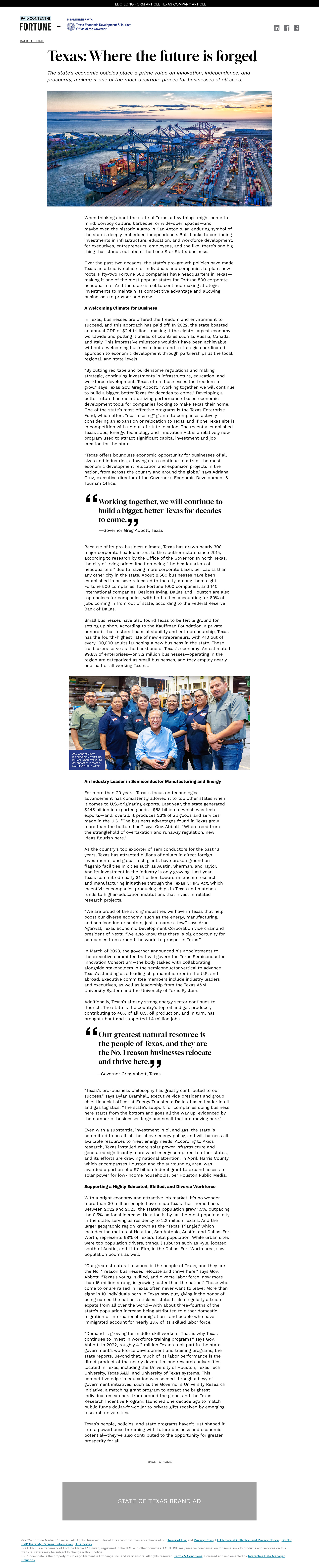
When thinking about the state of Texas, a few things might come to mind: cowboy culture, barbecue, or wide-open spaces—and maybe even the historic Alamo in San Antonio, an enduring symbol of the state’s deeply embedded independence. But thanks to continuing investments in infrastructure, education, and workforce development, for executives, entrepreneurs, employees, and the like, there’s one big thing that stands out about the Lone Star State: business.
Over the past two decades, the state’s pro-growth policies have made Texas an attractive place for individuals and companies to plant new roots. Fifty-two Fortune 500 companies have headquarters in Texas—making it one of the most popular states for Fortune 500 corporate headquarters. And the state is set to continue making strategic investments to maintain its competitive advantage and allowing businesses to prosper and grow.
A welcoming climate for business
In Texas, businesses are offered the freedom and environment to succeed, and this approach has paid off. In 2022, the state boasted an annual GDP of $2.4 trillion—making it the eighth-largest economy worldwide and putting it ahead of countries such as Russia, Canada, and Italy. This impressive milestone wouldn’t have been achievable without a welcoming business climate and a strategic coordinated approach to economic development through partnerships at the local, regional, and state levels.
Because of its pro-business climate, Texas has drawn nearly 300 major corporate headquarters to the southern state since 2015, according to research by the Office of the Governor. In north Texas, the city of Irving prides itself on being “the headquarters of headquarters,” due to having more corporate bases per capita than any other city in the state. About 8,500 businesses have been established in or have relocated to the city, among them eight Fortune 500 companies, four Fortune 1000 companies, and 140 international companies. Besides Irving, Dallas and Houston are also top choices for companies, with both cities accounting for 60% of jobs coming in from out of state, according to the Federal Reserve Bank of Dallas.
Small businesses have also found Texas to be fertile ground for setting up shop. According to the Kauffman Foundation, a private nonprofit that fosters financial stability and entrepreneurship, Texas has the fourth-highest rate of new entrepreneurs, with 410 out of every 100,000 adults launching a new business in the state. These trailblazers serve as the backbone of Texas’s economy: An estimated 99.8% of enterprises—or 3.2 million businesses—operating in the region are categorized as small businesses, and they employ nearly one-half of all working Texans.
An industry leader in semiconductor manufacturing and energy
For more than 20 years, Texas’s focus on technological advancement has consistently allowed it to top other states when it comes to U.S.-originating exports. Last year, the state generated $445 billion in exported goods—$53 billion of which was tech exports—and, overall, it produces 23% of all goods and services made in the U.S. “The business advantages found in Texas grow more than the bottom line,” says Gov. Abbott. “When freed from the stranglehold of overtaxation and runaway regulation, new ideas flourish here.”
As the country’s top exporter of semiconductors for the past 13 years, Texas has attracted billions of dollars in direct foreign investments, and global tech giants have broken ground on flagship facilities in cities such as Austin, Sherman, and Taylor. And its investment in the industry is only growing: Last year, Texas committed nearly $1.4 billion toward microchip research and manufacturing initiatives through the Texas CHIPS Act, which incentivizes companies producing chips in Texas and matches funds to higher-education institutions that invest in related research projects.
“We are proud of the strong industries we have in Texas that help boost our diverse economy, such as the energy, manufacturing, and semiconductor sectors, just to name a few,” says Arun Agarwal, Texas Economic Development Corporation vice chair and president of Nextt. “We also know that there is big opportunity for companies from around the world to prosper in Texas.”
In March of 2023, the governor announced his appointments to the executive committee that will govern the Texas Semiconductor Innovation Consortium—the body tasked with collaborating alongside stakeholders in the semiconductor vertical to advance Texas’s standing as a leading chip manufacturer in the U.S. and abroad. Executive committee members include industry leaders and executives, as well as leadership from the Texas A&M University System and the University of Texas System.
Additionally, Texas’s already strong energy sector continues to flourish. The state is the country’s top oil and gas producer, contributing to 40% of all U.S. oil production, and in turn, has brought about and supported 1.4 million jobs.
“Texas’s pro-business philosophy has greatly contributed to our success,” says Dylan Bramhall, executive vice president and group chief financial officer at Energy Transfer, a Dallas-based leader in oil and gas logistics. “The state’s support for companies doing business here starts from the bottom and goes all the way up, evidenced by the number of businesses large and small that are moving here.”
Even with a substantial investment in oil and gas, the state is committed to an all-of-the-above energy policy and will harness all available resources to meet energy needs. According to Axios research, Texas installed more solar power infrastructure and generated significantly more wind energy compared to other states, and its efforts are drawing national attention. In April, Harris County, which encompasses Houston and the surrounding area, was awarded a portion of a $7 billion federal grant to expand access to solar power for low-income households, per Houston Public Media.
Supporting a highly educated, skilled, and diverse workforce
With a bright economy and attractive job market, it’s no wonder more than 30 million people have made Texas their home base. Between 2022 and 2023, the state’s population grew 1.5%, outpacing the 0.5% national increase. Houston is by far the most populous city in the state, serving as residency to 2.2 million Texans. And the larger geographic region known as the “Texas Triangle,” which includes the metros of Houston, San Antonio, Austin, and Dallas-Fort Worth, represents 68% of Texas’s total population. While urban sites were top population drivers, tranquil suburbs such as Kyle, located �south of Austin, and Little Elm, in the Dallas-Fort Worth area, saw �population booms as well.
“Our greatest natural resource is the people of Texas, and they are the number one reason businesses relocate and thrive here,” says Gov. Abbott. “Texas’s young, skilled, and diverse labor force, now more than 15 million strong, is growing faster than the nation.” Those who come to or are raised in Texas often never want to leave: More than eight in 10 individuals born in Texas stay put, giving it the honor of being named the nation’s stickiest state. It also regularly attracts expats from all over the world—with about three-fourths of the state’s population increase being attributed to either domestic migration or international immigration—and people who have immigrated account for nearly 23% of its skilled labor force.
“Demand is growing for middle-skill workers. That is why Texas continues to invest in workforce training programs,” says Gov. Abbott. In 2022, roughly 4.2 million Texans took part in the state government’s workforce development and training programs, the state reports. Beyond that, much of its labor performance is the direct product of the nearly dozen tier-one research universities located in Texas, including the University of Houston, Texas Tech �University, Texas A&M, and University of Texas systems. This competitive edge in education was seeded through a bevy of government initiatives, such as the Governor’s University Research Initiative, a matching grant program to attract the brightest individual researchers from around the globe, and the Texas Research Incentive Program, launched one decade ago to match �public funds dollar-for-dollar to private gifts received by emerging �research universities.
Texas’s people, policies, and state programs haven’t just shaped it into a powerhouse brimming with future business and economic potential—they’ve also contributed to the opportunity for greater prosperity for all.

Working together, we will continue to build a bigger, better Texas for decades to come.
“
”
—Gov. Greg Abbott, Texas
—Gov. Greg Abbott, Texas
”
Our greatest natural resource is the people of Texas, and they are the number one reason businesses relocate and thrive here.
“
BACK TO HOME


© 2024 Fortune Media IP Limited. All Rights Reserved. Use of this site constitutes acceptance of our Terms of Use and Privacy Policy | CA Notice at Collection and Privacy Notice | Do Not Sell/Share My Personal Information | Ad Choices FORTUNE is a trademark of Fortune Media IP Limited, registered in the U.S. and other countries. FORTUNE may receive compensation for some links to products and services on this website. Offers may be subject to change without notice. S&P Index data is the property of Chicago Mercantile Exchange Inc. and its licensors. All rights reserved. Terms & Conditions. Powered and implemented by Interactive Data Managed Solutions.
Opinions and claims from sponsors of The Texas Draw are solely their own and do not necessarily reflect the opinions and beliefs of the Office of the Texas Governor. Inclusion within The Texas Draw does not imply endorsement by the Office of the Texas Governor.


When thinking about the state of Texas, a few things might come to mind: cowboy culture, barbecue, or wide-open spaces—and maybe even the historic Alamo in San Antonio, an enduring symbol of the state’s deeply embedded independence. But thanks to continuing investments in infrastructure, education, and workforce development, for executives, entrepreneurs, employees, and the like, there’s one big thing that stands out about the Lone Star State: business.
Over the past two decades, the state’s �pro-growth policies have made Texas an attractive place for individuals and companies to plant new roots. Fifty-two Fortune 500 companies have headquarters in Texas—making it one of the most �popular states for Fortune 500 corporate headquarters. And the state is set to continue making strategic investments to maintain its competitive advantage and allowing businesses to prosper and grow.
A Welcoming Climate for Business
In Texas, businesses are offered the freedom and environment to succeed, and this approach has paid off. In 2022, the state boasted an annual GDP of $2.4 trillion—making it the eighth-largest economy worldwide and putting it ahead of countries such as Russia, Canada, and Italy. This impressive milestone wouldn’t have been achievable without a welcoming business climate and a strategic coordinated approach to economic development through partnerships at the local, regional, and state levels.
“By cutting red tape and burdensome regulations and making strategic, continuing investments in infrastructure, education, and workforce development, Texas offers businesses the freedom to grow,” says Texas Gov. Greg Abbott. “Working together, we will continue to build a bigger, better Texas for decades to come.” Developing a better future has meant utilizing performance-based economic development tools for companies looking to make Texas their home. One of the state’s most effective programs is the Texas Enterprise Fund, which offers “deal-closing” grants to companies actively considering an expansion or relocation to Texas and if one Texas site is in competition with an out-of-state location. The recently established Texas Jobs, Energy, Technology and Innovation Act is a relatively new program used to attract significant capital investment and job creation for the state.
“Texas offers boundless economic opportunity for businesses of all sizes and industries, allowing us to continue to attract the most economic development relocation and expansion projects in the nation, from across the country and around the globe,” says Adriana Cruz, executive director of the Governor’s Economic Development & Tourism Office.
“By cutting red tape and burdensome regulations and making strategic, continuing investments in infrastructure, education, and workforce development, Texas offers businesses the freedom to grow,” says Texas Gov. Greg Abbott. “Working together, we will continue to build a bigger, better Texas for decades to come.”
Developing a better future has meant utilizing performance-based economic development tools for companies looking to make Texas their home. One of the state’s most effective programs is the Texas Enterprise Fund, which offers “deal-closing” grants to companies actively considering an expansion or relocation to Texas and if one Texas site is in competition with an out-of-state location. The recently established Texas Jobs, Energy, Technology and Innovation Act is a relatively new program used to attract significant capital investment and job creation for the state.
“Texas offers boundless economic opportunity for businesses of all sizes and industries, allowing us to continue to attract the most economic development relocation and expansion projects in the nation, from across the country and around the globe,” says Adriana Cruz, executive director of the Texas Economic Development & Tourism Office within the Office of the Governor.
