Trailblazer Cal Calamia Is Racing for ‘Advocacy, Storytelling, and Performance’

By — Front Office Sports
Posted — September 4, 2025
Share —


Sponsored by

Cal Calamia’s running journey began in Chicago, handing out Gatorade to racers during marathon weekend as a high school student. Calamia, who uses they/him pronouns, is now on the other end of that hand-off. As an elite runner in their own right—a six-star World Marathon Majors finisher—Calamia is running the Chicago Marathon for the fifth time in October.
The 29-year-old endurance trailblazer is the first athlete to compete in the non-binary division for all six majors (seven as of this year’s addition of the Sydney Marathon, which Calamia plans to race in 2026). They’ve placed first or second each time, and set a personal best of 2:41 at the 2024 Berlin Marathon.
They also played a major role in advocating for the inclusion of a non-binary race category across the sport—a mission that started as a means to fulfill a personal dream of completing all six majors. It’s sparked a movement of equality and boundary-breaking in sports.
This interview has been lightly edited and condensed for clarity.�
Front Office Sports: How does the Rocket X 3 feel different from the Rocket X 2?
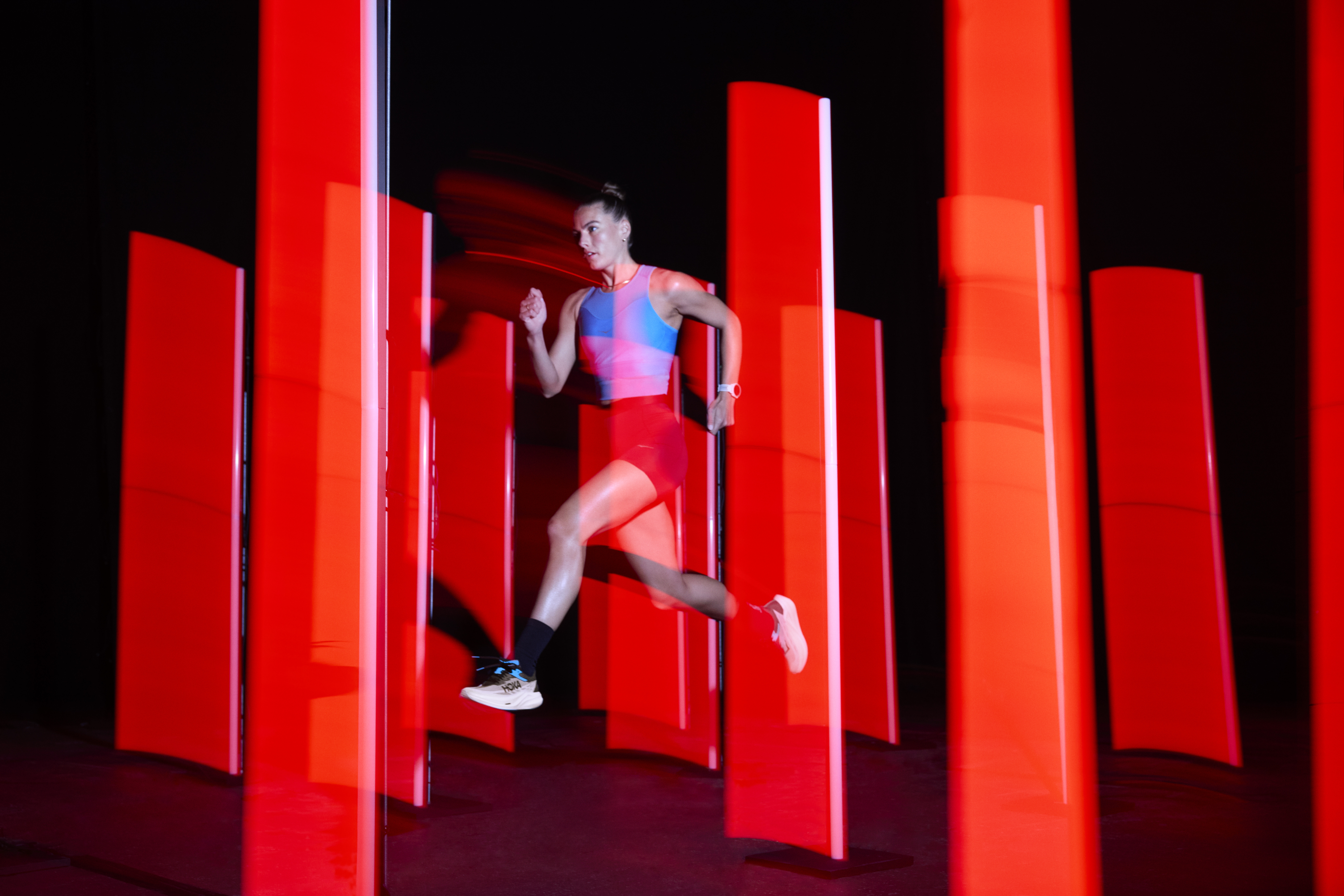
Cal Calamia: To me, it offers more cushion and it's more lightweight. There's also a little bit of additional support in the heel, so it manages to offer a bit more structure and a bit more cushion while still overall feeling like a lighter, faster, and serious race shoe.
FOS: What’s in your typical shoe rotation?
CC: I have five pairs of running shoes that I keep in high rotation for my training. Operating that way is good for running sustainability and injury prevention. It's something that I've adopted in the past few years and feel really strongly about now.
Right now, my day-to-day trainer is the Clifton 10. I often run in the Skyward X for tempo work, or even sometimes when I'm just feeling heavy, because it just makes running feel a little more fun and a little bouncier. The front-runner for racing is the Rocket X 3, and I'll throw that on for some track and other speed work.
My staple for the trails is the Speedgoat. It’s sort of like the equivalent of the Clifton 10 on the roads versus on the trails. If I'm racing on trails, I'll run in the Tecton X 3, which has a sock liner that goes up and provides additional ankle support. It's also kind of like a built-in gaiter, so it keeps things from getting in your shoes when you're out there in the dirt.

I used the new HOKA Rocket X 3 on the track. I'm still getting acquainted with the shoe and trying it out in different contexts, but I'm feeling really excited about it because the Rocket X 2 was formerly my favorite race shoe, and this version of it is upgraded, so I'm amped to put it to the test in Chicago.
Cal Calamia, runner and sports activist
Learn More about the Rocket X 3
Go to HOKA
Back to Top

The marathoner wants excellence—not just inclusion—to be the goal for non-binary athletes.
FOS: How is your training going for the Chicago Marathon?
Cal Calamia: I’m just getting ramped up. I lead non-binary run club, and we did a collaborative pyramid workout with the San Francisco November Project. I did 400m, 800m, 1200m at 10k pace, and then 800m, 400m at 5k pace. It was a nice rust-buster.
Last week, I started cranking up my mileage, and this morning was my first track workout since before I raced the London [Marathon] in April. It felt really good, and I feel really strong.
I used the new HOKA Rocket X 3 on the track. I'm still getting acquainted with the shoe and trying it out in different contexts, but I'm feeling really excited about it because the Rocket X 2 was formerly my favorite race shoe, and this version of it is upgraded, so I'm amped to put it to the test in Chicago.

FOS: At the London Marathon, you not only won the nonbinary division, but also became the first athlete to complete all six World Marathon Majors in the non-binary category. How did it feel to cross that finish line?
CC: It was absolutely phenomenal. So much of what I've accomplished in my life I did not know was possible. Through my own work and advocacy, as well as the collaborative atmosphere of having sponsors like HOKA, I've been really pleasantly surprised with just how much I've been able to achieve and excel as an athlete myself, and how much space I've been able to create for other people to follow in my footsteps.
A big part of my work has been not only my own athletic performance, but also having a meaningful impact on the running industry at large. More people can feel like they can not only toe the start line but also really be successful athletes, no matter who they are.
FOS: What was the behind-the-scenes process like to be advocating for marathons to include a non-binary category?
�CC: I have three key things that I need to juggle and maintain—advocacy, storytelling, and performance.
I think the specific role that I play is so unique because I am a high-performance athlete. There are several key elements around my direct advocacy and conversation with the races about why the non-binary division is important, plus my storytelling about who I am, what my identity and experience means to me, and how it factors into my desire and ability to compete. And then, in order to be taken seriously in the landscape, it's important that I perform well.
Community building is also a huge part of the work I do. I had been advocating for these [non-binary] divisions, and I had been performing well in them, but I still felt like something was missing. I realized it was that sense of community. Having the community that I have in person and online now [with non-binary run club] is so quintessential, because it provides context. It provides rationale for actually incorporating the non-binary divisions.
There’s evidence we are a real community of real people. There's a real demand and a real need for spaces for us to show up and be a part of the sport.
FOS: How did you start the non-binary run club?
CC: I was dealing with feeling not included, not represented, and not in the community. I felt like I couldn't have been the only person experiencing that struggle. I think it's a perfect example of the saying, “If you build it, they will come,” because they do.
So much of the exclusion of trans, non-binary athletes happens by isolating us into thinking that we're the only one, and maybe it's not a space where we belong. But when we come together, I think we're much more able to empathize with each other and, in turn, ourselves. It also just creates a [positive] training environment, which is something all athletes need regardless of gender—to have people to hold us accountable to our goals, and be running right alongside us toward those goals.
We really try to strike the balance between creating safe and affirming spaces that appropriately challenge our members, while also building meaningful connections with other communities in the area and beyond. We're engaging in meaningful conversations about how there's room within the sport for all of us.
FOS: What’s next for you?
�CC: Really rallying my community to not only show up for races, but also to feel empowered enough to set performance goals for themselves. I want to see more trans athletes being represented and stood behind by brands in the industry. I think there's a lot of power in collaboration itself, and so I'm just excited to continue to ideate and generate creative solutions and plans around what it can look like to really spotlight trans excellence and the trans and non-binary athletes who are doing amazing things within the sport.


FOS: What motivates you to keep doing this work every day?
CC: It can be really challenging, because there are many different roles I have to play to just show up and compete. It's not as simple as it may be for other athletes, but I continue because I believe in a future that is beyond trans and non-binary inclusion, and really is all about trans and non-binary excellence in sport.
I spent so long being worried about being included, and I just realized how low of a bar that is. The idea of inclusion can sometimes strip away the possibility for trans athletes to really excel. I'm going to continue to push myself as an athlete and a community leader so that I can prove to not only myself, but also my community, that we really are capable of doing whatever it is we set our minds to.