Cities and the waterways that run through them are inextricably linked— economically, culturally, and geographically. Columbia, South Carolina, is no exception. At the heart of this college town and capital city, the convergence of the Broad, Saluda, and Congaree rivers forms a natural crossroads that for centuries forged connection and commerce and today sustains recreation, transportation, and civic life.
For Indigenous traders and early colonial settlers, “the river was everything,” says Mike Dawson, CEO of the River Alliance, a Columbia-based nonprofit. Before the Revolutionary War, these waterways provided the fastest route for transporting goods to the coast and back. Then the canal system was built—the largest public works project in South Carolina in the early nineteenth century—and the people became less reliant on the rivers. In many ways, Dawson says, that disconnect persisted until the early 1990s, when his organization began working to reclaim the city’s blue heart as a public amenity.
Converging in the heart of the city, Columbia’s three rivers have evolved from
historic trade routes into thriving hubs of recreation and connection
Columbia's Riverfront Finally
Has Its Moment
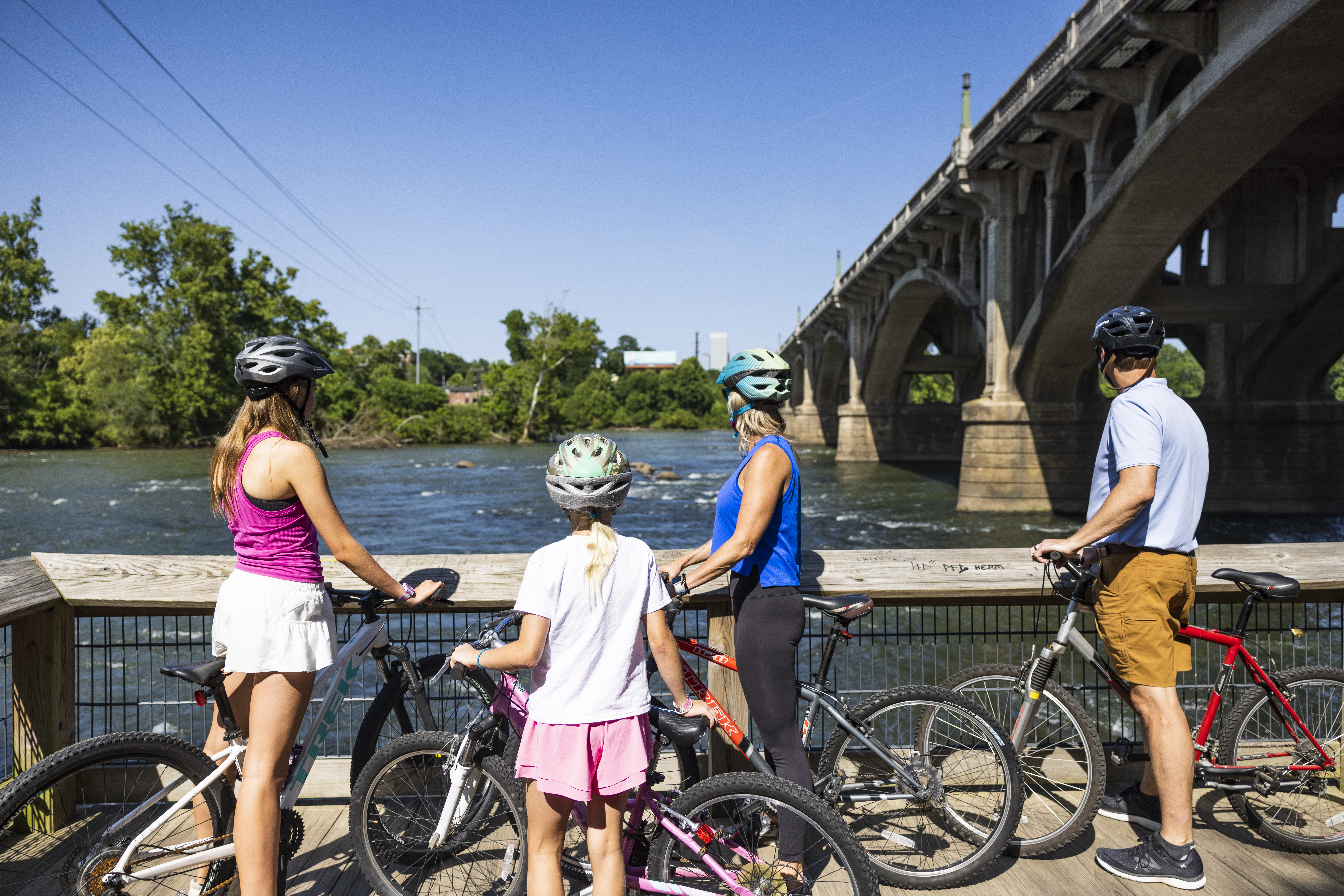
Today, thanks to the River Alliance and a multi-county partnership, fifteen miles of trails invite residents and visitors to bask in the beauty of these natural playgrounds, which new pedestrian walkways knit directly to downtown streets. “You can walk, you can bike, you can hike, you can rollerblade, you can go fish, you can do all of the above,” Dawson says. “Some people have a place they go every day and swing in a hammock or sit out with a physics book and study.”
Or you can take to the water, perhaps launching into the current with the help of Palmetto Outdoor, a tubing and canoe outfitter in West Columbia’s River District. The popular Z–G route carries floaters past the Riverbanks Zoo & Garden before concluding at the West Columbia Riverwalk—an unhurried, roughly three-hour drift along the city’s most scenic stretch of river. “You’re floating from a natural river into the downtown, and you can get off and have lunch,” Dawson says.
Explore Columbia’s natural playground at
ExperienceColumbiaSC.com/Things-To-Do/Outdoor-Recreation
TTk Lorem Ipusim
Two line caption
Tk Lorem Ipusim
As Columbia continues to grow, its three rivers have become more than a scenic backdrop and window into the past. What once carried goods now carries people: walking, biking, floating, gathering. A working landscape has become a living one, a place where conservation, recreation, and community converge in the heart of the city as naturally as the Broad, Saluda, and Congaree.



IN PARTNERSHIP WITH


You can walk, you can bike, you can hike, you can rollerblade, you can go fish, you can do all of the above.
mike dawson
EXPERIENCE COLUMBIA SC