Fibroids can be a pain for women during their periods. An outpatient procedure can ease the discomfort and heavy bleeding.
No one looks forward to their period — but some women have more reason to dread it than others. They experience very heavy and prolonged periods, lots of bleeding, and pelvic discomfort. Pressure on the pelvis can cause frequent urination and sometimes, loss of bladder control altogether. Often, fear of an accident is almost as bad as the blood and pain.
These are all symptoms caused by fibroids. Also known as myomas, fibroids are tumors that grow, either alone or in groups, in the wall of the uterus. They are usually non-cancerous and can be as tiny as an apple seed. But over time, they can grow and cause women a lot of pain, distress, and embarrassment.
What are fibroids?
These symptoms are more than just annoying — they can greatly impact a person’s quality of life. Sometimes fibroids can be treated medically through birth control pills, an IUD (intrauterine device), or hormones. There is also a nonsurgical treatment called focused MR ultrasound, in which high-intensity focused ultrasound targets and destroys harmful tissue, but that is usually only effective in treating one or two fibroids that must be in a particular location.
If the fibroids are numerous and widespread in the uterus, and other treatments fail to significantly improve matters, traditionally, the only option left for women is surgery. A surgery to remove the fibroids can be performed through a large incision in the abdomen or through smaller incisions using laparoscopy. In other situations, women opt for a complete hysterectomy to remove the uterus altogether.
“One in five women thinks that hysterectomy is their only option,” says Dr. Hsu.
That’s why Dr. Hsu has been outspoken about spreading awareness of uterine fibroid embolization and ARA Diagnostic Imaging’s state-of-the-art ability to do the treatment and provide relief to the women of Central Texas.
SCROLL
Uterine fibroid embolization begins with a tiny incision made in the groin or wrist through which the interventional radiologist guides a catheter using a moving X-ray camera. The catheter goes through the circulatory system to the arteries that feed blood to the fibroids. Then the physician injects tiny, FDA-approved beads into those arteries, cutting off the blood and causing the fibroids to shrink over time.
“Our procedure is usually performed with moderate sedation,” says Dr. Hsu. “I like to call it ‘a few margaritas through the IV with no hangover.’ It’s mostly done as an outpatient procedure. The recovery process is usually one to two weeks, unlike a hysterectomy, which is typically four to six weeks. UFE also has a very low complication rate. And I think the most important thing for women to consider is that you keep your uterus.”
Another important aspect of UFE: It works. Data suggests that 90 percent of women will experience significant relief with the procedure. The benefits include:



80
have uterine fibroids before the age of 50
%
the age range most at risk for fibroids
"It’s a great non-surgical treatment that treats all the fibroids in one setting. It has a very low complication rate."
- Dr. Connie Hsu, ARA Diagnostic Imaging
Solving problems like this is why Connie Hsu became a doctor.
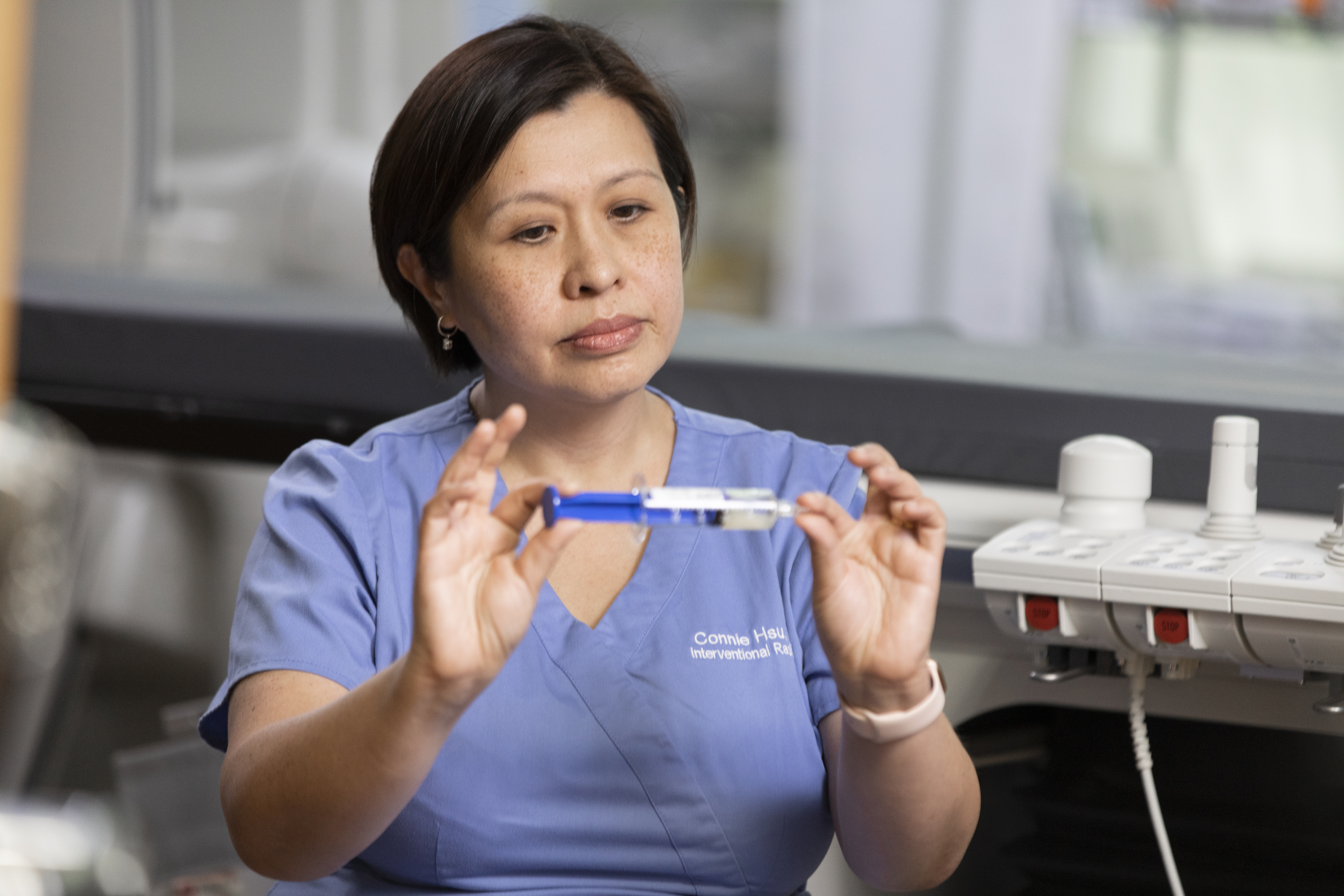
“I think as any physician, we go into medicine wanting to make a difference,” says Dr. Hsu, an interventional radiologist at ARA Diagnostic Imaging (ARA), a radiology group that provides medical imaging services to Central Texas through 17 outpatient centers and in 24 hospitals within the region. “So, when I have a patient who has been bleeding for months on end, as a woman, I feel for her. And as a physician, I know that I can help her.”
Dr. Hsu can help heal patients using something called uterine fibroid embolization or UFE. It’s a simple, minimally invasive procedure to treat fibroids that will decrease bleeding, relieve pelvic pain, perhaps most importantly, restore a patient’s confidence — and help them to get back to their normal lives as quickly as possible.
“It’s a great non-surgical treatment that treats all the fibroids in one setting,” says Dr. Hsu. “It has a very low complication rate — and a lot of women just don’t know about it.”
35-54
By Monica Vanover on Nov 21, 2025
Fibroids are more common than most people might think. In fact, about 80 percent of women will have uterine fibroids before the age of 50. Women most at risk are between the ages of 35 and 54, especially African American women. Other risk factors include a family history of fibroids, getting your period at an early age, being overweight, and high blood pressure.
Greater than 99% of fibroids are benign (non-cancerous). And some women who have fibroids won’t experience any symptoms. But that doesn’t mean they are always completely harmless. As they grow, they can cause a whole host of symptoms, including:
UFE: Proven, Safe, Effective
>99
%
of fibroids are benign
(non-cancerous)
"UFE also has a very low complication rate. And I think the most important thing for women to consider is that you keep your uterus."
- Dr. Connie Hsu, ARA Diagnostic Imaging


“I tell women that medicine keeps improving as time passes, and uterine fibroid embolization has been around for over 30 years,” says Dr. Hsu. “So, it’s a proven, safe, effective treatment for uterine fibroids.”
Of course, technology also improves over time, and ARA Diagnostic Imaging has kept up with the advances in tools to provide cutting-edge interventional radiology treatments for its patients.
“We have the latest state-of-the-art equipment available so that when we treat our patients, we have the best equipment possible to take care of them,” says Dr. Hsu. “It’s really a luxury to have these tools available to us. We can do the best we can for our patients. And they’re able to have more energy and get back to their normal lives.”
But technology is only part of what ARA Diagnostic Imaging offers. In addition to the latest machines, tools, and methods, the practice also emphasizes a personalized approach to any treatment. From techs to nurses to administrative staff, everyone at ARA is dedicated to helping patients find comfort, convenience, and relief.
Dr. Hsu and her team at ARA are passionate about giving patients back their quality of life through UFE and other minimally invasive procedures.
sponsored by: ARA Diagnostic Imaging

If you're wondering if UFE is right for you, take this quick survey from ARA Diagnostic Imaging. Get back on your feet and get back to living the active life you love.
Learn More
Quick SURVEY
Pain in the lower back and legs
Constipation
Frequent urination and loss of bladder control
Pelvic pain and pressure
Painful and prolonged period
Excessive menstrual bleeding
No change in hormones or effect on internal organs
More confidence and less chance of period messes
Better urinary function
Relief of pelvic pain and/or pressure
Keeping your uterus, or womb
Decrease in heavy period flow
Feeling better emotionally and physically