In Houston, our dedicated first responders are heroes. However, learning CPR can turn anyone into a hero in waiting. Bystander CPR from individuals while waiting for emergency services can potentially save up to 200,000 more lives every year.
Harris Health in collaboration with the American Heart Association, is committed to training as many bystander CPR responders as possible. On Oct. 16, the two organizations are hosting Restart a Heart Day, a multi-site CPR training effort across Houston and Harris County and across Harris Health hospitals and clinical sites. The goal, part of a centennial celebration of the American Heart Association, aims to train 30,000 local residents in this life-saving intervention in a single day.
Harris Health and American Heart Association Team Up for CPR Training, Heart Walk
By StoryStudio on september 27, 2024
SPONSORED BY Harris Health
Specialties
Heart health is a subject close to Porsa’s heart. His mother battled congestive heart failure for most of her life. His work at the American Heart Association, like chairing the Houston Heart Walk on Saturday, Oct. 26, is in part motivated by this personal experience. This year, the Houston Heart Walk hopes to raise $2.5 million to fund research and treatment for heart disease.
“For over a century, the American Heart Association has depended on philanthropic support to drive research and treatment for heart related diseases, hypertension, heart attack and stroke,” Porsa adds.
Improving heart health in Harris County is a collective effort and dependent on public support. Porsa is grateful to Harris County residents for their support of the $2.5 billion bond election in 2023 that will fund vital infrastructure for Harris Health to help continue to improve the health and well-being of the community.
“We’re so excited about the future of Harris Health and the residents of Harris County,” Porsa says. “Thanks to everyone who voted in support of our bond proposal, Harris Health is responding to the future needs of our community.”
Appointments
Locations
“The Chest Pain Program is a structured initiative within the hospital that focuses on the rapid assessment, diagnosis, treatment and management of patients presenting with chest pain or symptoms suggestive of a heart attack,” Eapen says.
She notes that while men are at higher risk of heart attack, the risk for post-menopausal women is as high or surpasses that of men. General risk factors include high blood pressure, high cholesterol, diabetes, smoking, obesity, physical inactivity and a family history of heart disease. These same risk factors apply to stroke as well, says Sophia Cheruiyot, coordinator, Stroke Service, Harris Health Lyndon B. Johnson Hospital. It’s the job of both Cheruiyot and Eapen to coordinate data-driven initiatives to improve heart care.
“We are one of the top performing centers for heart attack and heart failure care in Houston, making us unique in public health care,” says Waleed Kayani, MD, director, Cardiology, Harris Health Ben Taub Hospital, and assistant professor, Cardiology, Baylor College of Medicine. “Heart disease symptoms are life-limiting, so prevention and early detection can have a role in managing these patients. Focusing on heart health and high-quality disease care allows us to make a real impact in people’s lives. Harris Health’s strong focus on primary, as well as secondary prevention, of heart disease will go a long way in improving our community’s well-being.”
Care for cardiovascular disease at Harris Health takes many forms with specialized care at the Lipid Clinic and a robust heart valve program, among others. Sini Eapen, program manager, Chest Pain Program, Ben Taub Hospital, leads the charge on heart attack care.
"Currently less than 50% of those suffering cardiac arrest receive bystander CPR. Training more bystanders in CPR could double the survival rate."


But to receive Harris Health’s available services, a heart attack or stroke victim has to first make it to the hospital. Both Cheruiyot and Eapen stress that if one is experiencing symptoms of a heart attack (chest pain, arm or leg pain or weakness, back pain, shortness of breath, nausea or vomiting, dizziness, indigestion) or stroke (loss of balance, facial droop, trouble speaking, blurred vision), immediately call 9-1-1. In both cases, time is of the essence. The sooner you receive treatment, the better the outcome.
“We tell patients to never drive themselves,” Cheruiyot says.
“Always call 9-1-1,” Eapen adds. “Driving yourself can get you killed.”
As a bystander, if you notice someone collapse, starting CPR chest compressions immediately until emergency services arrive can help save a victim’s life. That’s why learning CPR is so important.


“The impact of CPR training is huge,” Kayani says. “Receiving CPR in the field is the best predictor of survival.”
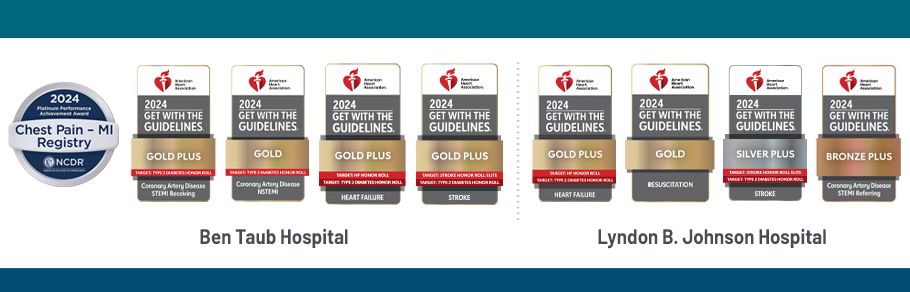
The success of Harris Health’s heart care is well-known in the industry. Heart attack and stroke care at Harris Health hospitals has been consistently recognized by the American Heart Association’s Get with the Guidelines awards, a program for improving heart and stroke care by promoting consistent adherence to the latest scientific treatment and benchmarks.
“Being recognized by the American Heart Association with the ‘Get With The Guidelines’ for stroke and heart attack care is a huge testament to the fact that our hospitals compete not only with other safety net hospitals, but with every hospital in the country in terms of the quality of care we provide,” Porsa says. “These recognitions are a validation of our mission to improve the health of our community, not only in treating disease, but in disease prevention as well.”
"From the time a patient walks in with stroke symptoms to the time they’re discharged, patients at Harris Health are getting the highest quality care."
"Being recognized by the American Heart Association with the ‘Get With The Guidelines’ for stroke and heart attack care is a huge testament to the fact that our hospitals compete not only with other safety net hospitals, but with every hospital in the country in terms of the quality of care we provide."
Harris Health invites residents to participate in the upcoming AHA events. For more information on the Restart a Heart training event on Oct. 16, visit this site. For more information on the Houston Heart Walk on Oct. 26, visit this site.
“Currently less than 50% of those suffering cardiac arrest receive bystander CPR,” says Esmaeil Porsa, MD, president and CEO, Harris Health, and the incoming president of the American Heart Association’s Houston Chapter. “Training more bystanders in CPR could double the survival rate.”
Cardiovascular disease is the number one cause of death in the U.S. including Harris County residents, causing heart attack, stroke and death. To address this crisis, improving heart health in the community has become a top priority for Harris Health.

Sophia Cheruiyot, coordinator, Stroke Service, Harris Health Lyndon B. Johnson Hospital
Waleed Kayani, MD, director, Cardiology, Harris Health Ben Taub Hospital
Heart health is a subject close to Porsa’s heart. His mother battled congestive heart failure for most of her life. His work at the American Heart Association, like chairing the Houston Heart Walk on Saturday, Oct. 26, is in part motivated by this personal experience. This year, the Houston Heart Walk hopes to raise $2.5 million to fund research and treatment for heart disease.
“For over a century, the American Heart Association has depended on philanthropic support to drive research and treatment for heart related diseases, hypertension, heart attack and stroke,” Porsa adds.
Improving heart health in Harris County is a collective effort and dependent on public support. Porsa is grateful to Harris County residents for their support of the $2.5 billion bond election in 2023 that will fund vital infrastructure for Harris Health to help continue to improve the health and well-being of the community.
“We’re so excited about the future of Harris Health and the residents of Harris County,” Porsa says. “Thanks to everyone who voted in support of our bond proposal, Harris Health is responding to the future needs of our community.”
Harris Health invites residents to participate in the upcoming AHA events. For more information on the Restart a Heart training event on Oct. 16, visit this site. For more information on the Houston Heart Walk on Oct. 26, visit this site.
“The impact of CPR training is huge,” Kayani says. “Receiving CPR in the field is the best predictor of survival.”
The success of Harris Health’s heart care is well-known in the industry. Heart attack and stroke care at Harris Health hospitals has been consistently recognized by the American Heart Association’s Get with the Guidelines awards, a program for improving heart and stroke care by promoting consistent adherence to the latest scientific treatment and benchmarks.
“Being recognized by the American Heart Association with the ‘Get With The Guidelines’ for stroke and heart attack care is a huge testament to the fact that our hospitals compete not only with other safety net hospitals, but with every hospital in the country in terms of the quality of care we provide,” Porsa says. “These recognitions are a validation of our mission to improve the health of our community, not only in treating disease, but in disease prevention as well.”

Sini Eapen, program manager, Chest Pain Program, Harris Health Ben Taub Hospital
“From the time a patient walks in with stroke symptoms to the time they’re discharged, patients at Harris Health are getting the highest quality care,” Cheruiyot explains. Harris Health’s multi-disciplinary stroke support system team includes nurses, doctors, neurologists, neurosurgeons, clinical pharmacists, social workers, psychologists, physical therapists, occupational therapists, speech therapists, nutritionists and Harris Health’s innovative Food Pharmacy. These experts work in concert to ensure each patient gets the best care.
Sini Eapen, program manager, Chest Pain Program, Harris Health Ben Taub Hospital