


Download Report
Commercial property rates are surging, but hope is on the horizon.
Explore HUB’s detailed rate forecast and property guidance.
Business
Outlook Mid-Year Rate Report


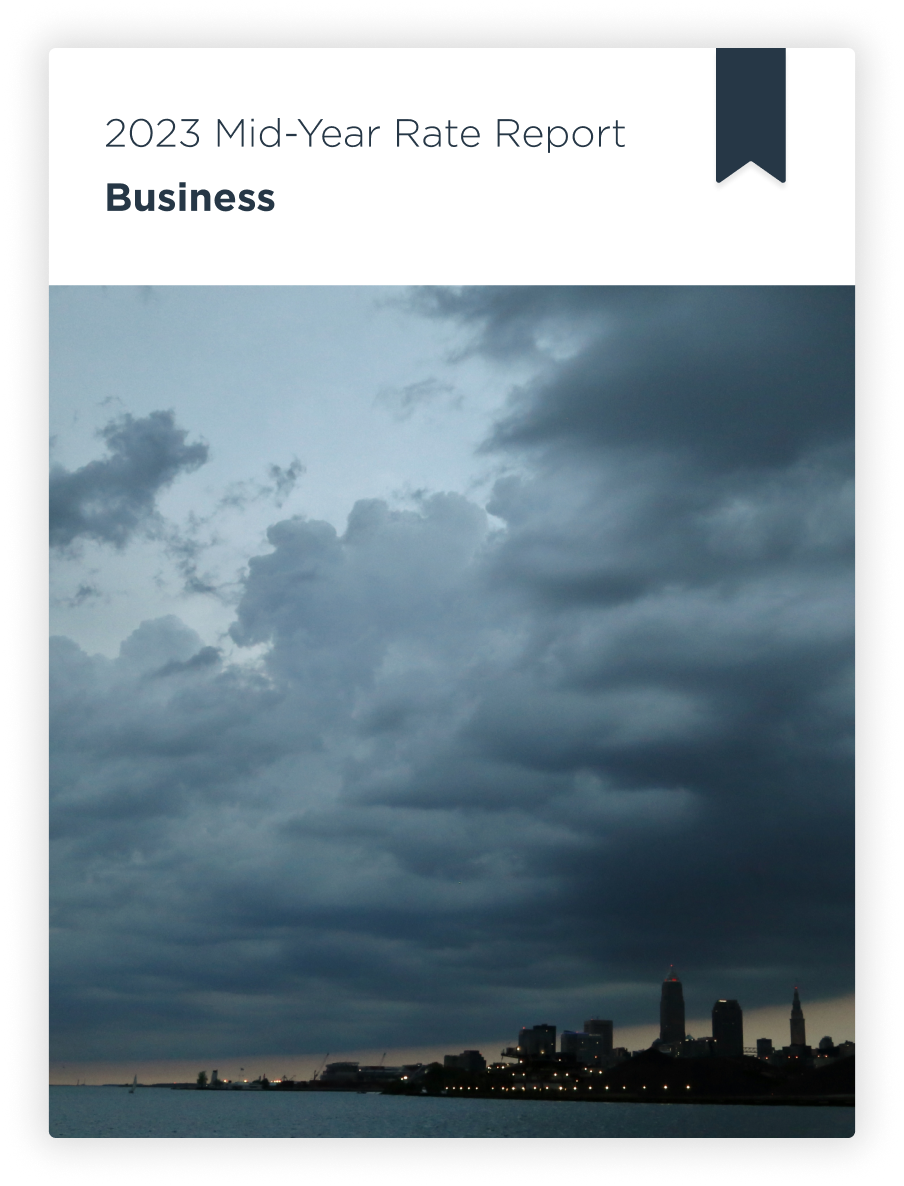
The volatile commercial property insurance market began 2023 in tumult, with economic uncertainty, rising replacement costs, supply chain delays and prominent weather catastrophes in 2022 elevating rates. Industries across the board are likely to pay more for property insurance and see terms and conditions tighten, but stabilizing inflation and improved underwriting should help the market settle into a less erratic future.
Setting the Scene
Mother Nature wreaked havoc across the globe in 2022. Losses from natural disasters cost insurers more than $125 billion globally, contributing to a 17% jump in commercial property rates worldwide this year. Unexpected high inflation, rising interest rates and greater-than-expected CAT losses hurt the world’s four largest reinsurers’ bottom lines in 2022. As a result, reinsurance rates for commercial property insurers rose 20% to 60% in the first quarter of 2023. Those insurers are now passing on costs to policyholders with higher rates and burdensome terms and conditions.
In the U.S., hurricanes in the Southeast, tornadoes in the Midwest, hailstorms in the north and wildfires throughout the West battered the country. In Canada, late-winter storms in the East; tornadoes, hail and wind in the West; and Hurricane Fiona in Eastern Quebec and the Maritimes made 2022 the third-most costly year for insured damage in the country’s history.
But there is hope that prices will moderate soon. Inflation in the U.S. has fallen steadily since its peak of 9% in June 2022, and few lingering supply chain bottlenecks from the pandemic remain. Insureds who invest in mitigation strategies are likely to see the greatest benefits.
Commercial property rates have been on the rise — increasing every quarter since 2018. Adding to the market burdens are record disaster losses and higher costs for building materials, equipment, labor and financing. For property insurers, those rising prices drove up loss costs $30 billion in 2021, marking a trend that continued into 2022.
The rising prices have also affected property valuations: Nearly one-third of commercial properties are undervalued, creating gaps between coverage amounts and rebuilding costs.
For most of the U.S., property insurance rates will rise 10% to 25%; properties in catastrophe-prone locations will see even more rate elevation. In Canada, rates will increase 5% to 15%, largely due to increased valuations. But there are signs that the market may peak this summer.
Underwriters are requiring property owners to post updated property valuations while shoring up terms and conditions. Best-in-class commercial property will obtain the most favorable terms and be first in line for rate relief.
Catastrophes and inflation contributing to rising rates

A lack of underwriting appetite for commercial properties among carriers will exacerbate challenges for property owners. Since the end of 2022, more than 85% of risk managers reported seeing reduced commercial property capacity. Insurers are scaling back coverages and in some cases, exiting difficult markets altogether.
While commercial insureds in Florida and Louisiana have had difficulty finding sufficient property coverage for many years, the capacity crunch has gotten worse. In Florida, more than a dozen insurance companies have been placed into receivership in the past two years, further crunching capacity.
With high inflation and rising construction prices, commercial companies may not be able to purchase full replacement cost for their buildings — which can leave them in violation of loan covenants.
Other states are feeling the pinch. Insurers are cutting capacity in Texas, which suffered immense property damage from the deep freeze of February 2021 and hurricanes hitting its Gulf Coast. Carriers are pulling away from tornado-prone states like Oklahoma, and reducing their interest in underwriting earthquake coverage across the U.S.
Insurers have also been fleeing California for reasons beyond wildfires.
Capacity will continue to challenge commercial property insureds
The state’s insurance commissioner has increased property coverage limits to $20 million under the Fair Access to Insurance Requirement (FAIR) Plan for those unable to secure insurance in the primary market. However, insurers are required to help absorb losses from FAIR Plan participation, which will be a major disincentive to insure commercial property in California.
In Canada, catastrophe-prone areas will see reduced capacity and increased rates. Commercial properties with exposure to earthquakes, floods and hailstorms will experience the most difficulty.
As insurers reduce capacity, it could force many CAT-exposed commercial property owners to seek coverage from excess and surplus (E&S) carriers. However, fewer E&S insurers are willing to underwrite commercial property catastrophe coverage. E&S rates for property have risen more than 20%, with rates more than doubling for CAT-exposed property coverage.


Commercial properties and construction sites are under increased underwriter scrutiny, making transparency crucial. With chronic supply chain delays, contractors are routinely storing expensive equipment and materials on site — and builder’s risk policies may not account for the loss of or damage to that equipment.
Contractors can expect to see their builder’s risk rates rise 10% to 15% in 2023 — and much more for sites located in catastrophe-prone zones. Those who previously allotted about 2% of their budget for insurance can expect to earmark as much as 5% this year. And with insurers less likely to underwrite an entire project, contractors may need to procure shared and layered insurance programs, further increasing costs.
High inflation and increased construction costs are also leaving some projects underinsured mid-build.
Underwriters are scrutinizing all aspects of a build, including supply procurement and storage, and routinely inserting protective safeguard clauses — such as site security requirements or the employment of night guards — into policies, driving up costs even further.
For example, insurers are requiring contractors and storage operations in transportation to show precisely what equipment and combustible materials are on site and how long they will remain there. Also, underwriters are requesting specific evacuation plans, particularly for construction sites located in coastal or wildfire-prone areas. This includes plans for shutting down the site, evacuating workers and removing heavy equipment in the event of an impending catastrophe. They also need to show insurers a risk management strategy for security, as well as solid fire and water mitigation strategies on construction sites.
Insurance property prices
will pinch many industries
In the transportation industry, insurers are keeping a close eye on warehouse and garage safety, particularly with regards to fire hazards such as charging stations for vehicles or combustibles such as cardboard and trash. Insurers also expect in-depth plans for water and fire mitigation and security.


Start renewals as early as possible.
For a traditional renewal, plan to start the process 120 to 150 days out. Be sure to provide carriers with detailed information on recent upgrades to electrical, plumbing and roofs. Failing to provide that information could cause your risk profile to default to the worst-case scenario and highest premium.
Improve your risk management — and let
the world know about it.

Develop evacuation plans for catastrophes.
Take a layered approach to security.
Develop evacuation plans for catastrophes.
Take a layered approach to security.
Start renewals as early as possible.
Consider technological upgrades to reduce exposures, such as water sensors, sump pumps, electrical backups and outdoor property improvements to reduce damage from wildfires, erosion and flooding. Completing a business insurance worksheet may provide a better picture of exposures and how they can be mitigated. Provide insurers with data that shows your properties are best-in-class risks and deserving of better terms and rates.
Improve your risk management — and let
the world know about it.
Insurers want to know that there’s a plan for dealing with a catastrophic event. You need plans for evacuating personnel, removing equipment and securing buildings in case of an approaching hurricane, windstorm, wildfire or possible flooding.
Develop evacuation plans for catastrophes.
Start renewals as early as possible.
Improve your risk management — and let the world know about it.
Take a layered approach to security.
Start with physical security such as fencing, signage, secured gates and doors, access control and security personnel. Then layer on technologies to further improve security, such as motion detectors, sensors and video surveillance.
Take a layered approach to security.
Start renewals as early as possible.
Improve your risk management — and let
the world know about it.
Develop evacuation plans for catastrophes.
Manage your risk to improve attractiveness to insurers
While finding insurance for commercial properties will remain difficult, we expect market instability will level off as 2023 progresses. But to improve insurability and reduce risk immediately, we recommend property owners adopt several best practices, including the following:
Check your property valuations.
Consider nontraditional insurance coverage.
Work in partnership with your broker.
With inflation and rising construction costs, it’s crucial for commercial property owners to have enough insurance to cover rebuilding. Also, it’s imperative that you understand policies’ full terms and conditions — be aware of any loss provision limitations or exclusions that could lead to losses.
Check your property valuations.
Start renewals as early as possible.
Improve your risk management — and let
the world know about it.
Develop evacuation plans for catastrophes.
The days of finding adequate commercial property coverage from a single insurer may be over for some insureds. Purchasing difference in conditions (DIC) coverage or a deductible buy-down may be needed to fill in the gaps when traditional insurers reduce limits and coverage or raise deductibles. Commercial property owners may also consider coverage from E&S underwriters, consider participating in a captive or risk sharing, or shoulder additional risk themselves. Consult with your broker on these nontraditional options, as well as how to tame insurance costs through deductibles, self-insured retentions or other alternative means. Remember that your broker will need access to alternative insurance markets to leverage these options.
Consider nontraditional insurance coverage.
Start renewals as early as possible.
Improve your risk management — and let
the world know about it.
Develop evacuation plans for catastrophes.
Always consult your insurance broker before purchasing a commercial building or building a new one, even in the concept development phase. It’s essential to understand the risks and to leverage risk advisors’ experience to identify exposures and develop risk mitigation plans. Your broker can show how to make your properties more attractive during both the construction phase and for the lifetime of the asset, and find the right insurance with the best possible terms and price.
Work in partnership with your broker.
Start renewals as early as possible.
Improve your risk management — and let
the world know about it.
Develop evacuation plans for catastrophes.
Check your property valuations.
Consider nontraditional insurance coverage.
Work in partnership with your broker.
Check your property valuations.
Consider nontraditional insurance coverage.
Work in partnership with your broker.
Check your property valuations.
Consider nontraditional insurance coverage.
Work in partnership with your broker.
Take a layered approach to security.
Consider nontraditional insurance coverage.
Work in partnership with your broker.
Take a layered approach to security.
Check your property valuations.
Work in partnership with your broker.
Take a layered approach to security.
Check your property valuations.
Consider nontraditional insurance coverage.

Business Insurance
When you partner with HUB, you're at the center of a vast network of experts who will help you reach your goals. Download our Rate Report to learn how you may be affected by today's insurance rates and how it may impact your total cost of risk.
Download Report
1. Swiss Re Institute, "A perfect storm," March 22, 2023.
2. Fitch Ratings, “Different Degrees of Diversification Drive European Reinsurers’ 2022 Earnings,” March 23, 2023.
3. Fitch Ratings, “Strong Pricing in Property and Specialty Dominate 2023 Reinsurance Renewals,” January 10, 2023.
4. Statista, “Monthly 12-month inflation rate in the U.S. from March 2020 to March 2023,” April 17, 2023.
5. FM Global, “Record US $800 million membership credit for FM Global’s client-owners,” April 28, 2023.
6. McKinsey & Company, “Countering inflation: How US P&C insurers can build resilience,” August 25, 2022.
7. Property Casualty 360, “Growing construction costs driving commercial property coverage gap,” April 3, 2023.
8. Insurance Office of America, “Rates Moderate For Most Lines As Commercial Property Lurches Upward,” March 7, 2023.
9. E&E News, “Growing insurance crisis spreads to Texas,” April 17, 2023.
10. Business Insurance, “California plan increases commercial property cover limits,” March 30, 2023.
11. Inside P&C, “HNW homeowners space ‘in hardest market in decades,’” March 22, 2023
12. Intelligent Insurer, “No longer niche: Swiss Re thinks parametric insurance is the future,” May 4, 2023.

Losses from natural disasters cost insurers more than $125 billion globally, contributing to a
jump in commercial property rates worldwide this year.
17%

Since the end of 2022, more than
of risk managers reported seeing reduced commercial property capacity
85%

in 2023
15%
Contractors can
expect to see their builder’s risk rates rise
Despite the difficult insurance market, alternative approaches can alleviate the pain for commercial property owners.
To help reduce rates, property owners can shoulder additional risk through reduced limits and increased deductibles and alternative placements. Captive insurance or a structured risk program may provide an alternative for commercial property owners who have absolute faith in their risk management strategies.
For CAT-exposed properties, parametric insurance is another coverage option; parametric coverage provides immediate payouts based on agreed-upon measurements such as wind speed or rainfall. Though still small, the parametric market is expected to grow to $29.3 billion by 2031.
Alternatives, risk retention will provide some relief
Even for properties in CAT-exposed areas, insureds can find affordable coverage if they’re committed to decreasing risk. A knowledgeable broker armed with a client’s solid risk reduction strategy, the right data and a positive loss history across a portfolio can mean the difference between getting declined and obtaining coverage.

Though still small, the parametric market is expected to grow to
$29.3
by 2031
billion
Swiss Re Institute, “A perfect storm,“ March 22, 2023.
10% to
1
5
4
7
6
3
2
11
10
12
9
8
Sitemap
Terms & Conditions
Privacy Statement
© 2023 HUB International Limited. 150 N Riverside Plaza, 17th Floor, Chicago, IL 60606. All rights reserved.
Subscribe
Keep pace with the latest trends.
Contact Us
Stay In the Know
Outlook Home
Business
Private Client


Go to HUB site

Head to hubinternational.com
to learn more about us.
FR
EN
Canada
US
EN


US
EN
Contact Us
Private Client
Business

12