





Employee Benefits
Organizations will embrace innovative strategies to keep benefits affordable, and workforces vital and resilient.
Download Report

What to Expect in 2025
The cost of healthcare benefits — driven largely by skyrocketing pharmaceutical prices — will continue to pressure employers committed to maintaining these and other benefits. In addition, employers are enhancing benefits to improve mental health and employee wellbeing. To increase productivity and retention, employers will ramp up job training and reskilling programs, leaning heavily on data analytics, artificial intelligence (AI) and personalized benefits.
Download Report

1
Affordability
Cost pressures will require rethinking how health insurance plans are constituted and delivered.

2
Vitality
Upskilling and smarter incentives will help make benefits programs indispensable to employers and employees.

3
Resiliency
Employers who embrace changes in technology and the workforce will create benefits plans that are resilient for the long haul.

4
Employee Wellbeing
To ensure employee wellbeing, organizations will focus on mental health, human-centric workplaces and benefits delivery.

Cost pressures will require rethinking how health insurance plans are constituted and delivered.
1 | Affordability
12%
Overall drug spending is expected to rise as much as 12% in 2024, with more hikes to follow in 2025.

Upskilling and smarter incentives will help make benefits programs indispensable to employers and employees.
2 | Vitality


of employees satisfied with their benefits in July 2024, compared with 65% a year earlier.11
Employers who adapt to changes in technology and the workforce will create benefits plans that are resilient for the long haul.
3 | Resiliency
Medical cost trend — which represents employers’ most significant expense in benefits — is expected to rise 8% in 2025, the highest increase in 13 years.1
While high utilization and the cost of behavioral care are two reasons for the increase, the main culprit is a familiar one: pharmacy drug prices. Overall prescription drug spending is expected to increase 10% to 12% in 2024,2 with pressure coming from increased use of GLP-1 drugs for weight loss and specialty treatments like gene therapies that can cost millions of dollars.3
Health insurance premiums are rising, but employers are wary to pass the cost increases to employees. Strategies like not paying for drugs like GLP-1s for weight loss — developed to treat diabetes but also showing efficacy in weight loss and improving cardiovascular health — may achieve short-term savings but without the improvements these drugs afford on long-term employee health. It also can burden organizations with additional medical expenses over time and lower productivity.
Employers can reduce costs through leveraging data analytics, clinical informatics and claims data to better identify health risk
�trends and analyze contracts with providers, resulting in savings not visible on the surface. This type of analysis is at the forefront of cutting costs — especially pharmaceutical costs.
In addition, employers can reduce costs through managing health and employee wellbeing. Employee wellbeing programs to improve employe mental and physical health lead to better health outcomes, improve productivity and reduce absenteeism.4
Such insight requires a dedicated team of professionals who understand the mechanics of healthcare and insurance — and who know what they’re seeing when they look under the hood.
�Case Study
A HUB client needed to find cost savings in its self-funded health plan. Using sophisticated data analytics, HUB came up with a plan that saved millions of dollars through ingredient cost discounts, improved rebates and clinical program enhancements. HUB also formulated a detailed cost-benefit analysis of GLP-1 drugs for weight loss to help inform decision-making on the drug class.
Download Report

Month-to-month unemployment fell slightly to 4.1% in September 2024 as total nonfarm employment increased by 254,000 jobs.5 The higher employment comes in the face of a predicted slowdown,6 showing that it’s impossible to predict the future.
But what is clear is that many businesses in numerous industries can’t fill open positions, while struggling to keep top talent. Employers are also making major changes — including implementing artificial intelligence (AI) and automation — that could profoundly alter the workplace.
Paired with these changes is the fact that productivity remains an enormous concern for employers. Productivity has grown at an annualized 1.6% rate in the current business cycle, below the long-term rate of 2.1% but above the 1.5% in the business cycle from the fourth quarter of 2007 through the fourth quarter of 2019.7
In fact, 69% of respondents to the HUB International 2025 Outlook Executive Survey8 said improving productivity was a workforce priority for 2025, making it the most-often cited response, even more than dealing with medical benefits costs. Two-thirds of respondents intend to align total rewards incentives to drive productivity gains.
While it’s true that AI and automation will eliminate positions, it’s likely to create more jobs due to the need for AI-trained workers.9 That fact alone means employers need to showcase training and “upskilling” efforts in their benefits offerings, as it’s easier and less expensive to train existing workers than hire new ones. It’s not a message lost on employers, as 80% pay for training and education to develop new skills.10
Training opportunities comprise only one of many benefits an employer must offer to recruit and retain a dedicated workforce. What’s become evident is that employers need to offer benefits that are relevant to employees, meeting them where they stand in their life journey.
Doing so requires data analytics that can help determine which employees need assistance in financial wellbeing, which ones need help caring for an elderly relative, which ones need help with supporting a growing family, or which have completely different needs altogether.
Tools like HUB’s Workforce Persona Analysis™ can identify individual needs and help employers build a benefits strategy that aligns with organizational goals. In doing so, benefits can deliver a quality employee experience (QEX) that lifts recruiting, retention and employee engagement.
Download Report

Technological changes that have been underway for several years are likely to accelerate in 2025, presenting challenges to benefits plans. But the same changes also represent an opportunity for employers to optimize productivity, recruiting and retention.
More than 90% of companies use technology in some form for their benefits administration and delivery, with half centralizing them on a single platform.12 That’s not to mention data analytics and AI, which can identify employees likely to leave and design retention strategies to keep them with the company.
Artificial intelligence can also leverage employee biometric data to improve employee wellbeing. More than 75% of HR executives feel they need to adopt AI in the next 12 to 24 months to avoid falling behind their competitors.13
Indeed, almost all organizations say that they are moving forward with technology and analytics: 37% of respondents to the HUB survey see analytics in shaping their benefits strategy as “extremely important,” 30% reporting analytics are “significantly important,” and another 30% reporting them as “moderately important.”
Growing technological sophistication and improved access to benefits data under the Consolidated Appropriations Act of 202114 have made data analytics even more potent. Leaning into this new environment will provide greater control over costs and provide insights to shape benefits initiatives in 2025.
All the recent changes in technology and benefits — along with the recognized need to personalize benefits — have put additional pressure on HR departments to deliver.
The stress is made more tangible by the fact that multiple generations in the workforce have far different needs and wants. Even within each group, there are variations: For instance, retirement planning may be important to someone in their early 20s, while a Generation X employee in her or his mid-50s may want benefits to care for an adopted child.
Technology and AI can help employers meet these challenges and keep benefits programs resilient for the long-haul. The right benefits advisor can help HR leaders understand and leverage the interaction between technology, benefits and employees’ desires, optimizing programs and reducing the pressure on HR.
Download Report

While efforts to improve employee health, career and financial situations are essential elements to a successful benefits strategy, employers will pay extra attention to mental health and work environments to help employee wellbeing in 2025.
The U.S. has an ongoing mental health crisis: Anxiety affects 42.5 million Americans, and 41% are dealing with an untreated mental illness. Mental health crises lead to 60 million visits to primary care and 6 million to emergency rooms each year.15
There’s also enormous productivity and retention issues with burnout. Nearly 45% of workers feel burned out from their work and are three times more likely to be looking for another job than employees who aren't feeling burned out.16
And mental health isn’t just a productivity or compassion issue, but also a financial one. Behavioral health is a major healthcare expense — and four out of five employers are seeing an increase in utilization of behavioral health benefits.17
Employers cannot simply depend on employee assistance plans (EAP), which typically cover a limited number of therapy visits and are often underutilized.
The high cost of therapy, combined with a shortage of mental health professionals,18 has made access a problem even for employers with generous mental health benefits. And due to a patchwork of state regulations, some health insurers may not cover online therapy,19 often used to improve access.
Digital platforms that combine telepsychiatry, digital therapeutics and wellness apps to help manage stress and anxiety are emerging and show promise. Employers can upscale the use of digital platforms, improving patient comfort in using such tools and allaying privacy issues.
Another way to improve wellbeing is through “human-centric” workplaces that emphasize flexible work, collaboration and empathetic management. Doing so will boost group cohesiveness and help reduce stress and burnout.20
These conditions underscore how claims and cost data can be a powerful tool in uncovering overall wellness trends in the workforce and identifying gaps in access and benefits equity. Combined with a deep understanding of the workforce, employers will have the guidance they need to maximize employee wellness.
Download Report

To ensure employee wellbeing, organizations will focus on mental health, human-centric workplaces and benefits delivery.
4 | Employee Wellbeing

Navigating Your Next Steps
HUB employee benefits specialists will work with you to develop a tailored strategy for 2025.
1
Consider alternative healthcare financing approaches.
The rising cost of benefits — especially for health insurance — will burden employers throughout 2025. Solutions like health insurance captives or self-insurance can be less expensive and more effective than traditional third-party coverage. Ask your broker if they have expertise in alternative solutions to traditional health insurance to tame costs.
Dive into data to set goals.
2
Whether your main HR goals include lower turnover, improved employee engagement or streamlining costs, determining specific employee benefits goals will inform your approach to benefits in 2025. Data analytics tools such as HUB Infused Analytics™ or HUB EmpoweRx™ can help you reach your goals. Work with your HUB benefits specialist to define goals and an approach through data.
Personalized benefits fit the needs and wants of individual employees. HUB’s Workforce Persona Analysis™ will help provide data-driven insights that support sound decision-making and lead to quality employee experiences throughout the organization.
Turbocharge benefits personalization.
3
A benefits strategy that focuses on employee wellbeing can help energize the workforce, improve retention and enhance workplace culture. Holistic, integrated solutions that take the employee’s entire wellbeing into account will perform better than stand-alone initiatives that have a limited shelf life and limited effectiveness.
For instance, organizations can offer access to financial education and wellness programs through HUB FinPath and help connect workers to personal insurance coverage through solutions like VIU by HUB.
Make employee wellbeing a priority.
4

Be Prepared
Download our 2025 U.S. Employee Benefits Outlook to see what to expect in the coming year.
Download Report
Meet the Experts
Practice Leader

Employee Benefits
Michael Barone

Linkedin Profile
Chief Operating Officer
Linda Keller
Employee Benefits
Linkedin Profile

Chief Strategy Officer
Jeff Faber
Employee Benefits
Linkedin Profile

Chief Sales Officer
Michael Booth
Employee Benefits
Linkedin Profile


Job Title Here
Firstname Lastname
Practice Name Here
Linkedin Profile

Job Title Here
Firstname Lastname
Practice Name Here
Linkedin Profile
Executive Vice President
Andrea Goodkin
People & Technology Consulting
Linkedin Profile

Executive Vice President
Anthony Scott
Employee Benefits Major Markets
Linkedin Profile

Job Title Here
Firstname Lastname
Practice Name Here
Linkedin Profile
Job Title Here
Firstname Lastname
Practice Name Here
Linkedin Profile
Job Title Here
Firstname Lastname
Practice Name Here
Linkedin Profile
Job Title Here
Firstname Lastname
Practice Name Here
Linkedin Profile
HUB Employee Benefits
When you partner with us, you’re at the center of a vast network of experts who will help you reach your goals. For more information on how to manage your costs, reduce your risk and take care of your employees, talk to a HUB employee benefits specialist.
About Us
5th
largest insurance broker in the world
6M+
covered employees
5,000+
HUB Employee Benefits Associates


How data-driven strategies can transform your company's health plan spend.
eBook
Download now



Get step-by-step guidance on how to create an internal AI policy for your organization.
Checklist
Download now

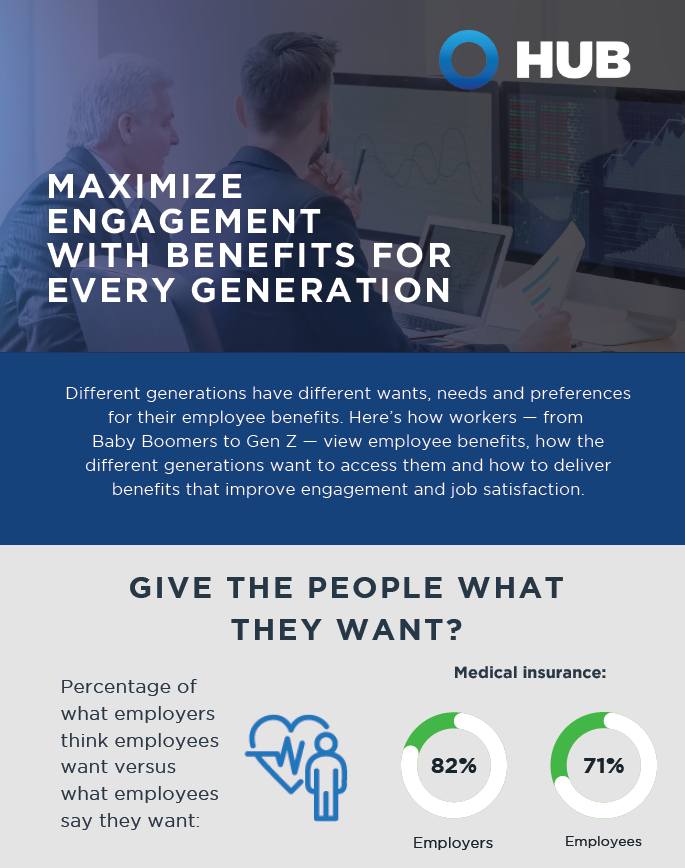

Maximize Engagement with Benefits for Every Generation.
Infographic
Download now


Related Resources
US | EN


CA | FR
CA | EN
US | EN

Transportation
Real Estate
Nonprofit
Hospitality
Healthcare
Financial Institutions
Entertainment & Sports
Education
Construction
Cannabis
Agribusiness
Industry Outlooks
Industry Outlooks
Retirement
Private Client
Personal Insurance Marketplace
Employee Benefits
Product Outlooks
Product Outlooks
North American Outlook



3. Evernorth Health Services, “As more gene therapies come to market, payers need expanded options to protect their plans,” August 28, 2024.
4. WellSteps, “Published Workplace Wellness Statistics Show the Benefits of Wellness,” January 2, 2020.
5. U.S. Department of Labor, “The Employment Situation — September 2024,” October 4, 2024.
6. Morningstar, “We Expect the Job Market’s Slowdown to Renew in 2024,” September 6, 2024.
7. Bureau of Labor Statistics, “Productivity and Costs,” September 5, 2024. The long-term rate measures productivity gains since 1947.
8. HUB’s Executive Outlook Survey polled 900 C-Suite and VP-level executives on the issues facing them on profitability, employee vitality and organizational resilience.
9. Forbes, “The Future Of Work: Embracing AI’s Job Creation Potential,” March 12, 2024.
10. SHRM, “2024 Employee Benefits Survey,” accessed September 23, 2023.
11. Reuters, “US workers more glum on compensation and work prospects, New York Fed says,” August 19, 2024.
12. Guardian, “Quantum Leap: Real-time connectivity is the next frontier in employee benefits administration,” accessed October 11, 2024.
13. Gartner, “AI in HR: The Ultimate Guide to Implementing AI in Your HR Organization,” accessed September 23, 2024.
14. Certilytics, “How the Consolidated Appropriations Act Puts Healthcare Power in Employers’ Hands,” December 14, 2022.
15. The Zebra, “Mental Health Statistics,” July 26, 2024.
16. SHRM, “Here’s How Bad Burnout Has Become at Work,” April 30, 2024.
17. HR Executive, “How priorities for employee benefits are shifting in 2025,” August 20, 2024.
18. Health Resources & Services Administration, “Health Resource Projections,” March 2024.
1. PWC, “Medical Cost Trend: Behind the Numbers 2025,” accessed September 20, 2024.
2. National Library of Medicine, “National trends in prescription drug expenditures and projections for 2024,” July 8, 2024.
69%
of employers say increasing productivity is a priority for 2025.
45%
of workers are burned out, making them three times more likely to seek another job than other employees.
56%
19. NPR, “Insurers can restrict mental health care. What laws protect patients in your state?” August 27, 2024.
20. Gartner, “Gartner Research Shows Human-Centric Work Models Boosts Employee Performance and Other Key Talent Outcomes,” December 7, 2022.
Sitemap
Terms & Conditions
Privacy Statement
© 2024 HUB International Limited. 150 N Riverside Plaza, 17th Floor, Chicago, IL 60606. All rights reserved.
Industry Outlooks
Retirement
Private Client
Personal Insurance Marketplace
Employee Benefits
Product Outlooks
Transportation
Real Estate
Nonprofit
Hospitality
Healthcare
Financial Institutions
Entertainment & Sports
Education
Construction
Cannabis
Agribusiness
North American Outlook
Keep pace with the latest trends.
Stay in the Know
Subscribe
Learn more about us.�Visit hubinternational.com

Nearly