Isamaya Ffrench’s Picasso
Makeup for Stüssy
This year, Stüssy and photographer Tyrone Lebon concluded their world tour series, having shot the last five seasons’ campaigns in Tokyo, Jamaica, Paris, Los Angeles and New York. Each photo set explored themes specific to the location where they were shot. To no surprise, the Paris campaign dabbled into high and low art, couture, caricature, Napoleon, romance, and of course French kissing.
Amongst the photos was a portrait of a short-haired model whose face became canvas for a cubist portrait. Painted by makeup artist Isamaya Ffrench, the work references Picasso’s Dora Maar, bringing together an element of street and high art while portraying a complicated relationship between artist and muse. Dora Maar was a pseudonym for Henriette Theodora Markovitch, who was a fellow painter and lover to Picasso. Their relationship was complex and often sad however, as she felt pressured by Picasso to adapt his style of cubism in lieu of her own. It eventually ended, leaving her to cope with depression for the remainder of her life. The model in this photo then, wears the sombre face of Dora Maar.

Stüssy's Fall/Winter 2016 Campaign shot by Tyrone Lebon
Picasso, 'Dora Maar,' 1936

Raf Simons’ Longtime Love Affair With Art and His WORK With the Robert Mapplethorpe Foundation
Raf Simons’ relationship with art has always played a key part in his career. He’s known to have an extensive personal collection, housing works from artists like Picasso, George Condo, Olafur Eliasson, Mike Kelley, and of course longtime friend and collaborator Sterling Ruby. It’s not uncommon for these pieces to make their way into Simons’ work, as Ruby’s sculptures have become sweaters worn on the runway and Warhol’s screenprints have become backdrops for his Calvin Klein campaign.
With all this in mind, his reputation for being a such a passionate art collector is the reason the estate of the late Robert Mapplethorpe approached him for collaboration. To honor the legendary photographer’s legacy, Simons imposed his monochrome portraits and still lifes onto thoughtfully tailored pieces for his Fall/Winter 2017 collection. With a campaign shot by Willy Vanderperre to follow, the final black and white images pay homage to the photographer. Locations Mapplethorpe had previously shot at were included, and the leather stylings were introduced in reference to his sexuality.
The Mysterious Section 8’s Possible Reference to Artist Zhang Huan
Men's Raf Simons Fall/Winter 2017 campaign shot by Willy Vanderperre

The runway premier was perhaps the most shocking though, as models were seen walking with dead koi fish hanging from their mouths. Almost proverbially, a Section 8 representative told 032c, “a fish in the mouth is an end to discussion.” Looking deeper into the meaning of it all, the brand could be referencing a specific work by Chinese performance artist Zhuan Huan called My Japan. The piece which was part of a series, explored the artist’s experience of settling into new places as a foreigner. In the case of Japan, one possible explanation could be that the koi fish in the mouth symbolizes a difference between cultures — the artist may have felt as though he could not speak openly, as being opinionated and outspoken is frowned upon in Japan. It could also be referencing a need to censor himself and his thoughts about the country, considering its violent history with China.
In February of this year, an unknown fashion brand took to New York’s Lower East Side to debut its first ever womenswear collection. Shortly after, Pamela Anderson was seen sporting a head-to-toe Section 8 outfit on Instagram. Little is known about the brand and its founders so far, aside from association to the names of London designer Ryohei Kawanishi and Hood By Air stylist Akeem Smith. Together, they have been credited with reimagining the contours of business casual with a touch of ’90s flair with some FUBU added into the mix.

Zhang Huan's 'My Japan' Performance
Section 8, image sourced from 032c

Rick Owens’ Tribute to
Allen Jones’ Bondage Sculptures


Rick Owens table at the JOYCE Hong Kong Store
Allen Jones,
'Table' 1970
It’s Jones’s rebellious spirit and disruptive attitude that can be seen at the heart of Rick Owens’ work as well, as he states in his 2011 book Rick Owens, “I would lay a black glittering turd on the white landscape of conformity.” Owens’ reputation sits outside expectations, thriving on shock to force audiences to reconsider how they see clothing, eroticism, and the human body. We’ve seen this in cases like his Spring/Summer 2016 showing where women walked assertively while wearing other women, in his Fall/Winter 2015 show where men’s genitals were made a new focal point, and in collaborative projects like his NSFW music video “Butt Muscle.” All things considered, it is no surprise Owens would pay homage to Allen Jones, objectifying himself in place of the women in Hatstand, Table and Chair.
When Allen Jones first debuted his erotic sculpture series Hatstand, Table and Chair in 1970, he was met with utter disdain. Militant feminists protested his show and stink bombs were once let off inside the exhibit. When asked about the artworks, he told The Telegraph “I wanted to kick over the traces of what was considered acceptable in art” — something he succeeded in, judging by the public’s harsh rejection. However, the series was misunderstood. It was not about the objectification of women, but a protest against minimalism. Paintings of squares and sculptures of empty boxes were being praised as progressive at the time, while critics saw figurative art depicting people as irrelevant. Jones set out to disprove them by demonstrating just how powerful the body’s image could be. He explained to The Guardian “When you’re dealing with the human figure and with identity, people feel strongly. The thing about eroticism is that nobody sits on the fence. It forces a response.”


Antonio del Pollaiuolo, 'Battle of the Nudes,' 1470-1475

Christophe Chemin, 'The Important Ones,' colored pencil, 2016

Men's Fall/Winter 2016, Milan


Men's Fall/Winter 2016, Milan
Critoforo de Predis, 'Morte del Sole, della Luna, e caduta della Stelle,' 1476
Christophe Chemin, 'Impossible True Love,' colored pencil, 2016
Banquet Thieves
Here, Chemin has made use of Baroque style Vanitas, which originated as an attempt to discreetly slip religious messaging into art between the 17th and 18th centuries. They often manifested in the form of flowers and skulls which would remind its viewers that death is inevitable. In the case of Banquet Thieves, the vanitas are mice. As a particularly fertile animal, they symbolize excessive sexual desire and destruction.
The Important Ones
The Important Ones re-imagines a Renaissance battle scene with some of the most reputable figures from history in place of mythological gods and warriors. Nina Simone grapples with Joan of Arc, while Geronimo wields a golf club above Che Guevara’s head and Hercules attempts to bash Freud with his Hulk-sized hands. Muscles here are rendered in great detail, frozen in dramatic and diagonal motions much like Antonio del Pollaiuolo's Battle of the Nudes which Chemin has noted as reference.
Impossible True Love
A soldier who resembles Elvis Presley grasps the Egyptian goddess Isis in a sweet embrace against the beautiful apocalyptic backdrop that is Critoforo de Predis’ Death of the Sun, Moon, and Fall of the Stars. The illustration is like a dream where time isn’t real and truly impossible romances can happen between people who would otherwise never meet. It’s hard to think of how the unlikely lovers came to be, however Chemin gives us some insight with a quote from Honoré de Balzac; “Love is like the wind, we never know where it will come from...”
THE REFERENCES IN CHRISTOPHE CHEMIN'S ART FOR PRADA
Immigration, famine, assassination and pessimism — these were the themes of Miuccia Prada’s striking Fall/Winter 2016 collection. As a designer who's always brought an intelligent and well-informed worldview into her work, it’s easy to see why she’s chosen the provocative and self-taught artist Christophe Chemin to collaborate with. Together, they’ve transformed bowling-style shirts into collector’s items, adorning them with meaningful visuals that reimagine history with pop culture icons and messages of a hopeful future. Below, we’ll take a look at the paintings, styles and symbolism referenced in each.

Allen Jones, 'Chair,' 1970
Rick Owens chair at the JOYCE Hong Kong Store
Lodewik Susi, 'Still Life with Mice,' 1619

Men's Fall/Winter 2016, Milan
Christophe Chemin, 'Banquet Thieves,' colored pencil, 2016

A SYMBIOTIC RELATIONSHIP
Men's Prada Fall/Winter 2016, image sourced from i-D

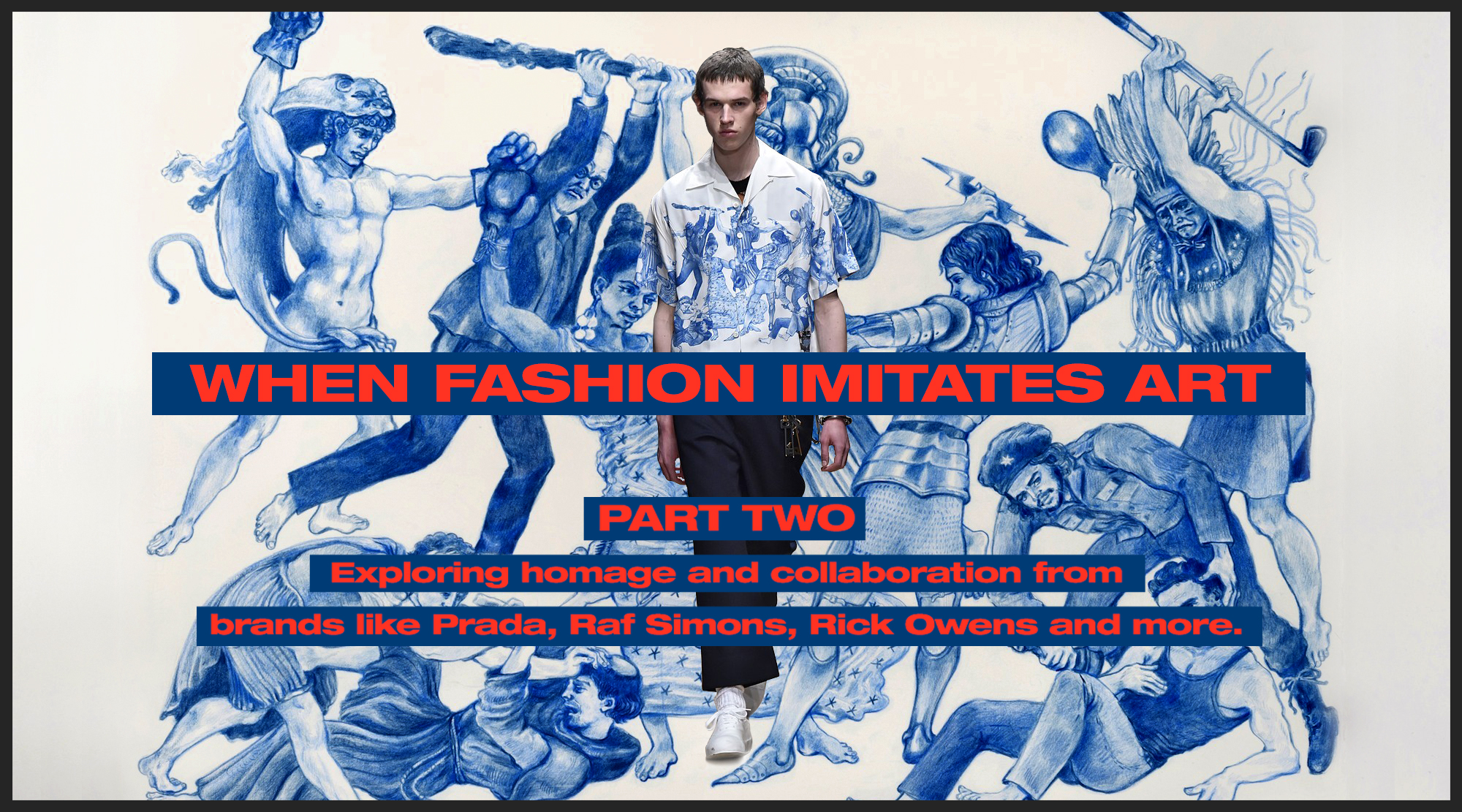
In the first segment of this article, we looked at brands like Maison Margiela, Louis Vuitton and Hood by Air to explore the uncanny similarities and references between art and fashion. Ahead, we take another look at the symbiotic relationship the two have managed to form through an interchange of aesthetic, symbolism, attitude and imagery. Among those are Prada's collaboration with Christophe Chemin, Raf Simons' work with the Robert Mapplethorpe Foundation, Rick Owens' homage to sculptor, Allen Jones and more.