PLANTA INDUSTRIAL
DUENDITA
FIFI ZHANG
DREAMCASTMOE
54 ultra
presented by corona extra
PLANTA INDUSTRIAL
Being with my family all the time and making beats for my cousins. I was like the Dominican beatmaker kid in high school.

For me, the angel is an apocalyptic symbol — like it's still 1999, and the world is ending. My favorite manga and anime, like X by Clamp, Neon Genesis Evangelion, all have angels as antagonists to end the human world.

The Retro-Futurist Voice of 54 Ultra��
WORDS BY FELSON SAJONAS�
PHOTOS BY Nayquan Shuler�
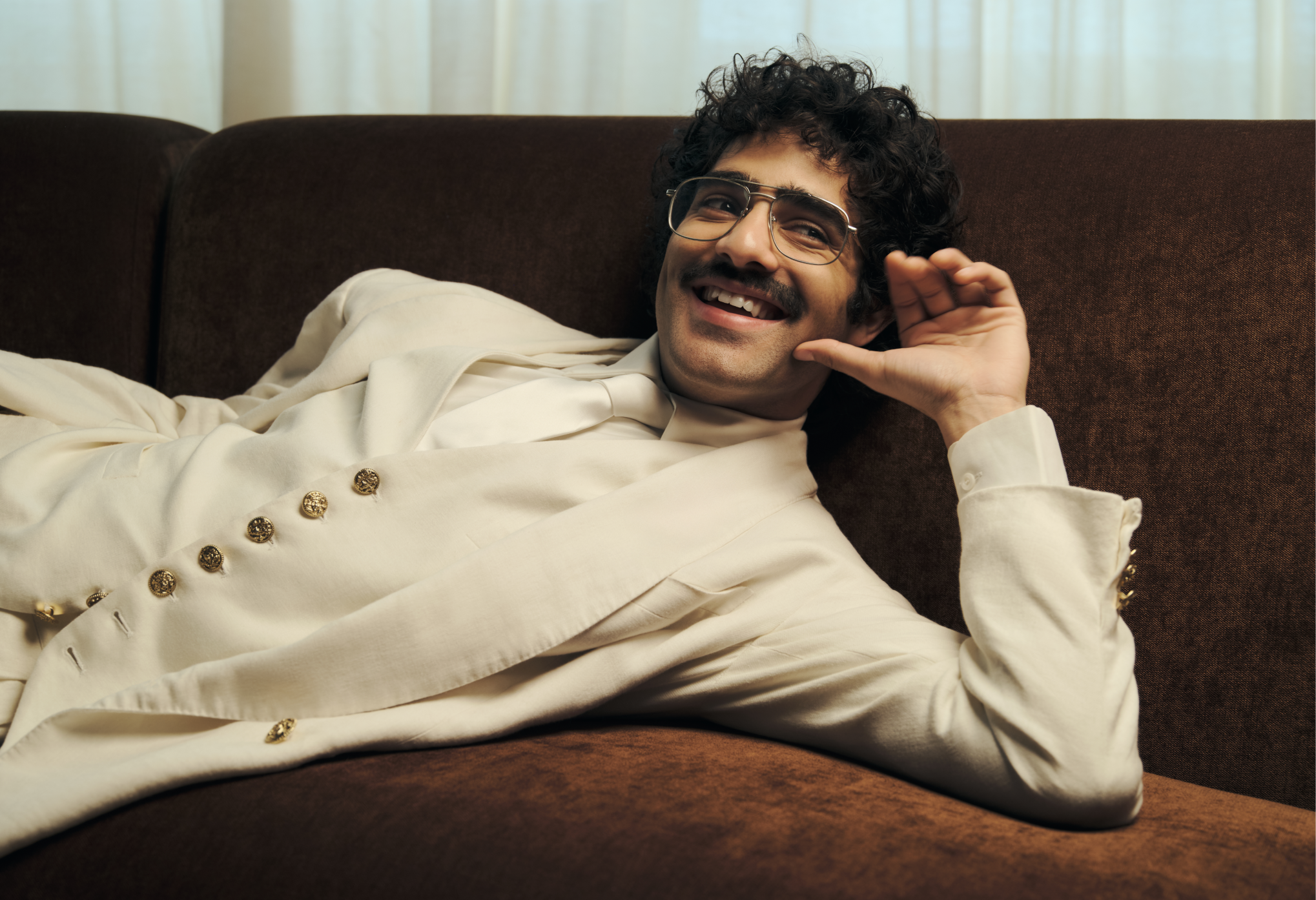
Two days before our interview, 54 Ultra played back-to-back sets in Brooklyn and Manhattan, where velvet-lit stages served as ideal backdrops for Johnny Rodriguez’s analog soul revivalism. When we spoke, he was already gearing up for another double-header: a pair of shows in Los Angeles, set for Tuesday and Thursday. The pace is relentless — but so is the sense that something much bigger is about to break.��He’s also one of five breakout artists featured in Nueva Generaciones, a new music platform powered by Corona® Extra spotlighting rising voices reshaping the sonic future. The campaign is a natural extension of his cultural mission: redefining what Latin soul can sound like today.��By all appearances, Johnny Rodriguez — better known by his sonic alias 54 Ultra — could be mistaken for a soul singer plucked straight out of a 1970s variety show rerun. Flared pants, wide collars, analog textures, and dreamy vocals create an aesthetic that’s equal parts Donny Hathaway, Dev Hynes, and downtown DIY. But dig deeper, and you’ll find a 25-year-old Dominican-Puerto Rican artist from Bloomfield, New Jersey, with a vision that is as forward-looking as it is nostalgic. His sound isn’t just retro for retro’s sake — it’s built on studied intention, cultural memory, and a quiet defiance of genre constraints. In an era of ephemeral hits, Rodriguez is creating something built to last.
That honesty fuels everything Rodriguez does — from his layered, bilingual compositions to the vintage clothes he carefully curates for each performance. It’s an identity forged in family, nurtured in solitude, and sharpened in the crucible of New Jersey basements, brownstone rooftops, and soul-filled soundchecks.��Rodriguez grew up in New Jersey, in a household steeped in rhythm and cultural memory. “Not much in my house was Americanized,” he says. “It was straight traditional music—Bachata, Merengue, Salsa, Bolero. My mom would quiz me like, ‘You need to know this rhythm. Is this Dengue? Is this typical?’ I guess that stuck with me.” Those early listening sessions weren’t merely playful exercises — they laid the foundation for his deep understanding of rhythm and genre. Over time, what started as his parents’ music became his own, repurposed through a modern lens.
Blending vintage soul and bilingual flair, 54 Ultra is reshaping indie music from North Jersey outward.
"I'm just trying to be honest,” Rodriguez tells me. “The last thing I want to do is be a gimmick."
Being with my family all the time and making beats for my cousins. I was like the Dominican beatmaker kid in high school.
Sometimes when I want to make a song feel a little more special, I’ll just make it in Spanish,” he explains. “It opens up a whole new context.�
“I didn’t know what I wanted to do visually,” Rodriguez says. “And then one day I just woke up and said, ‘Oh, I can do this.’”
“I don’t think there’ll ever be a moment that’s too big for me,” he says with a laugh. “I just want to keep doing what I do — and do it honestly.”

Before he was a performer, though, Rodriguez was a beatmaker, crafting tracks for cousins or anyone in his high school who wanted to rap over his instrumentals. “That was my real culture,” he says. “Being with my family all the time and making beats for my cousins. I was like the Dominican beatmaker kid in high school.” His productions traveled fast by word of mouth, showing up at parties, battles, and bedrooms across North Jersey — Passaic, Paterson, and Clifton. It was his first taste of how music could connect people, and how he could quietly shape a sound from the background.��Eventually, audio engineering school cracked open his creative world, inspiring him to pick up a guitar and, in his words, “make the songs I enjoy listening to.” It shifted his focus from the technical to the emotional, from what sounded good to what felt true.
The transition wasn’t immediate. He started by emulating his heroes. “I would practice and make pretend Steve Lacy songs, or pretend Frank Ocean songs, or Ben Folds songs. That’s how I taught myself to write.” He treated each exercise like homework, reverse-engineering their melodies and structures until he found something of his own in the process. What began as imitation slowly became intuition.��Rodriguez’s evolution from beatmaker to full-fledged songwriter wasn’t a leap either — it was a slow, intentional pivot. “What still felt like making beats turned into writing lyrics,” he says. “Instead of using different instruments, it became my voice.” His time singing in a salsa band for over a year became an unexpected turning point as well. “Subconsciously, I use a lot of salsa vocal arrangements in my songs,” he says. “Call and response, vocal layering—I didn’t even realize I was doing it at first.”
Despite his growing fan base, Rodriguez resists the lure of instant gratification. His career is a slow build by design. “The hardest part is just waking up every day and wondering how I’m going to prove myself today,” he says. “I moved the goalposts on myself. I celebrate things eventually, but I always keep moving.” He’s learned to detach from metrics and momentum, focusing instead on consistency and craft. Even small wins — finishing a demo, nailing a bassline, sourcing the right vintage jacket — are folded into the process. For Rodriguez, progress isn’t chasing virality but about staying grounded while evolving forward.
He’s refreshingly open about the mundane struggles of creative life. Just a year ago, he was answering phones at a car dealership, trying to pass as business casual in bell-bottoms. “Everyone laughed at me, but in a funny way. That was just life.” Still, he showed up each day with the quiet belief that music would eventually pull him out of the cubicle. “Being a creative person is already a challenge in society,” he adds. “Especially in Hispanic families, where you're told to get a good job with a pension. But if you believe in yourself? That’s the challenge.” He’d walk home from work and immediately dive into writing demos, stitching ideas together in his bedroom studio late into the night. There was no roadmap — just a feeling that his vision was worth the risk. “I knew I had to keep going, even if no one else could see it yet,” he continues.
As we speak, Rodriguez is already several steps ahead. He’s preparing a full-length album and plans to tour as his audience grows. “There’ll definitely be more music by fall,” he says. “Hopefully I’ll be touring, meeting everyone who’s been supporting me.” The album, he hints, will explore new textures while staying grounded in the vintage soul DNA that defines his sound. He’s been writing constantly — sometimes from a place of joy, sometimes from exhaustion — but always with honesty.��He’s not rushing. He never has. But the world around him is catching up. And when they do, they’ll find something real: not a viral sensation, but an artist fully formed, rooted in his culture, and committed to the long game. His rise might feel quiet now, but it’s the kind of quiet that builds pressure — slow, steady, and ready to break wide open. He’s already cut his teeth on iconic New York stages like The Bowery Electric and Rubulad in Brooklyn, where his blend of showmanship and sincerity turned casual listeners into fast believers. His latest EP, First Works, feels like a declaration of intent — raw, intimate, and impressively cohesive. Tracks like “No Tengo Valor” and “Talk 2 Me” showcase both his bilingual fluency and his knack for vintage-soul phrasing, offering snapshots of a young artist who’s already curating his legacy in real-time.�
Tapped as part of Nueva Generaciones, a cultural spotlight on rising Latin voices, Rodriguez’s inclusion feels less like a breakout moment and more like an organic progression of what he’s already been crafting. “A brand like Corona Extra has a large platform, so it’s nice to see them recognize with genuine interest the ideas of authentic communities when they turn to developing artists,” he says. And maybe that’s what makes 54 Ultra so compelling. In a world driven by spectacle, Johnny Rodriguez is building something intimate, enduring, and defiantly soulful — a retro-futurist sound born in the Latin-influenced neighborhoods of North Jersey and aimed squarely at the world.
Bilingual songwriting also came naturally since Rodriguez grew up speaking Spanish more fluently than his siblings and leaned into that connection when words in English didn’t feel quite right. “Sometimes when I want to make a song feel a little more special, I’ll just make it in Spanish,” he explains. “It opens up a whole new context.” ��His 2023 single “Where Are You” marked a shift not just in style, but in audience. The Latin soul-infused track tripled his monthly Spotify listeners in a matter of weeks and caught the ear of analog producer Max Shrager. “The timing couldn’t have been better,” Rodriguez says. “Max reached out right when I was already trying to make that kind of music. He elevated everything.” Together, they recorded “Heaven Knows” and “What More Can I Do,” both dripping with the warmth of old tape and the restraint of a seasoned soul veteran. The collaboration felt like an organic creative turning point — proof that Rodriguez’s instincts were leading him somewhere tangible. It wasn’t just about vintage aesthetics anymore; it was more about carving out a lane within that lineage.
But with 54 Ultra, the music is only half the story — the rest is worn, styled, and staged. Fashion, visuals, and onstage charisma are integral to the experience. “Fashion came before the music,” Rodriguez says. “I just woke up one day and thought, ‘I need to find flare pants.’” From there, it became an obsession rooted in feel, fit, and historical reference. “I didn’t want to look like I was cosplaying the ’70s. I wanted to feel like I belonged to that era, even if I was just walking to the bodega.”��He turned vintage hunting into a discipline, influenced by icons like Michael Jackson and bands like Fleetwood Mac and Heatwave. “I never wanted to look like I was wearing a costume,” he explains. “I just wanted to subtly replace everyday clothes with vintage counterparts. Over time, it became my image.” He studied garment construction, read up on sizing systems from the ’70s, and learned how to tailor thrift store finds until they felt intentional.
And that visual identity carries through his music videos, which shimmer with retro grain and saturated palettes. “At the end of the day, you gotta catch people’s attention,” he says. “I study TV production, camera movements, direction. Every video I make, even the little clips, is me learning.” He takes notes from old variety shows and vintage commercials, using them as references to build moodboards for each release. It’s not about recycling the past for aesthetic points — it’s about reimagining it as a living, breathing part of the present. His visuals deepen what it means to experience the 54 Ultra universe, adding layers of context and atmosphere. Even in low-budget clips, there’s an attention to texture, rhythm, and framing that feels purposeful. It’s DIY with a director’s eye — scrappy, soulful, and cinematic.��It’s not a gimmick, but all part of the storytelling.
Rodriguez doesn’t position himself as part of a scene either, but he’s quickly becoming one of its most compelling voices. As Latin artists increasingly stretch the limits of genre, Rodriguez finds himself unintentionally part of a larger shift. “It’s an honor to represent the Caribbean side, the Jersey side,” he says. “A lot of indie Latin stuff is from the West Coast or South America — so I love bringing that Nuyorican, Dominican flavor.” He sees it less as a trend and more as a reclamation, proof that these sounds have always belonged in the alternative space. And while he’s proud to be included in the conversation, he’s more focused on expanding it. He name-checks Bad Bunny, The Marías, Joe Bataan, and Rafi Pagan as points of inspiration — not to replicate but to purposefully contribute to that conversation.
“I'm just trying to compete with records from the ’60s. To be honest, that’s all.”���
Photographer: Nayquan Shuler
Writer: Felson Sajonas
Executive Producer: Elana Staroselsky
Senior Producer: Sarah Schecker
Production Coordinator: Gina Lee
Executive Creative Director: Paul Heavener
Associate Creative Director: Jamier Boatman-Harrell
WEB DESIGN: YENNA CHANG
Stylist: Stone Jarboe
Groomer: Nigella Miller
Photo Assistants: John Manuel Gomez, Brandon Abreu
Stylist Assistant: Mo Johnson
DATE: SEPT 23 2025�
For 21+. Relax responsibly®. Corona Extra® Beer. Imported by Crown Imports, Chicago, IL

BACK TO TOP