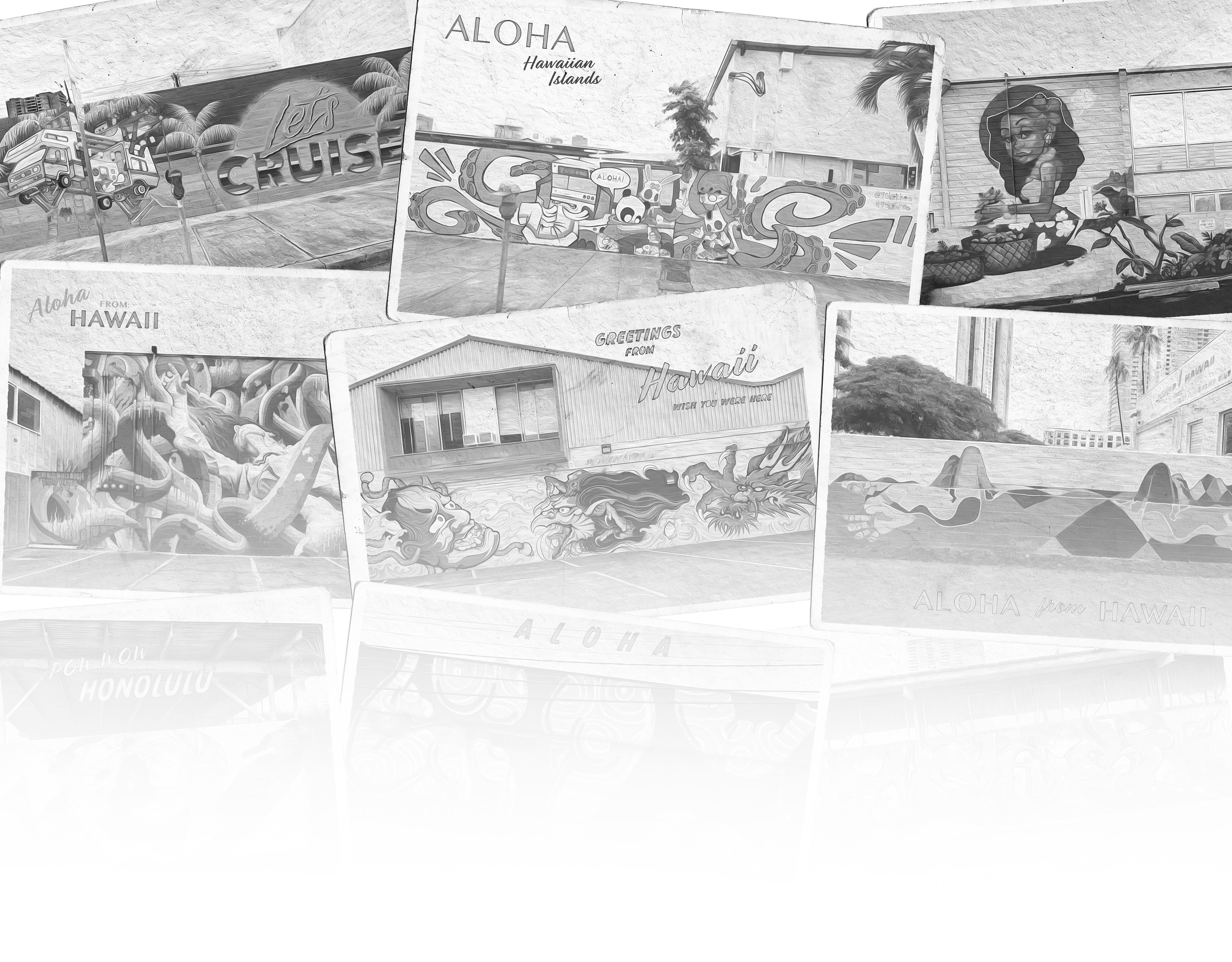
This cultural exchange helps shine a light on Hawaiian traditions for visitors, but it doesn’t quell the fears of locals who may be worried about the escalating gentrification of Kaka’ako. As the neighborhood transforms, the founders are looking at different measures to keep the spirit of the festival alive. Hadar strongly expresses, “I always tell the guys, if we don’t want gentrification to happen, we need to own the buildings. We just need to be property developers. I don’t know if that will ever happen, but that’s sort of the solution I feel.” Wong adds, “We’re always being asked about gentrification. It’s a really sensitive subject, but for us, we just want to create art and leave this place in a more beautiful place than we found it. Change is inevitable. Whether or not it’s a positive change, we’re just trying to leave a positive legacy.”

As more and more tourists flock to new hotspots such as Kaka’ako, the Hawaiian government’s involvement with POW! WOW! may be to help preserve the native Hawaiian culture in the region. “We believe the majority of Native Hawaiians do not fully and comfortably embrace the prevailing business model of corporate tourism as generally contributing to the betterment of conditions of Native Hawaiians,” said the Hawaiian government in a statement. The administration isn’t saying that native Hawaiians are neglecting the economic benefits from tourism. Instead, it believes locals may be disappointed by the increase of tourism which may have “contributed to a degradation of their cultural values,” the government adds.
Whether or not the Hawaiian government was fully involved in the last festival, the culture of Hawaii was highly represented in the public murals painted in Kaka’ako. “POW! WOW! has been a great movement for a lot of people. We’re not just involving these international artists to paint walls, but also to embrace the Hawaiian culture and take something home with them that they didn’t know about this place. Cultural exchange exists,” says Rapozo. “We’re very isolated and are far away from the mainland so we have our own ideas, but the festival has brought that influence back here.”


From the surface, one can easily mistake POW! WOW! as a street art vessel for corporate interests and gentrification. However, the festival started out as a passion project for the founders, and today, it's still largely financed out of their own pockets. “We’re not going to charge tickets or money for people to look at public art or murals. There’s no way, it’s for the community. So there’s no real income channel,” said Wong. “We sell product and merchandise, but that doesn’t make enough to cover the costs. We’re lucky, because as POW! WOW! grows, we get sponsors to help cover those things and make partnerships.”
One partnership that POW! WOW! has is with the Hawaiian government. “To my knowledge, POW! WOW! is an officially sanctioned event. The organizers and artists have functioned as consultants or even been commissioned to paint murals for the City and County of Honolulu in the past, and Governor Abercrombie would come out to support POW! WOW! events. Artwork like this means the city doesn’t have to spend money painting over graffiti, and it makes the neighborhood nicer to walk through,” says Tracy Chan, digital media manager for Hawaii Magazine.

Artist Sydney James, who recently participated in the POW! WOW! Hawaii 2018 festival, proclaimed that street art’s role in gentrification is a double-edged sword. “I’m from Detroit, Michigan and similar things are happening like the revitalization or gentrification. It’s positive because it draws attention to certain areas that people wouldn’t pay attention to, but also there’s a fine line because, typically, people tend to follow artists,” says James. As a result of artists creating beautiful murals in overlooked communities, there will be an influx of new residents. These fledgling community members may “potentially out-price the citizens that made the place cool in the first place,” James adds.


Before hordes of tourists started to trickle in, POW! WOW! artists were a key factor in driving enterprise into the area. “So, nowadays, it’s completely changed, because of the artists and the art. They need a place to eat and drink so little restaurants and cafes started popping up,” says Kamea Hadar. These small businesses paved the way for property developers to construct luxury complexes across the district. “You started to see condos and multi-million dollar high-rises popping up in the community. Each apartment is worth four-to-five million dollars. All of these huge names are here buying property,” added Hadar.
With the influx of corporate interests, street art inevitably falls into the hands of privatization and monetization. City authorities, as well as wealthy property developers, may seek to commission artists to paint their building walls in order to attract the emerging “creative class” to their sites, as expressed by urban theorist Richard Florida. Ultimately, backed by deep pockets and motivated to usher a shiny new city, commissioners have taken full control over the aesthetics of the neighborhood.

Urban development in Kaka’ako continues to ascend. “Encouraged by favorable market conditions, developers are taking action and proposals for new projects are surging. At the current pace, the population in Kakaako is easily expected to double within several years,” the Hawaiian government expressed in a statement.


For Kaka’ako, there were little-to-no natives living in the area when POW! WOW! was founded in 2011. However, the aforesaid statement on displacement still rings true for those longtime businesses in the region, who may eventually be wiped out by other businesses that can withstand the market conditions as well as the intensity of rising competition in the area. “As things started coming up and lands being leased, you started to see all the businesses starting to move back out again and it started to get a little more expensive,” says Keola Rapozo.

One of those businesses is streetwear label Fitted, co-founded by fellow Hawaiian native Keola Naka’ahiki Rapozo. The seeds of change in the neighborhood were evident after just three years of POW! WOW! launching in Kaka’ako. “When we came here, POW! WOW! was about three years in. It was the beginning of this neighborhood gentrifying,” he says. “What you see now are these buildings going up and there’s a lot of construction and a lot of momentum within the community growing.”
Gentrification is not at all easy to define and break down in simple terms. For some, it’s a word that is synonymous with displacement — when affluent new transplants drive out lower-income residents. These fresh arrivals are able to afford stylish housing alongside the luxurious trappings of life in a hip urban neighborhood. As a result, lower-income residents are inevitably priced out of renting or buying.

Founded in 2011 by visual artists and native Hawaiians, Jasper Wong and Kamea Hadar, the weeklong POW! WOW! street art festival has become a cultural machine that spans from Japan to Washington, D.C. Although now present in over 10 cities across the globe, POW! WOW! is rooted in its Hawaiian residence, and widely regarded for transforming a run-down Honolulu neighborhood into a location now bustling with luxury condos, hotels, clubs, cafes, and boutiques.
Eight years ago, Kaka’ako was filled with auto-body shops, big warehouses, and office supply stores. Since then, the population of Kaka’ako has doubled from 10,673 to now 26,471 residents strong. Not to mention, the region continues to attract at least 300,000 visitors per year since 2011. “When we first started, we were a few blocks away from the road at Fresh Café. It was the only place you could get food in this area. Everything else was just auto body shops and warehouses. There was nobody around except for the homeless people living in the park in the middle of the community,” recalls Hadar.
Wong and Hadar chose Kaka’ako as POW! WOW!’s home because of one simple reason: “Nobody spent time in Kaka’ako, it was an industrial district filled with car mechanics, CompuServes, and office supply stores. It felt like the right place to do POW! WOW! because we needed flat, blank walls,” says Wong. The founders were on a mission to revitalize the neighborhood by bringing both local and international artists to create public murals, which led to the surge of trendy local businesses popping up in the area.