By: Keith Estiler
studio visits
studio visits
Cey Adams witnessed the birth of hip-hop firsthand. While his close friends were learning to breakdance or DJ, Adams sought out graffiti. From tagging walls with legendary New York City artists back in the 1970s to creating iconic album artworks for Def Jam Recordings, he is considered to be one of the most influential creatives in hip-hop culture.
In Adams’ early days as an artist, his peers were the likes of Keith Haring, Jean-Michel Basquiat, Futura, and DONDI.“Trying to find your own style was a very important thing coming out of the graffiti community and people would check you really fast if you were copying somebody else's style,” he tells HYPBEAST. “It was the one thing that was an absolute don't. I sort of knew that right from the start.”
He began the transition from “graffiti vandal” to a fine artist at the age of 19 years when he was approached by the Lower Manhattan gallery Graffiti Above Ground, which represented notable artists such as CRASH, DAZE, Pink, ALI, Zephyr, and REVOLT. Adams was represented by the gallery throughout the 1980s, leveraging the institution’s impressive roster to improve his skills and gain valuable industry insights. “We basically did everything together. They nurtured us and taught us how to talk to the media, how to stretch canvas, how to conduct yourself as a professional artist,” he says.
While working under the gallery, Adams was approached by Russell Simmons to helm the creative director role at Def Jam Recordings. In his early twenties, he co-founded the label’s in-house visual design firm entitled Drawing Board where he made album covers, logos, and campaigns for Run DMC, Beastie Boys, LL Cool J, Public Enemy, Notorious B.I.G., and more. When Adams wasn’t creating visuals for Def Jam, he was focusing on his fine art practice.
Cey Adams: From Graffiti Vandal to Fine Artist
Exploring the otherworldly artworks of the Brooklyn-based painter and sculptor.
Dumbo, Brooklyn
CeyAdams.com
Have you seen a big shift in Helsinki’s approach to fashion since then?

Cey Adams
In the last years it's changed a lot. Now you can see teenagers buying Raf Simons and Off-White™, and all the super expensive brands. I guess their parents buy them the clothes, but in my days when we were teenagers we didn't have that expensive clothing. But I think it's fun that people are more interested in fashion.
At what point did you want to become a fashion designer?
It was really by accident. During my 20's I tried to find myself, I don't know, maybe five times. Then when I was completely exhausted and had nothing, one of my friends just said, “You were always a bit interested in fashion, why don't you try that?” Before that I was interested in doing something artistic, but I didn't know what it could be. After that I applied for sewing school and that was it. I hate to use terms like fell in love because that doesn't sound Finnish at all, but basically I fell in love with the idea of making something myself.
Hip-hop was born around the time that I was a teenager, so if you think about hip-hop coming in to be in the '70s, I'm just starting to have an understanding of who I am. A lot of people will tell you that graffiti predates hip-hop, and it does, but for me, I don't get hung up on those sorts of things, because I have always been an artist. To me, I predate hip-hop and I predate graffiti.
Love that you asked that. Number one, things were less expensive back then and we stole everything. To be completely honest, we stole spray paint, we stole markers, all of it. We called it racking, and you'd have a big coat on and you just go into a department store and you'd steal all the paint that you needed and markers and everything. There was no money to buy anything. A little bit later, I started getting commissions to do storefront gates and car washes and little street sign jobs and things like that. That's how I earned money. Back then, that money was going towards food, it wasn't necessarily putting it back into my craft. That came much, much later.
How would you describe your style when you were growing up?
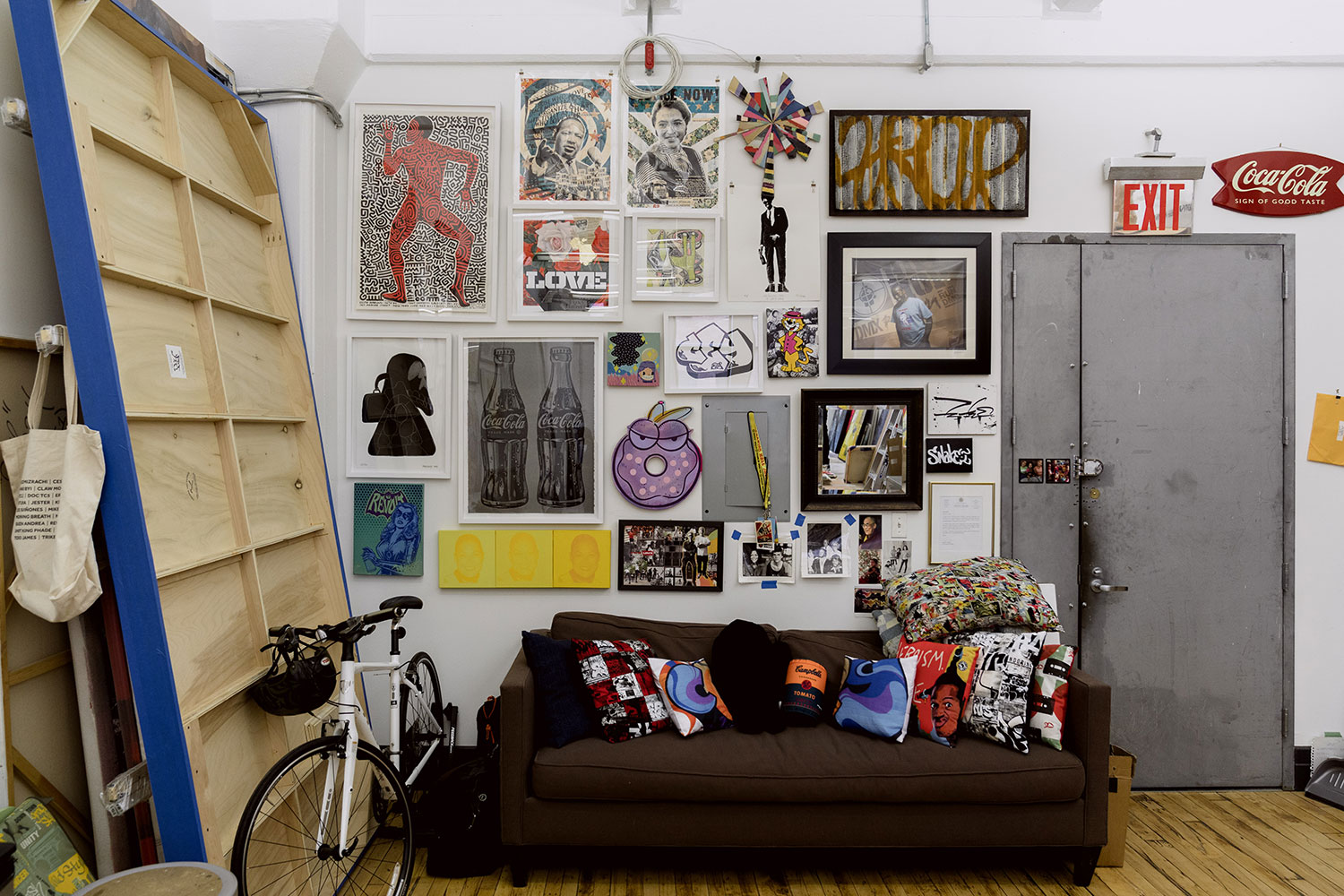
Adams has shown his works at reputable institutions such as the Museum of Modern Art, the Brooklyn Museum, and the Museum of Contemporary Art Los Angeles. One of his more renowned bodies of work, Trusted Brands (2015), is a series of collages where he combines corporate logos from the likes of Coca-Cola, McDonald’s and Pan Am with acrylic paint and paper elements, touching upon themes of consumerism and pop culture.
The artist expands on those concepts with his latest collaboration with Pabst Blue Ribbon, where Adams reimagines the beer company’s signature 12oz can and packaging. Adams and PBR are also set to launch National Mural Day on May 7 to celebrate public artworks all across the globe. Read on to learn more about Cey Adams’ career and his latest project.
Whether it was hip-hop, breakdancing, or graffiti, the era you grew up in saw the birth of revolutionary outlets of creative expression. What was it like growing up in that time?
How were you funding materials to create your works?
“I'm a child of the pop era, so I grew up loving Andy Warhol and Jasper Johns and Roy Lichtenstein.”
Cey Adams
“Working with collage was a way for me to really challenge myself.”
Yeah, I started designing album covers once they formed Def Jam. That was the thing that made me sort of transition out of being a fine artist. A lot of my friends went to Europe, Jean-Michel got picked up, Keith Haring got picked up by Tony Shafrazi and a lot of other people just stopped making works and got real jobs. Or got regular jobs, I should say.
For me, I always had a graphic style and sensibility, so it seemed fitting that becoming a graphic designer was what I was going to do because I just always had clean lines in my blood and was always a fan of craftsmanship and sharp edges. If you look at my early graffiti paintings, all of that stuff was in the work back then.


Were you ever influenced by the styles of your cohorts such as Keith Haring, Jean-Michel Basquiat, DONDI or Futura?
Keith Haring had his style, and Futura had his style, and DONDI had his style, and Zephyr had his style. Because we were all coming up together, you couldn't really be tight with somebody and be doing the same thing they're doing. It just didn't work. Because we all came from different places, so even though we hung out together, I was from Queens while Zephyr and Revolt were from the Upper West Side and Keith was downtown.
We were always professionals. We were professionals when we were teenagers and that's the thing I tell people all the time. You look at the careers of Pink, Crash, Daze, myself, Futura, we were professionals then, we were professionals in the '90s, we were professionals in the 2000s. We were career artists right then and there. It's sort of ironic that the mainstream art movement didn't latch on to what we were doing because we were committed to making work. It wasn't a fad the way people thought, we weren't going to stop and start doing other things. We were capital “A” artists.
Did your parents approve of you becoming an artist?
They were not happy. While my folks were supportive of me as an artist when I was an adolescent. By the time I'm a teenager and I'm introducing graffiti, they were not happy about it. It was like myself and my brothers, we just took a left turn and we were just lost as far as they were concerned. The thing that they kept saying over and over again was, "If you get caught, don't call home." That was the number one thing that you understood is you've got nobody that you can call. You've got to figure it out on your own. The goal was to not get caught, period.
Did you ever get caught?
No, I never did get caught. I never did. It's the one benefit of being part of the crew is that you just have to be faster than the slowest guy in the crew.
Let’s talk about your creative director role at Def Jam. What was that experience like?
What were some of your favorite projects that you worked on?
Oh my goodness, so many. Man. Certainly, Public Enemy's Fear of a Black Planet. Onyx, Montell Jordan, just EPMD, some of the stuff for Slick Rick. It was a really great time. I was fortunate enough to work with so many great artists that Def Jam and Bad Boy, but it all just seems like a blur. It was such a long time ago and we were working so hard and so fast, we never really had time to step back and smell the roses. We were just in this sort of continuous state of making work and working long, long hours. We were young and we were doing the things that we loved, so it strangely enough never felt like work.

We had our own design firm called Drawing Board Design and then Drawing Board Pictures came later which was the video division of our company. We were just working really hard. I started off by myself and then I had a partner and then we hired another person and then two people and then three people and then four people. Before you knew it, we had a full staff, because we were working with so many different companies.
Did you have any other projects going on while you were working at Def Jam?
Working with collage was a way for me to really challenge myself. A lot of my friends that do graffiti and street art primarily work with spray paint and acrylics. I'd done that for a lot of years and I thought to myself, "I want to try a different medium." Collage just spoke to me and I just thought it would be interesting to see what I could do with this medium. Working with glue sticks and paper was something that seemed attractive to me.
Let's talk about developing your most recent style. Where was the source of inspiration for that and how long ago did you start doing that?
Whether it's Japanese rice paper or a vintage magazine ad, to me, all of those things are sort of woven together in the collage to help with the storytelling. When the viewer looks at the work, they understand that it's not just a graphic. If you zoom in, you'll learn a little bit more about some of my experiences and hopefully some of the experiences of the viewer as well. To me, a lot of these things are universal, especially as it relates to American history.
The color palette is really important to what I'm doing in the same way any other artist would lay out a color palette with paint. I'm just doing it on paper. I want to compare different textures and weights and things like that, so the piece has depth. That's really the idea, first and foremost. Then, the storytelling begins after that.
I sort of think about a concept or an image that I want to create. Sometimes, it's a brand; sometimes, it's a graphic; sometimes, it's an American flag. Whatever that initial concept is, I sketch it out first, then I bring it into my computer and I clean it up and I make sure that it's sharp. Then I printed out and I apply it to the surface, whether it's canvas or a panel. Then I start to lay in the graphics.
Incorporating archival materials is also very important in your practice. What sorts of materials do you use and where do you source them from?
Walk us through the creative process behind a collage.
We had our own design firm called Drawing Board Design and then Drawing Board Pictures came later which was the video division of our company. We were just working really hard. I started off by myself and then I had a partner and then we hired another person and then two people and then three people and then four people. Before you knew it, we had a full staff, because we were working with so many different companies.
Did you have any other projects going on while you were working at Def Jam?

“A lot of people will tell you that graffiti predates hip-hop and it does, but, for me, I don't get hung up on those sort of things, because I have always been an artist. To me, I predate hip-hop and I predate graffiti.”
Cey Adams
I'm a child of the pop era, so I grew up loving Andy Warhol and Jasper Johns and Roy Lichtenstein. I've also loved the work of Jacob Lawrence and Romare Bearden. When I started making work again, I wanted to do things that incorporated all of my interests. I wanted to have my graffiti roots be represented, I wanted my graphic design sensibility to come through in the work that I do and then I wanted everything that I had learned over the years to be incorporated in these pieces.
That's where this idea of trusted brands came from. It was a celebration of all of my favorite logos over the years and really doing a great homage to all of the great graphic designers that came before me. When the folks at Pabst Blue Ribbon reached out to me, I jumped at the chance, because I thought, "I am already doing what they need done."
The idea about National Mural Day is really just trying to get fans of street art to recognize their favorite works. It's no more than that. Just recognizing that these artists out here doing great work and it's all done for the public, most of the time, for free and we just want people to recognize that these artists are really talented and just get out there and support them. The thing about where we are now is that it's a national phenomenon.
Your collage works are also infused with pop culture references.
You’re also launching National Mural Day with Pabst. What was the idea behind that?
What I'm doing next is working on a coffee table book that incorporates all the work that I've been making from the very beginning of my career. It's the first time that I've been able to make a book that tells the whole story. I've been fortunate enough to make large-scale books for Def Jam that celebrates the history of hip-hop, working on a coffee table book with the Smithsonian that chronicles the history of hip-hop and rap, but this will be a book that just celebrates the work that I've done over some 35-40 years. I'm really looking forward to it, because of a lot of the images that I'm pulling I haven't seen since I was a kid. It's going to be very interesting to see what that's like when it's all said and done.
What are you working on next?
Working with collage was a way for me to really challenge myself. A lot of my friends that do graffiti and street art primarily work with spray paint and acrylics. I'd done that for a lot of years and I thought to myself, "I want to try a different medium." Collage just spoke to me and I just thought it would be interesting to see what I could do with this medium. Working with glue sticks and paper was something that seemed attractive to me.
Let's talk about developing your most recent style. Where was the source of inspiration for that and how long ago did you start doing that?