By: Keith Estiler
studio visits
studio visits
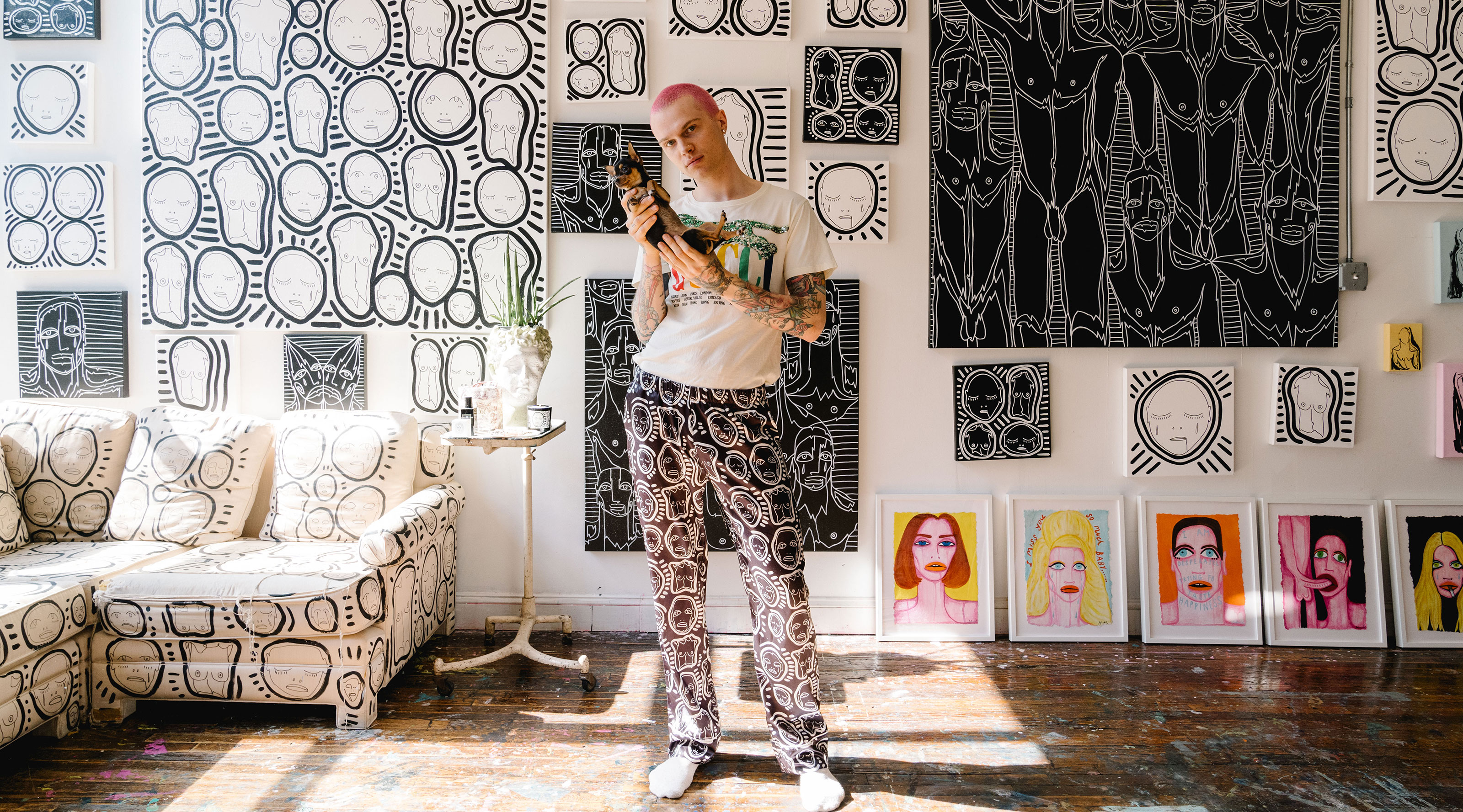
Patrick Church is unapologetically himself. As HYPEBEAST enters the British artist’s Brooklyn studio, we immediately see Church wearing a white tee and flowy trousers covered with hand-painted portraits of his signature characters. One look at his ensemble and it’s clear that he’s proud to flaunt his personal creations. But, the extent of his creativity doesn’t stop at painting his clothes.
From a greige sectional sofa to glass perfume containers, the 28-year-old creative has made his mark on plenty of objects inside his studio. A rickety wooden table layered with his acrylic creations is placed at the center of his workspace. Meanwhile, a statue head scrawled with black lines is displayed on a coffee table. The bulk of the creations in the studio is embellished with illustrations of expressive faces. “I have to keep making things because I feel physically and mentally so unwell if I stop,” Church explains.
Art and Fashion Collide in the World of Patrick Church
Exploring the otherworldly artworks of the Brooklyn-based painter and sculptor.
Williamsburg, Brooklyn
patrickchurchartist.com
What’s the contemporary art scene currently like in Los Angeles? What are your thoughts on the art industry today as a whole?

Patrick Church
NM: We are in this time of Post-Post Modern. I wouldn’t give a Clement Greenburg-style critique of the scene, but it’s hard to ignore the surge of African-American artists and their relation to diaspora and Art Brut (outsider art). With that said, the art world presently has a gravitation to the work of Black artists. While rewarding, as an African-American I have my own questions. My first read is that it has a relationship to the times and today’s political sensitivities. As a survivalist, I am curious why today’s contemporary art world is so invested in so much Black all of a sudden.
MR: I’m from LA, so from my perspective, it’s a tight-knit community that feeds off of itself. We hold equity in many creative industries, which I believe allows all the different “sub” and mainstream scenes to sometimes cross-pollinate. I think it’s a good time to be a creative pluralist on the creative/maker side. To refer to industry, that means we are speaking to the economic aspect, so when you involve sums of money that the “art industry” generates I think it’s the same it’s always been — creatively unscrupulous. However, I do believe we are in a renaissance period where artists are empowering themselves and creating their own financial and creative ecosystems.
How do you select which subjects to paint?
Sometimes I'll be working in a particular face for quite a while, and then get to a point where I just block it out with one solid color. It seems like all the work that went into sort of trying out different details and different layers just sort of leads to a color decision. Then other times, it's really intentional and specific. Like the way I'm starting these new paintings lately, they usually start with couples that are staring into each other’s eyes, they're having a little moment of romance or kissing.
What sparked your interest in art?
How have your upbringings shaped your overall style or aesthetic?
Church also dwells in personal memories when it comes to developing concepts for his gallery shows. His most recent solo exhibition took place at the Toth Gallery in downtown Manhattan last year. Entitled “Drive Thru,” the presentation spotlighted a slew of nudes and portraits that formed a visual narrative of his journey to from England to America -- an expedition that was spurred by his marriage to his husband Ariel while living in London three years ago. “Marriage, love and my work all developed so quickly making it hard to keep up with the range of emotions and all aspects of change I was moving through; my transition mimicked America's fast-paced consumerism as this exhibition does too,” he says.
Oftentimes Church’s works are so visually austere, they don’t need painted phrases to hint at meanings behind their compositions. One example is a recent project of untitled works on paper where Church brazenly portrays his subjects performing oral sex. “I am so unapologetically queer that it shapes everything. I don't like to let it define me,” he says. “I don't think of myself as a queer artist or a queer fashion designer, I'm just a gay man that makes art and clothing and it just rubs off.”
When Church isn’t creating artworks, he’s holed up in his studio prepping a high fashion collection. The artist’s foray into fashion started in 2017 when he hand-painted secondhand garments such as leather jackets with portraits of fashion savants like Marc Jacobs and Donatella Versace. He launched an e-commerce store on his website that same year, displaying clothing with his signature motifs. For months, he teetered between making custom artwork on clothes for interested buyers and designing his own collection. A year later, he found success in the latter when his original designs were stocked at Opening Ceremony’s Soho store.
NM: Growing up in LA, I was privileged to be around various creatives. I’ve always been drawn to the technical drawings of Charles White, and the layering of found objects in the works of Noah Purifoy. These inner-city legends not only shaped the art community at large but taught others how to create greatness through resourcefulness.
MR: From a young age, I’ve been really blessed to interact with people from different ethnic, religious, and economic backgrounds. My upbringing was instilled with acknowledging self-worth and also seeing the value in all people, regardless of their or my situation. As a result, my process is influenced by the clear social and economic dualities that exist in LA. My aesthetic and style resonate dualities of life/death, refined/raw, gesture/form, art/design, reality/surreal/fantasy. For me, all sides have to be represented to communicate my balance and truth.
When did you start showing your work at exhibitions?
I started exhibiting my work in New York in like 2004 at a gallery in Williamsburg, then went onto a couple different galleries in Chelsea where I've worked over the years. I've been showing in Copenhagen and recently Hong Kong.
How did you each come up with your distinct visual language?
“I didn't really take the fashion thing very seriously before, but now I feel a great responsibility for each collection I'm making to be better and more elaborate. And, I'm realizing fashion is an art form,” he says. “It’s actually a greater art form because you're telling stories and you can build so many things around a collection which is really exciting. But, I do feel like my favorite thing to do is just to literally work on a flat surface.”
Church designs clothes like he creates his art. A majority of his garments are hand-painted right down to their labels. When he works with dressmakers, he paints directly onto panels of fabric before they are transformed into final garments. If he decides to use print on clothes, the graphics all stem from his original sketches or paintings. “I feel the art's the forefront of everything. I'll be drawing or painting a lot, and then I make prints for the clothing from that,” he says. “We'll take bits of my art, mesh the motifs together, put these graphics onto a computer and then turn them into a print. It's important to me to keep some of the pieces hand done as well.”
The artist’s deep passion for fashion and art is well-documented on social media. His Instagram account, @patrickchurchny, is especially a productive platform for the artist to shout out new artworks, collections, collaborations and other highlights from his multifaceted practice. As any savvy artist-influencer would, Church also models his creations across his social posts. From posing beside his painting of Kim Kardashian to making out with his husband as the pair don skin-tight mesh, the artist consistently aims high for bold presentations and the social engagement follow suit.
Where do you source the materials for your works?
NM: Usually, I begin my process by thrifting from sales racks sponsored by bank foreclosures and deceased estates. As I rummage through these valuables from those who have passed away, I construct a narrative of them based on what I’ve discovered. These narratives have an innate relationship with the characters in my own life. For these assemblages, I use a CNC machine to create the “windows,” and design the Plexiglas vitrines. Together, they build a display suitable for archival.
MR: I source my taxidermy online. I’m able to source different species from around the world. Other materials I get locally from flower marts, floral supply shops, art stores, my framer, general department stores and in some rare cases, from thrifting. I love the thought that I’m re-purposing something dead like taxidermy and dried floral into a new form of life through the context of the environments I create. In no scenario would a beetle from Malaysia inhabit the same habitat as a butterfly from Congo, except through a man-made environment — in this case, my paintings.
My connection with floral is by way of my grandmother, who was a professional florist. I believe I utilize florals as a symbol of freezing the moment of life and its beauty. I’ve always wanted more time with her since her passing when I was eight.
Your color palette is so vivid. How do select the tones for each artwork?
First, I like using colors that bleed and give you a real bright luminosity, so it's these bright yellows, oranges, and magenta. Then, I start working those vivid colors into flesh tones. Finally, I incorporate some darks, like the really deep blues or a Payne's gray. There's a lot of balance between dark and light. A balance between the luminosity of color paired with traditional flesh tones.
Define Dreamhaus LA.
Apart from the furniture and miscellaneous items, Church dedicates one wall to display earlier works, saving an opposing wall for newer pieces. His first series of paintings are comprised of acrylic on canvas works with motifs that are sharp and intricate. They are packed with black outlines of delicate nudes and portraits with exaggerated facial features. In contrast, his recent pieces are made using watercolor paints. They feature similar characters as his past creations, but their compositions are more minimal, with rougher brushstrokes. “I feel like I've tried to be in control my whole life. I want to let go and be freer. You can see it in the lines of these newer works,” he says.
On a daily basis, Church isn’t really concerned with sticking to a particular aesthetic or genre. Depending on his mood, he’ll decide whether to paint nudes or portraits; use acrylic or watercolor paint; steal inspiration from Keith Haring or Tracy Emin. The only invisible thread connecting all of his paintings is the shared theme. “My biggest inspiration is always the idea of love and longing and being in love,” he says. “And, everything is autobiographical. Even if I'm not painting myself, the artwork is always about me. It's a diary of my life.”
Church’s artworks are never not personal. They are rife with unabashed messages of his queer identity and love life. Take, for instance, Self Portrait Diary, his 2018 series made up of acrylic on Khadi paper works. These pieces feature portraits with confessional text such as, “No validation is ever enough”; “Sex sometimes feels so invasive”; and “I have no idea who I am, I feel like a scared child.” Putting these phrases on canvas is a sort of therapy for the artist. “Layering these things on top of each other and them sort of like being hidden, but coming through, it's really sensual and romantic,” he says of the process.
How has your work evolved over the years?
I was doing reverse painted acrylic polymer peel paintings for a long time, and those were hyper-detailed and all super hard-edged and super meticulous. It got to a point with that where I guess around like 2012, I wanted to start doing something more visceral and more painterly and less sort of slick.
Any advice for aspiring artists?
Good advice is work a lot, experiment a lot, and see a lot of art. Find out who the artist is who you really admire and what do you like about their work, what can you bring into the work, but also how can you experiment with materials and make paint do something that's your own language. At least for me, that's always been really important to my practice.
“My biggest inspiration is always the idea of love and longing and being in love.”
Patrick Church
“I feel the art's the forefront of everything.”
Tell us about your new Dreamhaus LA space.
But as Church has found, one downside to building a large social media following is keeping up with expectations. “I always worry that I'm gonna be left behind if I stop posting things on social media. I try not to take it that seriously because it's just not reality. But in a way, it is the reality now,” he says. However, he acknowledges that the platform has its advantages. “You know, I really do think social media is a great thing. It can be such a great tool for creatives because people can have access to your work and you can curate your own sort of life.”
Church always maintains creative control over his projects, be it his clothes or his art. Throughout our visit, the artist occasionally chimes in to help elevate his presentation for the visuals in this feature. He hops in and out of ensembles, posing with verve for each snapshot captured to make this piece truly his own. “Sorry, I'm constantly switched on creatively. I’m always thinking of the next thing,” he says as he goes through a sprawling rack of his collections.
What do you hope to accomplish with this collective?
NM: Being the example. Raising the ceiling of our dreams every passing year, envisioning, and fulfilling. More recently, I have discovered a stronger sense of this purpose. We are in a position of taking back the quality of our community, without reliance on elected officials.
MR: Establish an ecosystem such that each component feeds the next, where none of this works without the synthesis of all the moving parts. This empowers other people to pursue their passions and discover their purpose within our system.
Why is it important to get the community involved in the art scene, especially the inner-city youth?
NM: In the community of South Central, there’s not much exposure to examples of success in the visual arts. Visual arts are not perceived as financially lucrative. The first goal is to expose youth to success stories and showing them the role of visual arts in many professions as a problem-solving tool.
MR: Speaking specifically to the demographic that we work within, it’s very common that kids and even adults in the inner city have never fully explored creative expression. The taboo of arts as just craft or, more specifically, arts as something that you could never financially or spiritually support yourself and family with, is a general perception. A lot of the kids and adults in these communities have special voices and perspectives. All they need is some guidance, access, consistency, and most of all, someone they can identify with actively pursuing it. People are able to see it in Nikk and me. That’s major.