By: Emily Jensen
studio visits
studio visits
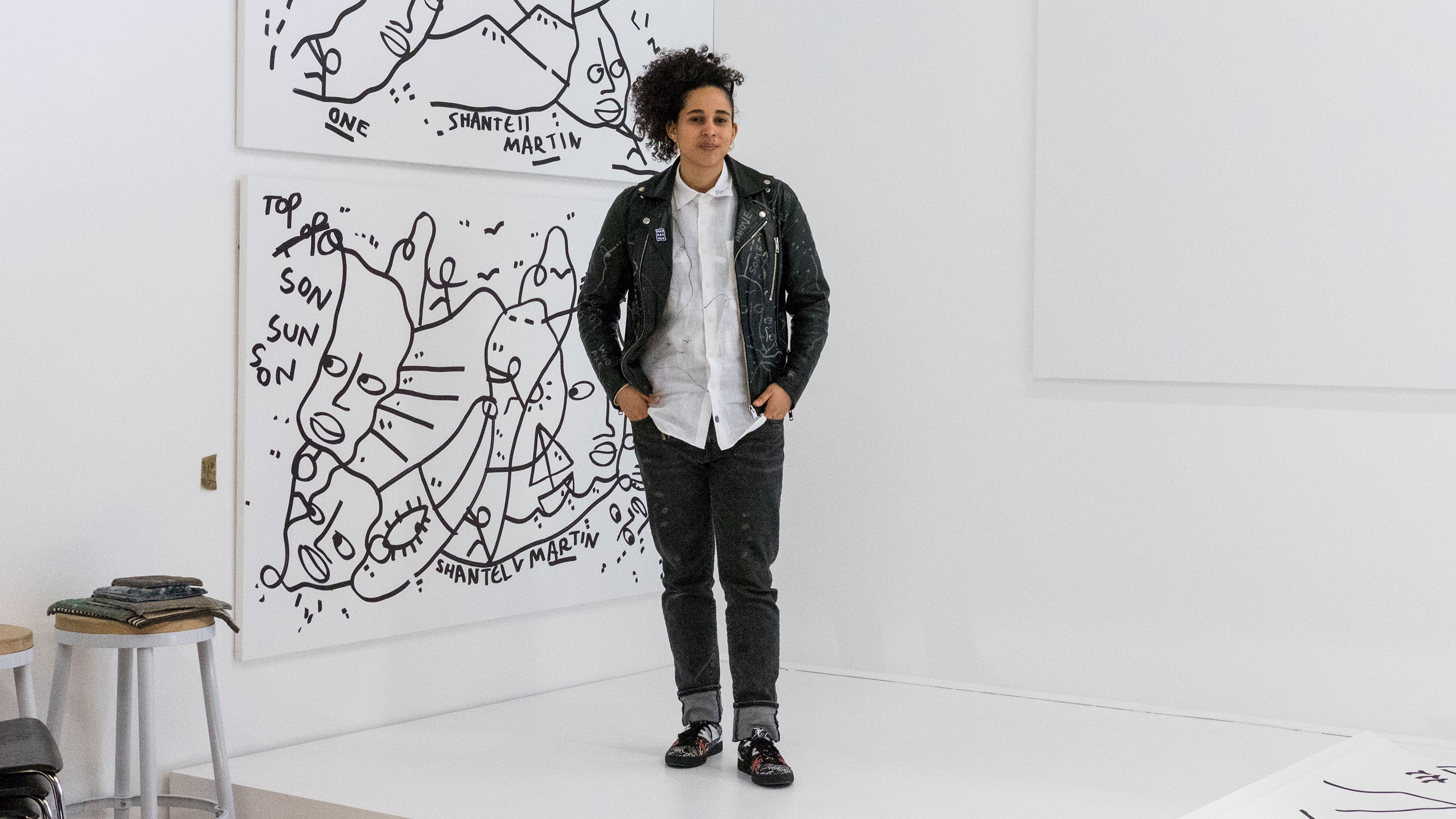
Shantell Martin gets eight hours of sleep a day. When HYPEBEAST visits her New Jersey studio, she tells us that not only is she firm about getting a full night’s rest, but she also typically only comes to the space on Monday and Friday for about four hours a day.
This shouldn’t be such a notable fact about the British artist. But in an era that fetishizes burnout culture and working to the grind, it seems surprising that someone with Martin’s success and output would be so relaxed about getting it all done.
After all, she is just finishing up a collaboration with the New York City Ballet, launching a contest with United Airlines for International Women’s Day, preparing a takeover of Governor’s Island for the spring, and later this year, will create an installation for the Denver Art Museum. Martin tells us she’s always been efficient with her time since her art student days, but her philosophy also questions the models for work we’ve been given.
Shantell Martin Shares the
Secret to Her Success
Exploring the otherworldly artworks of the Brooklyn-based painter and sculptor.
Mana Gallery
888 Newark Ave, Jersey City, New Jersey
shantellmartin.art
What’s the contemporary art scene currently like in Los Angeles? What are your thoughts on the art industry today as a whole?

Shantell Martin
NM: We are in this time of Post-Post Modern. I wouldn’t give a Clement Greenburg-style critique of the scene, but it’s hard to ignore the surge of African-American artists and their relation to diaspora and Art Brut (outsider art). With that said, the art world presently has a gravitation to the work of Black artists. While rewarding, as an African-American I have my own questions. My first read is that it has a relationship to the times and today’s political sensitivities. As a survivalist, I am curious why today’s contemporary art world is so invested in so much Black all of a sudden.
MR: I’m from LA, so from my perspective, it’s a tight-knit community that feeds off of itself. We hold equity in many creative industries, which I believe allows all the different “sub” and mainstream scenes to sometimes cross-pollinate. I think it’s a good time to be a creative pluralist on the creative/maker side. To refer to industry, that means we are speaking to the economic aspect, so when you involve sums of money that the “art industry” generates I think it’s the same it’s always been — creatively unscrupulous. However, I do believe we are in a renaissance period where artists are empowering themselves and creating their own financial and creative ecosystems.
How do you select which subjects to paint?
Sometimes I'll be working in a particular face for quite a while, and then get to a point where I just block it out with one solid color. It seems like all the work that went into sort of trying out different details and different layers just sort of leads to a color decision. Then other times, it's really intentional and specific. Like the way I'm starting these new paintings lately, they usually start with couples that are staring into each other’s eyes, they're having a little moment of romance or kissing.
What sparked your interest in art?
How have your upbringings shaped your overall style or aesthetic?
But while her career has taken an unusually varied path, for Martin there’s no complex song-and-dance of hustling and networking to leverage those opportunities. The secret is that there is no secret. Most projects come about simply because people email her, she tells us, and if the collaboration is the right fit for her and her art, she’ll say yes. When it comes to working with huge brands like Nike and PUMA, she simply trusts her gut on what feels appropriate for her.
“As an artist, I feel like I have to justify myself a lot,” Martin says. “I have to justify myself because I work with these different industries. And I’m like, I didn’t make those boxes, why should I put myself in them? You made them.”
As she sees it, these collaborations often provide a valuable platform that she wouldn’t otherwise have. “We as artists should be using those tools to get our message out there,” Martin says. “Not that they should be using us.”
Looking at the canvases in Martin’s studio, there is a lightness to her work that seems unencumbered by grandiose expectations of what art is “supposed” to be. But her work was not always so ebullient. “Art students are quite dark,” she laughs, showing us some of her earlier work. She pulls out a notebook from her childhood; each page is filled with methodical lines of lint, granola, fabric fibers, and other common items found around the house, all attached to neat rows of adhesive strips. At the time she didn’t consider what she was making art, but simply part of her interest in collecting things. Looking at the notebook in her studio however, the graphics’ repetition and simplicity seem like a forebear to her contemporary line-based work.
NM: Growing up in LA, I was privileged to be around various creatives. I’ve always been drawn to the technical drawings of Charles White, and the layering of found objects in the works of Noah Purifoy. These inner-city legends not only shaped the art community at large but taught others how to create greatness through resourcefulness.
MR: From a young age, I’ve been really blessed to interact with people from different ethnic, religious, and economic backgrounds. My upbringing was instilled with acknowledging self-worth and also seeing the value in all people, regardless of their or my situation. As a result, my process is influenced by the clear social and economic dualities that exist in LA. My aesthetic and style resonate dualities of life/death, refined/raw, gesture/form, art/design, reality/surreal/fantasy. For me, all sides have to be represented to communicate my balance and truth.
When did you start showing your work at exhibitions?
I started exhibiting my work in New York in like 2004 at a gallery in Williamsburg, then went onto a couple different galleries in Chelsea where I've worked over the years. I've been showing in Copenhagen and recently Hong Kong.
How did you each come up with your distinct visual language?
It was in her childhood as well that Martin began to ask the question that appears throughout so much of her art: Who are you? Growing up in Thameshead, South East London, she stood out from her blonde-haired, blue-eyed siblings, with her brown skin and afro. “I think some of us feel like we fit in when we grow up and some of us don’t. And so there is this question of like who are you, or where do you belong,” she says.
Martin’s formal artistic career began at Central Saint Martins, but she took an unconventional path after graduating from the prestigious school. She moved to Tokyo in 2003 and began to work as a VJ, creating live digital drawings, most of which she never bothered to save. “The first five years of my career as an artist don’t really exist,” she explains. She did, however, stumble upon her style of drawing on her subjects, as she’s done recently with New York City Ballet dancers, when fans in Tokyo asked her to sign their bodies.
Martin first came to New York on vacation in 2008, which convinced her to move to the city. Here she’s seen much of her work captivate a larger audience. “In London, I’m trying to figure out who I am, and there aren’t artists around me so I don’t really know that’s something I can do. It’s more about this discovery or this journey,” Martin tells us. “And in Japan, it’s like I get to figure out who I am a bit, and I get to explore that and I get to try different mediums and collaborate. And then in New York, it’s about taking all that and kind of showing it off on a bigger scale.”
Where do you source the materials for your works?
NM: Usually, I begin my process by thrifting from sales racks sponsored by bank foreclosures and deceased estates. As I rummage through these valuables from those who have passed away, I construct a narrative of them based on what I’ve discovered. These narratives have an innate relationship with the characters in my own life. For these assemblages, I use a CNC machine to create the “windows,” and design the Plexiglas vitrines. Together, they build a display suitable for archival.
MR: I source my taxidermy online. I’m able to source different species from around the world. Other materials I get locally from flower marts, floral supply shops, art stores, my framer, general department stores and in some rare cases, from thrifting. I love the thought that I’m re-purposing something dead like taxidermy and dried floral into a new form of life through the context of the environments I create. In no scenario would a beetle from Malaysia inhabit the same habitat as a butterfly from Congo, except through a man-made environment — in this case, my paintings.
My connection with floral is by way of my grandmother, who was a professional florist. I believe I utilize florals as a symbol of freezing the moment of life and its beauty. I’ve always wanted more time with her since her passing when I was eight.
Your color palette is so vivid. How do select the tones for each artwork?
First, I like using colors that bleed and give you a real bright luminosity, so it's these bright yellows, oranges, and magenta. Then, I start working those vivid colors into flesh tones. Finally, I incorporate some darks, like the really deep blues or a Payne's gray. There's a lot of balance between dark and light. A balance between the luminosity of color paired with traditional flesh tones.
Define Dreamhaus LA.
“You can unconsciously get caught up into this like hamster-rabbit race. If your boss is telling you that you need to stay until 9 p.m., then something’s wrong with him or her. Because they’re not having you work productively and efficiently to get work done in the hours that you should,” she says. “So something needs to be questioned there.”
And her approach fits her methodology, which is based on reacting to a moment, rather than forced introspection. “When you put yourself in a position where you’re not overthinking things, you’re just reacting, then for me the work speaks greater and is more honest than it would have been if I spent six months trying to think of something really smart,” Martin says.
Martin applies that method to far more than just her drawings. During a 2016 residency at Autodesk’s Pier 9 Workshop in San Francisco, Martin was tasked with creating new products using the studio’s 3D printers. “What’s the most simple thing I can do that will have a profound effect on my output?” she questioned at the time.
The answer was to create a tool that would allow her to draw with two markers at once. From there, Martin created one of her signature black and white canvases, this time with a mix of thick and thin lines. When she was asked to collaborate with Max Mara the next year, she used that canvas to create 1,000 unique prints for a collection of sunglasses.
That trajectory is quite representative of Martin’s career, where one idea or one project can live on through multiple mediums and connect seemingly unrelated industries. “I’ll be working at MIT on something nerdy, and at the same time I’m in Vogue,” Martin says of her career path.
How has your work evolved over the years?
I was doing reverse painted acrylic polymer peel paintings for a long time, and those were hyper-detailed and all super hard-edged and super meticulous. It got to a point with that where I guess around like 2012, I wanted to start doing something more visceral and more painterly and less sort of slick.
Any advice for aspiring artists?
Good advice is work a lot, experiment a lot, and see a lot of art. Find out who the artist is who you really admire and what do you like about their work, what can you bring into the work, but also how can you experiment with materials and make paint do something that's your own language. At least for me, that's always been really important to my practice.
“We as artists should be using those tools to get our message out there. Not that they should be using us.”
Shantell Martin
“When you break creativity down, it’s really simple and pure.”
Tell us about your new Dreamhaus LA space.
After a decade in the U.S., Martin’s work appears well-defined, but it’s still developing. “I think over time you want your fingerprint to be able to evolve and to grow. But you want your core identity or style to, you know, if it’s true to you there’s going to be a part of it that stays the same throughout your life. And for me, I’ve always been interested in trying different mediums.” That’s clearly evident in her studio, much of which has been converted into a stage where she can workshop a one-woman show, complete with a white piano covered in black squiggles and lines.
With her expansion into live performances, she’s also interested in pursuing TV appearances, particularly in a show like Broad City where she could play herself. As Martins has learned from working with Kendrick Lamar, whom she collaborated with on a Miami Art Basel performance in 2016, there’s a shared root to all art forms. “You think, wow these people on stage in front of thousands of people, there must be a really kind of complex kind of practice or process. And then it’s like no, when you break creativity down, it’s really simple and pure,” she says.
Martin isn’t particularly interested in predicting where her career will go next; everything up until now has been a surprise, that it’s impossible to guess. It all comes down to choosing what feels right at the moment, rather than getting overwhelmed with too many projects. “The question for everyone is: Do you remember when it was fun?” she asks. “And if things stop being fun, then you’re approaching it in the wrong way.”
On our way out Martin gives us a few of her customized markers, which are imprinted with her name and the phrase, “Make and share.” That’s really all it takes, after all.
What do you hope to accomplish with this collective?
NM: Being the example. Raising the ceiling of our dreams every passing year, envisioning, and fulfilling. More recently, I have discovered a stronger sense of this purpose. We are in a position of taking back the quality of our community, without reliance on elected officials.
MR: Establish an ecosystem such that each component feeds the next, where none of this works without the synthesis of all the moving parts. This empowers other people to pursue their passions and discover their purpose within our system.
Why is it important to get the community involved in the art scene, especially the inner-city youth?
NM: In the community of South Central, there’s not much exposure to examples of success in the visual arts. Visual arts are not perceived as financially lucrative. The first goal is to expose youth to success stories and showing them the role of visual arts in many professions as a problem-solving tool.
MR: Speaking specifically to the demographic that we work within, it’s very common that kids and even adults in the inner city have never fully explored creative expression. The taboo of arts as just craft or, more specifically, arts as something that you could never financially or spiritually support yourself and family with, is a general perception. A lot of the kids and adults in these communities have special voices and perspectives. All they need is some guidance, access, consistency, and most of all, someone they can identify with actively pursuing it. People are able to see it in Nikk and me. That’s major.